
Explaining Secret Hides: Designing Creative Caches
Secret stashes are specially designed places that protect objects or geocaches from discovery through camouflage, psychological diversion, and time delay. In geocaching, they are also called cache hides or disguised containers. Well-known forms include PETlings, fake water signs, and hollow coins. Those who build a good secret stash combine three things: an inconspicuous exterior, suitable material, and a location that is not routine. This guide explains how it works, what types there are, and how to design your own stash securely and permanently.
How do secret stashes work? Psychology and security explained
The basic principle of any secret stash is time delay. Burglars search typical zones for only a few minutes. The longer the search takes, the more likely they are to give up. The same principle applies to geocaching: a cache that is not immediately recognized as such remains undisturbed for longer.
Camouflage works on two levels. First, it makes an object invisible because it looks like a normal everyday item. Second, it creates uncertainty for the seeker because they don't know if they are even looking in the right place. The most effective security is one that is not even recognized as security.

Routine is the greatest enemy of a good hide. Burglary specialists recommend storing valuables far away from routine hiding places. In geocaching, this means: no cache under the next lamppost if there are already ten others there. Creative placement protects your cache from quick finders and muggles alike.
Pro-Tip: Never place your cache in a spot you would search first. Think like a muggle, not a geocacher.
Avoiding quick search zones is not just theory. Lampposts, park benches, and bridge railings are considered overused in the geocaching community. If you still place a cache there, the camouflage should be particularly elaborate, for example, with a PETling with a magnetic holder that blends seamlessly with metal structures.
- Avoid the classic search zones: lampposts, park benches, bridge railings
- Use everyday objects as camouflage: screws, stones, tree bark
- Combine camouflage with an unexpected location for maximum effect
- Think of muggles: What would a passerby never touch or notice?
What types of secret stashes are there?
Secret stashes can be broadly divided into three categories: physical camouflage containers, everyday objects as deception, and electronic stashes. Each category has its own strengths and limitations.
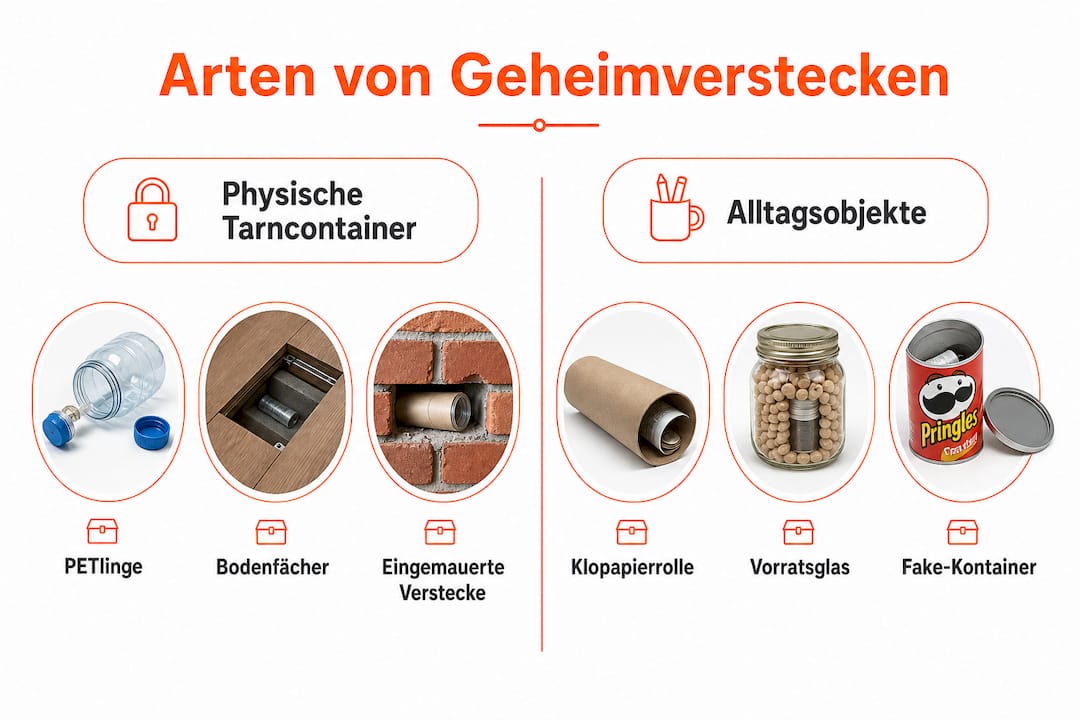
Physical camouflage containers
PETlings are small plastic tubes that look like harmless objects. They are weather-resistant, easy to attach, and available in various sizes. Fake water signs are another example: they look like real signs and are completely inconspicuous in urban environments. The Fake Water Sign from Cachewerk can even be custom-labeled, making the camouflage even more convincing.
Floor compartments and built-in stashes are more elaborate but more durable. They are suitable for caches that are meant to stay permanently in a fixed location. The disadvantage: once placed, they are difficult to maintain or move.
Everyday objects as deception
An empty toilet paper roll in a storage jar makes cash almost impossible to find because no one looks there. This principle works just as well in geocaching. A hollow screw, a deceptively real stone, or a branch with a built-in logbook are classics. Hollow coins are indistinguishable from normal coins externally. This makes them one of the most inconspicuous stashes of all.
Electronic and digital stashes
Digital secret compartments use encryption instead of physical camouflage. Tools like Steganos Digital Safe embed data in unsuspecting files, making them undetectable to third parties. Electronic stashes are less common in geocaching, but puzzle caches sometimes use encrypted clues or digital locks as part of the game.
| Type | Camouflage | Effort | Weather Resistance | Suitable for |
|---|---|---|---|---|
| PETling | Medium | Low | High | Beginners, all environments |
| Fake Water Sign | Very High | Medium | High | Urban caches |
| Hollow Coin | Very High | Low | Medium | Nano caches, puzzles |
| Floor Compartment | High | High | Very High | Permanently fixed caches |
| Socket Dummy | High | Medium | Low | Interiors, puzzle caches |
DIY stashes like socket dummies or hollow coins are particularly effective for smaller objects and inconspicuous locations. The key is to use several small stashes instead of one large one.
How do I build a stash? Materials and methods
A good secret stash begins with the right material. For outdoor caches: waterproof, UV-resistant, and mechanically stable. PETG is the material of choice here. It tolerates temperature fluctuations, remains dimensionally stable, and can be precisely printed. Cachewerk uses exactly this material for its 3D-printed stashes.
- Choose material: PETG for outdoors, ABS for indoors, metal for particularly durable stashes
- Plan camouflage: Adapt color, shape, and texture to the environment. A green cache in a bush, a gray one on a wall
- Secure attachment: Choose magnetic holder, screws, or Velcro depending on the surface
- Protect logbook: Waterproof film or a separate mini-container prevents moisture damage
- Test: Search for the cache yourself before hiding it. If you find it immediately, the camouflage is not good enough
Pro-Tip: Photograph your cache from the perspective of a seeker before hiding it. Often you'll immediately see what still stands out.
Camouflage techniques go beyond color. Texture is at least as important. A smooth plastic container immediately stands out on a rough stone wall. Textured paints, glued-on bark, or foam rubber compensate for this. For urban caches, imitating everyday objects is crucial: a cache that looks like a cable duct, a valve cover, or a sticker is simply ignored by muggles.
Thermal decoupling in floor safes prevents moisture damage. Condensation destroys documents and electronics. If you embed a cache in the ground, you should use an insulation layer or a double-walled container. This also applies to caches in wall cavities, where temperature fluctuations are particularly strong.
For creative DIY ideas, it's worth looking at proven methods from the community. Many of the best stashes are made from simple everyday materials but camouflaged with great attention to detail.
What are the security risks of secret stashes?
Secret stashes only reduce risk and create hurdles. They are not absolute security. Those who understand this use them correctly. For geocaching, this means: a well-camouflaged cache protects against muggles and quick finders, but not against a determined seeker with time and experience.
The most common problem is forgetting. Many losses occur because owners forget the stashes. In geocaching, this happens when a cache owner moves, gets sick, or gives up the hobby. The cache remains, no one maintains it, the logbook rots. Therefore, a good stash always includes documentation.
- Create documentation: Record the location, GPS coordinates, and description of the stash in writing
- Secure access data: For electronic stashes, store PIN or code in a second secure location
- Create maintenance plan: Check the cache at least once a year, replace logbook, inspect container
- Appoint successor: In the geocaching profile on geocaching.com, enter a representative who will take over the cache
Maintenance of electronic camouflage mechanisms is critical. A dead battery in a PIN-secured stash means no more access. This applies to smart safes as well as electronic cache locks. Anyone using such systems should schedule battery replacement firmly in their calendar.
And another point that many underestimate: the biggest mistake with secret stashes is routine. Those who always hide the same type of cache in the same type of places will quickly be seen through by experienced seekers. Variety in type, material, and location is not a luxury, but a basic principle.
Key Takeaways
A good secret stash combines camouflage, an unexpected location, and regular maintenance, because only all three factors together offer long-term protection.
| Topic | Details |
|---|---|
| Basic principle of camouflage | Stashes work through time delay and psychological diversion, not absolute security. |
| Best materials | PETG is the first choice for outdoor caches due to weather resistance and dimensional stability. |
| Avoid routine | Always placing the same cache type in the same location makes stashes predictable for experienced seekers. |
| Documentation | Securing location and access data in writing prevents permanent loss due to forgetting. |
| Maintenance of electronic stashes | Battery replacement and regular checks are mandatory to avoid losing access. |
What I've truly learned after years in geocaching
I've built many caches. Some were too easy, some too complicated. But the most common mistake I see in others and have made myself is different: you think too much like a geocacher and too little like a muggle.
It sounds simple. But it's not. Anyone who knows geocaching automatically looks near lampposts, under benches, and by bridges. A muggle walks past without even looking. That's precisely the advantage of a really good hide: it's findable for the initiated, invisible to everyone else.
What surprised me most: the most elaborate stashes are rarely the best. A simple PETling in camouflage colors, well-secured in a place where no one looks, beats any elaborate wooden construction. Effort and quality of camouflage are two different things.
And then there's the documentation. I know caches that no one has maintained for years because the owner is no longer reachable. That's a shame for the community and avoidable. When you place a cache, you take responsibility. A short entry with coordinates and a description, safely stored somewhere, is perfectly sufficient.
For beginners, I recommend: Start with a simple, weather-resistant container. Learn how muggles think. And look at what experienced geocachers in your area have built. The Outdoor Cache Hide Guide from Cachewerk is a good starting point.
— Benedikt
Cachewerk: Equipment for creative secret stashes
If you want to place a cache that truly surprises, you need the right tools.
Cachewerk offers exactly that: from the Geocaching Starter Bundle with PETling, logbook, and holder to the fake water sign for urban camouflage stashes. All products are made of PETG, weather-resistant, and designed for continuous use. The Starter Bundle is ideal for your first cache. The fake water sign is suitable for advanced users who want to remain invisible in the urban landscape. Check out the complete range and find the right stash for your next cache.
FAQ
What are secret stashes in geocaching?
Secret stashes in geocaching are camouflaged containers or locations that protect a cache from muggles and unintentional finders. They use camouflage, unexpected locations, and inconspicuous materials.
Which material is best suited for outdoor caches?
PETG is the preferred material for outdoor caches because it is weather-resistant, UV-resistant, and dimensionally stable. Cachewerk uses precisely this material for its 3D-printed stashes.
How do I prevent my cache from being found by muggles?
Camouflage and location selection are crucial. Avoid known search zones like lampposts and park benches, and use everyday objects as camouflage, such as fake screws, stones, or fake signs.
What to do if I can no longer find my own cache?
Document every cache with GPS coordinates, a precise description, and a photo immediately after hiding it. Keep this information in a second secure location so you have access even after a long time.
How often do I need to maintain a cache?
You should check your cache at least once a year, replace the logbook, and inspect the container for damage. For electronic stashes, regular battery replacement is mandatory to avoid losing access.
