
Future Trends in Hiding: Guide 2026
Anyone who believes that the best hiding place is always deep in the forest, far from any path, is wrong. The most exciting future trends in hiding spots show exactly the opposite: the most thrilling caches are hidden right among us, on streetlights, between tree roots, or behind digital maps. Geocaching is evolving faster than ever. New technologies, creative camouflage concepts, and growing communities are pushing the future of hiding in directions that were hardly imaginable just a few years ago. This article will show you where the journey is headed.
Table of Contents
- Key Insights
- Future Trends in Urban Hides
- Nature-Inspired Hides: The Trend from Nature
- AI and Machine Learning in Hides
- Combining Digital Planning and Physical Camouflage
- Hide Types Compared: Urban and Nature-Inspired Caches
- My Assessment of the Trends
- Discover Special Hides at Cachewerk
- FAQ
Key Insights
| Point | Details |
|---|---|
| Urban Hides are Booming | Urban environments offer deceptively real camouflage through everyday objects like signs or street furniture. |
| Nature-Inspired Camouflage Remains Strong | Stones, tree stumps, and pinecones as hides combine creativity with environmental protection. |
| AI Changes Security | Machine learning helps with monitoring and protects hides from unwanted discovery. |
| Digital Tools Improve Planning | Google My Maps and similar tools make creative treasure hunts feasible even for beginners. |
| Combination Wins | Combining digital planning and physical camouflage creates the most convincing geocaching experiences. |
Future Trends in Urban Hides
Urban geocaching hides are no longer a niche. They are one of the strongest trends in hiding that the geocaching scene is currently experiencing. From February 1 to March 31, 2026, the official geocaching theme was entirely dedicated to urban camouflage in public spaces. The result: thousands of caches disguised as everyday objects, lying directly in front of unsuspecting passersby.
What makes this type of hiding so captivating? It's simple. Urban environments offer a plethora of opportunities to place hides in such a way that they are never noticed. No one turns over a street sign, no one looks under a park bench, no one questions a city emblem on a house wall. That's exactly what makes it so appealing.
Popular examples of urban camouflage:
- Magnetic mini-containers under metal covers
- Fake traffic signs with hollow interiors for logbooks
- Dummy key switches on fences or junction boxes
- Seemingly normal bolts with a screw-out compartment
- City emblems or plaques made of synthetic resin with a hidden cavity
Hides in everyday spaces not only enhance the fun of the game but also sharpen awareness of one's surroundings. Geocachers report that after intensive urban tours, they perceive places in their hometown in a completely new way.
Pro Tip: Always pay attention to the permit requirements for urban hides. Local regulations may apply to public structures like streetlights or fences. A well-chosen private area or a public square with owner's consent creates more secure hides in the long term.
For anyone who wants to dive into the world of urban cache camouflage, it's worth taking a look at proven camouflage methods. Good preparation is everything here.
Nature-Inspired Hides: The Trend from Nature
Parallel to urban concepts, a second strong trend is growing: geocaches that are seamlessly integrated into natural environments. The geocaching theme for the second quarter of 2026 is "Hiking and Nature" and builds precisely on this. Hides are to be designed to be close to nature, for example, as stones, tree stumps, or pinecones.
That sounds like classic geocaching. But modern variants go significantly further than earlier generations of nature hides. Today's camouflages imitate natural structures so deceptively that even experienced geocachers hesitate.
Typical nature-inspired hide types:
- Artificial stone replicas made from PETG prints with faithful texture
- Hollow tree stump models adapted to local tree species
- Pinecones with magnetic closures
- Pieces of bark made of weather-resistant material over a mini-container
- Moss replicas over waterproof nano-caches
Environmental protection plays a crucial role here. Hides in nature must not leave permanent traces. This means: no buried containers without permission, no damaged tree bark, no disturbance of animal breeding grounds.
Pro Tip: Use weather-resistant materials like PETG or ABS for nature hides. These withstand rain, frost, and UV radiation without fading or breaking. Good camouflage must not only be visually convincing; it must also function after two winters.
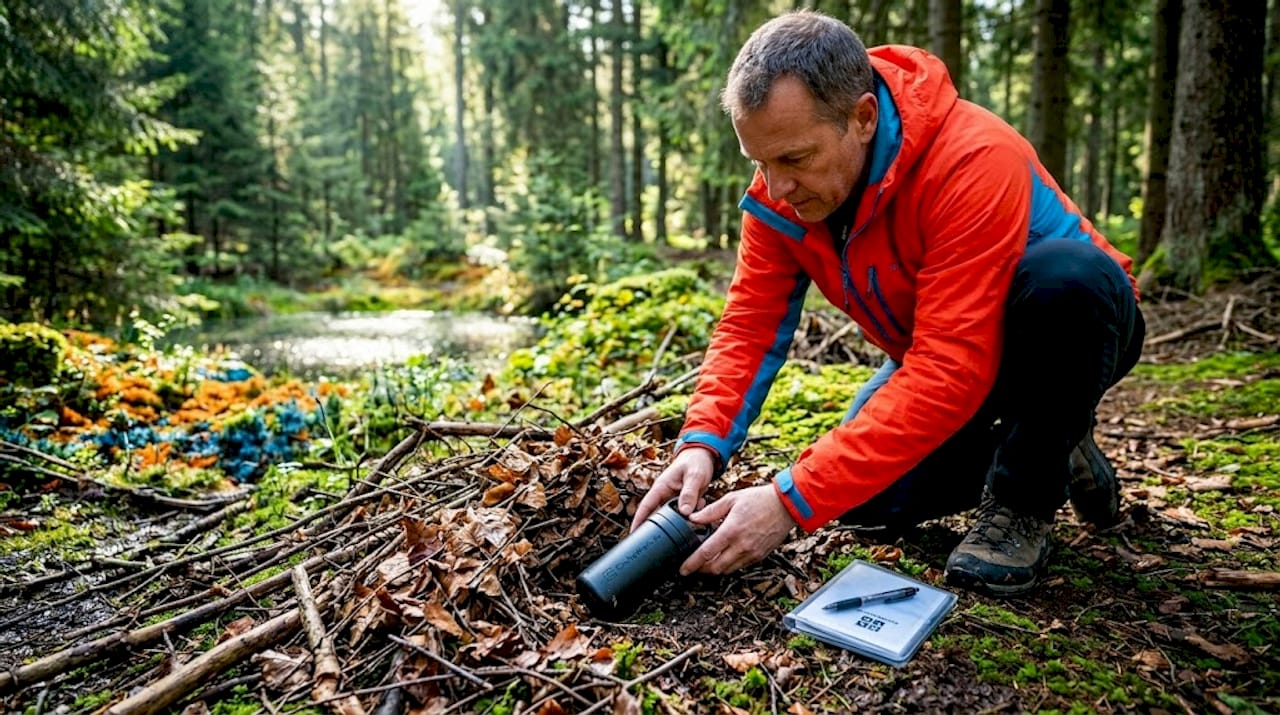
Creative camouflage instructions help you design nature hides yourself without needing expensive specialized tools. This is a good starting point, especially for beginners.
AI and Machine Learning in Hides
Who would have thought that artificial intelligence would eventually play a role in geocaching? But that's exactly what's happening. AI is increasingly being used for automated detection and monitoring of hides. For geocaching, this specifically means: operators can use smart systems to detect whether a cache is still there or has already been "muggled" (stolen or removed).
The technology works through anomaly detection. A system learns what a certain area "normally" looks like. If the image deviates from this, it reports a possible incident. For cache owners with rare or elaborate hides, this can be a real advantage.
| Application Area | Advantage | Limitation |
|---|---|---|
| Monitoring Urban Caches | Early detection of muggle activity | High costs for private setups |
| Natural Environments | Detection of environmental changes | Poor network coverage in forests |
| Digital Log Analysis | Detect unusual visitor patterns | Data protection issues with public data |
| Securing Rare Hides | Protection against loss of valuable caches | Technical effort for setup |
In addition to protecting the hides, there is also a downside: anti-surveillance measures are becoming more prominent. The principle is no longer just "hide well" but "generate confusing data." Those who feed false environmental data into a system protect their hide better than through pure shielding.
For most geocachers, AI monitoring remains more a topic for community organizers and event planners than for individuals. But the direction is clear: technology will change hiding in the long term.
Combining Digital Planning and Physical Camouflage
Good hides don't happen by accident. The combination of digital preparation and handcrafted camouflage makes the difference between a forgotten cache and one that collects hundreds of logs.
Google My Maps is excellent for planning entire treasure hunts. You can place symbols, draw routes, and link clues directly in the map. This works for simple children's scavenger hunts as well as multi-stage mystery caches.
Here's how to proceed:
- Create a new map in Google My Maps and name it after your cache project.
- Mark all planned hide locations with descriptive symbols, for example, a tree for nature hides or a building for urban caches.
- Add notes for each point: material, camouflage type, coordinates, and clues for the seeker.
- Export the map as a KML file and import it into your preferred geocaching app.
- Before publishing, check each location on-site for plausibility and accessibility.
The combination of digital map and physical camouflage doesn't have to be an expensive project. Even a simple film canister, some aluminum foil, and a well-designed map can create an experience that delights finders.
Pro Tip: Always plan hides digitally first before driving to the location. A clear picture of the route saves time and already shows on the map if two hides are too close together or if access paths overlap.
Those looking for creative hide ideas for 2026 will also find inspiring practical examples for different terrains and difficulty levels there.
Hide Types Compared: Urban and Nature-Inspired Caches
Geocaching enthusiasts often face the question: city cache or forest cache? Both approaches have their strengths. This comparison will help you choose the right hide type for your next project.
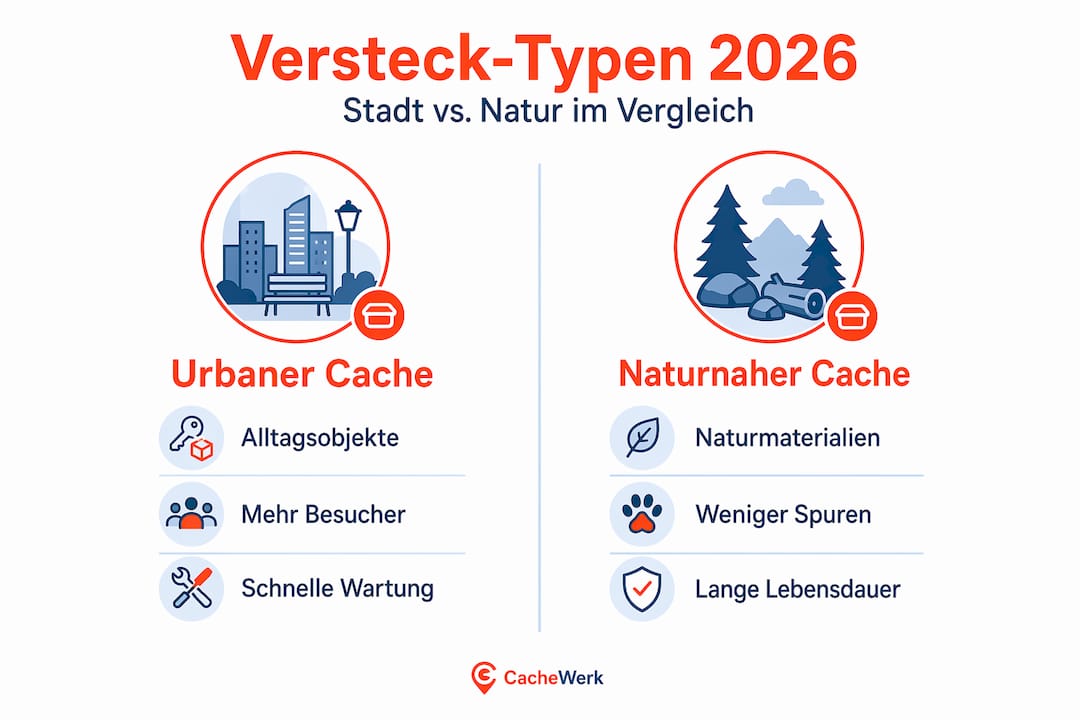
| Criterion | Urban Cache | Nature-Inspired Cache |
|---|---|---|
| Camouflage | Very high through everyday objects | High through natural materials |
| Accessibility | Year-round, possibly barrier-free | Seasonal, sometimes difficult to reach |
| Creativity Potential | High, many camouflage variations | Very high, locally adapted solutions |
| Environmental Protection | Low environmental impact | Careful site selection necessary |
| Maintenance Effort | Medium (higher muggle risk) | Low (less frequentation) |
| Technology Use | Well integratable | Limited by connectivity |
Modern geocaches imitate local symbols and natural structures to achieve maximum camouflage effect. This applies to both categories. A good cache never feels like a foreign object in its environment.
The startup mentality "hidden but high-quality" is increasingly transferring to geocaching: it's not just about simple hiding, but about the quality and thoughtfulness of the hide.
For choosing the right hide type, the following rule of thumb applies: If you want many logs and visits, choose urban hides in frequented areas. If you want to create a special experience in nature, invest time in high-quality natural materials and choose a location with added value for the finder.
My Assessment of the Trends
I've been intensely focused for years on what truly makes geocaches good. And my honest experience is: the best hides I've ever encountered weren't the best-hidden ones. They were the most well-thought-out.
Urban hides particularly fascinate me. I've seen caches disguised as street signs that remained undiscovered for years, even though hundreds of people walked past them daily. This tells me that the brain filters out the familiar. That's exactly what makes urban camouflage so effective.
With nature hides, I've had a different experience: the effort is worth it, but only if the material is right. A poorly crafted artificial stone rots after a winter, not only ruining the cache but also leaving trash in nature. Quality here is not an option; it's a requirement.
The AI aspect is interesting, but I consider it overrated in the short term. For 99 percent of the community, geocaching remains an analog experience. AI will primarily operate in the background, for example, in moderating cache listings or analyzing muggle activity. The real change lies elsewhere: in the growing creativity of the community and the willingness to invest more time in design.
What I recommend to everyone: Start with a simple urban hide. Learn how people perceive their surroundings. Then think about how to exploit that very perception.
— Benedikt
Discover Special Hides at Cachewerk
You now have a good overview of the direction in which hiding is developing. The next step is implementation. That's exactly what Cachewerk is for.
Cachewerk offers a wide selection of professionally manufactured hides specifically developed for creative and durable geocaching projects. Whether you're looking for a deceptively real fake traffic sign for your next city cache or need high-quality special hides for urban caches, you'll find solutions for all environments at Cachewerk. All products are weather-resistant, durable, and designed to disappear into their surroundings, not stand out. Browse the assortment and get inspired for your next cache. Your best hide is still waiting to be built.
FAQ
What are the most popular hide types in geocaching 2026?
Urban camouflage as everyday objects and nature-inspired hides made from weather-resistant materials are currently the most popular hide types. Both trends were strengthened by official geocaching themes in 2026.
How do I implement a nature-inspired cache in an environmentally friendly way?
Use weather-resistant materials like PETG, leave no permanent traces, and choose locations without protected area status. Hides should imitate nature without harming it.
What role does AI play in future hides?
AI enables automated monitoring of cache locations through anomaly detection and can signal muggle activity early. For most geocachers, however, direct use remains limited for now.
How do I plan a multi-stage treasure hunt digitally?
Google My Maps is excellent for planning. You can embed points, routes, and clues directly into the map and then import the file into geocaching apps.
Who are urban caches particularly suitable for?
Urban caches are suitable for geocachers who aim for many finds and a high log frequency. They are accessible all year round and benefit from the natural camouflage provided by the urban environment.
