
Camouflage in Caching: Tips for Invisible Geocaches
The best geocaches are often right under your nose. You look three times, find nothing, and then it turns out: The cache was exactly where you were looking. Perfect camouflage is the key to exciting, unforgettable caching experiences. Whether you're just starting out or have already hidden hundreds of caches, the topic of camouflage always offers new possibilities. In this article, we'll show you the most effective techniques for urban and rural environments, explain the basic principles of camouflage, and give you concrete ideas for your next hiding spot.
Table of Contents
- Basic Principles of Camouflage in Geocaching
- Proven Camouflage Methods in Rural Environments
- Camouflage in Urban Environments: Creativity and Adaptation
- Innovative Camouflage Ideas and Practical Examples
- Our Perspective: What Really Works and What Doesn't
- Camouflage in Caching: The Best Solutions from CacheWerk
- Frequently Asked Questions about Camouflage in Geocaching
Key Insights
| Point | Details |
|---|---|
| Camouflage Basics | The right mix of size, color, and material ensures almost invisible caches. |
| Rural Hides | With natural materials, you can camouflage geocaches harmoniously and environmentally friendly. |
| Urban Camouflage Technique | In urban areas, mini-containers and everyday imitations are particularly effective. |
| Innovation through 3D Printing | Individual cache camouflages can be realized easily and creatively with 3D printing. |
| Practical Implementation | Step-by-step instructions inspire new camouflage ideas for any environment. |
Basic Principles of Camouflage in Geocaching
Camouflage in geocaching means hiding a cache so that it completely blends into its surroundings. The goal is for a casual observer, whom we call a Muggle in geocaching jargon, not to perceive the container as a foreign object. A Muggle is anyone who is not a geocacher and is not supposed to know about the existence of the hide. The better the camouflage, the safer the cache remains undetected.
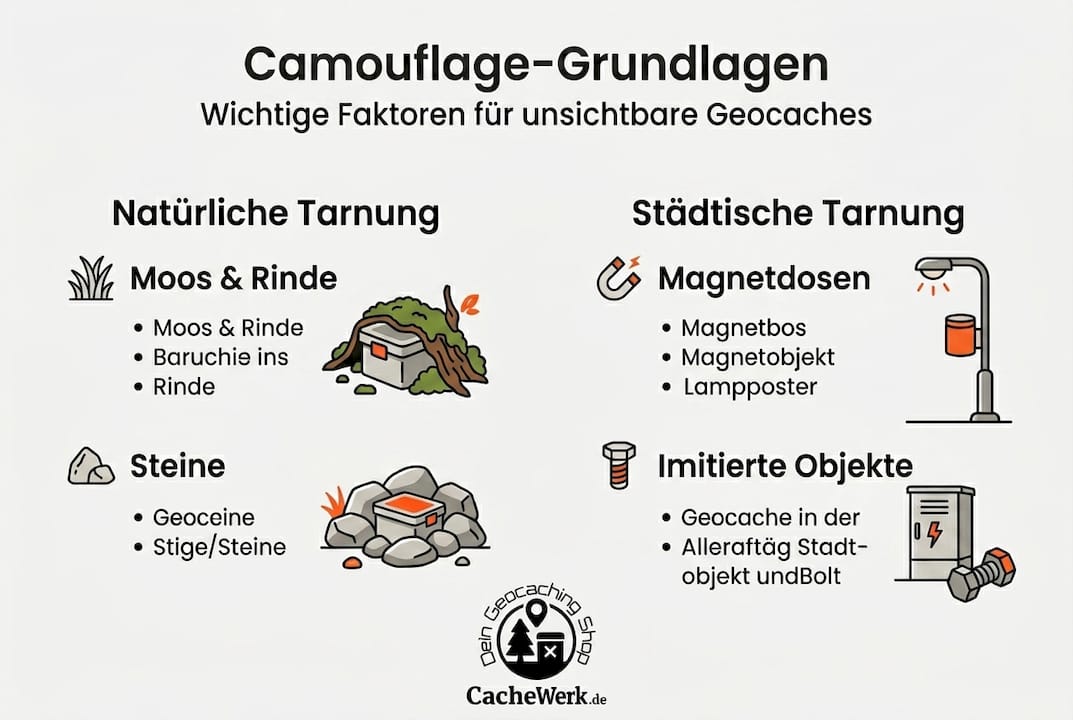
The three most important components of good camouflage are color, texture, and size. These three factors must work together for a hide to really work.
Color: A green container in an autumnal brown forest immediately stands out. A grayish-brown stone in a rocky streambed, on the other hand, is hard to distinguish. The color of the container or its covering must match the immediate surroundings, not the season in general.
Texture: Smooth plastic containers look artificial in natural environments. Only when moss, bark, or paint with a structured pattern is applied does the desired effect emerge. Resin, textured paint, or glued natural materials dramatically change the surface.
Size: Small caches are generally easier to camouflage. Nano-caches and micro-caches can disappear under a magnetic lid on a railing or behind a stone. Large containers require more effort because they are harder to completely conceal.
Both natural and artificial options are suitable materials:
- Natural materials: Moss, bark, sticks, stones, soil, dry leaves
- Artificial materials: Acrylic paint, textured spray, foam, resin
- Technical solutions: 3D-printed caches that precisely replicate objects from the environment
The basic principle is simple but effective: Colors, textures, and size must be adapted to the environment, using colors, natural materials like moss or bark, or individual 3D-printed replicas.
Pro-Tip: Before hiding your cache, take a photo of the planned hiding spot. Then hold the container next to it and compare. Do you see a difference in color and texture? Then you need to improve it. This simple procedure saves you a lot of time and prevents Muggles from discovering the cache.
Another principle: camouflage is not a one-time effort. Weather, seasons, and vandalism can damage the covering over time. Check your caches regularly and maintain the camouflage if necessary.
Proven Camouflage Methods in Rural Environments
In forests, fields, and by streams, you have the advantage that nature already offers a complex pattern of colors and textures. This makes it easier to find materials, but they must truly match the specific environment.
Natural outdoor camouflage means utilizing trees, rocks, and tree stumps with moss, bark, and soil, where hollow trees or loose stones can serve as a hiding place without damaging the environment.
Proven techniques for rural environments:
- Moss covering: Artificial moss from craft stores adheres well to containers and looks deceptively real. Real moss should not be taken from nature.
- Bark as covering: Loose, fallen bark pieces can be arranged around a container or attached with non-toxic glue.
- Stone replicas: A container shaped and painted like a stone is one of the classic and most effective camouflages ever. These can also be produced as individual outdoor hides using 3D printing.
- Utilizing hollow trees: A naturally formed cavity in a tree trunk is ideal, as long as the cache is waterproof and does not harm the tree.
- Earth hide: Partially buried, soil-covered containers are hard to find, but you must ensure that no plant roots are damaged.
Environmental protection is mandatory for rural hiding. Damaged plants, dug-up soil layers, or displaced small animals are not acceptable side effects. Only use natural materials for camouflage that have already fallen off or are naturally present.
| Method | Environment | Effort | Durability |
|---|---|---|---|
| Moss covering | Forest, meadow | Medium | High (artificial) |
| Bark as covering | Forest, bush | Low | Medium |
| Stone replica | Rock, stream | High | Very high |
| Hollow tree hide | Forest | Low | Low to medium |
| Earth hide | Forest, field | Medium | Medium |
Pro-Tip: Visit your planned hiding spot at different times of the year before placing the cache. A pile of leaves that provides perfect camouflage in autumn will be gone in spring. Plan the camouflage for the entire year, not just for the moment of hiding.
An important note on the season: Some camouflages look ideal in summer with fresh green but appear out of place in winter. Brown and gray tones often work better year-round than lush green.
Camouflage in Urban Environments: Creativity and Adaptation
Urban geocaching presents completely different demands. Here, there are significantly more Muggles, fewer secluded spots, and a completely different material world. Concrete, metal, asphalt, and plastic dominate. At the same time, the city offers countless opportunities for creative camouflage, because people in the city simply don't consciously perceive many things.
“In areas with many Muggles, smaller, better camouflaged containers are needed. Avoid conspicuous markings like ‘Geocache’ on the outside.” Geocache Camouflage
The principle of urban invisibility works differently than in the forest. In the city, the rule is: what looks normal goes unnoticed. A sticker on an electrical box, a small lock on a bike rack, a screw on a railing. People don't consciously perceive any of this in everyday life.
Particularly effective hides in urban areas:
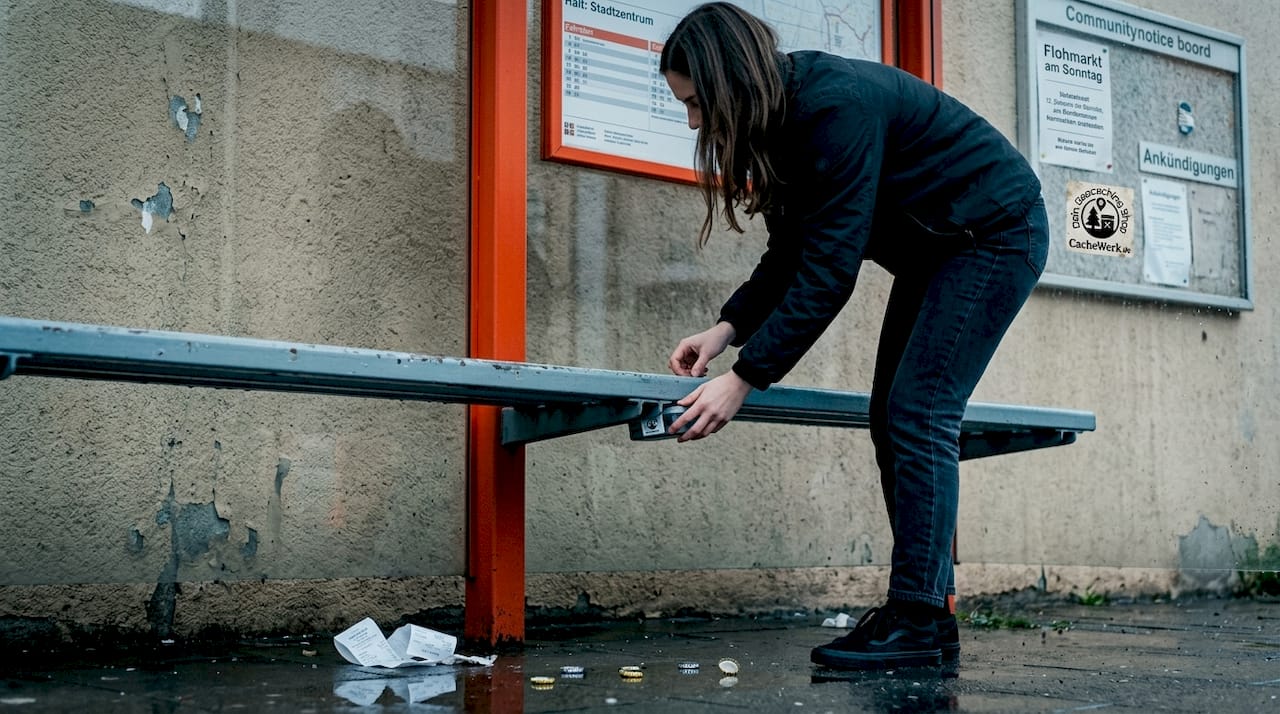
- Magnetic mini-caches: Small containers with strong magnets stick to metal structures and are hardly visible.
- Fake screws and nuts: These mimic fasteners and are completely uninteresting to Muggles.
- Fake signs: A deceptively real information sign or water sign that looks like an official object is rarely noticed.
- Everyday objects as camouflage: Petling disguised as a ballpoint pen, lipstick, or pencil, fits into many urban situations.
- Undersides of benches and tables: Magnetic containers on the underside of park benches are classic and effective.
For modern cache ideas in urban areas, the more mundane the object, the better the camouflage. People look at the unusual, not the familiar.
| Feature | Urban Camouflage | Rural Camouflage |
|---|---|---|
| Main material | Metal, plastic, concrete | Moss, bark, stones |
| Typical size | Nano to Micro | Micro to Small |
| Muggle density | Very high | Low to medium |
| Weather resistance | High required | High required |
| Creativity required | Very high | Medium to high |
A common mistake with urban caches is over-composition. Those who glue, smear, or craft too much create something that stands out from the crowd instead of disappearing into it. Less is often more here. A single, cleanly crafted object appears more inconspicuous than an elaborate craft.
Color choice is particularly important in the city. Gray, black, and rusty brown fit into almost any urban environment. Bright or colorful colors attract attention, even if the container is otherwise well designed.
Innovative Camouflage Ideas and Practical Examples
Theory is good, practical examples are better. Here are concrete steps and real ideas that geocachers successfully use.
Example 1: The Stone Imitator
- Choose a container of suitable size (e.g., a film canister or a small screw-top container).
- Apply textured paint in gray and beige to create a stone effect.
- Work the surface with a crumpled piece of foil while the paint is still wet, for an irregular texture.
- Place it among real stones and ensure it doesn't lie too uniformly.
- Check the impression from two meters away.
Example 2: The Invisible Magnetic Cache
- Get a small magnetic container (approx. 2 cm diameter).
- Cover it with a piece of sandpaper in the color of the background (e.g., concrete or rust).
- Attach it to an inconspicuous metal spot, such as the bottom of a stair railing.
- Choose a location that is easily accessible but unattractive to Muggles.
Example 3: The 3D-Printed Natural Stone
With modern DIY camouflage caches made from a 3D printer, deceptively real imitations of tree bark, stones, or even branch sections can be produced. PETG material is particularly popular because it is weather-resistant and dimensionally stable.
- Choose the model of the desired object (many are available online for free).
- Print with a robust material like PETG.
- Paint the printed result with acrylic paint in multiple layers.
- After drying, add some textured glue for a more realistic impression.
Statistics: According to community evaluations from geocaching forums, well-camouflaged caches are discovered by Muggles significantly less often than uncamouflaged containers, with color and texture adaptation having the greatest impact on the success rate.
Pro-Tip: Show your finished camouflaged cache to a friend who doesn't know where it is. Do they find it in ten seconds? Then you need better camouflage. This simple test is the most reliable quality control there is. No hobby test can replace a fresh pair of eyes.
Particularly creative cachers also use the temporal aspect of camouflage. A cache that is ideally camouflaged at night can stand out during the day. Plan your hide for the period when it will be most frequently searched for.
Our Perspective: What Really Works and What Doesn't
In the geocaching community, we repeatedly see the same mistake: cachers invest a lot of time in complicated camouflage techniques and overlook the most obvious. A screw that looks too clean and too new stands out just as much as a bright red container. Good camouflage doesn't mean effort, but consistency.
What is truly underestimated: aging. A freshly painted stone in an environment full of weathered rocks immediately looks wrong. A little dirt, a bit of structural adhesion, a few real scratches make the difference between "almost good" and "invisible." This is the knowledge embedded in our experience.
The big trend of the coming years is clear: individualization through 3D printing. Custom-made imitations that perfectly match the environment are far superior to any generic container. Anyone who has seen a 3D-printed tree stump cache immediately understands why this technology is changing geocaching.
Camouflage in Caching: The Best Solutions from CacheWerk
You now have all the important techniques and ideas for your caches. Now you need the right products to implement them. At CacheWerk, you'll find exactly that.
Browse our complete geocaching equipment and discover everything you need for professional camouflage. Particularly popular are our Fake Traffic Sign Hide, which imitates deceptively real signs, and the Customizable Water Meter Cover, which perfectly blends into urban environments. Both products are made of robust PETG, weather-resistant, and designed so that even experienced cachers have to look twice. Come visit and be inspired by our range!
Frequently Asked Questions about Camouflage in Geocaching
How can I best protect my cache from curious Muggles?
Choose small, inconspicuous containers in the color of the surroundings and definitely avoid external markings. In high-traffic areas, smaller, better-camouflaged containers without obvious labels are the most reliable.
Which materials are particularly suitable for natural camouflage?
Moss, bark, stones, or soil allow for harmonious integration into nature. According to proven hiding techniques, hollow trees and loose rocks are suitable hiding places, as long as no environmental damage occurs.
Is there effective camouflage for geocaches in urban areas?
Magnetic containers and mini-caches that imitate everyday objects are particularly effective in the city. Smaller and better camouflaged always beats larger and more conspicuous, especially in areas with a high muggle presence.
How can I make camouflage more sustainable?
Only use natural materials that have already fallen off and artificial alternatives instead of fresh plant parts. Environmentally friendly hiding means that no natural structures such as roots or moss cushions are damaged.