
Geocache Sizes: A Practical Check for Creative Hides
TL;DR:
- The correct cache size influences find rate, maintenance effort, and the finders' experience.
- Standard sizes range from Micro to Large, suitable for the environment and content.
- Clear description for "Other" caches prevents frustration and DNF logs.
Incorrect size specifications in the listing frustrate finders and permanently damage a cache's reputation. Anyone who has spent hours searching for a supposed regular container that turned out to be a tiny film canister knows exactly what we're talking about. Choosing the right geocache size not only affects the find rate but also the maintenance effort, creativity, and the finders' experience. In this article, you'll get a clear overview of all standard sizes, practical comparisons, and concrete decision-making aids for urban and rural environments.
Table of Contents
- Criteria for Choosing the Appropriate Geocache Size
- Overview: The Proven Geocache Sizes in Detail
- Comparison: Which Container Is Ideal for Which Situation
- Special Cases and Creative Geocache Sizes
- What Is Often Underestimated from Experience: Practical Tips for Successful Geocaches
- Finding Creative Geocache Hides and Equipment
- Frequently Asked Questions about Geocache Sizes
Key Takeaways
| Point | Details |
|---|---|
| Standard sizes at a glance | Micro, Small, Regular, and Large are based on volume and determine the search and hide experience. |
| Choice according to circumstances | The best geocache size depends on terrain, camouflage needs, and maintenance effort. |
| Utilize special solutions | The 'Other' category opens up space for unusual hides but should always be clearly explained. |
| Good listings prevent frustration | Detailed information and photos help seekers avoid failed attempts. |
Criteria for Choosing the Appropriate Geocache Size
Before you simply hide any container, it's worth proceeding systematically. The appropriate size depends on several factors that you should weigh beforehand. Those who know these criteria make better decisions and prevent future problems.
Volume and Classification
Volume is the fundamental characteristic of every cache size. Geocaching.com uses container sizes from Micro to Large, as well as the special category "Other" for anything that falls outside the standard. Micro means under 100 ml, Small is 100 ml to 1 liter, Regular covers 1 to 20 liters, and Large starts at 20 liters. The larger the volume, the more content is possible. This sounds simple, but the consequences for placement and camouflage are enormous.
Accessibility and Environment
Urban or rural? That's one of the most important questions. In the city, there are so-called Muggles (geocaching term for non-geocachers) who could quickly discover or steal a large container. In the countryside or forest, there is significantly more scope for larger containers. The terrain, i.e., the area around the hiding spot, also influences how large a container can actually be.
Content and Mechanics
A simple logbook requires little space. If you want to include trade items, puzzle cards, or even mechanical elements, you need appropriate space. The question of content determines the minimum size of your container.
Important selection criteria at a glance:
- Volume: Does the content (logbook, trade items, mechanics) actually fit?
- Camouflage: Can the container be made invisible in the chosen environment?
- Muggle danger: How frequented is the location?
- Weather resistance: Can the container withstand rain, frost, and heat?
- Maintenance: How often do you have to replace the logbook or check the container?
Maintenance effort and long-term suitability
An often underestimated criterion. Small containers fill up quickly, logbooks get wet and illegible. Larger containers require less maintenance if they are well-sealed. A robust choice of material significantly extends the lifespan and saves you unnecessary maintenance trips.
Pro-tip: Estimate the maintenance effort realistically. A micro in the city center sounds easy to maintain, but often needs a new logbook every few weeks. It's better to plan more generously.
Overview: The Proven Geocache Sizes in Detail
Now it gets concrete. Each standard size has its strengths, its typical areas of application, and its pitfalls. Here's a quick overview so you immediately know which size makes sense when.
| Size | Volume | Typical Containers | Typical Use |
|---|---|---|---|
| Micro | under 100 ml | Film canister, magnetic container | City, exposed locations |
| Small | 100 ml to 1 l | Screw-top container, small box | Outskirts, parks |
| Regular | 1 l to 20 l | Lock&Lock container, canning jar | Nature, forests |
| Large | from 20 l | Ammo box, barrel | Secluded spots |
The definition and typical volume ranges for Micro, Small, Regular, and Large are standardized internationally so that finders know what to expect.
Micro (under 100 ml)
The film canister is a classic. Small, inconspicuous, easy to place. Perfect for dense urban areas with high Muggle frequency. The downside: It really only fits a logbook, often even just a strip of paper. Moisture can penetrate in rain or frost. Regular checks are a must.
Small (100 ml to 1 l)
This intermediate range is often underestimated. A small screw-top container already offers space for a proper logbook and perhaps a small sticker. Ideal for parks, forest edges, or playgrounds.
Regular (1 l to 20 l)
This is where it gets really interesting. Lock&Lock containers are popular because they seal well and offer plenty of space. Trade items, puzzles, small surprises – all of that works. The best choice for family caches.
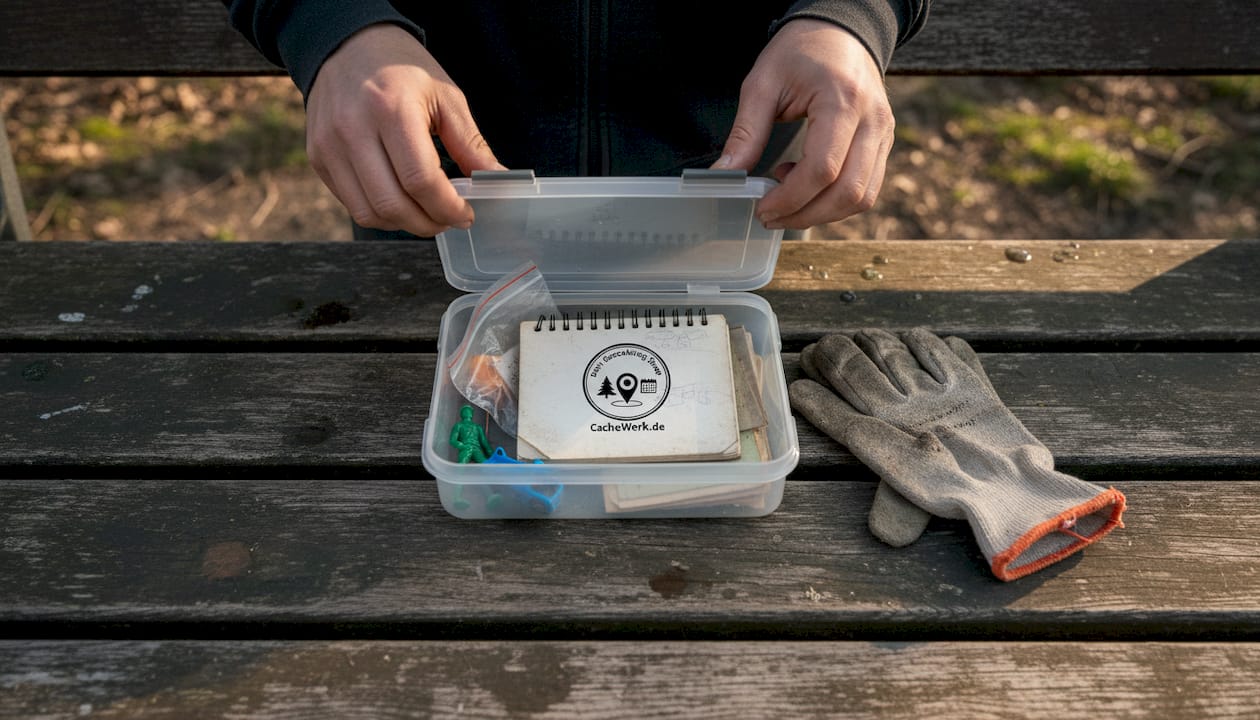
Large (from 20 l)
Ammo boxes or large plastic containers offer maximum space. Ideal for secluded forest areas or mountain tours. Difficult to transport, but low-maintenance if well hidden.
Examples of use by environment:
- City center with Muggle danger: Micro or camouflaged magnetic container
- City park or suburban area: Small to Regular
- Forest or nature: Regular or Large
- Mountain tours or extreme locations: Large, preferably ammo box
Pro-tip: Before placing, specifically observe how many Muggles pass by the location daily. More than 50 passers-by per hour? Then Micro is the safest choice. For all others: choose a robust cache container that truly fits your environment.
Comparison: Which Container Is Ideal for Which Situation
Knowledge alone is not enough. You need to know when a certain size truly shines and when it fails. Here's a direct comparison.
| Criterion | Micro | Small | Regular | Large |
|---|---|---|---|---|
| Camouflage | Very good | Good | Medium | Difficult |
| Space for content | Minimal | Sufficient | Plenty | Very much |
| Maintenance effort | High | Medium | Low | Very low |
| Creative potential | Low | Medium | High | Very high |
| Suitable terrain | City | City/Nature | Nature | Secluded |
Recommended containers per terrain:
- Urban high-traffic spots: Magnetic containers, screw-top tubes, camouflaged everyday objects
- City parks and suburban areas: Small Lock&Lock containers or mini Tupperware containers
- Forest paths and nature trails: Canning jars, standard Lock&Lock, weather-resistant PETG containers
- Mountains, caves, and extreme locations: Military ammo boxes or large plastic barrels
- Water and wetlands: Special waterproof containers or sealed PVC pipes
A special topic deserves its own attention: the category "Other". Experience shows that edge cases and "Other" caches require special consideration because they don't fit into the standard logic.
"When you specify 'Other' in the listing, you take responsibility. Finders no longer have a reference. A clear description, ideally with a photo or dimensions, is then not an option, but a must."
This means specifically: Describe in the listing exactly what finders can expect. Is it a flat magnetic hide or a fist-sized artificial stone? Are there clues about the size or contents? Without this information, frustrated DNF logs (DNF stands for "Did Not Find") will occur.
Challenges with creative DIY constructions:
- Higher planning effort for design and placement
- Weather resistance must be checked separately
- Muggles could take the object as a real item
- Spare parts for defects are often harder to obtain
Opportunities and advantages:
- Unique experiences for finders who remember the cache
- More favorite points due to exceptional execution
- Creative freedom without format constraints
- Stronger connection to your geocaching profile
Anyone who uses "Other" should be aware: You are leaving the comfort zone of standards. That's a good thing. But only if you consider finders and communicate transparently.
What Is Often Underestimated from Experience: Practical Tips for Successful Geocaches
After years of geocaching, we keep noticing the same thing: Many cache owners underestimate how quickly a micro becomes a burden. A small tube in the city center sounds easy to maintain. But logbooks quickly fill up, moisture creeps in, and after three months, the cache ends up on the list of inactive caches.
Regular and large containers, on the other hand, offer much more than just space for trade items. They invite creativity: puzzle boxes, personal messages, small mechanisms – all of this makes a cache a true experience. Finders talk about it longer, award favorite points, and recommend the cache to others.
Incorrect size specifications combined with poor maintenance are the most common reasons for DNF logs and cache loss. If finders expect the wrong thing, they search in the wrong place. This is avoidable.
Our clear advice: Rather go for an unusual, carefully maintained size than another run-of-the-mill micro. If you're looking for creative solutions, you'll find plenty of inspiration for robust and original containers in our DIY tips.
Pro-tip: Test every new cache container before hiding it: Fill it with paper, leave it in the rain for 24 hours, and then check if everything has remained dry. This simple test saves many logbooks.
Finding Creative Geocache Hides and Equipment
You now know what sizes exist, what they can do, and what their limitations are. The next step: finding the right hide for your next project. At cachewerk.de you'll find just the right thing, whether you're planning an inconspicuous city hide or an elaborate nature hide.
For forest hides, for example, we recommend our camouflage hide for the forest, which blends perfectly into the natural environment. Those who love urban hides will find what they're looking for with our creative city hides. All products are designed for durability and specially developed for the demands of active geocachers. Take a look and get inspired!
Frequently Asked Questions about Geocache Sizes
What exactly does the geocache size "Micro" mean?
A Micro has a volume of less than 100 milliliters and usually only offers space for a logbook. Trade items generally do not fit inside.
How can I clearly describe an "Other" listing?
"Other" indicates that the container does not conform to the standard. Always include clear hints about shape and size, and ideally photos, in the listing to avoid misunderstandings.
Which cache size is best for beginners?
Regular containers with 1 to 20 liters of volume are ideal for beginners because they are easier to find and easier to stock than micro hides.
What all counts as equipment for a Regular or Large container?
In addition to the logbook, trade items and puzzle boxes fit easily. This makes these sizes particularly attractive for families and groups with children.