
DIY Geocache Camouflage: A Creative Guide
TL;DR:
- Creative camouflage requires planning, suitable materials, and environmental awareness.
- Urban and rural caches differ in durability, material, and maintenance.
- Regular inspection and care ensure the long-term success of the geocache.
A poorly camouflaged cache will be discovered. Muggles will notice it, caches will disappear, and the fun will quickly end. Those who hide their own geocaches soon realize that standard DIY store solutions are rarely sufficient. Good camouflage requires planning, the right materials, and an understanding of the environment. Whether it's an urban nano magnet on a lamppost or a deceptively real-looking branch in the forest, the methods differ greatly. This guide shows you step-by-step how to build creative camouflage for both urban and natural environments, what materials truly last, and how to avoid common mistakes from the start.
Table of Contents
- Material Overview and Preparation for Geocache Camouflage
- Magnetic PETlings and Urban Special Solutions: Instructions and Practical Tips
- Creative Nature Camouflage: Cache in a Hose, Mini Birdhouse, and Ecological Aspects
- Maintenance, Sources of Error, and Finder-Friendliness: How to Ensure Balance
- Our Conclusion: Why Creativity and Care Are Inseparably Linked
- For Perfect Camouflage: Discover the Right Geocaching Accessories
- Frequently Asked Questions about Geocache Camouflage
Key Takeaways
| Point | Details |
|---|---|
| Creative camouflage increases caching fun | DIY camouflage makes the geocaching experience more varied and promotes ingenuity. |
| Material choice is crucial | Robust, weather-resistant materials significantly extend the lifespan of your cache. |
| Regular maintenance is mandatory | Check your cache regularly to avoid frustration and DNF logs. |
| Observe nature conservation | Only caches that respect nature and trails are accepted and maintained in the long term. |
| Balance between camouflage and fairness | Good camouflage conceals without frustrating seekers – testing and feedback ensure success. |
Material Overview and Preparation for Geocache Camouflage
To get started right away, you need an overview of what materials are suitable for your camouflage. The choice of materials largely depends on whether you want to hide a cache in the city or in nature. Both environments place completely different demands on durability, appearance, and fastening.
For urban hides, robustness comes first. Urban vs. Rural: Differences in Material shows that PETG containers, stainless steel components, and strong neodymium magnets have a clear advantage in the city. Additionally, camouflage foils in gray or black, as well as rust paint spray, are used to optically adapt metal surfaces. In rural environments, on the other hand, natural materials such as bark, moss, jute, or wood are used. Here, durability is key, as checks are less frequent.
Material Comparison: Urban vs. Rural
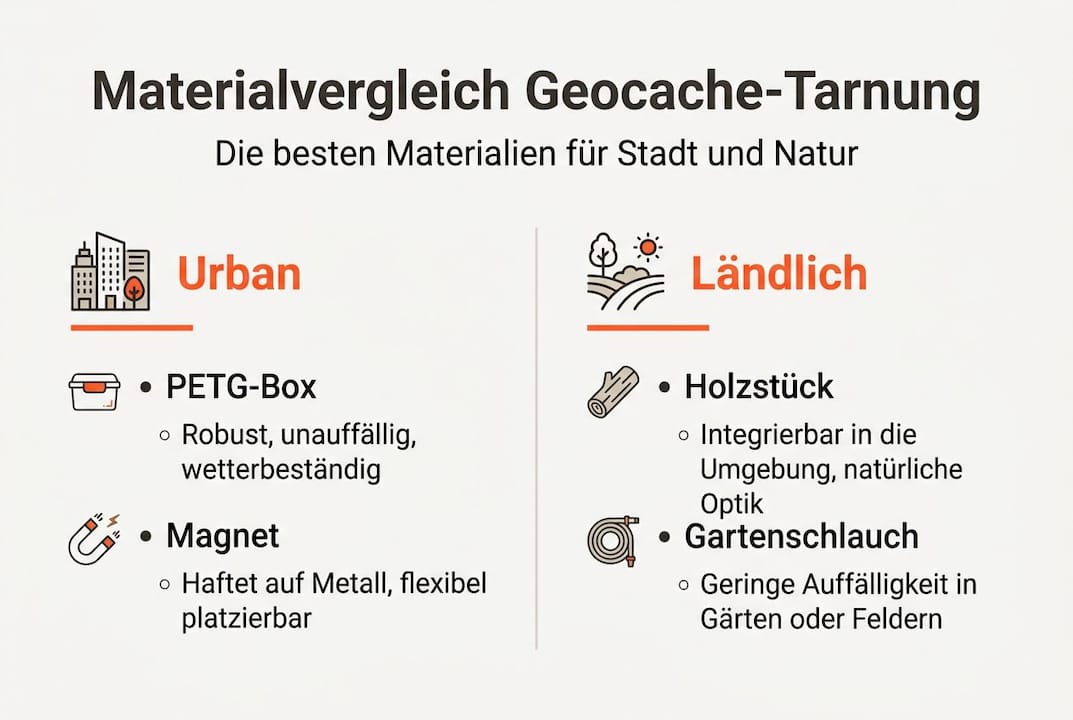
| Criterion | Urban Hide | Rural Hide |
|---|---|---|
| Container Material | PETG, stainless steel | Wood, plastic |
| Fastening | Neodymium magnet, epoxy adhesive | Wire, natural cavities |
| Camouflage | Camouflage foil, rust paint | Moss, bark, natural paints |
| Maintenance Interval | Every 3 months | Every 6 to 12 months |
| Typical Durability | 6 to 18 months | 2 to 5 years |
For preparation, you will also need the following tools:
- Sandpaper (80 and 120 grit) for roughing surfaces
- Weatherproof adhesive like Pattex or UHU Outdoor
- Brushes and acrylic paints in earth tones
- Scissors, utility knife, and hot glue gun
- Gloves to avoid fingerprints on containers
If you are looking for creative geocache ideas, you will also find inspiration for unusual container shapes there. Also, plan for enough drying time: adhesives and paints often need 24 hours before the cache is truly ready for use.
Pro Tip: Buy materials in small quantities and test them first at home under real conditions. An adhesive that holds in a room may fail in frost or rain.
Magnetic PETlings and Urban Special Solutions: Instructions and Practical Tips
With the right materials, you can immediately test your first camouflage. Here are the instructions for typical urban situations. The magnetic PETling is one of the most popular urban caches of all, because it is inconspicuous, robust, and easy to build.
The DIY method for a magnetic PETling works like this:
- Choose a PETling with a screw cap and dry it completely.
- Sand the outside with 80-grit sandpaper so that paint and glue adhere better.
- Attach a strong neodymium magnet (at least N42) to the bottom of the container with epoxy adhesive. Press the magnet firmly and let it cure for 24 hours.
- Prime the PETling with gray or black spray paint. Two thin coats are better than one thick one.
- After drying, apply a coat of weatherproof acrylic lacquer to seal the paint.
- Optionally, attach a small piece of camouflage tape or sandpaper to the outside so that the container does not shine.
- Test the magnetic force at the planned location before inserting the logbook.
"A well-built PETling will stick to a metal lamppost without slipping, even if someone bumps into it. The quality of the magnet is everything."
In the city, camouflage colors in dark gray, anthracite, and rusty brown work best. Camouflage tape in these shades can be bought cheaply and cut easily. If you want to make your cache even more inconspicuous, also glue small pebbles or sandpaper to the surface. This breaks up the smooth structure and deceives the eye.
For the logbook, waterproof mini logbooks or self-cut strips of baking paper are recommended. Geocaching stickers for the logbook and container are a nice personal touch that many finders appreciate.
Those looking for tips on creative geocache building will find more ideas for unusual container shapes in urban areas there.
Pro Tip: Always use two-component epoxy adhesive for the magnet, not normal superglue. Superglue breaks in cold and shocks; epoxy lasts for years.
Creative Nature Camouflage: Cache in a Hose, Mini Birdhouse, and Ecological Aspects
While discretion is required in the city, creative nature solutions score points outdoors. Here are the best methods for rural environments that delight finders and at the same time respect nature.
Two particularly popular designs are the cache in a hose and the mini pseudo birdhouse. The DIY method for hose cache containers and mini birdhouse provides detailed step-by-step instructions for both variants.
Cache in a hose: Cut a sturdy garden hose to about 15 cm in length. Seal one end with a wooden stick and hot glue. Insert the logbook, seal the other end with a stopper. Paint the outside with earth-colored paint or glue bark on it. A container that is hardly noticeable in the bushes is ready.

Mini Birdhouse: Build a small, non-functional birdhouse from thin plywood. The logbook is inside behind a flap. Such caches appear as decoration to muggles and are never noticed.
Comparison Table: Nature Camouflage at a Glance
| Method | Construction Time | Material Costs | Difficulty Level |
|---|---|---|---|
| Cache in a hose | 30 minutes | 3 to 8 Euros | Easy |
| Mini Birdhouse | 2 to 3 hours | 10 to 20 Euros | Medium |
| Branch Imitation (wooden tube) | 1 hour | 5 to 12 Euros | Medium |
| Moss Container | 45 minutes | 2 to 6 Euros | Easy |
Rural caches generally have a significantly longer lifespan than urban hides, as they are less exposed to vandalism and weathering effects occur more slowly.
However, clear rules apply when hiding in nature. Geocaching and nature conservation stipulates: a maximum of one step away from the path, no damage to vegetation, no digging or angler hides. These rules are not bureaucratic red tape; they protect the habitats in which we play.
Important points for nature-friendly hiding:
- Do not damage or remove living plants
- Do not permanently move stones or disturb soil
- Place containers so that animals are not endangered by the cache
- In protected areas, always check beforehand whether geocaching is permitted
If you want to learn more about outdoor hides and practical guides, you will find many other ideas for nature-friendly caches there.
Maintenance, Sources of Error, and Finder-Friendliness: How to Ensure Balance
Even the best camouflage needs care and good judgment. The final step is about sustainable fun for all involved.
A common mistake: Cachers build such perfect camouflage that no one can find the cache anymore. Too good camouflage leads to DNF logs and frustrates the community. Urban caches also disappear faster due to vandalism and weather. Robust materials and regular maintenance significantly increase their lifespan. The recommendation is to check at least every three months to ensure everything is still in order.
Maintenance Checklist for Urban Caches:
- Is the container still in the right place and securely attached?
- Is the logbook dry and does it still have enough space for entries?
- Are the paint and camouflage material still intact or peeled off?
- Do the coordinates still match the actual position?
- Are there any indications of muggle discoveries or vandalism?
- Is the magnet still strong enough or has it rusted?
For rural caches, a check every six to twelve months is sufficient, but after severe storms or floods, you should always check promptly.
"A cache you don't maintain is a cache that will soon be archived. Regular checks are not a burden; they are respect for the community."
For a balance between difficulty and findability: have your cache tested by two or three other cachers before publishing it. Their feedback will show you whether the camouflage is too obvious or too tricky. Adjust the difficulty rating honestly.
Common mistakes and how to avoid them:
- Too conspicuous objects: A freshly painted stone stands out. Use natural aging or buy already weathered materials.
- Bad coordinates: Measure the position multiple times with different devices. Deviations of more than 5 meters are problematic.
- No backup logbook: Always include a second small logbook in case the first one gets full or wet.
- Untested attachment: Test the magnet or attachment under real conditions, i.e., in rain, frost, and wind.
If you want to read more about maintenance and error prevention, you will find practical advice from the community there.
Pro Tip: Photograph your cache from different angles immediately after hiding it. These photos will help you quickly find the exact position and original condition during the next maintenance.
Our Conclusion: Why Creativity and Care Are Inseparably Linked
After many of our own caching adventures and countless camouflage attempts, one thing is clear: the most unusual idea alone does not make a legendary cache. What truly matters is the harmonious mix of creative execution, honest difficulty rating, and consistent maintenance.
Many cachers invest hours in construction but forget about maintenance. This is a mistake. A cache that still works perfectly after two years and delights finders is more valuable than ten half-hearted hides that are archived after a few months.
User-friendliness beats innovation. A simple, well-maintained PETling with clever placement brings more joy than a technically complex container that no one can find. If you read experience reports from the geocaching community, you will recognize this pattern again and again.
Whoever's cache still brings joy after years leaves a lasting impression. That is the actual goal.
For Perfect Camouflage: Discover the Right Geocaching Accessories
Equipped with basic knowledge and practical experience? If you want to go one step further, you will find everything you need here. At CacheWerk, you will find specially selected accessories for urban and rural camouflage: weatherproof containers made of PETG, strong neodymium magnets, camouflage material, and ready-made kits for beginners and professionals.
Whether you are building your first magnetic PETling or planning an elaborate nature hide, the geocaching equipment and accessories from CacheWerk provide you with exactly what you need. High-quality materials, well-thought-out solutions, and a shop that truly understands the geocaching community. Take a look now and discover what makes your next cache special.
Frequently Asked Questions about Geocache Camouflage
What materials are best suited for weatherproof geocache camouflage?
Neodymium magnets, PETG containers, stainless steel, and weatherproof adhesives like Pattex prove particularly durable for camouflage. For urban hides, PETG and stainless steel are the first choice because they withstand weather and vandalism.
How can I prevent my geocache from being too hard or too easy to find?
Use conspicuous camouflage sparingly, check the position multiple times, and ask testers for feedback on the difficulty level. Too perfect camouflage leads to DNF logs and frustrates the community in the long run.
What environmental rules must I observe when camouflaging a cache?
Geocaches must not damage vegetation and must be located a maximum of one step from the path, without digging. In protected areas, it must also be checked beforehand whether hiding is permitted at all.
How often should I maintain or check an urban cache?
A check is recommended at least every three months, as urban caches are more frequently exposed to vandalism and weather problems than rural hides.
What are typical mistakes when hiding and camouflaging?
Too obvious objects, unverified coordinates, and inadequate maintenance are among the classics. Regular maintenance and repeatedly tested coordinates prevent frustration for finders and archiving by reviewers.