
Geocaches aus dem 3D-Drucker: nachhaltig und individuell
Viele Geocacher glauben, dass 3D-gedrucktes Zubehör im Freien schnell zerfällt oder nicht wetterfest genug ist. Diese Annahme ist ein weit verbreiteter Irrglaub, der innovative Bastler davon abhält, individuelle Lösungen zu gestalten. Mit der richtigen Materialwahl und durchdachten Schutzmaßnahmen lassen sich langlebige, umweltfreundliche Geocaches herstellen, die kommerzielle Massenware übertreffen. Sie profitieren von lokaler Produktion, biologisch abbaubaren Materialien und einzigartigen Designs, die genau auf Ihre Anforderungen zugeschnitten sind.
Inhaltsverzeichnis
- Was sind geocaches aus dem 3D-drucker und welche vorteile bieten sie?
- Materialien und haltbarkeit: welche filamenttypen eignen sich für outdoor-geocaches?
- Herstellung und gestaltung: tipps für den 3D-druck von geocaches und zubehör
- Umweltaspekte und nachhaltigkeit beim 3D-druck von geocaches
- Kreative einsatzmöglichkeiten von 3D-druck im geocaching und praktische beispiele
- Entdecken sie geocaching-materialien und zubehör bei CacheWerk
- Häufig gestellte fragen zu geocaches aus dem 3D-drucker
Wichtige erkenntnisse im überblick
| Punkt | Details |
|---|---|
| 3D-Druck ermöglicht individuelle Geocaches | Maßgeschneiderte Designs und anpassbare Funktionen bieten Vorteile gegenüber Standardware aus China. |
| Materialwahl bestimmt Haltbarkeit | PLA ist biologisch abbaubar aber weniger haltbar, PETG und ASA widerstehen Witterung besser. |
| UV-Schutz verlängert Lebensdauer | Spezielle Lacke und Beschichtungen erhöhen die Beständigkeit im Freien deutlich. |
| Lokale Produktion reduziert Umweltbelastung | In Deutschland hergestellte Caches sparen Transportwege und nutzen umweltfreundliche Materialien. |
| Recycling möglich | PETG hat eine 95% Recyclingquote und ermöglicht nachhaltige Produktion. |
Was sind geocaches aus dem 3D-drucker und welche vorteile bieten sie?
Der 3D-Druck erlaubt komplexe, einzigartige Designs und individuelle Anpassungen, die bei Massenware aus China unmöglich sind. Sie können Geocaches mit speziellen Tarnmustern, angepassten Größen oder integrierten Rätselmechanismen gestalten, die perfekt zu Ihrem Versteck passen. Im Gegensatz zu standardisierten Produkten aus Fernost bietet der 3D-Druck volle Kontrolle über jedes Detail.
Die Vorteile gegenüber kommerziellen Importprodukten sind erheblich:
- Lokale Produktion in Deutschland eliminiert lange Transportwege und reduziert CO2-Emissionen drastisch
- Anpassbarkeit bei Einzelstücken ohne Mindestbestellmengen, etwa bei einem 3D-Druck Vogelhaus Versteck mit personalisierter Farbgebung
- Besondere Formen wie Pilze, Mastdosen oder fake Schilder, die in China nicht wirtschaftlich produziert werden können
- Umweltfreundliche Materialien wie biologisch abbaubares PLA oder PETG mit 95% Recyclingquote
- Kostenersparnis bei Spezialwerkzeugen durch Eigenproduktion
Maßgeschneiderte Angelhaken für Baumcaches sind ein perfektes Beispiel. Diese leichtgewichtigen Helfer erleichtern das Platzieren von Caches in großer Höhe, ohne schwere kommerzielle Werkzeuge mitschleppen zu müssen. Farbliche Anpassungen in Neonfarben helfen zudem, verlorene Werkzeuge im Gelände schnell wiederzufinden.
Profi-Tipp: Drucken Sie Ihre Werkzeuge in auffälligen Farben wie Orange oder Gelb. Das erleichtert das Wiederfinden bei Verlust und unterscheidet Ihre Ausrüstung von anderen Geocachern.
Materialien und haltbarkeit: welche filamenttypen eignen sich für outdoor-geocaches?
Die Wahl des richtigen Filaments entscheidet über die Lebensdauer Ihres Geocaches im Freien. Nicht jedes Material eignet sich gleichermaßen für den Dauereinsatz unter wechselnden Witterungsbedingungen.
PLA (Polylactic Acid) ist das beliebteste Filament für Einsteiger. Es ist biologisch abbaubar und stammt aus nachwachsenden Rohstoffen wie Maisstärke. Allerdings zersetzt sich PLA biologisch unter speziellen Bedingungen und verliert im Freien bereits nach wenigen Monaten an Stabilität. UV-Strahlung macht das Material spröde, Feuchtigkeit fördert den Abbau. Für temporäre Caches oder Innenanwendungen ist PLA ideal, für langfristige Outdoor-Verstecke jedoch ungeeignet.
PETG (Polyethylenterephthalat Glykol) bietet deutlich bessere Haltbarkeit. Es widersteht Feuchtigkeit gut, zeigt höhere Schlagfestigkeit und behält seine Form auch bei Temperaturschwankungen. PETG neigt jedoch zu Gelbfärbung durch UV-Strahlung und kann nach zwei bis drei Jahren im direkten Sonnenlicht an Festigkeit verlieren. Die 95% Recyclingquote macht PETG zur nachhaltigen Wahl für umweltbewusste Geocacher.
ASA (Acrylnitril-Styrol-Acrylester) ist die Königsklasse für Outdoor-Anwendungen. Es zeigt im Vergleich zu PLA und PETG die beste UV- und Witterungsbeständigkeit und behält seine mechanischen Eigenschaften über Jahre hinweg. ASA ist das Material der Wahl für permanente Verstecke, die extremen Bedingungen ausgesetzt sind.
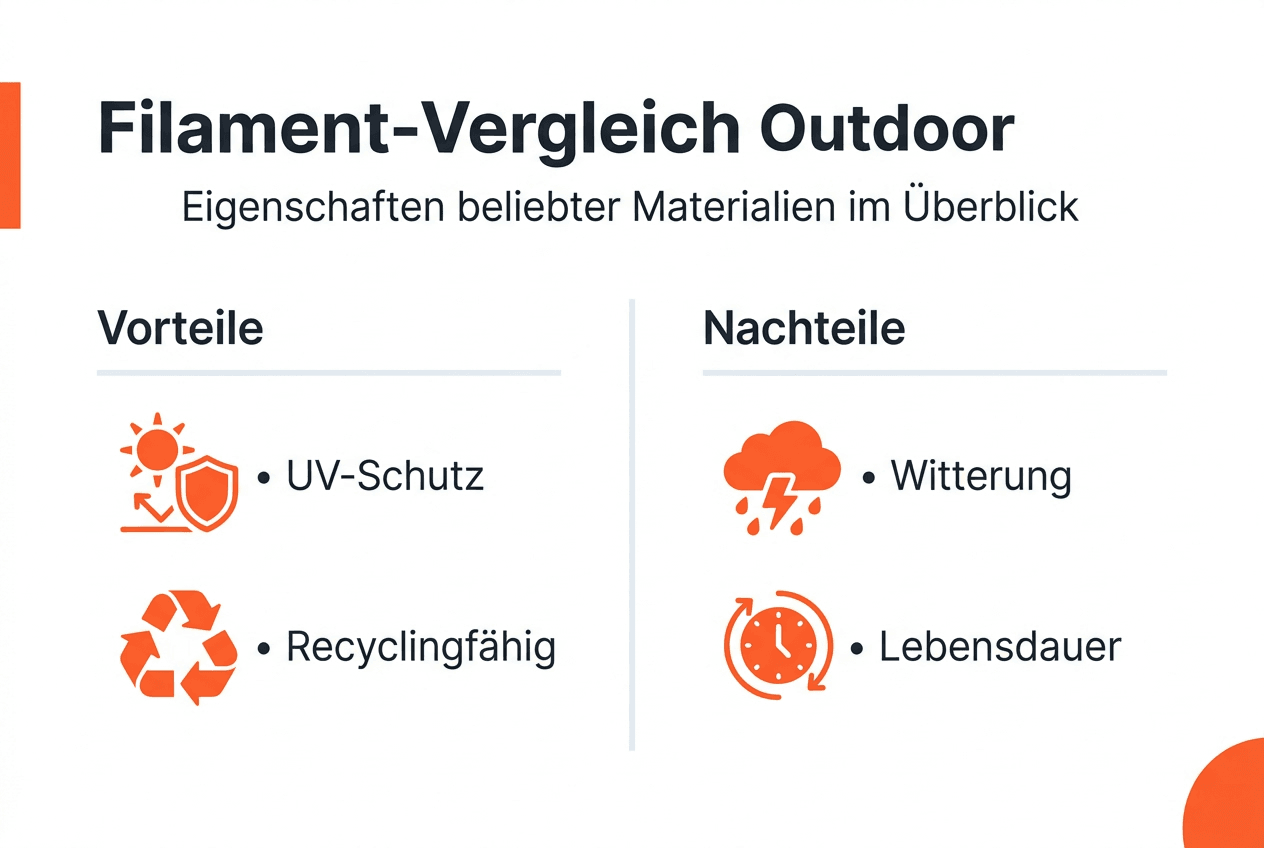
| Material | UV-Beständigkeit | Biologisch abbaubar | Outdoor-Haltbarkeit | Recyclingquote |
|---|---|---|---|---|
| PLA | Gering | Ja | 3-6 Monate | Mittel |
| PETG | Mittel | Nein | 2-3 Jahre | 95% |
| ASA | Sehr hoch | Nein | 5+ Jahre | Niedrig |
Profi-Tipp: Beschichten Sie PETG-Drucke mit UV-resistentem Klarlack. Diese einfache Maßnahme verlängert die Lebensdauer um bis zu 50% und bewahrt die ursprüngliche Farbe.
Zusätzliche Schutzmaßnahmen für 3D-Drucke im Freien umfassen spezielle Versiegelungen, Beschichtungen oder konstruktive Anpassungen wie Überhänge zum Regenschutz. Die Materialwahl bleibt jedoch der entscheidende Faktor für die Langlebigkeit Ihres Geocaches.
Herstellung und gestaltung: tipps für den 3D-druck von geocaches und zubehör
Die praktische Umsetzung erfordert mehr als nur eine STL-Datei und einen Drucker. Durchdachte Vorbereitung und optimierte Druckeinstellungen machen den Unterschied zwischen einem funktionalen Cache und einem gescheiterten Experiment.
Dateiformate und Kompatibilität: 3D-Modelle wie Geocaching Angelhaken sind für FDM-Drucke optimiert und ermöglichen einfache Herstellung. STL-Dateien sind der Standard, 3MF speichert zusätzliche Informationen wie Farben und Druckeinstellungen, STP-Dateien erlauben nachträgliche Designanpassungen in CAD-Software. Nutzen Sie 3MF, wenn Sie Projekte mit mehreren Farben oder komplexen Einstellungen teilen möchten.
Optimale Druckeinstellungen für langlebige Geocaches:
- Setzen Sie den Infill auf mindestens 30% für ausreichende Stabilität bei Outdoor-Belastung
- Wählen Sie eine Schichthöhe von 0,2 mm als Kompromiss zwischen Druckzeit und Oberflächenqualität
- Reduzieren Sie die Druckgeschwindigkeit auf 40-50 mm/s für bessere Schichthaftung
- Aktivieren Sie eine Wandstärke von mindestens 3 Perimetern für wetterfeste Außenhülle
- Nutzen Sie Supports nur wo unbedingt nötig, um Materialverschwendung zu vermeiden
- Drucken Sie mit erhöhter Betttemperatur für bessere Haftung der ersten Schicht
Individuelle Anpassungen machen den wahren Mehrwert aus. Ein Pfostenversteck lässt sich in der Größe anpassen, um auf verschiedene Pfostendurchmesser zu passen. Fake-Schilder können mit beliebigen Texten personalisiert werden, um perfekt in die Umgebung zu passen. Diese Flexibilität ist bei Importware aus China nicht möglich, wo Mindestbestellmengen individuelle Anpassungen unwirtschaftlich machen.
Profi-Tipp: Erstellen Sie einen Testdruck in kleinerem Maßstab, bevor Sie das finale Objekt drucken. Das spart Material und Zeit bei der Feinjustierung der Einstellungen.
Die Nachbearbeitung umfasst das Entfernen von Supports, Glätten der Oberfläche mit Schleifpapier und Versiegeln mit UV-Schutzlack. Investieren Sie Zeit in diese Schritte, sie machen den Unterschied zwischen einem Amateur-Druck und professionellem Geocaching-Zubehör.
Umweltaspekte und nachhaltigkeit beim 3D-druck von geocaches
Der ökologische Fußabdruck ist ein wichtiger Faktor, der 3D-gedruckte Geocaches von Massenprodukten unterscheidet. Lokale Produktion und durchdachte Materialwahl reduzieren die Umweltbelastung erheblich.
Vorteile der lokalen 3D-Produktion:
- Präzises Drucken minimiert Materialabfall, da nur benötigte Strukturen hergestellt werden
- Individuelle Bedarfsdeckung vermeidet Überproduktion und Lagerbestände
- Wegfall langer Transportwege aus China spart CO2-Emissionen
- Nutzung erneuerbarer Energien beim Drucken in Deutschland möglich
- Reparatur defekter Teile statt Komplettersatz verlängert Produktlebensdauer
Herausforderungen und Nachteile:
Der ökologische Fußabdruck des 3D-Drucks hängt stark von Filamentherkunft und Produktionseffizienz ab. 3D-Drucker verbrauchen Strom, oft über mehrere Stunden pro Druck. Die Herstellung von Filamenten, selbst bei PLA aus nachwachsenden Rohstoffen, erfordert industrielle Verarbeitung mit entsprechendem Energieaufwand.
PETG punktet hier mit seiner hohen Recyclingfähigkeit. Das Material kann nach Nutzung eingeschmolzen und zu neuem Filament verarbeitet werden, wodurch der Materialkreislauf geschlossen wird. Spezialisierte Anbieter nehmen alte PETG-Drucke zurück und recyceln sie zu hochwertigem Filament.
“Die Kombination aus biologisch abbaubarem PLA für temporäre Anwendungen und recycelbarem PETG für langlebige Caches bietet den besten Kompromiss zwischen Umweltfreundlichkeit und Funktionalität.”
UV-Schutz und durchdachtes Design reduzieren die Notwendigkeit häufiger Ersatzproduktion. Ein gut geschützter PETG-Cache hält drei Jahre oder länger, während billige Importware oft bereits nach einer Saison ersetzt werden muss. Diese Langlebigkeit macht den höheren initialen Aufwand ökologisch und wirtschaftlich sinnvoll.
Kreative einsatzmöglichkeiten von 3D-druck im geocaching und praktische beispiele
Die wahre Stärke des 3D-Drucks liegt in den unbegrenzten Gestaltungsmöglichkeiten. 3D-gedruckte Geocaches können komplexe Verstecke mit Rätseln und Täuschungen realisieren, die bei Massenware unmöglich sind.
Funktionale Werkzeuge für effizientes Geocaching:
- Angelhaken mit verschiedenen Längen und Winkeln für unterschiedliche Baumhöhen
- Magnethalterungen für Petlinge in Metallverstecken
- Wasserdichte Schraubverschlüsse mit individuellen Gewinden
- Werkzeughalter für Multi-Tools am Rucksack
- Cache-Öffner für spezielle Verschlussmechanismen
Innovative Versteckdesigns:
Ein 3D-Druck Vogelhaus Versteck täuscht als funktionales Nistobjekt und integriert gleichzeitig einen geheimen Hohlraum für Logbuch und Tauschgegenstände. Die natürliche Optik lenkt Muggles ab, während Geocacher den Mechanismus erkennen. Code Boxes mit integrierten Zahlenschlössern fordern Cacher heraus, Rätsel zu lösen, bevor sie Zugang erhalten.
Verstecke für Pfosten nutzen existierende urbane Strukturen. Diese Tarnungen passen sich perfekt an Durchmesser und Farbe des Pfostens an, was bei generischen Produkten nicht möglich ist. Durch kreative 3D-Druck-Anwendungen entstehen Pilzimitate, fake Steine oder künstliche Baumrinden, die in der Natur nicht von echten Objekten zu unterscheiden sind.
| Verstecktyp | Schwierigkeitsgrad | Typisches Material | Besonderheit |
|---|---|---|---|
| Vogelhaus-Cache | Mittel | PETG | Funktional und tarnend zugleich |
| Code Box | Hoch | ASA | Integriertes Rätselelement |
| Pfostenversteck | Niedrig | PETG | Urbane Tarnung, individuell anpassbar |
| Pilz-Imitat | Mittel | PLA mit UV-Schutz | Natürliche Waldtarnung |
| Fake-Schild | Niedrig | PETG | Personalisierbare Beschriftung |
Profi-Tipp: Drucken Sie Ersatzteile und Verschlüsse in bunten Farben wie Pink oder Türkis. Diese fallen im Gelände sofort auf, wenn sie verloren gehen, während das Hauptversteck in Tarnfarben gehalten bleibt.
Die Zusammenstellung individueller Sets als Hobby verbindet technisches Interesse mit Outdoor-Abenteuer. Sie können komplette Cache-Serien mit durchgängigem Thema gestalten, etwa eine Pilz-Serie mit verschiedenen Arten oder eine Urban-Serie mit städtischen Objektimitationen.
Entdecken sie geocaching-materialien und zubehör bei CacheWerk
Während der 3D-Druck enorme kreative Freiheiten bietet, ergänzen professionell gefertigte Produkte Ihr Geocaching-Arsenal perfekt. CacheWerk hat sich auf hochwertige Verstecke und Zubehör spezialisiert, die aus umweltfreundlichem PETG in Deutschland produziert werden.
Die Standardverstecke bei CacheWerk bieten bewährte Designs, die Sie sofort einsetzen können, ohne selbst drucken zu müssen. Ergänzen Sie diese mit spezieller Geocaching-Ausrüstung und Zubehör wie Trackables oder Tarnmaterial. Für anspruchsvolle Projekte finden Sie Spezialverstecke bei CacheWerk, die außergewöhnliche Designs mit höchster Funktionalität verbinden. Alle Produkte werden lokal gefertigt, nutzen recycelbare Materialien und können bei Bedarf individuell angepasst werden. Die Kombination aus eigenem 3D-Druck für Spezialanfertigungen und professionellen Produkten für Standardanwendungen gibt Ihnen maximale Flexibilität bei Ihren Geocaching-Abenteuern.
Häufig gestellte fragen zu geocaches aus dem 3D-drucker
Wie lange halten 3D-gedruckte geocaches im freien?
Die Haltbarkeit hängt primär vom gewählten Material ab. PLA-Drucke überstehen selten mehr als sechs Monate unter direkter Witterung, während PETG zwei bis drei Jahre durchhält. ASA-Drucke mit UV-Schutz bleiben über fünf Jahre funktional und formstabil. Zusätzliche Versiegelung mit Klarlack verlängert die Lebensdauer aller Materialien deutlich.
Welches filament eignet sich am besten für geocaching-verstecke?
PETG ist der beste Kompromiss zwischen Haltbarkeit, Umweltfreundlichkeit und Verarbeitbarkeit. Es widersteht Feuchtigkeit gut, hat eine 95% Recyclingquote und ist deutlich robuster als PLA. Für permanente Verstecke in extremen Bedingungen greifen Sie zu ASA. PLA nutzen Sie nur für temporäre Indoor-Caches oder Prototypen, die nicht länger als eine Saison im Einsatz bleiben.
Kann ich geocaches aus recyceltem filament drucken?
Ja, recyceltes PETG-Filament eignet sich hervorragend für Geocaches. Die mechanischen Eigenschaften unterscheiden sich kaum von Neuware, solange Sie qualitativ hochwertiges recyceltes Material verwenden. Achten Sie auf gleichmäßigen Durchmesser und saubere Verarbeitung. Recyceltes Filament reduziert den ökologischen Fußabdruck zusätzlich und unterstützt die Kreislaufwirtschaft.
Wie schütze ich 3D-drucke vor uv-strahlung und verwitterung?
Tragen Sie nach dem Druck mehrere Schichten UV-resistenten Klarlack auf, besonders bei PETG und PLA. Automotive-Klarlacke bieten ausgezeichneten Schutz. Konstruktiv helfen Überhänge, die das Versteck vor direktem Regen schützen. Platzieren Sie Caches wenn möglich im Schatten oder unter natürlichem Schutz. Regelmäßige Wartung und Nachversiegelung alle zwei Jahre erhält die Funktionalität.
Sind 3D-gedruckte geocaches umweltfreundlicher als kommerzielle produkte?
Bei richtiger Materialwahl ja. Lokale Produktion in Deutschland eliminiert Transportemissionen aus China. PLA ist biologisch abbaubar, PETG zu 95% recycelbar. Der gezielte Druck nur benötigter Mengen vermeidet Überproduktion und Lagerbestände. Allerdings verbraucht der Druckprozess Energie, weshalb die Gesamtbilanz von Ihrem Strommix und der Nutzungsdauer abhängt. Langlebige Caches amortisieren ihren ökologischen Aufwand deutlich besser als kurzlebige Billigware.
Welche designs eignen sich besonders für anfänger im 3D-druck?
Beginnen Sie mit einfachen Formen wie zylindrischen Petling-Haltern oder flachen Magnethalterungen. Diese Objekte erfordern keine Supports und drucken schnell. Angelhaken sind ebenfalls anfängerfreundlich, da kleine Fehler die Funktion kaum beeinträchtigen. Vermeiden Sie zunächst komplexe Geometrien mit Überhängen oder beweglichen Teilen. Sobald Sie die Grundlagen beherrschen, steigern Sie sich zu anspruchsvolleren Designs wie Code Boxes oder Tarnverstecken mit integrierten Mechanismen.