
3D-printed geocaches: sustainable and individual
Many geocachers believe that 3D-printed accessories break down quickly outdoors or are not weather-resistant enough. This assumption is a widespread misconception that keeps innovative hobbyists from creating individual solutions. With the right choice of material and well-thought-out protective measures, long-lasting, eco-friendly geocaches can be produced that outperform commercial mass-produced goods. You benefit from local production, biodegradable materials, and unique designs that are tailored exactly to your requirements.
Table of Contents
- What are 3D-printed geocaches and what benefits do they offer?
- Materials and durability: which filament types are suitable for outdoor geocaches?
- Manufacturing and design: tips for 3D printing geocaches and accessories
- Environmental aspects and sustainability in 3D printing geocaches
- Creative uses for 3D printing in geocaching and practical examples
- Discover geocaching materials and accessories at CacheWerk
- Frequently asked questions about 3D-printed geocaches
Key insights at a glance
| Point | Details |
|---|---|
| 3D printing allows for custom geocaches | Tailor-made designs and adaptable features offer advantages over standard goods from China. |
| Material choice determines durability | PLA is biodegradable but less durable; PETG and ASA resist weather better. |
| UV protection extends lifespan | Special varnishes and coatings significantly increase resistance outdoors. |
| Local production reduces environmental impact | Caches manufactured in Germany save on transport routes and use eco-friendly materials. |
| Recycling is possible | PETG has a 95% recycling rate and enables sustainable production. |
What are 3D-printed geocaches and what benefits do they offer?
3D printing allows for complex, unique designs and individual adjustments that are impossible with mass-produced goods from China. You can create geocaches with special camouflage patterns, customized sizes, or integrated puzzle mechanisms that fit your hiding spot perfectly. Unlike standardized products from the Far East, 3D printing offers full control over every detail.
The advantages over commercial imported products are significant:
- Local production in Germany eliminates long transport routes and drastically reduces CO2 emissions
- Customizability for individual pieces without minimum order quantities, such as with a 3D-printed birdhouse cache with personalized coloring
- Special shapes like mushrooms, post caps, or fake signs that cannot be produced economically in China
- Eco-friendly materials such as biodegradable PLA or PETG with a 95% recycling rate
- Cost savings on special tools through in-house production
Tailor-made fishing hooks for tree caches are a perfect example. These lightweight helpers make it easier to place caches at great heights without having to lug around heavy commercial tools. Color adjustments in neon colors also help to quickly find lost tools in the field.
Pro tip: Print your tools in eye-catching colors like orange or yellow. This makes them easier to find if lost and distinguishes your equipment from that of other geocachers.
Materials and durability: which filament types are suitable for outdoor geocaches?
The choice of the right filament determines the lifespan of your geocache outdoors. Not every material is equally suitable for continuous use under changing weather conditions.
PLA (Polylactic Acid) is the most popular filament for beginners. It is biodegradable and comes from renewable raw materials like corn starch. However, PLA biodegrades under specific conditions and loses stability outdoors after just a few months. UV radiation makes the material brittle, and moisture promotes degradation. PLA is ideal for temporary caches or indoor applications, but unsuitable for long-term outdoor hiding spots.
PETG (Polyethylene Terephthalate Glycol) offers significantly better durability. It resists moisture well, shows higher impact resistance, and retains its shape even with temperature fluctuations. However, PETG tends to yellow due to UV radiation and can lose strength after two to three years in direct sunlight. The 95% recycling rate makes PETG a sustainable choice for environmentally conscious geocachers.
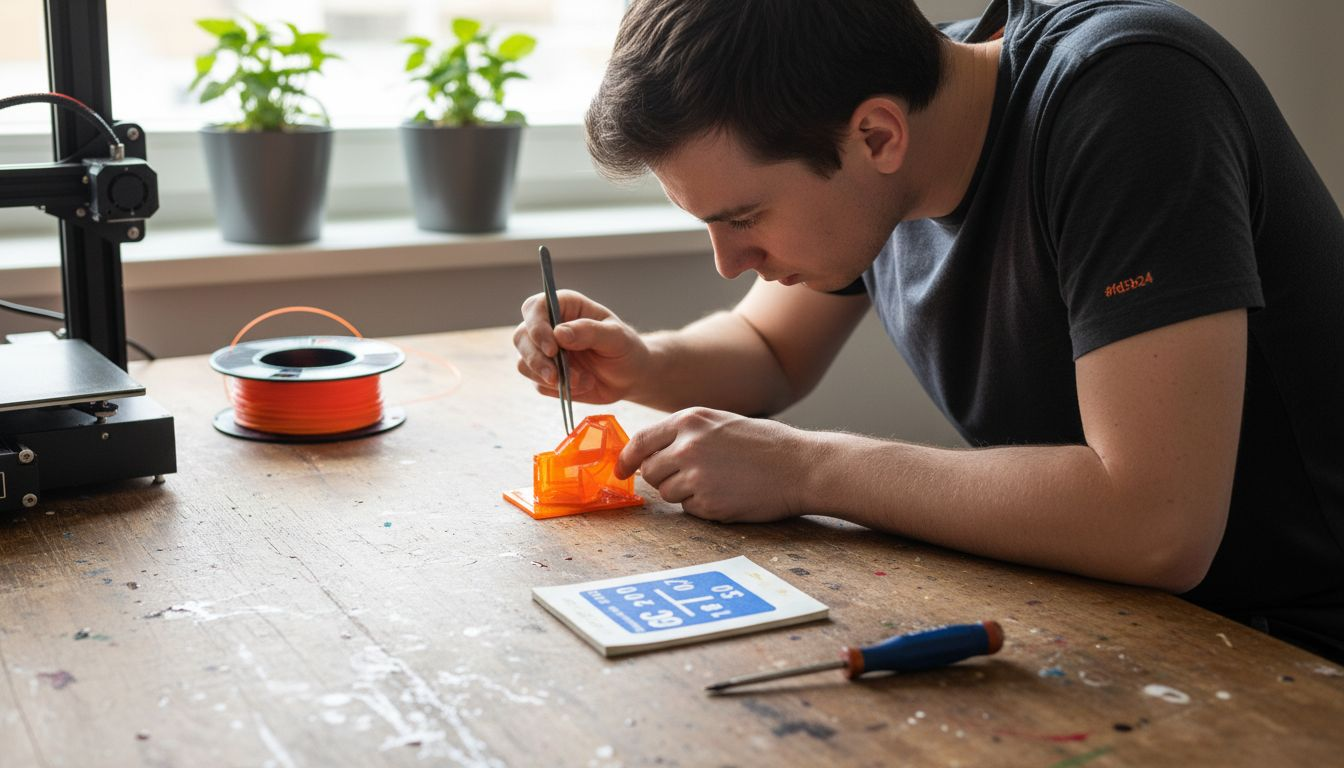
ASA (Acrylonitrile Styrene Acrylate) is the premium choice for outdoor applications. It shows the best UV and weather resistance compared to PLA and PETG and retains its mechanical properties for years. ASA is the material of choice for permanent hiding spots that are exposed to extreme conditions.
| Material | UV Resistance | Biodegradable | Outdoor Durability | Recycling Rate |
|---|---|---|---|---|
| PLA | Low | Yes | 3-6 months | Medium |
| PETG | Medium | No | 2-3 years | 95% |
| ASA | Very high | No | 5+ years | Low |
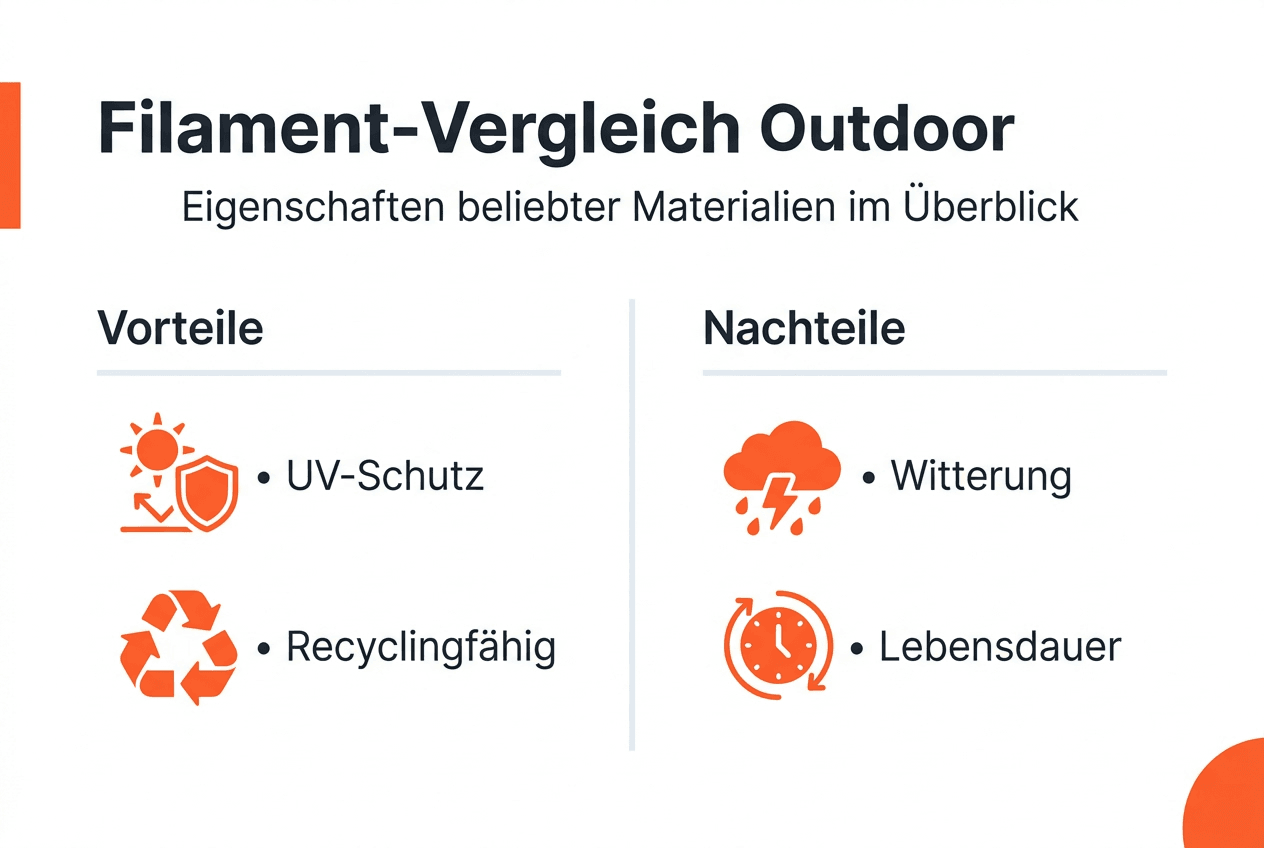
Pro tip: Coat PETG prints with UV-resistant clear lacquer. This simple measure extends the lifespan by up to 50% and preserves the original color.
Additional protective measures for 3D prints outdoors include special sealants, coatings, or structural adjustments like overhangs for rain protection. However, the choice of material remains the decisive factor for the longevity of your geocache.
Manufacturing and design: tips for 3D printing geocaches and accessories
Practical implementation requires more than just an STL file and a printer. Well-thought-out preparation and optimized print settings make the difference between a functional cache and a failed experiment.
File formats and compatibility: 3D models such as geocaching fishing hooks are optimized for FDM prints and allow for easy manufacturing. STL files are the standard, 3MF saves additional information like colors and print settings, and STP files allow for subsequent design adjustments in CAD software. Use 3MF if you want to share projects with multiple colors or complex settings.
Optimal print settings for long-lasting geocaches:
- Set the infill to at least 30% for sufficient stability under outdoor stress
- Choose a layer height of 0.2 mm as a compromise between print time and surface quality
- Reduce the print speed to 40-50 mm/s for better layer adhesion
- Use a wall thickness of at least 3 perimeters for a weather-resistant outer shell
- Use supports only where absolutely necessary to avoid material waste
- Print with a higher bed temperature for better adhesion of the first layer
Individual adjustments provide the true added value. A post cache can be adjusted in size to fit different post diameters. Fake signs can be personalized with any text to fit perfectly into the environment. This flexibility is not possible with imports from China, where minimum order quantities make individual adjustments uneconomical.
Pro tip: Create a test print on a smaller scale before printing the final object. This saves material and time during the fine-tuning of settings.
Post-processing includes removing supports, smoothing the surface with sandpaper, and sealing with UV-protective lacquer. Invest time in these steps; they make the difference between an amateur print and professional geocaching equipment.
Environmental aspects and sustainability in 3D printing geocaches
The ecological footprint is an important factor that distinguishes 3D-printed geocaches from mass-produced products. Local production and careful material selection significantly reduce the environmental impact.
Benefits of local 3D production:
- Precise printing minimizes material waste, as only necessary structures are manufactured
- Individual demand fulfillment avoids overproduction and inventory
- Elimination of long transport routes from China saves CO2 emissions
- Use of renewable energies possible when printing in Germany
- Repairing defective parts instead of replacing the whole unit extends product lifespan
Challenges and disadvantages:
The ecological footprint of 3D printing depends heavily on filament origin and production efficiency. 3D printers consume electricity, often over several hours per print. The production of filaments, even with PLA from renewable raw materials, requires industrial processing with corresponding energy consumption.
PETG scores points here with its high recyclability. The material can be melted down after use and processed into new filament, closing the material cycle. Specialized providers take back old PETG prints and recycle them into high-quality filament.
“The combination of biodegradable PLA for temporary applications and recyclable PETG for long-lasting caches offers the best compromise between environmental friendliness and functionality.”
UV protection and well-thought-out design reduce the need for frequent replacement production. A well-protected PETG cache lasts three years or longer, while cheap imports often need replacing after just one season. This longevity makes the higher initial effort ecologically and economically sensible.
Creative uses for 3D printing in geocaching and practical examples
The true strength of 3D printing lies in the unlimited design possibilities. 3D-printed geocaches can realize complex hiding spots with puzzles and deceptions that are impossible with mass-produced goods.
Functional tools for efficient geocaching:
- Fishing hooks with different lengths and angles for different tree heights
- Magnetic mounts for micro-containers in metal hiding spots
- Waterproof screw caps with individual threads
- Tool holders for multi-tools on backpacks
- Cache openers for special locking mechanisms
Innovative hiding spot designs:
A 3D-printed birdhouse cache disguises itself as a functional nesting object while simultaneously integrating a secret hollow space for a logbook and trading items. The natural look distracts "muggles," while geocachers recognize the mechanism. Code boxes with integrated combination locks challenge cachers to solve riddles before gaining access.
Hiding spots for posts take advantage of existing urban structures. These camouflages adapt perfectly to the diameter and color of the post, which is not possible with generic products. Through creative 3D printing applications, mushroom imitations, fake rocks, or artificial tree bark are created that are indistinguishable from real objects in nature.
| Hiding Spot Type | Difficulty Level | Typical Material | Special Feature |
|---|---|---|---|
| Birdhouse Cache | Medium | PETG | Functional and camouflaging at the same time |
| Code Box | High | ASA | Integrated puzzle element |
| Post Hiding Spot | Low | PETG | Urban camouflage, individually adjustable |
| Mushroom Imitation | Medium | PLA with UV protection | Natural forest camouflage |
| Fake Sign | Low | PETG | Personalizable lettering |
Pro tip: Print spare parts and closures in bright colors like pink or turquoise. These stand out immediately in the field if lost, while the main hiding spot remains in camouflage colors.
Assembling individual sets as a hobby combines technical interest with outdoor adventure. You can design complete cache series with a consistent theme, such as a mushroom series with different species or an urban series with imitations of city objects.
Discover geocaching materials and accessories at CacheWerk
While 3D printing offers enormous creative freedom, professionally manufactured products perfectly complement your geocaching arsenal. CacheWerk specializes in high-quality hiding spots and accessories, produced in Germany from eco-friendly PETG.
The standard hiding spots at CacheWerk offer proven designs that you can use immediately without having to print them yourself. Supplement these with special geocaching equipment and accessories such as trackables or camouflage material. For demanding projects, you will find special hiding spots at CacheWerk that combine extraordinary designs with maximum functionality. All products are manufactured locally, use recyclable materials, and can be individually adapted if necessary. The combination of your own 3D printing for custom-made items and professional products for standard applications gives you maximum flexibility in your geocaching adventures.
Frequently asked questions about 3D-printed geocaches
How long do 3D-printed geocaches last outdoors?
Durability depends primarily on the chosen material. PLA prints rarely survive more than six months under direct weather, while PETG lasts for two to three years. ASA prints with UV protection remain functional and dimensionally stable for over five years. Additional sealing with clear lacquer significantly extends the lifespan of all materials.
Which filament is best suited for geocaching hiding spots?
PETG is the best compromise between durability, environmental friendliness, and processability. It resists moisture well, has a 95% recycling rate, and is significantly more robust than PLA. For permanent hides in extreme conditions, opt for ASA. Use PLA only for temporary indoor caches or prototypes that will not remain in use for longer than one season.
Can I print geocaches from recycled filament?
Yes, recycled PETG filament is excellent for geocaches. The mechanical properties hardly differ from virgin material as long as you use high-quality recycled material. Ensure consistent diameter and clean processing. Recycled filament further reduces the ecological footprint and supports the circular economy.
How do I protect 3D prints from UV radiation and weathering?
After printing, apply several layers of UV-resistant clear coat, especially for PETG and PLA. Automotive clear coats offer excellent protection. Structurally, overhangs that protect the hide from direct rain help. If possible, place caches in the shade or under natural cover. Regular maintenance and re-sealing every two years preserves functionality.
Are 3D-printed geocaches more environmentally friendly than commercial products?
With the right material choice, yes. Local production in Germany eliminates transport emissions from China. PLA is biodegradable, and PETG is 95% recyclable. Printing only the quantities needed avoids overproduction and excess inventory. However, the printing process consumes energy, so the overall balance depends on your electricity mix and usage duration. Long-lasting caches amortize their ecological cost much better than short-lived, cheap goods.
Which designs are particularly suitable for 3D printing beginners?
Start with simple shapes like cylindrical petling holders or flat magnetic mounts. These objects do not require supports and print quickly. Fishing hooks are also beginner-friendly, as small errors hardly affect their function. Avoid complex geometries with overhangs or moving parts at first. Once you have mastered the basics, move up to more demanding designs like code boxes or camouflage hides with integrated mechanisms.