Hanging cache construction: How to build it sturdy and weatherproof

A secure hanging cache construction combines three things: a tree-friendly, resilient suspension system, a weatherproof container, and a realistic maintenance plan. Materials such as ropes with certified webbing slings, neodymium magnets, and PETG housings have proven successful in the community, as has the classic wooden log baton. Anyone considering T5-rated climbing caches should be aware that the effort required in terms of equipment and time is significantly higher than that for a ground hide.
In short:
- Hanging caches benefit most from a pretensioned rope or cord suspension that effectively compensates for gusts of wind.
- The choice of material is crucial; weatherproof PETG, wooden batons, sturdy canisters, or 3D-printed containers offer long-lasting hiding spots depending on the deployment conditions.
- Tree-friendly attachment requires wide webbing slings and certified carabiners to relieve the tree and avoid damage to the bark.
- Maintenance and inspection for climbing hides require more time and experience, and safety equipment and occasional checks should always be kept in mind.
- Creative crafting is possible, but should always be done with a focus on durability and responsible installation to avoid damage to the natural environment.
Table of Contents
- Basic principles of a hanging cache construction
- Materials and container types for hanging caches
- Three DIY designs for hanging caches to replicate
- How to attach a cache in a tree-friendly way
- How to protect a hanging cache from the weather
- How much effort does maintaining hanging caches take?
- Why these recommendations are based on real-world practice
- Personal perspective: Combining creativity with responsibility
- Suitable products from Cachewerk for your hanging construction
- Sources
- FAQ
Basic principles of a hanging cache construction
In hanging constructions, stability is not created by mass, but by tension. The principle of pretensioning, as known from large tensile structures, can be applied directly to a lightweight geocache: if a string or rope is tensioned purposefully rather than hanging loosely, the container swings less and withstands wind loads much better.
The critical point is almost always at the top, at the anchor point. This is precisely where it is decided whether your cache will still be hanging from the branch in a year or lying in the bushes. Static fixings in hanging constructions must absorb dynamic loads, i.e., wind, vibration, and the weight of changing finders' hands on the container.
In practice, this means you have to choose between a flexible and a rigid suspension.
- Flexible suspension (rope, webbing sling): tolerates wind better but requires regular visual checks for chafing.
- Rigid suspension (carabiner on an eye bolt): sits more firmly but transfers forces more directly to the tree or post.
- Combination: carabiner at the upper anchor point, short flexible intermediate piece to the container; this is the best compromise for most crafters.
Pro tip: Never pull your suspension rope completely taut. A little leeway of a few centimeters absorbs gusts of wind without the anchor point snapping.
Materials and container types for hanging caches
The choice of material determines whether your cache survives for ten years or gives up after the first rainy autumn. Every material has a clear area of application.
- PETG from the 3D printer: lightweight, very weather-resistant, and can be printed to fit precisely with sealing lips or O-ring grooves. Disadvantage: with thin wall thicknesses, UV radiation can make the material brittle over the years.
- Wooden log baton: quick to build, smells and looks natural in the forest, but requires a coat of waterproof paint and regular maintenance.
- Metal or plastic-coated canisters: stable against animal bites but heavier. Rust protection on cut edges is mandatory, otherwise, rust will bloom through within a season.
- Ready-made branch containers from 3D printing are now also available as market products with waterproof logbooks, which shows: the construction method has proven itself in practice.
Logbook protection is often underestimated. A wet log is the most common reason why finders give a poorly constructed cache a bad rating. Waterproof log strips in the inner compartment, additionally packed in a plastic sleeve, keep out even persistent rain. Anyone using magnets to attach the log compartment should insert them into blind holes about five millimeters deep and glue them flush; otherwise, they easily break out during transport or opening.
Three DIY designs for hanging caches to replicate
These three constructions can be built with manageable tools and are common in the crafting community.
- The classic log baton: material list: a roofing batten, two to three neodymium magnets, stainless steel screws, waterproof glue. Construction process: cut the batten, drill blind holes for the magnets, glue in the magnets, cut the log strips to size, paint the batten, attach to a webbing sling. Check the glued joint for cracks after the first season.
- The hanging branch from the 3D printer: typical dimensions are between 15 and 25 centimeters in length. The surface is treated with a waterproof finish such as acrylic paint; the suspension is carried out via a screwed eyelet instead of a glued connection, which lasts significantly longer.
- The camouflaged urban object, such as a fake water sign on a post: the mechanism is usually located in a screw connection that can be opened without tools at the place of residence, but with a small Allen key on-site. Important: No permanent drilling into someone else's property; the installation must remain reversible.
Pro tip: Before the first listing, always run a test run at home: leave it outside for three days, then open it and check whether moisture has penetrated.
Anyone looking for creative DIY caches will find further variations of these three basic types.
How to attach a cache in a tree-friendly way
The tree is not to blame for your hobby, so the attachment should not harm it either. Rubberized loops or wide webbing slings distribute the load over a larger area and prevent the bark from being cut into, unlike a thin cord or even a screw directly in the trunk.
- Use wide webbing slings instead of thin cord; this protects the bark during wind and movement.
- Carabiners with a certified breaking load connect the loop and container; a simple figure-eight knot is usually sufficient for securing.
- For small containers with a low dynamic load, you can expect less, but for larger wooden structures, it is better to have a reserve upward.
- In the city, a post holder replaces the tree; this is often the more gentle and unobtrusive solution.
- Keep a short maintenance checklist: check the loop for chafing, carabiners for rust, and knots for security.
A detailed guide to tree-friendly installation also shows how different branch diameters can be treated differently. Community listings also emphasize: if, despite all caution, damage remains on the tree, archiving the cache is the right decision, not holding on to the location.
How to protect a hanging cache from the weather
Moisture is the greatest enemy of any hanging construction because rain and condensation creep into open edges from below. Silicone on lid joints, O-rings on screw caps, and overlapping lid constructions keep water out, while UV-resistant paint prevents plastic or wood from becoming brittle within months.
- Silicone or O-rings on every opening; that is cheaper than a new container after the first winter.
- Rite in the Rain strips or comparable weather-resistant paper for the logbook, additionally in a plastic sleeve.
- A replacement log inside the container saves the cache if the main log gets soaked anyway.
- Seasonal check in spring and autumn, while checking glued joints, seals, and signs of rust.
How much UV light and moisture change a material over the years depends heavily on the location. A cache in a dense forest ages more slowly than one in an open field. A detailed tutorial on the weather-resistant installation of cache hides goes into more detail on individual sealing variants.
How much effort does maintaining hanging caches take?
Do not underestimate the effort. A listing of tree-hanging caches shows: maintenance and searching can take significantly more than an hour for tree-climbing hides, including climbing rope and safety equipment.
- Never climb alone; a second person secures and helps in an emergency.
- Use short-rope positioning and, at greater heights, professional training instead of trial and error.
- Clearly document in the listing what equipment finders need and how often you look after it yourself.
It is better to choose a position so that maintenance remains possible from the ground or with a small stepladder. Hides that are hung too high often end up abandoned in practice because even the owner avoids the effort eventually.
Why these recommendations are based on real-world practice
These construction tips come from a mixture of community experience and craftsmanship, not purely from theory. The CacheWerk tutorials on tree-friendly attachment and building weather-resistant hides arise directly from the construction and sale of corresponding products. In addition, community logs such as the Opencaching listing cited above and technical articles on structural engineering provide the technical basis for the recommendations on pretensioning and anchor points.

Personal perspective: Combining creativity with responsibility

A spectacular hide brings good ratings in the short term, but a boring yet solid construction brings joy for ten years. I would advise every crafter to build conservatively and check more often than to build spectacularly once and then never again. Tree protection beats show effects, every time.
Anyone who runs a simple test series before listing—three days of rain, one windy day, a check after a week—saves themselves many frustrated finder logs later. And anyone who honestly writes in the listing how much maintenance and equipment a cache needs respects the time of other cachers. In the end, that is the true craftsmanship behind a hanging construction: not the appearance, but the reliability over years.
— Benedikt
Suitable products from Cachewerk for your hanging construction
Hides developed from the perspective of active geocachers offer a well-thought-out construction where every gram and every seal counts.
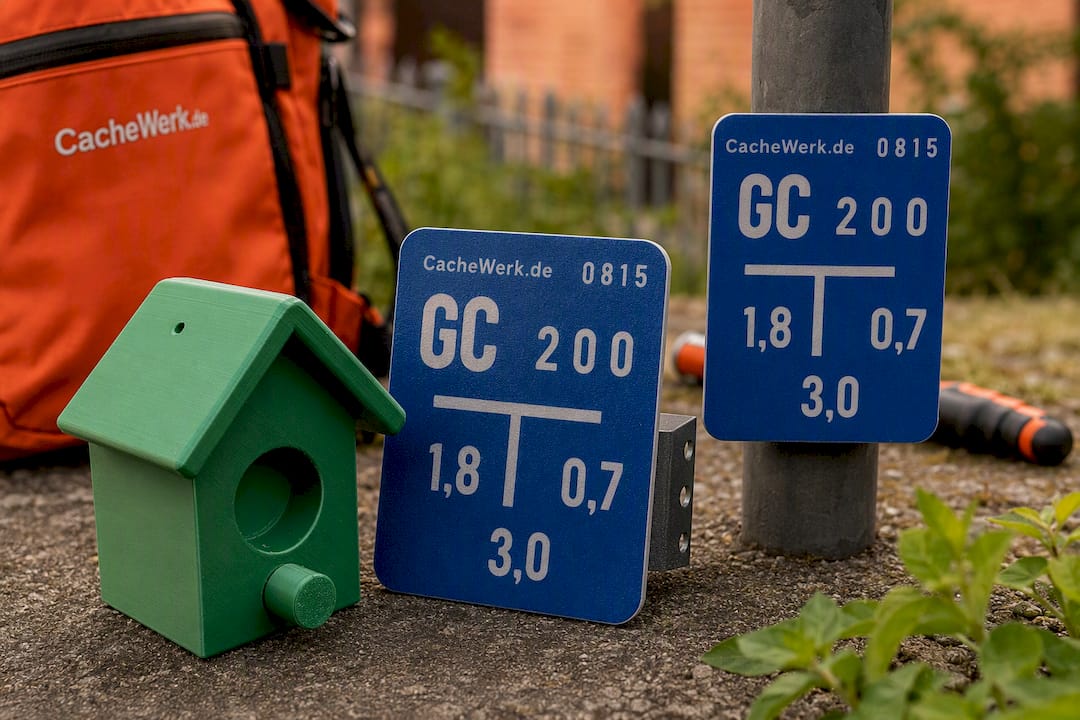
For urban camouflage without a tree, the Geocaching Birdhouse Medium with its screw mechanism is suitable: it can be mounted firmly without finders encountering a difficult-to-open construction, and the screwed mechanism keeps it reliably closed even in wind. Those who prefer to remain completely invisible in the cityscape will find a customizable camouflage hide with a post holder in the customizable fake water sign, ideal for lampposts or traffic signs. The ready-made version, the fake water sign as a standard hide, offers the same urban camouflage without any adaptation effort, practical for all who want to get started quickly.
For the suspension itself, it is worth taking a look at the Geocaching equipment and accessories, and anyone planning electronic logging devices will find a suitable addition in water-repellent battery holders. Stop by the shop and find the right foundation for your next hanging construction.
Sources
- FD90 The Hanging Gardens - Geocaching with Opencaching
- Frei Otto – Technical Foundations
- Hanging Glazing | BauNetz Knowledge
FAQ
What is the difference between L1, L2, and L3 cache?
This is a term from computer technology, not from geocaching: L1, L2, and L3 refer to memory levels in a processor, ordered by speed and size. For a hanging cache construction in the geocaching sense, this distinction has no meaning.
What types of caches are there?
In geocaching, a distinction is made between traditional, multi, mystery, and earthcaches, among others, as well as by container size: nano, micro, and regular. Hanging constructions such as branch hides or tree-suspended log slats are a subcategory that also scores points with their suspension and maintenance requirements.
How do I create my own geocache?
First, choose a container, such as a log slat or a 3D-printed housing like the 3D-printed hides from Cachewerk, then select a weatherproof location with a stable mounting point. Place a logbook and, if desired, trade items inside, and register the hide via the appropriate geocaching platform with clear coordinates.
What is a cache explained simply?
A geocache is a hidden container with a logbook that others find using GPS coordinates and confirm in the logbook. In a hanging cache construction, this container is located at a height on a cord, carabiner, or eyelet, such as on a branch or post, instead of on the ground.
Do you need special equipment for hanging caches?
For simple, low-hanging hides, a sling and carabiner are perfectly sufficient. For climbing caches with a T5 rating, however, you need climbing ropes and a lanyard, as a real-world listing shows, plus ideally professional training.