
Build a DIY Cache Lock: A Guide for Geocachers
For most cache owners, a weatherproof cache box with a padlock and internal emergency release is the best basic solution. It is affordable, maintainable, and reliably withstands German weather conditions. According to building instructions from MixiTV, the material costs for the basic elements often amount to only €3–4. Three mistakes ruin most DIY locks: no weather protection, no backup release, and batteries without sleep mode for electronic versions. If you plan for these three points from the start, you'll build a cache that lasts for years.
Key Takeaways
A weatherproof DIY cache lock can be reliably achieved if you plan for double casings, backup release, and suitable materials from the outset.
| Topic | Details |
|---|---|
| Best Basic Solution | Padlock with stainless steel hasp on weatherproof box; low cost. |
| Weather Protection | Double casing with sealing tape and internally mounted hinges prevents most common failures. |
| Backup Access | Always plan for a manual emergency release or a spare key, especially for electronics. |
| Electronics Tip | Servos with sleep mode and energy-efficient hardware can last up to ten years, according to Heise. |
| Cachewerk Option | Starter bundles and ammo box hides provide ready-made basic bodies for quick prototyping. |
Table of Contents
- What Do You Need for Your DIY Lock System?
- Which Construction Variant Suits You?
- What Must You Absolutely Not Forget During Construction?
- How Do You Protect Your Cache from Weather and Break-ins?
- Emergency Opening, Maintenance, and Field Checklist
- Electronic Locks: Which Components Are Really Worth It?
- Step-by-Step: Two Quick Guides to Replicate
- Where Can You Get Parts in Germany, and What Does Cachewerk Offer?
- What Legal and Ethical Considerations Must You Observe?
- What I've Learned After Many DIY Projects
- Ready-Made Parts and Hides Directly from Cachewerk
- Sources
What Do You Need for Your DIY Lock System?
For a simple mechanical cache box, materials from a hardware store are sufficient. Here are the most important parts at a glance:
- Casing: Weatherproof wood (phenolic plywood, min. 12 mm) or metal box; alternatively, an ammo can
- Lock: Padlock with hardened steel shackle (e.g., Abus 55/40), price approx. €5–10
- Hasp: Sturdy stainless steel hasp with safety plate, approx. €2–4 Seal: Neoprene foam sealing tape or silicone sealant for lid and hinges
- Fasteners: Stainless steel screws M4/M5, washers, possibly T-nuts
- Tools: Drill, saw or Dremel, screwdriver, file, sandpaper
- Optional for Puzzle Parts: 3D printer with PETG filament
Electronic variant additionally: Arduino Nano or ATtiny85, micro servo (e.g., SG90 or MG90S), LiPo or AA battery holder, waterproof enclosure for the electronics.
Hardware store chains like Bauhaus, OBI, or Hornbach carry hasps, hinges, and sealing material. Electronic components can be purchased from Reichelt Elektronik or Conrad. Ready-made hide bodies and geocaching accessories can be found directly at Cachewerk.
Which Construction Variant Suits You?
Three approaches cover most requirements. Each has a different cost and effort profile.
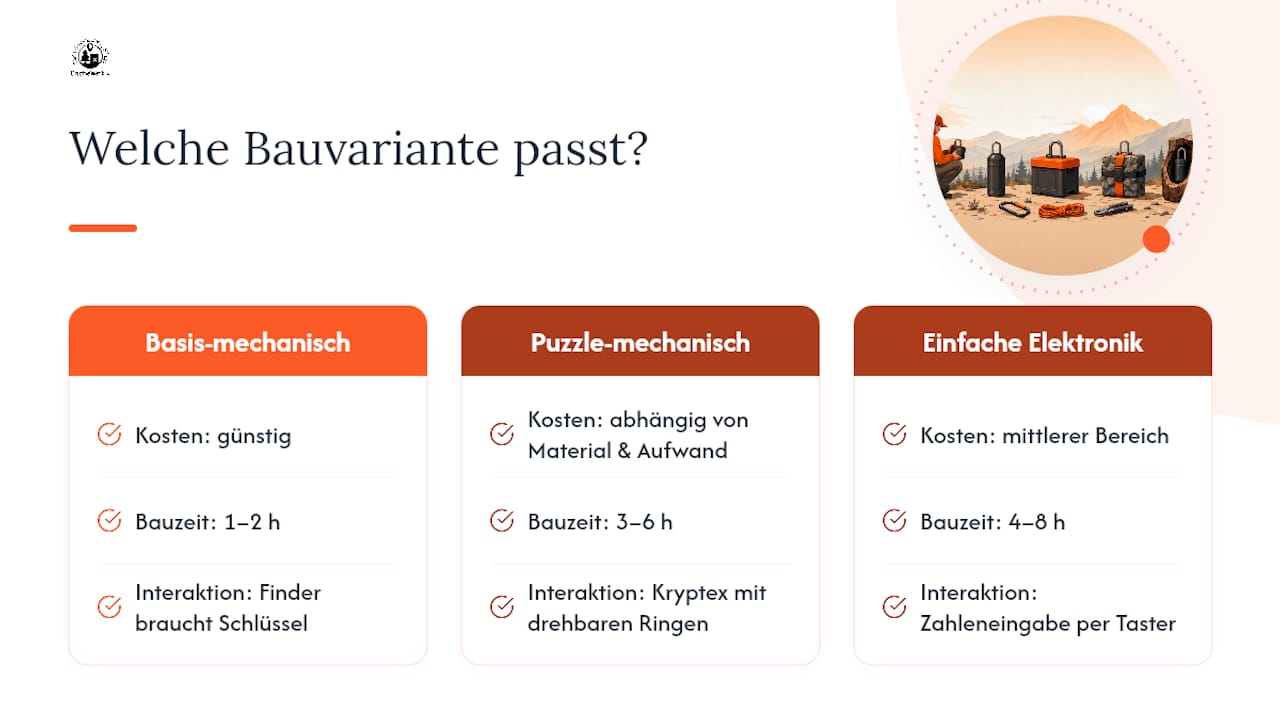
Variant A: Basic Mechanical (Padlock + Hasp) Low cost, build time 1–2 hours. Very weatherproof, minimal maintenance, no power failure possible. Ideal for beginners and forest hides. The finder needs a key that you hide at another stage.
Variant B: Puzzle Mechanical (Cryptex-style) Cost depends on material and effort, build time 3–6 hours. A Cryptex can be built with inexpensive materials; rotating plastic or wooden rings secure an inner container. Medium effort, good puzzle integration. Weather resistance heavily depends on the casing material.
Variant C: Simple Electronics (Servo + Code) Medium cost, build time 4–8 hours. Highest interactivity, e.g., number input via buttons. However, it absolutely requires a backup release and a well-thought-out power concept. Not suitable for beginners without soldering experience.
What Must You Absolutely Not Forget During Construction?
The critical details differentiate a cache that lasts a year from one that breaks after the first winter.
Mechanical Variant
- Always attach the hasp with two screws, never just one. Screwing into end grain will pull out.
- Mount hinges on the inside of the lid so they cannot be used as leverage.
- Avoid pulling movements on the lock: The hasp must be perpendicular to the plane of the lock shackle.
Puzzle Cryptex
- Keep manufacturing tolerances tight: Print or mill rings with 0.2–0.3 mm clearance, otherwise the system will jam or wobble.
- Use PETG instead of PLA. PETG withstands mechanical stress and weathering significantly better than PLA, which softens in summer heat in a car or in the sun.
- Lightly roughen friction surfaces so the rings don't slip on their own.
Electronic Variant
Pro Tip: Completely decouple electronics and outer casing. The circuit board sits in its own waterproof inner casing (e.g., a small plastic box with a sealing ring), and the outer casing only protects against mechanics and weather.
- Position the servo so that it briefly actuates the bolt and then releases it; the bolt holds mechanically, not by continuous power.
- Provide strain relief for cable routing so that vibrations do not break solder joints.
How Do You Protect Your Cache from Weather and Break-ins?
Weather protection is the biggest challenge for cache owners, according to Geocaching. The most proven method is the double casing.
- Outer Shell: Ammo can, metal box, or robust plastic box for weather protection
- Inner Container: Separate electronics or logbook container that remains dry even if water penetrates
- Seal: Neoprene foam sealing tape on the lid flange, silicone sealant on cable glands
- Rust Protection: Choose all metal parts in stainless steel or treat with zinc spray
- Internal Hinges: Externally accessible hinges are the most common point of attack for vandalism
Experienced owners report that visible weak points on the outer shell are preferred targets for attacks. A hasp with a screwed-on safety plate and hidden screw heads (Torx or hex socket) significantly increases resistance. If you want to learn more about comparing casing materials, Cachewerk offers a detailed overview.
Material Note: Phenolic plywood from hardware stores is cheaper than stainless steel sheet and, if properly sealed, similarly weather-resistant. For weather protection for outdoor materials, the same basic principles apply as for other outdoor products: watertightness over material thickness.
Emergency Opening, Maintenance, and Field Checklist
No cache without backup access. Stefan Michaelis documents that electronic caches without backup release become permanently inaccessible if batteries fail. This is not a theoretical risk.
Maintenance Plan (recommended intervals):
- Every 3 months: Check logbook, replace if necessary; check seal for cracks
- Every 6 months: Check hinges and hasp for corrosion; tighten screws
- Every 12 months: Replace batteries (even if capacity remains); check electronics for moisture damage
- After every storm: Visual inspection for damage and displacement
Field Repair Kit (always carry):
- Spare logbook in zip-lock bag
- Tape (waterproof, e.g., Gorilla Tape)
- Small stainless steel screws M4 assorted
- Spare batteries matching electronics
- Multitool (e.g., Leatherman Wave)
- Spare padlock
Electronic Locks: Which Components Are Really Worth It?
Servos are the better choice for most DIY locks compared to electromagnets. The Arduino Craft Corner explains why: Servos offer position control, only draw power when actuated, and then hold the bolt mechanically. An electromagnet must be continuously powered to hold.
- Servo Recommendation: MG90S (metal gear) instead of SG90 for mechanically stressed bolts
- Car central locking actuators (e.g., fuel flap openers) are a robust alternative with built-in mechanical self-locking
- Microcontroller: ATtiny85 for simple applications (lower quiescent current than Arduino Nano)
- Sleep Mode: Put the microcontroller into deep sleep between queries; this reduces quiescent current to a few microamperes
Pro Tip: Plan power consumption before building. Estimate the number of visits per month, multiply by the servo's activation current, and add the quiescent current. Heise describes that well-designed electronic geocaches with energy-efficient hardware can achieve a battery life of up to ten years.
Battery failure occurs more frequently in practice than software errors. Therefore, always install an internal mechanical emergency release that the owner can operate from the outside with a tool or key.
Step-by-Step: Two Quick Guides to Replicate
Guide 1: Basic Lockbox (Mechanical)
- Cut plywood casing (e.g., 20 × 15 × 10 cm), sand edges
- Mount hinges inside the lid, countersink screw heads
- Attach hasp with two M4 screws and safety plate to the front
- Apply sealing tape all around the lid rebate
- Insert padlock, check locking function
- Waterproofness test: Place closed box in water for 10 minutes, check inside for moisture
- Strength test: Apply 50 N tensile force to the bolt, hasp must not bend
- Store emergency release key separately or deposit at owner's address
Guide 2: Simple Servo Code Lock
- Bend mechanical bolt from aluminum flat bar (3 mm) and fit into casing
- Mount MG90S servo so that the servo arm moves the bolt 8–10 mm
- Wire ATtiny85 or Arduino Nano with buttons for code input
- Program code logic (e.g., 4-digit code, sleep mode between inputs)
- Install electronics in separate waterproof inner casing, seal cable gland
- Battery test: Measure capacity, calculate runtime at estimated 5 activations/day
- Fallback check: Test emergency release with key from outside before deploying the cache
| Step | Basic Box | Servo Box |
|---|---|---|
| Prepare casing | Cut + Sand | Cut + Mill servo cutout |
| Mount lock | Hasp + Padlock | Servo + Bolt mechanism |
| Seal | Lid sealing tape | Sealing tape + Cable gland |
| Test | Water + Strength test | Battery + Fallback test |
Where Can You Get Parts in Germany, and What Does Cachewerk Offer?
For hardware store materials, Bauhaus, OBI, and Hornbach are the first choice. Electronic components (servos, microcontrollers, battery holders) can be ordered affordably from Reichelt Elektronik or Conrad. PETG 3D printing filament is available at local makerspaces or online.
Cachewerk offers ready-made hide bodies and accessories that significantly shorten construction time:
- Geocaching Starter Bundle 1 (PETling + Logbook + Holder): Complete package for the inner container, saves individual orders
- Geocaching Starter Bundle 2 (PETling + Logbook + Hanging Device): Variant with hanging solution for tree or fence mounting
- Geocaching Ammo Box Hide Trick Edition: Ready-made weatherproof outer shell, ideal as the outer shell for a double-casing design
- Survey Point Hide: 3D-printed from PETG with PETling integration, for decorative or more technical uses
- Geocaching Rusty Bolt Cache: Urban camouflage hide with nano container for final positions in the city
Cachewerk ships to Germany and offers support for product selection questions. Replacement logbooks and PETlings can be reordered as individual parts.
What Legal and Ethical Considerations Must You Observe?
Geocaching in Germany is subject to clear rules that you, as the owner, must know:
- No Damage: Neither property nor nature may be damaged by mounting or hiding. Screwing into trees is forbidden.
- Nature Conservation: Special rules apply in nature reserves and national parks; in case of doubt, inquire with the responsible authority.
- Public Safety: No locks that could endanger uninvolved parties (sharp edges, heavy falling parts).
Caching ideas like a padlock with a key hidden at another station work well as a multi-cache mechanic but need to be clearly communicated in the description.
What I've learned after many DIY projects
The most common question we get at Cachewerk is, "Why is my cache broken after one winter?" Almost always, the answer is the same: no seal on the lid, external hinges, no backup key. Three mistakes that can be prevented with €5 and 30 minutes of extra effort.
What fascinates me about this topic is that the simplest variant, i.e., padlock and hasp, is often the most reliable. Electronic locks are exciting and turn caches into real experiences. But they don't forgive planning errors. Anyone who builds without backup unlocking risks a cache that no one, not even the owner, can open anymore. That's no fun for finders and doesn't paint a good picture for the community.
Cachewerk products like the survey marker or the ammo box are born from precisely this experience: robust materials, well-thought-out geometries, PETG instead of PLA. Those who build themselves can learn from these decisions and apply them to their own projects.
Ready-made parts and hides directly at Cachewerk
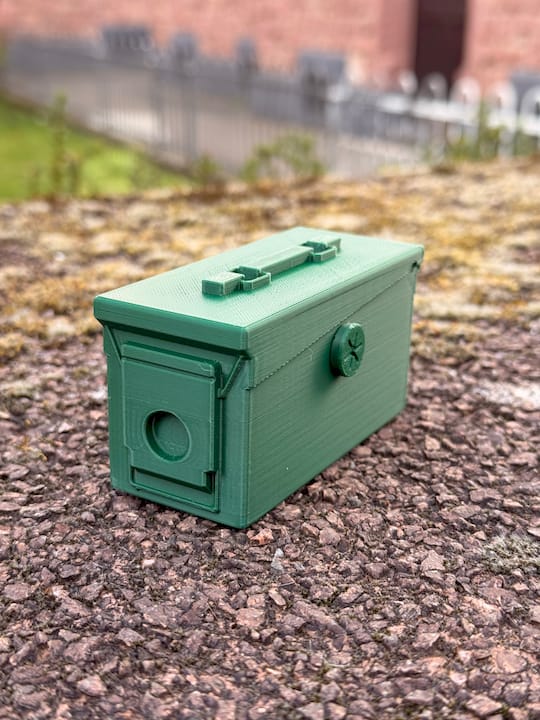
If you want to save time, Cachewerk offers ready-made solutions that significantly speed up DIY construction. The Geocaching Ammo-Box Trick Edition provides a weatherproof outer shell that you can immediately use as the outer shell in a double casing. The Starter Bundles with PETling, logbook, and mounting or suspension save you from ordering several parts individually.
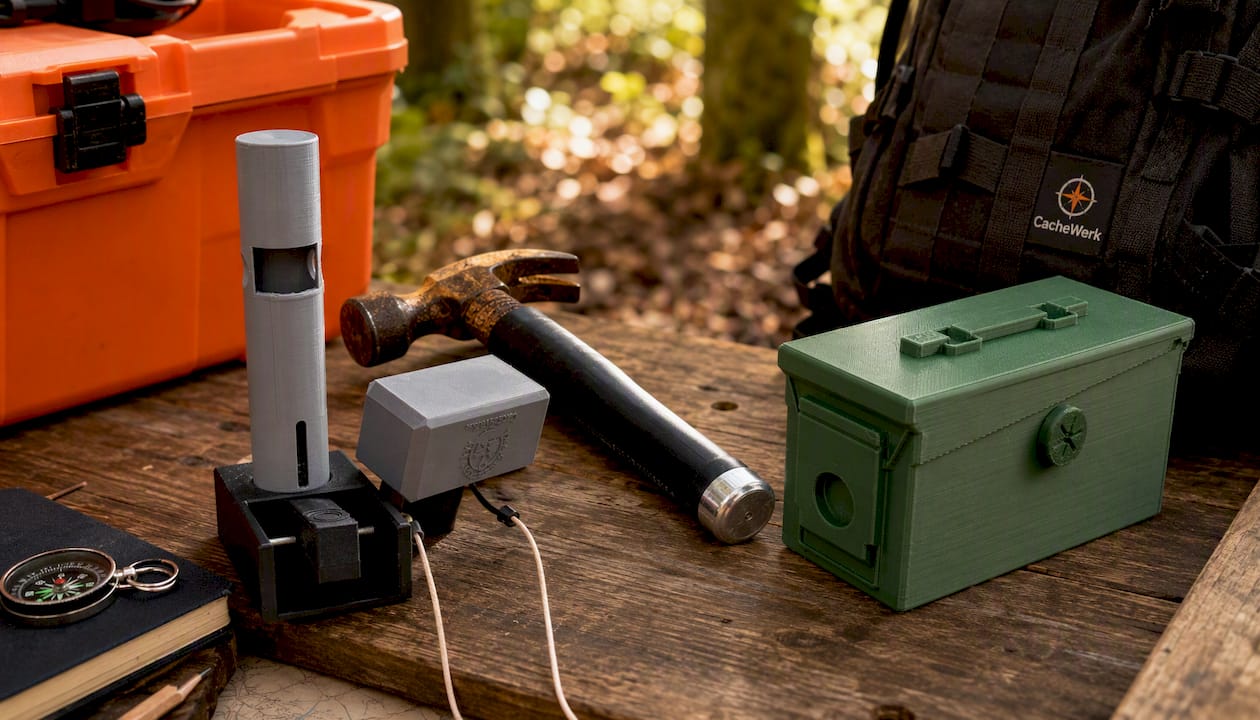
For urban final positions, the Rusty Bolt Cache is a clever camouflage solution that doesn't require its own casing. All products are available in Germany, with fast shipping and direct support. Check out the complete range at Cachewerk and start your next cache build with the right parts.
Sources
- DIY Building Instructions Key Box Simple Geocache building - MixiTV
- Geocaching
- A Sunset Cache — Arduino Craft Corner
- Blog post: The assembly — Stefan Michaelis
- Electronic Geocaches with long-lasting battery in DIY — heise
- Cryptex as Geocaching Container | stv0g’s weblog