
Micro vs. Regular Cache: The Geocaching Size Guide
You create a new cache and simply choose "Micro" because it's small. Sounds logical. But this is exactly where many problems in the geocaching community begin. The difference between micro and regular caches is greater than most people think, and false expectations on both sides lead to frustrated finders, poorly maintained logs, and ultimately archived caches. The community is currently creating a disproportionately large number of micro-caches, which creates new challenges and highlights the need for a true understanding of cache types in comparison. This guide clarifies the situation.
Table of Contents
- Fundamentals of Cache Sizes: Definitions and New Guidelines
- Functionality and Challenges: Micro vs. Regular Cache in Everyday Practice
- Creative Design and Stealth: How Micro and Regular Caches Influence Hides
- Expectation Management and Equipment: Why Accurate Cache Attributes Are Important
- Comparison Table Micro vs. Regular Caches: Features, Advantages, and Typical Challenges
- Our Perspective: Why Fewer Micro and More Regular Caches Enrich the Community
- Discover Exclusive Hides for Micro and Regular Caches at CacheWerk
- Frequently Asked Questions About the Difference Between Micro and Regular Caches
Fundamentals of Cache Sizes: Definitions and New Guidelines
Before we talk about pros and cons, we need a common language. And that changed in 2026.
Since April 2026, new guidelines apply for container sizes, clearly distinguishing between Micro and Regular. The definitions are now more precise than ever, which means: If you want to categorize your cache correctly, you need to know the new standards.
What is a Micro Cache?
A micro cache is a very small container. The logbook inside is so narrow that you can only write on it with a very thin pen or micrography. Many are familiar with classic film canisters, magnetic buttons, or small screw tubes. The crucial point: You cannot put a finger in and get it back out.
What is a Regular Cache?
A regular cache offers significantly more space. The new definition clearly states: You can put a finger into the container and pull it back out. This sounds simple, but it is a concrete, applicable criterion. This space is sufficient for a proper logbook, small SWAG items, and sometimes even trackables.
Here is a brief overview of typical container examples:
- Micro: Magnetic button, film canister, mini screw tube, key chain container
- Small (intermediate size): Small plastic containers, 100 ml containers
- Regular: Classic Tupperware, canning jars, 500 ml containers, ammo boxes (small)
- Large: Large ammo boxes, buckets, elaborate constructions
The new guidelines address a real community problem. Too many caches are created as "Micro" even though they are actually larger or should be. This distorts finders' expectations and harms the experience. You can find more about this in the Geocache Sizes Practical Check, where you will see concrete size comparisons and creative application examples.
Functionality and Challenges: Micro vs. Regular Cache in Everyday Practice
The differences in cache size directly affect your experience in the field. Here's what you need to know.
Micro-caches place higher demands on the finder. This starts with logging. Micro-cache logs must be specially rolled and inserted to avoid kinks and jamming. If you don't know this and just start writing, you damage the logbook for all subsequent finders. And a damaged log often means: maintenance needed, cache disabled, frustration for owners and finders.
Typical challenges with micro-caches in everyday use:
- The logbook is already full when found, simply because there isn't enough space.
- Moisture penetrates because the lid was not properly checked after closing.
- The pen brought along is too thick, and the log remains blank.
- Tweezers are missing to safely remove the rolled-up logbook.
- In winter: Frozen lid that cannot be opened.
Regular caches have these problems significantly less often. You can write in the logbook with a normal pen, exchange items, and comfortably pack everything back in. This is particularly family-friendly and makes geocaching more accessible for beginners. Furthermore, trackables fit inside, integrating the cache into a worldwide network. For a structured approach to finding caches, feel free to check out our Geocache Finding Workflow.
Pro Tip: Always roll up the logbook correctly in a micro-cache before closing the lid. Check the seal for tightness, especially after rain. A small tea-bag-sized silica gel packet inside significantly prevents condensation and extends the log's lifespan.
Creative Design and Stealth: How Micro and Regular Caches Influence Hides
Cache size doesn't just determine the logbook. It shapes the entire experience, from camouflage to puzzle design.

Micro-caches have an advantage in terms of camouflage. You can attach them to lampposts, wedge them into rock crevices, hide them under benches, or disguise them as deceptively real screws. This variety makes micro-caches ideal for creative small hides. But there's a downside: the more options a location offers, the longer finders search. A micro in a bush with a hundred branch stumps can become a test of patience.
Regular caches enable different creativity. You have space for mechanical puzzles, multiple layers of packaging, small surprises inside, and elaborate camouflage objects. A large ammo box that looks like an old stone causes real astonishment upon discovery. However, it is harder to hide and requires the right environment. In urban areas, a regular cache is often too conspicuous.
A remarkable example of creative micro-design: Spaceballs the Cache shows how a micro-cache can integrate exciting mechanics despite its tiny size. Here, the format was not seen as a limitation but as a design element.
“Small doesn’t mean simple.” This attitude is shared by the best cache designers worldwide.
For decision-making: Which size fits where?
- Urban environment: Micro wins with inconspicuous camouflage objects and low muggle risk
- Forest and nature: Regular offers more possibilities for complex puzzles and SWAG exchange
- Playgrounds and family areas: Regular is more accessible and exciting for children
- Climbing routes and hard-to-reach places: Micro is easier to transport and attach
For even more inspiration on design possibilities, we recommend our creative cache design ideas, which present both sizes with concrete examples.
Expectation Management and Equipment: Why Accurate Cache Attributes Are Important
You've built the perfect cache. But if finders arrive without the right equipment, all the effort was for nothing.
Attributes help the community find suitable caches and improve the finder experience through transparent expectations. Those who label their micro-cache with the attribute "tweezers recommended" or "micro-pen only" save finders and themselves a lot of trouble.
Which attributes are particularly relevant for micro and regular caches?
- "Small container size": Indicates that a normal pen won't fit
- "Tweezers recommended": Important for rolled-up logs in narrow tubes
- "SWAG available": Only makes sense for regular or larger
- "Suitable for children": Often better suited for regular caches
- "Special equipment needed": Honest warning for challenging hides
- "Winter-friendly": Especially relevant for micro-caches in metal containers
The difference between a good and a bad cache listing often lies in the detail of the attributes. Geocachers who log regularly and use attributes receive significantly more positive feedback. And finders come prepared.
Pro Tip: Check your attributes at least twice a year. Especially after seasonal changes, a container change, or after community feedback, you should update your listing. An outdated attribute is almost worse than none, because it actively sets false expectations.
In the Geocache Size Practical Check, you will find a practical overview of which attributes fit which cache size well and how to make your listing truly helpful.
Comparison Table Micro vs. Regular Caches: Features, Advantages, and Typical Challenges
The size definitions and typical community challenges in 2026 are now clearly distinguishable. This table provides a quick overview.
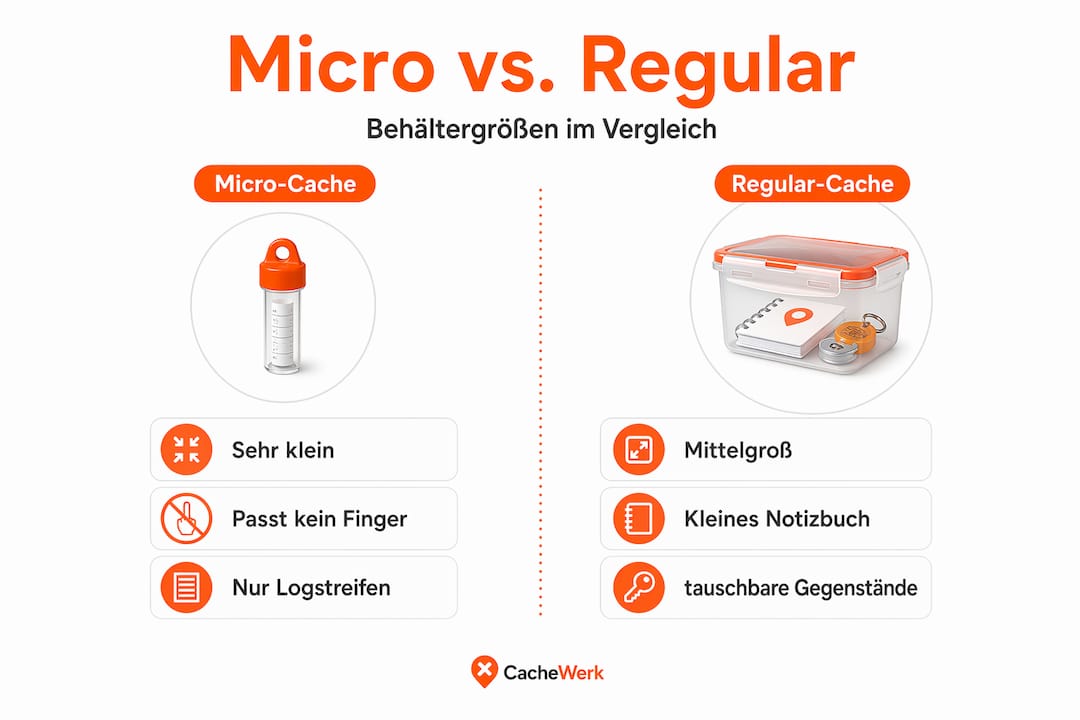
| Feature | Micro Cache | Regular Cache |
|---|---|---|
| Container Size | Very small (no finger fits) | Medium to large container (finger fits) |
| Logbook Format | Narrow, rolled, micro pen needed | Normal notebook format, standard pen suitable |
| SWAG/Trade Items | Not possible | Easily possible |
| Trackables | Not suitable | Ideal |
| Camouflage | Very good, inconspicuous | More difficult, requires more space |
| Urban Suitability | High | Medium to low |
| Family-Friendliness | Low (fine motor skills needed) | High |
| Maintenance Effort | Higher (logs fill quickly) | Lower |
| Equipment Required | Special (tweezers, micro pen) | Standard (normal pen) |
| Creative Potential | High for small puzzles | High for complex mechanics |
| Typical Problems | Moisture damage, full logs | Muggle risk, harder to hide |
| Recommended Environment | Urban, rock, fixed structures | Forest, meadows, secluded locations |
For a more detailed analysis of both cache types in real-world use, it's worth taking a look at our comparison of Geocache Sizes.
Our Perspective: Why Fewer Micro and More Regular Caches Enrich the Community
Here, we're talking plain language, even if not everyone likes to hear it.
Coco Lores emphasizes the community trend towards micro-caches and the growing desire for more regular caches. And we fully share this assessment. The dominance of micro-caches is not a sign of creativity, but often the opposite. Micro is easy. You take a magnetic container, stick it under a bench, and you're done. That costs little time, little material, and little thought.
The problem only arises when everyone thinks the same way. If 80 percent of new caches are micro, geocaching loses its character. The search becomes routine. Finders already know when they start: probably another small container under something. The element of surprise is missing.
Regular caches require more effort, but they also give back more. A well-designed regular cache with a thoughtful logbook, small SWAG surprises, and exciting camouflage remains in the finder's memory. They get a "wow" instead of a quick "found, logged, moved on."
Our recommendation to all cache owners: Look at your last cache placement. Why did you choose micro? If the honest answer is "because it was easier," then now is a good time for a regular. The new 2026 guidelines help make the size selection more conscious.
This doesn't mean that micro is bad. Quite the opposite. A truly creatively designed micro-cache that blends into the environment and hides a clever mechanism is something special. But it requires the same effort and love as a large cache.
The solution lies in variety. If you, as an owner, alternate between micro and regular, between simple and complex, between urban and rural, then you offer the community something that truly brings joy. For this, we also recommend looking at traditional vs. creative caches to get a broader picture of what is possible today.
Discover Exclusive Hides for Micro and Regular Caches at CacheWerk
You now know exactly what distinguishes a micro from a regular and what strengths both bring. Now comes the exciting part: implementation.
At CacheWerk, you'll find Special Hides for Micro and Regular Caches that were developed precisely for these requirements. Whether deceptively real screws for urban micro-caches, weather-resistant containers for forest regulars, or unusual 3D-printed special objects made of PETG for demanding hides: The assortment covers both worlds. Every product is designed to make your geocaching adventure a bit more special. Also, check out our creative cache design ideas and get inspired for your next hide.
Frequently Asked Questions About the Difference Between Micro and Regular Caches
What exactly distinguishes a micro cache from a regular cache?
Micro caches have a logbook that can only be written on with fine handwriting, while regular caches are larger, offer a normal logbook, and provide enough space for SWAG or trackables.
Why are so many new caches currently being created as micro?
The vast majority of new caches are micro, as the effort involved is lower. The updated 2026 guidelines aim to counteract this and promote more regular caches in the community.
What equipment is typically needed for micro caches?
Micro caches often require micro-writing or thin pens, and sometimes tweezers to safely remove and sign the rolled-up logbook.
How can a cache owner choose the right cache size?
The owner chooses the cache size according to terrain and community guidelines, and clearly communicates the choice via attributes in the listing so that finders arrive prepared.