
Nano Caches Explained: Tips for Creative Adventures
TL;DR:
- Nano-caches are extremely small containers under 10 ml volume, usually with magnetic attachment.
- They are mainly hidden in urban areas on metallic surfaces.
- Maintenance and special tools are essential for logging and care.
Nano-caches are considered the smallest and at the same time most fascinating challenge in geocaching. Many geocachers believe that this is its own official category. This is not true. In fact, nano-caches are described as extremely small containers with less than 10 ml volume, mostly appearing as tiny metal tubes. Those who hold them for the first time are often surprised at how small these things really are. In this article, you will learn everything about the definition, structure, creative uses, and practical tips that will make your next nano-cache hunt a success.
Table of Contents
- Definition and Classification of Nano-Caches
- Materials, Construction, and Mechanisms of Nano-Caches
- Locations and Creative Hiding Spots
- Practical Tips for Maintenance, Finding, and Logging Nano-Caches
- Personal Perspective: Why Nano-Caches Revolutionize Urban Geocaching
- Discover Nano-Caches and Creative Geocaching Solutions at CacheWerk
- Frequently Asked Questions about Nano-Caches
Key Insights
| Point | Details |
|---|---|
| Nano-Cache Definition | Nano-caches are particularly small containers, usually under 10ml, ideal for creative hiding places. |
| Classification as Micro | On Geocaching.com, nano-caches must be listed as micro, as there is no separate category. |
| Technology and Materials | Typical are metal tubes with screw caps, O-rings, and magnets for attachment. |
| Practical Tips | Regular maintenance, targeted hints, and tools like tweezers facilitate handling and finding. |
| Enable Creative Hiding | Nano-caches open up urban adventures through innovative camouflage and flexible placement. |
Definition and Classification of Nano-Caches
A nano-cache is a geocache container with an extremely small volume, usually less than 10 ml. That sounds abstract, but imagine a metal tube barely larger than a screw. Inside it, there's a tiny log strip; nothing more simply fits. No trade items, no pen, just paper and magic.
Officially, nano-caches on Geocaching.com are listed as micro-caches because there isn't a dedicated nano category. This regularly leads to confusion in the community, as a classic micro-cache can be somewhat larger and even contain a small pencil. Nano-caches, on the other hand, are so compact that even removing the log strip becomes a dexterity exercise.
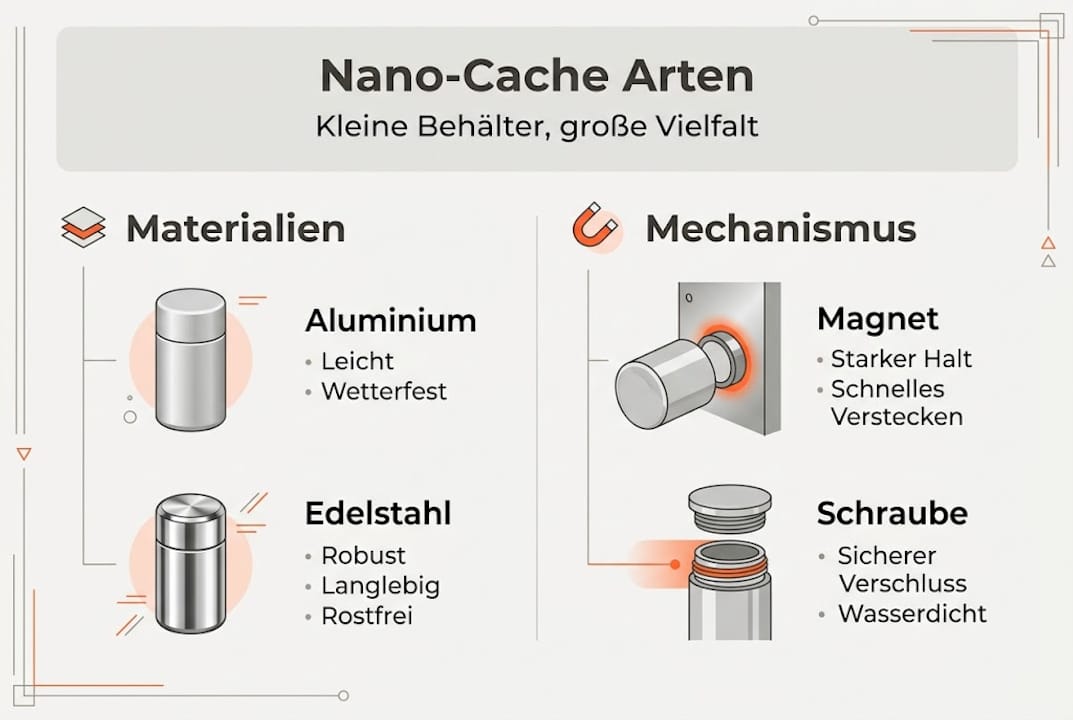
In the geocaching community, there has been a debate for years about a separate category for nano-caches, as they present specific challenges that normal micro-caches do not. The discussion is understandable, because anyone who has ever searched for a nano-cache knows that it is a completely different experience than finding a film canister micro.
Here's a quick overview of the official cache sizes in comparison:
| Size | Volume (approx.) | Typical Content |
|---|---|---|
| Nano | under 10 ml | Log strip |
| Micro | 10 to 100 ml | Logbook, small pen |
| Small | 100 ml to 1 l | Logbook, small trade items |
| Regular | 1 l to 20 l | Logbook, trade items |
| Large | over 20 l | Logbook, many trade items |
Key features of a nano-cache at a glance:
- Volume under 10 ml, often only 2 to 5 ml
- Material mostly metal, rarely plastic
- Content exclusively a thin log strip
- Attachment frequently with integrated magnet
- Camouflage inconspicuous due to small size and metallic surface
"Nano-caches present even experienced geocachers with real challenges, because their size and camouflage require a completely new search strategy." Geocaching Community
Materials, Construction, and Mechanisms of Nano-Caches
Now that the definition is clear, let's look at what nano-caches are actually made of. The classic design is simple yet well-thought-out. A screw-top with an O-ring, magnetic base, and thin paper as a log strip is the standard. The O-ring provides a certain seal against moisture, even if nano-caches are not completely waterproof.
The casing is usually made of aluminum or stainless steel. Aluminum is lighter and cheaper, while stainless steel is more robust and durable. Both variants are justified, depending on where the cache is placed. Stainless steel makes more sense in a damp location, while aluminum is perfectly sufficient indoors in dry environments.

The magnet is the real core of many nano-caches. It allows the cache to be attached to metallic surfaces without using glue or screws. This makes placement quick, flexible, and residue-free. Popular attachment points include metal benches, fence posts, lampposts, and signs. The magnet is either integrated directly into the bottom of the tube or glued on as a separate element.
Here's a comparison of the most common materials:
| Material | Weight | Durability | Price | Recommendation |
|---|---|---|---|---|
| Aluminum | very light | medium | cheap | Dry locations |
| Stainless steel | medium | very high | medium | Damp locations |
| Plastic (PETG) | light | high | variable | Custom designs |
The log strip is printed on thin paper and rolled into a tight coil. Some geocachers also use parchment paper, which is a bit more resistant to moisture. A small metal scroll or a thin metal sleeve holds the strip together and makes it easier to pull out.
For creative ideas for urban hiding places, it is worth trying out various construction variants. Some geocachers combine the nano-cache with a deceptively real screw or a fake rivet to perfect the camouflage.
Pro-Tip: When rolling the log strip, use a thin toothpick end as a winding aid. This keeps the strip tightly rolled and makes it easier to insert and remove from the tube.
Locations and Creative Hiding Spots
After understanding the construction and mechanics, let's look at practical application. Nano-caches are particularly popular for urban hides on benches, fences, or signs, because they blend seamlessly into the cityscape. Muggles, i.e., non-geocachers, simply don't notice them.
This is the decisive advantage in so-called high-muggle areas. These are places with many people where searching for a cache quickly attracts attention. A nano-cache on a lamppost or a park bench can be found and logged in seconds without anyone noticing anything.
Typical locations for nano-caches:
- Street furniture: Metal benches, bicycle racks, railings
- Infrastructure: Lampposts, traffic signs, bridge railings
- Nature: Metal fences at the edge of the forest, metal posts on hiking trails
- Buildings: Metal frames on doors, window grilles, drainpipes
- Public spaces: Monuments with metal parts, fountain edges
It gets particularly creative when the nano-cache is used as part of a multi or mystery cache. As an intermediate station in a puzzle cache, it provides the next coordinate or a code. This increases the excitement and makes the nano-cache more than just another smiley.
Statistic: An estimated over 30 percent of all urban caches in large cities are micro or nano caches because they are the least conspicuous and easiest to place.
For urban cache hiding spots, the more inconspicuous, the better. A nano-cache that looks like a screw is significantly harder to find than a nano-cache that is simply stuck to a post.
Pro-Tip: Make the hint in the listing as precise as possible without revealing the cache. Instead of "on a post," write "Look closely at what shouldn't be screwed down." This is fun and also helps with real search problems.
Practical Tips for Maintenance, Finding, and Logging Nano-Caches
From creative hiding to finding and maintaining, the focus now shifts to everyday use. Nano-caches require more maintenance than larger caches. The log strip fills up quickly, and regular maintenance is recommended to keep the cache active and accessible.
How often you should maintain it depends on the visit frequency. A nano-cache in a popular city square can be full within a few weeks. So plan from the beginning to change the strip every four to eight weeks.
Here's how to proceed with maintenance:
- Locate the cache and discreetly open it without attracting attention from muggles.
- Remove the log strip with fine tweezers or a thin tool.
- Check the strip for moisture, mold, or damage.
- Insert a new strip, tightly rolled and labeled with the date.
- Inspect the O-ring and lightly grease it with silicone grease if necessary.
- Close the cache and check the magnet's seating.
Nano-caches are not completely weatherproof, the log can jam, and in cold weather, the metal contracts, making it difficult to open. In winter, it is advisable to warm the cache slightly before attempting to open it. Hand warmth is usually sufficient.
Tools you need for searching and logging:
- Tweezers: Indispensable for pulling out the log strip.
- Thin pen or needle: For signing the log strip.
- Flashlight: For poor lighting conditions or hidden spots.
- Silicone grease: For maintaining the O-ring.
- Spare log strips: Always have a few on hand.
For special logs, you can also use geocaching stickers for logs, which make your entry individual and recognizable, even if space is very limited.
Pro-Tip: Clearly state in the listing that tweezers are helpful. This significantly reduces DNF (Did Not Find) logs and ensures satisfied finders. Those who come unprepared often have no chance of getting the strip out.
Personal Perspective: Why Nano-Caches Revolutionize Urban Geocaching
Nano-caches polarize. Some geocachers find them frustrating because the log strip is so tiny and the tools are missing. Others love precisely this challenge. Our experience shows that nano-caches are innovation drivers in urban areas, because they force geocachers to think creatively.
The community is sometimes unfairly skeptical. "Too small, too fiddly, not worth talking about" is heard more often. But anyone who finds a truly well-camouflaged nano-cache after 20 minutes of searching knows why the feeling of reward is so strong. It's not about size, but about cleverness.
Nano-caches enable adventure and demand creativity in hints and tools. It is precisely the creative hint design that makes the difference between a good and a great nano-cache. Anyone who designs their hint as a small puzzle gives the finder a real experience, not just a GPS coordinate.
Our tip: Combine the nano-cache with an exciting story in the listing. This makes even the smallest cache unforgettable.
Discover Nano-Caches and Creative Geocaching Solutions at CacheWerk
You are now well informed about nano-caches. Now all that's missing is the right accessories to build or find your own. At CacheWerk, you'll find exactly what you need.
From high-quality nano-cache tubes to magnetic attachments and creative camouflage solutions, CacheWerk offers everything for ambitious geocachers. Browse through the Geocaching Equipment and get inspired. Those looking for particularly unusual ideas will find what they're looking for among the special hiding spots. Quality, creativity, and passion for geocaching – that's CacheWerk.
Frequently Asked Questions about Nano-Caches
What is a Nano-Cache in Geocaching?
A nano-cache is a small container with a log strip, usually under 10 ml volume and typically a small metal tube with an integrated magnet for attachment to metallic surfaces.
How is a Nano-Cache officially classified?
Nano-caches are listed as micro on Geocaching.com, as there is no separate nano category and they officially fall under the micro-cache size.
What's the best way to find and log a Nano-Cache?
Use precise hints in the listing, bring logging tools like tweezers, and ensure the cache is regularly maintained so the log strip remains accessible.
Where can you buy nano-cache accessories?
Special nano-cache solutions and matching accessories can be found directly in the CacheWerk shop under Equipment and Special Hides, tailored to all requirements in urban and rural geocaching.