
Options for Illuminated Cache Hides: Shedding Light on the Darkness
Options for illuminated cache hides fall into three main categories: photoluminescent materials, electronic LED systems with microcontrollers like Arduino, and wired installations with external power. The right solution depends on the desired effect, the location, and, most importantly, the maintenance effort. Especially for night geocaching, the choice of lighting determines whether a cache delights or frustrates. Strontium aluminate pigments, LED modules, and weatherproof enclosures are the most important tools in the repertoire of creative cache builders.
1. Photoluminescent Materials: Maintenance-Free and Effective
Photoluminescent pigments are the simplest and lowest-maintenance lighting solution for cache hides. They store daylight and emit it in the dark as a greenish or blue-turquoise glow. No battery, no electronics, no failure.
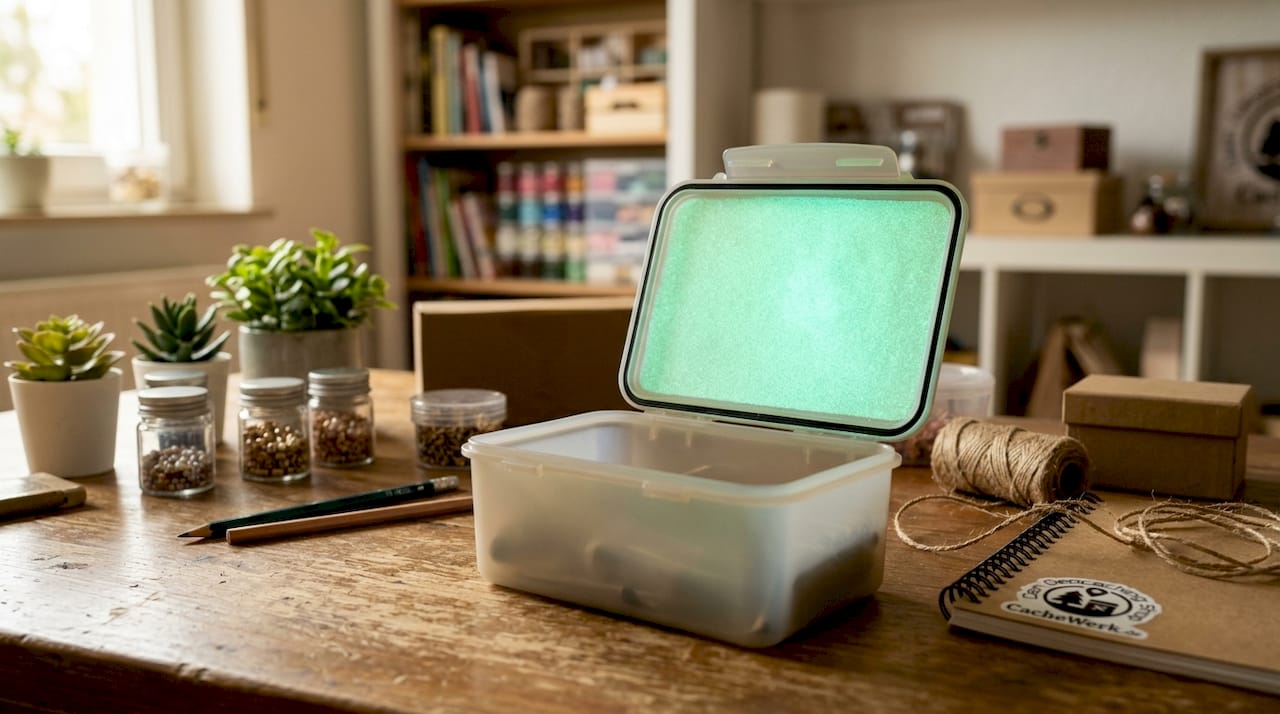
The functionality is incredibly simple: the material charges in daylight or under a UV lamp. After about 2 minutes of charging, it reaches its maximum brightness. This luminosity remains visible for 6–8 hours as an orientation light. That’s enough for any night search.
Photoluminescent pigments are suitable for cache hides in several forms:
- As powder mixed into clear varnish or clay paint and applied directly to the cache
- As ready-to-use luminous paint on plastic, wood, or metal
- As self-adhesive luminous strips for quick markings
- As a coating on signposts or coordinate boards
The costs are low. A small jar of luminous pigment is enough for several caches. However, quality is important: strontium aluminate pigments glow significantly brighter and longer than cheap alternatives. They are also not radioactive, which was not a given with older luminous paints.
Pro Tip: Mix the pigments directly into a waterproof clear varnish. This combination not only improves weather protection but also noticeably extends the glow duration of the applied layer.
For sustainable cache hiding, this method is particularly attractive: no special waste, no batteries, no electronics that eventually fail.
2. Electronic LED Solutions for Interactive Cache Experiences
LED-based cache hides with microcontrollers are the most technically exciting category. They enable light games, puzzles, and interactive effects that photoluminescent materials simply cannot offer. The price for this is higher construction effort and regular maintenance.
The basic components of an electronic cache are manageable:
- Microcontroller (e.g., Arduino Nano or ATtiny85)
- LEDs or small LED strips
- Sensors: vibration switches, magnetic sensors, or light sensors
- Power supply: CR2030 coin cells, AA batteries, or rechargeable batteries
- Weatherproof enclosure made of ABS plastic or similar material
Electronic geocaches with microcontrollers offer interactive light displays that are activated by a sensor. This significantly increases the fun of the game, but also increases the maintenance effort. Anyone who doesn't factor this in will quickly experience a cache with a dead battery and disappointed seekers.
The crucial design principle for LED caches: do not let the lighting burn continuously, but only switch it on as part of the puzzle when activated. This saves battery life and makes the light effect the actual experience. A magnetic trigger or a flashlight sensor are proven solutions for this.
Concrete ideas for interactive light caches:
- Morse Code Blinker: The cache blinks a cryptic coordinate or a solution word after activation.
- Color Code Puzzle: Three LEDs in different colors blink in a sequence that the seeker must decipher.
- Reaction Game: A button must be pressed at the right moment when the green LED lights up.
- Light Path: Several small caches with LEDs lead one after another to the main hide.
Pro Tip: A well-camouflaged enclosure protects the electronics from moisture and vandalism. Insect hotels, resin tree stumps, or concrete stones are proven housings for electronic caches. Intuitive operation is just as important as the technology itself.
Battery life depends heavily on the design. A cache that only lights up for 30 seconds when activated will last significantly longer with a CR2032 cell than a continuous burner. The redundancy principle applies here: hidden activation saves batteries, reduces incorrect operation, and protects against vandalism.
3. Wired Installations: Permanent, but Complex
Wired cache hides are the most complex category. They require an external power source, often via a cable from a nearby building or via solar panels with a battery. In return, they offer permanent visibility and can even operate heaters or fans to control moisture.
Wired, permanently illuminated caches can run for several years without loss of function. That sounds tempting. The downside: maintenance is necessary after almost every visit, due to moisture, technology, and use. Such projects require a dedicated owner team that is regularly on site.
Advantages of wired solutions:
- Permanent illumination without battery changes
- Possibility for complex electronics with displays, loudspeakers, or air conditioning
- High operational reliability with professional installation
- Ideal for multicaches with several interactive stations
Disadvantages you should be aware of:
- High installation effort and often requires permits
- Dependence on the power source (failure, cable damage)
- Intensive maintenance, especially in outdoor conditions in winter
- Not feasible everywhere, especially in nature reserves
For solar solutions, a high-quality lead-acid battery like the Sonnenschein A512 is recommended, which is designed for continuous outdoor operation. Cheap batteries often fail after a few weeks in freezing temperatures. This is simply not an option for continuous outdoor operation.
4. Comparison: Photoluminescence vs. LED vs. Power Supply
This overview shows which lighting solution is suitable for which cache:
| Criterion | Photoluminescence | LED with Microcontroller | Wired |
|---|---|---|---|
| Maintenance effort | very low | medium | high |
| Costs | low | medium | high |
| Luminosity duration | 6–8 hours | demand-controlled | permanent |
| Technical knowledge required | no | yes | yes, significantly |
| Weather resistance | good (with clear varnish) | good (with housing) | complex |
| Interactivity | none | high | very high |
| Sustainability | very good | good | medium |
The choice depends on the cache type. A simple night cache in a forest area benefits most from photoluminescent markings. A mystery cache with puzzle elements gains from LED interactivity. Only for very elaborate adventure caches with permanent visitor guidance is the effort of a wired installation worthwhile.
Combinations are conceivable. A cache can use photoluminescent markings for navigation and simultaneously use LED activation for the final "aha" moment. This is often the smartest solution: low-maintenance in basic operation, spectacular at the goal.
Pro Tip: For LED caches, choose lithium batteries instead of alkaline cells. Lithium lasts significantly longer in the cold, making it the more reliable choice for outdoor use.
5. Creative Lighting Scenarios for Unforgettable Cache Experiences
Light in the cache is more than a navigational aid. It can be the central puzzle element. The best illuminated geocaching hides use light as a game mechanic, not as decoration.
Here are concrete ideas you can implement directly:
- Secret UV Message: Invisible text with UV luminous paint on the logbook or the container. Only readable with a UV flashlight. The seeker must bring the right tool.
- Blinking Signpost: A small LED under a tree root blinks every 10 seconds. Those who look closely will find the direction to the next clue.
- Light Code Puzzle: After magnetic activation, the cache sends a sequence of blinking signals. The number of blinks reveals the coordinates of the final.
- Miniature String Lights: A battery-operated micro string light inside a hollow tree stump makes the find a real "wow" moment.
- Color Change as Confirmation: An RGB LED changes from red to green after successful opening. Simple but effective.
Such lighting effects are particularly well-suited for internal company treasure hunts or group events. Teams react more strongly to visual stimuli than to pure text clues. This also makes illuminated caches attractive for team-building events.
Important for all creative lighting solutions: operation must be intuitive. A puzzle that only works with an instruction manual frustrates more than it excites. Less is often more. A single, well-placed light effect remains in memory longer than five overloaded game mechanics.
6. Night Geocaching: Tips for the Safe Use of Light
Night geocaching has its own rules. Light helps in finding, but can also attract muggles or disturb nature. Anyone planning illuminated caches for the night should know a few basic principles.
Safety first. Mark the path to the cache with photoluminescent dots on trees or stones, but only where permitted. Avoid glaring continuous lights that disturb animals or draw the attention of residents. Discreet is better than spectacular.
For cache maintenance: check batteries and luminous pigments at least every 3 months. Moisture is the biggest enemy of all outdoor lighting solutions. Sealing rings, silicone sealant, and weatherproof housings are not optional extras, but mandatory.
Plan the cache so that it also works without light. Batteries die, pigments fade. A cache that relies exclusively on light will eventually be logged as "not found". That is annoying for everyone involved.
Key Takeaways
The best lighting solution for a cache is the one you can maintain long-term.
| Topic | Details |
|---|---|
| Photoluminescence as an introduction | Strontium aluminate pigments with clear varnish are maintenance-free and glow for 6–8 hours. |
| Plan LED caches carefully | Activation-based LEDs save batteries and significantly increase the fun of the game. |
| Wired caches only with a team | Continuous operation requires intensive maintenance, often after every visit. |
| Combination as the smartest choice | Photoluminescence for pathfinding plus LED for the final effect is often the best solution. |
| Don't underestimate maintenance | The maintenance effort determines the success of an illuminated cache more than the technology. |
My Honest Assessment After Years with Illuminated Caches
I have seen many illuminated caches that were built with great enthusiasm and stopped working after three months. This is rarely due to the technology. It is almost always due to underestimating the effort required for maintenance.
Photoluminescent solutions are the more realistic entry point for most geocachers. They work reliably, cost little, and require no technical knowledge. Once they've gotten a taste for it, they can take the next step with a simple Arduino project.
For electronic caches, I recommend a clear principle: don't build anything you can't repair in 20 minutes. Complex systems with many components are impressive, but they also fail more often. And a failed cache is not a good cache.
Wired installations are simply too complex for most individuals. This is not a judgment, but a realistic assessment. Anyone who has an owner team and the necessary time can create extraordinary experiences with it. Everyone else is better off with the first two categories.
My personal favorite remains the combination: photoluminescent markings for the path and a single, well-placed LED effect for the moment of finding. This is low-maintenance, effective, and genuinely fun.
— Benedikt
Suitable Hides for Your Lighting Project at Cachewerk
If you're now inspired to build an illuminated cache, you'll need the right enclosure as a foundation.
Cachewerk offers a selection of hides that are particularly well-suited for lighting projects. The Geocaching Ammo-Box Trick Edition offers enough space for electronics and is weatherproof enough for continuous operation. The Mini Birdhouse Hide is ideal for small LED installations or photoluminescent coatings. If you're just starting out, the Starter Bundle 2 contains everything you need for your first cache, including a logbook and hanger. All products can be found directly in the Cachewerk Shop.
FAQ
What are the best lighting options for cache hides?
Photoluminescent pigments based on strontium aluminate are the lowest-maintenance solution and glow for 6–8 hours without electricity. For interactive effects, LED systems with Arduino microcontrollers offer the greatest flexibility.
How long do photoluminescent cache hides glow?
After about 2 minutes of charging from daylight or a UV lamp, the luminosity remains visible for 6–8 hours as an orientation light. The exact duration depends on the pigment quality.
How do I protect LED electronics in the cache from moisture?
A weatherproof ABS plastic enclosure with a sealing ring is mandatory. Silicone sealant at cable entries and the use of lithium batteries instead of alkaline cells significantly increase reliability outdoors.
How often do I need to maintain an illuminated cache?
That depends heavily on the type. Photoluminescent caches require little maintenance, while LED caches should be checked every 3 months. According to experience reports from 2026, wired installations sometimes require maintenance after almost every visit.
Are illuminated cache hides suitable for beginners?
Photoluminescent solutions are also well suited for beginners, as they require no technical knowledge. Electronic LED caches with Arduino require basic knowledge of electronics and programming.