Outdoor card game cases: Which protection really lasts

For regular outdoor gaming, completely waterproof plastic cards are the safest choice because they withstand moisture, sand, and dirt without the need for sleeves. For occasional rounds at the beach or the campsite, robust PP or PET sleeves combined with a hard transport case are perfectly sufficient. Both methods protect edges, keep moisture out, and are easy to clean. Matching components for both options are available in our assortment.
In short:
- Waterproof PVC cards offer the best protection during prolonged contact with water and usually do not require additional protection.
- For occasional use at the beach or campsite, PP or PET sleeves combined with a sturdy box are sufficient to ensure edge protection and moisture resistance.
- The right sleeve size is crucial: a card must fit exactly, with a 1 to 2-millimeter buffer for movement to avoid wear and tear.
- For longer periods of direct sunlight or heat, plastic sleeves with a thickness of 100 microns or more should be chosen, as thinner materials become brittle more quickly.
- Moisture can get trapped in sealed sleeves, which is why it is important to dry cards well before packing them to prevent mold or clouding.
Table of contents
- Overview: Sleeve and protection types for outdoors with Outdoor Card Game Sleeves
- Understanding materials and protective features: PVC, PP, PET, and laminate
- Formats, fit, and special cases: Round, square, Tarock
- How do I pack cards for outdoor use correctly and clean them afterwards?
- Why experience from the geocaching field helps with card protection
- How much damage does direct sunlight cause to outdoor card sleeves?
- Can card sleeves trap moisture instead of keeping it out?
- How do card sleeves react to outdoor heat and cold?
- How long do outdoor sleeves really last with regular use?
- Which sleeves and materials are best suited for outdoors?
- Three ready-made outdoor setups based on frequency of use
- Suitable products at Cachewerk for your outdoor card protection
- Sources
- FAQ
Overview: Sleeve and protection types for outdoors with Outdoor Card Game Sleeves
Before deciding on a solution, it is worth looking at the three basic types. They differ not only in material, but also in how much protection they actually offer and what they are intended for.
Completely waterproof plastic cards consist entirely of PVC or a similar synthetic material. They do not need an additional sleeve because the material itself acts as the protection. Waterproof playing cards made of PVC are therefore ideal for the pool, beach, or camping, where cards regularly come into direct contact with water.
Transparent sleeves made of PP or PET protect regular paper or plastic cards from the outside. They are the right choice if you want to keep using your existing card game instead of buying completely new cards.
Laminated cards lie in between: a thin protective layer makes them more resistant to moisture without being completely waterproof.
For transport, you usually need more than just a sleeve:
- Beach and pool: waterproof cards without a sleeve, plus a small waterproof box to protect against sand
- Camping and hiking: PP sleeves plus a hard case to protect against pressure in the backpack
- Festivals: robust transport box with compartments for several card games at once
- Rainy tours: completely waterproof cards, as sleeves reach their limits in persistent rain
A hard case complements any sleeve solution because it provides extra protection against bending and edge damage during transport.
Understanding materials and protective features: PVC, PP, PET, and laminate
The material specification in the shop says more about the actual protection than any marketing claim. Three plastics dominate the card protection market, and they perform very differently.
PVC is the classic choice for genuine water resistance. Cards made of this material can be rinsed under running water and dry quickly afterwards, as providers of waterproof playing cards confirm. PP (polypropylene) is the standard for protective sleeves because it remains flexible, robust, and relatively thin. PET or PETG is used more for 3D-printed boxes and inserts because it is dimensionally stable and can be manufactured precisely.
A detail many buyers overlook: the term "weatherproof" does not automatically mean "waterproof." A splash-proof sleeve keeps out brief rain but fails if the cards are left in water for a longer period.
Pro Tip: Always check the sleeve's thickness in microns (µ). Anything under 80 microns may seem cheap, but it will tear much faster with frequent shuffling.
There are also differences in UV and abrasion resistance: PP handles sunlight better than thin PVC, which can become brittle over time.
- PVC: 100% waterproof, ideal for water contact, slightly stiffer to handle
- PP: flexible, acid-free, good for long-term storage of collectible cards
- PET/PETG: dimensionally stable, usually processed into printed boxes rather than used as sleeves itself
Formats, fit, and special cases: Round, square, Tarock
The wrong size is the most common mistake when protecting cards. A sleeve that is too large allows the card to slip, while one that is too small presses on the edges and accelerates the exact wear it is supposed to prevent. A community discussion on protecting round cards shows how often this problem arises with unusual formats.
Here is how to find the right size:
- Measure the width and height of the card exactly, not just with a rough estimate.
- Add 1 to 2 millimeters of buffer for the sleeve so that the card can still move slightly.
- Compare the result with common standard formats like 66×91 mm, 44×68 mm, or square 69×69 mm.
- For Tarock cards, it is worth looking at specially manufactured boxes with matching interior dimensions, as Tarock formats differ from standard Skat cards.
- For round or square special shapes like Dobble, a slightly thicker inner layer or foam inlay helps prevent slipping.
You should always compare manufacturer specifications for interior dimensions with the actual card size before purchasing, rather than blindly trusting the product description.
How do I pack cards for outdoor use correctly and clean them afterwards?
Good protection begins before the first game and doesn't end when the cards go back into the bag. Three phases are crucial.
Before use: Store cards dry and at room temperature, check sleeves for tears, and always pack one or two spare sleeves. If you are out and about a lot, you should check out types of outdoor cache boxes to find a suitable storage system.
During the game:
- Never place drinks directly over the laid-out cards.
- Shake off sand and dust before packing rather than trapping it in the sleeve.
- Do not place cards on wet ground or damp tables, even for a moment.
After the game: Wipe sleeves with a dry cloth, allow cards that have become damp to air-dry carefully rather than in the sun, then store in a dark, dry place.
Pro Tip: Never let waterproof cards dry in direct sunlight after rinsing. Quick drying in the shade protects both the print and the material.
Why experience from the geocaching field helps with card protection
Weatherproof protection has been part of everyday life in geocaching for years: logbooks, PETlings, and containers must withstand rain, frost, and sun without the contents suffering. This exact mindset can be applied one-to-one to outdoor card games.
Author Benedikt incorporates this practical experience from numerous tutorials and blog posts on weatherproof hides directly into his recommendations for card protection. A compact, waterproof container is well-suited for a small card game on the go. The crossbody bag for geocachers solves the transport problem when sleeves, boxes, and spare cards need to reach their destination together.
For a complete camping or geocaching set, it is best to combine a waterproof sleeve for the cards themselves with a sturdy box for transport and a bag for the rest of your equipment.
How much damage does direct sunlight cause to outdoor card sleeves?
UV radiation is the most inconspicuous enemy of outdoor card games because it does not cause immediately visible damage. After hours on the beach or on a camping table, sunlight fades printed material and makes many plastics brittle over time.
PP sleeves generally withstand UV exposure better than very thin PVC films because the material becomes brittle less quickly. With daily outdoor use, such as multi-day geocaching tours, the difference is clear: a high-quality sleeve remains pliable, while an inferior one develops fine cracks at the edges.
Anyone who frequently leaves cards directly in the sun instead of packing them away between rounds shortens the lifespan of every sleeve, regardless of the material. A simple rule helps: put the card game back in its sleeve or box after the round, rather than leaving it out on the table while the group takes a break.
Completely waterproof PVC cards are more robust against short-term UV exposure than thin sleeves because the material is thicker and more homogeneous. However, even PVC loses flexibility with permanent, intensive sunlight over many weeks of the year. A transport box stored in a dark place between rounds significantly extends the lifespan of any material, regardless of which sleeve you use.

Can card sleeves trap moisture instead of keeping it out?
One effect surprises many buyers: a sleeve that seals too tightly can trap moisture instead of keeping it out. If condensation or residual moisture is trapped between the card and the sleeve, it can hardly escape without ventilation.
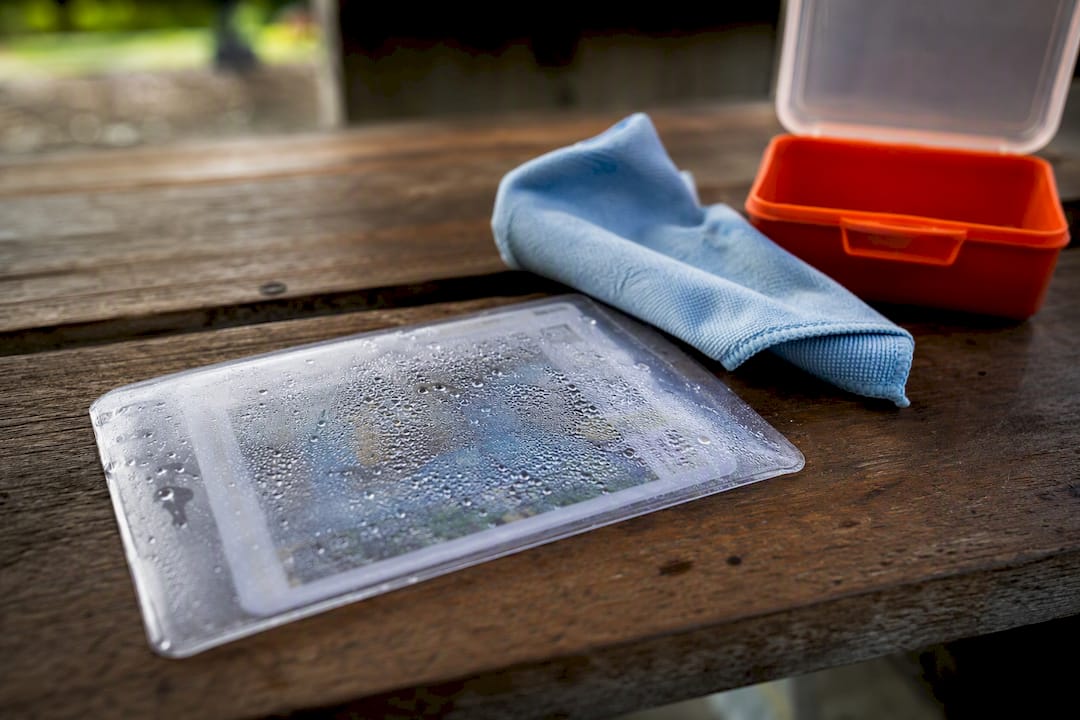
This typically happens when damp cards are packed away immediately after the game without drying first. In closed boxes without air exchange, the problem is intensified, especially in warm weather.
Waterproof PVC cards have a practical advantage here: they can be simply rinsed under running water and dry quickly, so residual moisture does not become a problem in the first place. For PP or PET sleeves, the simple rule applies: wipe cards briefly before packing and, if possible, let them air-dry for a few minutes before they go back into the sleeve.
For longer camping trips, a box with small ventilation slots is more worthwhile than a completely airtight container. This allows trapped residual moisture to escape without letting in rain or sand. Anyone who leaves cards damp overnight risks not only mold on paper cards but also that PP sleeves will eventually become cloudy and lose their transparency.
How do card sleeves react to outdoor heat and cold?
Temperature extremes affect plastic sleeves differently than moisture, but they are just as effective at impacting durability. In extreme heat, such as in a car under the summer sun or directly on the beach, PVC and PP become softer and can slightly stick together if cards are stacked on top of each other.
In the cold, the opposite happens: plastic becomes more brittle and loses flexibility. A sleeve that was pliable in the summer can tear in the winter when pulling out a card, especially at the edges where the material is thinnest.
PET or PETG, as used in 3D-printed boxes, behaves more stably under temperature changes than thin film sleeves because it is processed more thickly and remains dimensionally stable. This explains why printed storage solutions often last longer in outdoor use than simple card sleeves.
In practical terms, this means: never leave a card game directly on the dashboard in the sun in a car, and in winter, pre-warm sleeves in your jacket pocket briefly before their first use rather than bending them while ice-cold. If you regularly play outdoors in highly variable temperatures, such as on geocaching tours between spring and autumn, you should opt for thicker sleeves from 100 microns upwards. They tolerate temperature fluctuations much more readily than the thinnest offers on the market.
How long do outdoor sleeves really last with regular use?
Durability depends less on the price than on the actual usage pattern. A sleeve used once a month for a family game in the garden will last significantly longer than one that travels through sand and moisture weekly while camping.
Completely waterproof PVC cards have a clear advantage here, because there is no separate sleeve material to wear out. The Hoyle Waterproof deck, for example, is considered extremely durable and remains functional even after frequent shuffling and washing, because the entire card material is waterproof, not just a thin outer layer.
With classic PP sleeves, wear first appears at the edges, where the card rubs the most during shuffling. As soon as fine white lines or initial cracks form there, protection drops noticeably, even if the sleeve still looks intact.
One practical factor is often underestimated: the right size extends the lifespan just as much as the material itself. A sleeve that fits too loosely rubs against the card with every movement and therefore wears out faster than one that fits snugly. Anyone who wants to keep their equipment truly outdoor-ready will replace sleeves preventively as soon as the first signs of wear become visible, rather than waiting until they fail completely.
Which sleeves and materials are best suited for outdoor use?
A direct comparison shows what each material is suitable for, rather than calling a single solution the best in general.
| Solution | Strength | Limitation |
|---|---|---|
| Completely waterproof PVC cards | No separate sleeve protection needed, washable, tear-resistant | Slightly stiffer to handle than thin paper cards |
| PP sleeves | Flexible, acid-free, good for delicate printed cards | No substitute during prolonged water contact |
| Laminated cards | More resistance than plain paper at a low additional cost | Not completely waterproof |
| Hardcase transport box | Provides additional protection against creases and pressure in a backpack | Does not replace a sleeve, only the outer packaging |
For collectible card games with delicate printing, PP sleeves are usually the better choice because they are acid-free and do not directly alter the cards. For pure outdoor use involving water, sand, and frequent environmental changes, completely waterproof cards perform better, as no additional material can wear out here. A hardcase transport box is a sensible addition to any of the three solutions when cards are being transported in a backpack or suitcase.
Three ready-to-use outdoor setups based on frequency of use
Instead of a single recommendation for all cases, three clearly distinguished setups help, depending on how often and where you play outdoors.
Casual player: PP sleeves for the existing card game plus a simple storage box. Perfectly sufficient for a barbecue in the garden or the occasional round in the park.
Traveler or camper: Completely waterproof PVC cards or laminated cards, plus a hardcase to protect against pressure in luggage and a crossbody bag for transport on the go. This combination can withstand weeks in a backpack without the cards suffering.
Outdoor professional or geocacher: PETling with logbook as a compact, waterproof container for small card games, supplemented by a robust box such as an ammo box for transporting larger sets. This solution comes directly from geocaching practice, where weather resistance has been part of everyday life for years.
In the end, it is not the price that determines the right setup, but how often and under what conditions you actually play.
— Benedikt
Suitable products at Cachewerk for your outdoor card protection
Cachewerk knows the problem firsthand: everything intended to survive outdoors needs thoughtful protection, not just a thin layer of plastic. This is precisely why many geocaching products from the range can be used directly for outdoor card games, without having to go through specialized card accessory suppliers.
The Geocaching Starter Bundle 1 with PETling, logbook, and holder is excellent for storing a small card game in a waterproof manner, while the crossbody bag with the Opencaching logo handles the transport of cards, sleeves, and accessories together. For those who need more storage space, the Ammo Box in the Trick Edition offers enough room for several card games, including spare sleeves, protected against impact, moisture, and sand. Those who prefer an alternative with a simple hanging mechanism will find it in Starter Bundle 2.
Material and dimension specifications are provided directly on the product page, so that every combination can be checked against your own card formats beforehand. Take a look at the Cachewerk shop and put together your own outdoor set before your next tour begins.
Sources
For deeper research into materials and formats, these pages are worthwhile: waterproof PVC cards for complete waterproofing, Tarock card boxes for exact internal dimensions for special formats, and Shop for a broader overview of sleeve formats in the collectible card game sector.
- Waterproof playing cards - order now
- Hoyle Waterproof – Card game by US Playing Card
- Reddit discussion on protecting round cards
- Card box for Tarock format
FAQ
Which material is best suited for outdoor card game sleeves?
PVC offers complete waterproofing without a separate sleeve; PP is better suited for flexible, acid-free protective sleeves for existing cards. For regular water contact, PVC is the safer choice.
How do I clean waterproof playing cards after outdoor use?
Waterproof PVC cards can simply be rinsed under running water and then dry quickly. Drying in the shade instead of in direct sunlight is gentler on the material.
Which sleeve size fits my card game?
Measure the width and height of the card precisely and add 1 to 2 millimeters of buffer. Common standard formats are 66×91 mm, 44×68 mm, or square at 69×69 mm; Tarock cards require their own dimensions.
Is laminating worthwhile as an alternative to sleeves?
Laminated cards offer more resistance than plain paper, but are not completely waterproof like PVC cards. Laminate is sufficient for occasional use, but not for regular water contact.
How do I additionally protect cards during geocaching tours?
A PETling from the Cachewerk range keeps cards stored in a waterproof manner, while a robust box like the ammo box provides additional protection during transport in a backpack. This combination comes directly from geocaching practice for weatherproof hideouts.