
Geocaching Owner Role: Tasks, Responsibilities, and Tips
Many people think that once you hide a geocache, you're done. Put in a container, upload coordinates, finished. But the reality is quite different. As an owner, you take on a long-term responsibility towards the community, the platform, and the terrain. You are a founder, caretaker, and point of contact all in one. This article will show you what the owner role truly means, what rights and duties you have, and how to design your cache creatively and with easy maintenance in mind.
Table of Contents
- What does "Owner" really mean in geocaching?
- The most important tasks and duties of an Owner
- Special Responsibilities: Distance, Health Score, and Geocaching Guidelines
- Tips and recommendations for new and experienced Owners
- With the right equipment to become a successful Geocache Owner
- Frequently Asked Questions
Key Takeaways
| Point | Details |
|---|---|
| Owner bears responsibility | As an owner, you are not just a hider, but continuously responsible for maintenance and quality. |
| Strictly adhere to guidelines | Distance, condition, and community feedback are central owner duties. |
| Keep an eye on Health Score | Pay attention to system messages early and act immediately if problems arise. |
| Creative hides pay off | Innovative, well-maintained caches bring more fun and recognition within the community. |
| Grow with community exchange | Regular exchange and event visits help you become a better and more creative owner. |
What does "Owner" really mean in geocaching?
The term sounds simple, but it is full of responsibility. According to the Geocaching Help Center, the owner is the person who created, placed, and published the geocache. This can be an individual or a team. The key is: the actual work begins with publication.
As an owner, you have extensive rights. You can delete logs, change coordinates, disable, archive, or adopt the cache to another person. These rights are not an end in themselves but tools to ensure the quality of your cache.
It's important to distinguish between owner and finder. The finder searches, logs, and moves on. The owner remains responsible as long as the cache is active. This can be months or years.
When can an owner delete a log? Only if the log violates the guidelines, for example, with spoilers, insults, or incorrect information. Arbitrary deletion is not allowed and harms trust within the community.
The owner role is the foundation of every good geocache. Without dedicated owners, there are no high-quality hides.
| Task | Finder | Owner |
|---|---|---|
| Search for cache | Yes | Optional |
| Log cache | Yes | No |
| Maintain cache | No | Yes |
| Delete logs | No | Yes (if rule violation) |
| Disable cache | No | Yes |
| Change coordinates | No | Yes |
| Adopt cache | No | Yes |
This clear distinction shows: the owner bears the main burden for the long-term operation of a cache.
The most important tasks and duties of an Owner
Now that the basics and rights are known, let's look at the concrete daily life as an owner. Because there is often a large gap between theory and practice.
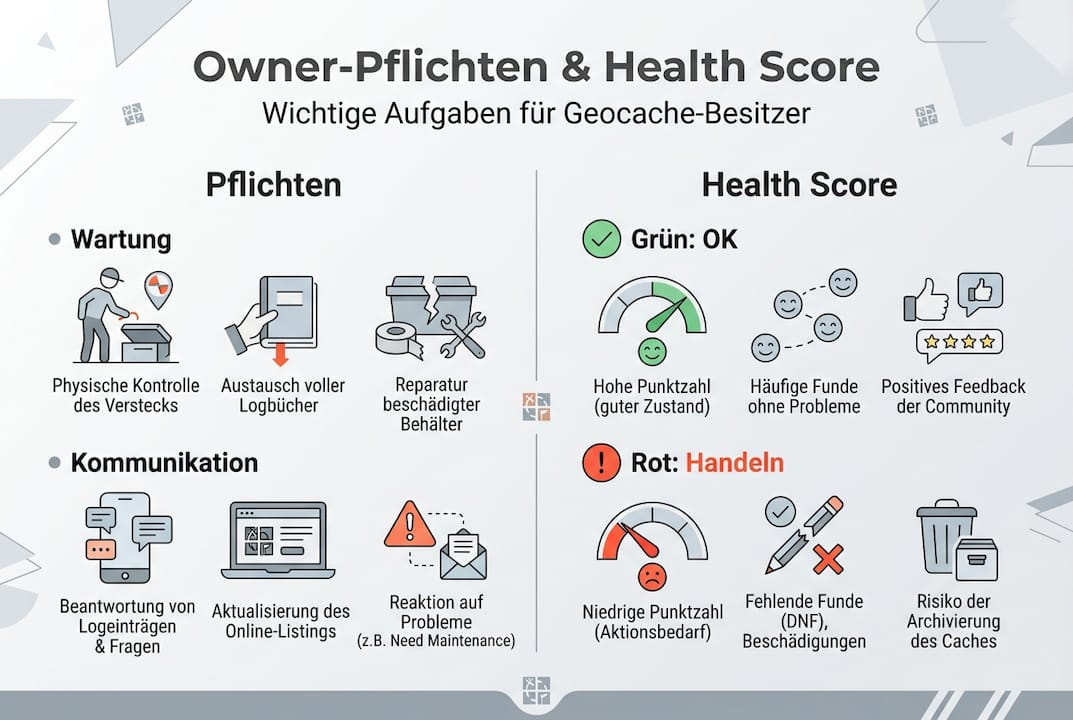
The central duty is maintenance. The owner is responsible for the condition of the cache. This means: regular on-site checks, replacing the logbook, repairing or replacing the container if damaged. Neglecting this risks bad logs, a low Health Score, and ultimately archiving.
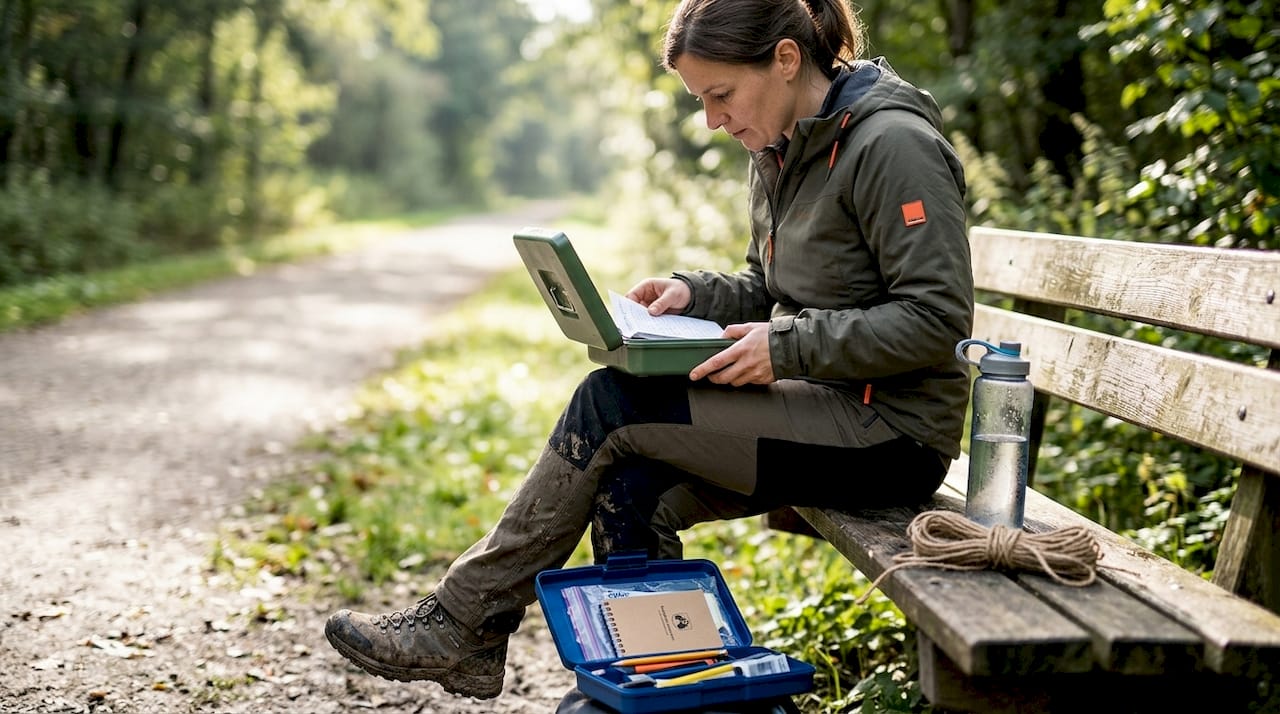
Communication is just as important. Finders leave hints in their logs, for example, that the logbook is full or the lid is stuck. Regularly reading and responding to this feedback is a sign of quality and respect for the community.
The Health Score is an automated rating system from Geocaching.com. It indicates how well a cache is maintained. Low values result from many "Needs Maintenance" logs or long inactivity. As an owner, you should take system messages seriously and act quickly.
Here are the typical owner tasks in an overview:
- Regularly check cache on site (at least once per season)
- Replace logbook and pen if they are full or damaged
- Read finder logs and respond to maintenance hints
- Keep an eye on the Health Score and act immediately on warning messages
- Disable cache during prolonged absence to avoid frustration for seekers
- Check coordinates, especially after storms or changes at the hide location
- Replace container if necessary, before it becomes leaky and ruins the logbook
That sounds like a lot of work. But with the right routine, it's easily manageable.
Pro-Tip: Establish a fixed maintenance rhythm. For example, a short round to your caches every first Sunday of the month. Log the maintenance as your own log so the community sees you are active. This builds trust and improves your reputation as an owner.
Particularly low-maintenance hides are those with robust containers made of PETG or similar weather-resistant materials. A good container saves you many maintenance trips in the long run.
Special Responsibilities: Distance, Health Score, and Geocaching Guidelines
In addition to general maintenance, there are specific rules that you, as an owner, must know and follow. Ignoring them risks the archiving of your cache.
The distance rule is one of the most important requirements. Geocaches must be at least 161 meters from other caches or physical stages. This also applies to stages in multi-caches. Before placing a new cache, check the saturation in the area. Too many caches in a small area degrade the player experience for everyone.
The Health Score works like a traffic light system. Green means: everything is in order. Yellow or red means: action required. Owners receive automatic emails when their Health Score is low. You should not ignore these messages. A quick response shows the community and the reviewer that you are a responsible owner.
| Situation | Health Score Impact | Recommended Action |
|---|---|---|
| Multiple “Needs Maintenance” logs | Decreases significantly | Check cache immediately |
| No finds for a long time | Decreases slightly | Check cache, update hint if necessary |
| “Did Not Find” series | Decreases sharply | Check coordinates and hide |
| Regular maintenance logs | Increases | Keep up the good work |
| Active owner communication | Stable to increasing | Read and respond to logs |
A typical mistake: The owner does not respond to maintenance notes and the cache is automatically archived after several weeks. This is annoying because it is avoidable. Anyone who reads and acts on emails from Geocaching.com will not have this problem.
Another common mistake is placing without local permission. On private land or in protected areas, you need permission. If it's missing, the cache can be removed immediately upon request. This costs time and nerves.
Statistically, Health Score problems are one of the most common reasons for cache archiving. Acting early saves a lot of effort and keeps your cache active long-term.
Tips and recommendations for new and experienced Owners
“Read the guidelines, attend events, and get permissions for innovative hides. That's the best start as an owner.” Geocaching Blog
This recommendation from the community hits the nail on the head. Those who know the guidelines avoid the most common mistakes from the start. Those who attend events learn from experienced owners and get ideas for creative hides.
Geocaching events are underestimated learning opportunities. There you meet other owners, exchange experiences, and find out what works well in your region. Many of the best hiding ideas emerge from conversations with other geocachers.
Local permissions are not bureaucratic effort, but protection for you and your cache. If you hide on private land or in nature reserves, you need written permission. This sounds complicated, but in most cases, it is straightforward.
Here are proven tips for high-quality, durable, and creative hides:
- Use weather-resistant containers, for example made of PETG or stainless steel, which remain sealed even in rain and frost
- Choose a location with meaning, not just a random spot, as interesting places motivate finders
- Plan maintenance from the start by placing the container easily accessible
- Use creative camouflage that matches the surroundings and does not attract the attention of muggles (non-geocachers)
- Test the cache yourself before publishing it, and have another geocacher test it
- Keep the logbook dry by protecting it in an extra foil or zip bag
- Document the location with photos so you can react quickly to changes
Pro-Tip: It's better to focus on a single, well-maintained cache than on a powertrail with many containers. Powertrails significantly increase the risk of damage and maintenance effort. A high-quality cache brings you more positive logs and more joy than ten poorly maintained containers.
If you're looking for inspiration for unusual hides, you'll find many practical ideas for creative and low-maintenance solutions on the blog about innovative geocaching products.
With the right equipment to become a successful Geocache Owner
As an owner, you now know what matters: maintenance, communication, knowledge of rules, and creativity. But the best strategy is of little use if the container leaks after two months or the camouflage doesn't match the surroundings. This is where the right equipment makes all the difference.
At cachewerk.de, you'll find geocaching equipment and accessories specifically designed for the needs of owners. Whether robust PETG containers, creative camouflage solutions for urban environments, or personalized trackables: the assortment helps you make your cache durable, low-maintenance, and exciting. Less maintenance effort means more time for what's truly fun. Take a look and get inspired.
Frequently Asked Questions
Can I transfer my geocache to someone else?
Yes, you can transfer your cache to another owner using the adoption feature. The adoption feature is available to all registered owners.
What happens if my cache gets a low Health Score?
You will receive an automatic system message and must maintain or archive the cache. According to the Geocaching Help Center, quick reactions are crucial to avoid archiving.
What distance rules must be observed when hiding a new cache?
There must be at least 161 meters between caches or physical stages. This rule applies worldwide on the Geocaching.com platform.
Am I allowed to delete logs from finders?
Yes, but only if they violate the guidelines, for example, with spoilers or insults. Deleting logs is permitted if there is a clear rule violation.
How do I find inspiration for creative geocache hides?
Attend local events and read blogs about innovative hide ideas. The Geocaching Blog also recommends knowing the guidelines and networking within the community.