
Developing Puzzles for Geocaches: A Step-by-Step Guide
You develop a puzzle for a geocache by choosing a theme and puzzle mechanic, logically hiding the final coordinates in the listing, and having at least one independent tester review the result. The entire process can be divided into five main steps: Choose a theme → Define puzzle mechanic → Determine final coordinates → Write listing → Test and submit. Following this order avoids common mistakes and gets your cache through the reviewer's approval much faster.
TL;DR: Quick Checklist
- Define theme and puzzle type (Mystery, Multi, Puzzle Trail)
- Prototype puzzle mechanic and check for solvability
- Select hide and container, measure final coordinates precisely
- Write listing: Introduction, puzzle, attributes, D/T rating, hint
- Add reviewer note with solution path
- Involve at least one independent tester
- Submit and await reviewer feedback
Time required: A simple mystery cache realistically takes a few hours from idea to submission. Costs: A solid container plus logbook is in a usual range, depending on the hide type and material.
Pro Tip: Completely develop the puzzle at your desk before finalizing the location. This way, you avoid having to adjust the listing afterward because the hide doesn't fit your puzzle mechanic.
Table of Contents
- How to develop a finished puzzle cache step-by-step?
- Which containers and materials are suitable for durable hides?
- What do you need to consider regarding rules, nature conservation, and legal aspects in Germany?
- What types of puzzles are there and what do mini-examples look like?
- How to write a good listing with a hint and correct coordinates?
- How do you test your cache and submit it correctly?
- A complete practical example: Walkthrough of a puzzle cache
- Cachewerk hides for your next puzzle cache
How to develop a finished puzzle cache step-by-step?
The official Geocaching blog recommends the following basic framework: Read guidelines, choose location, choose container, measure coordinates, write listing, contact reviewer. For a puzzle cache, the puzzle mechanic is an additional step in between.
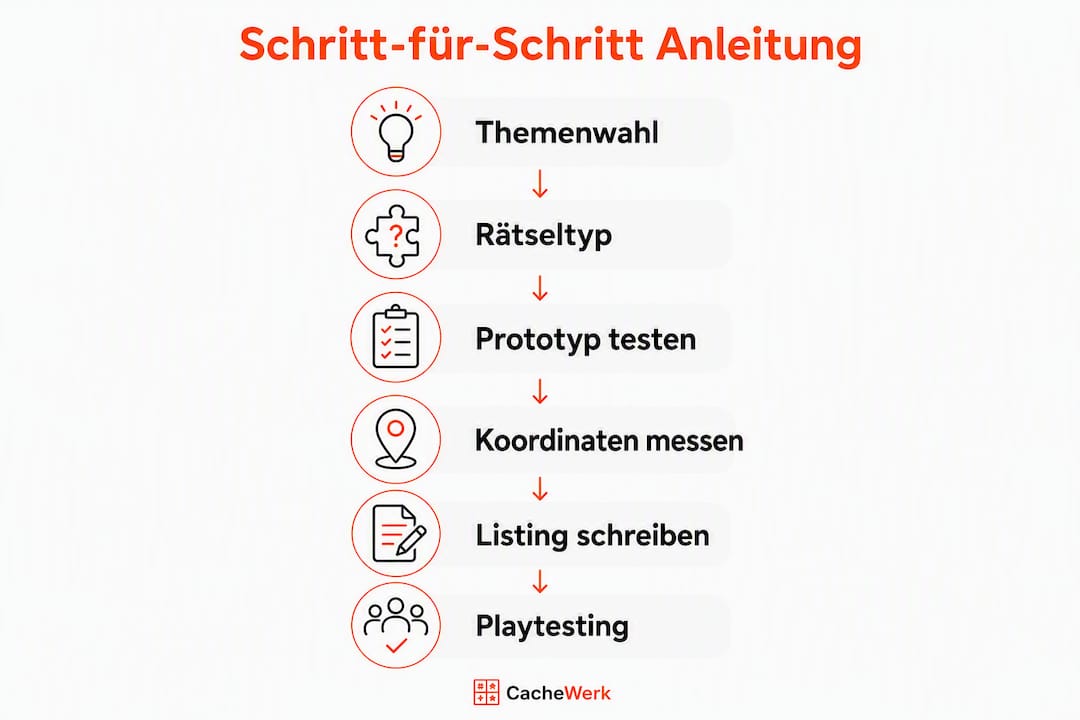
Step 1: Find a theme and idea (approx. 30–60 minutes)
Choose a theme with local relevance or personal interest. A puzzle aligned with your own interests appears more authentic and is easier to test and explain. A cache about the history of an old train station in your city works better than a generic number puzzle without context.
Ask yourself: What will cachers who visit this place know afterward that they didn't know before?
Step 2: Define puzzle mechanic and type (approx. 1–2 hours)
Decide which cache type fits the idea. Mystery caches, multi-caches, and puzzle trails have different requirements for listing and coordinates. Choose a mechanic that suits the target audience: ROT13 for beginners, Vigenère cipher for experienced puzzle cachers.
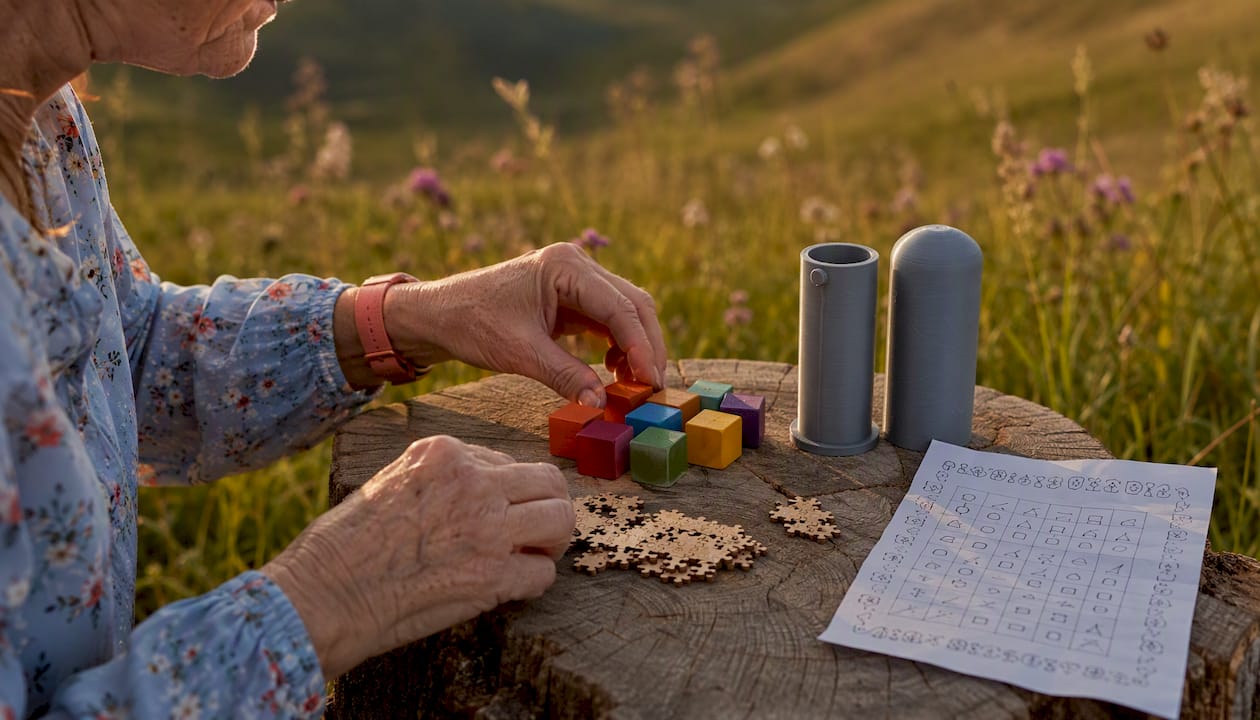
Step 3: Build and test a prototype (approx. 1–2 hours)
Write the puzzle on paper or in a text document. Solve it yourself, wait a day, then solve it again. If you still know how to do it after 24 hours, the logic is clear enough.
Step 4: Choose a hide and measure final coordinates (approx. 1–2 hours on-site)
Only when the container and location are fixed do you measure the final coordinates. Measure multiple times, ideally at different times of day, as GPS signals vary depending on vegetation and weather. Note down the coordinates immediately.

Step 5: Write the listing (approx. 1–2 hours)
Listing template:
| Element | Content |
|---|---|
| Introduction | Theme and context of the cache (2–4 sentences) |
| Puzzle task | Clear task description with all necessary information |
| Attributes | Access, tools, season |
| D/T Rating | Difficulty and Terrain rating (1–5 each) |
| Hint | Restricting hint without spoiler |
| Reviewer note | Solution path for the reviewer (not public) |
Step 6: Playtesting and submission (approx. 1–3 hours)
Have at least one independent tester solve the puzzle without help. Document errors and adjust the listing. Then submit.
Pro Tip: Write the reviewer note as if you were explaining the solution path to a friend on the phone. Short, clear, with an example calculation. Reviewers greatly appreciate this.
Which containers and materials are suitable for durable hides?
The container is the heart of every cache. It must be sealed, inconspicuous, and low-maintenance. Poor material choice is one of the most common reasons for "Needs Maintenance" logs.
| Container Type | Application Area | Strengths | Weaknesses |
|---|---|---|---|
| PETling | Urban, bushes, trees | Small, lightweight, inexpensive | Little space for logbook |
| Magnetic container | Metal structures, urban | Very inconspicuous | Only nano-logbook |
| Ammo Box | Forest, terrain | Very robust, waterproof | Large, conspicuous |
| 3D-printed stealth hides | Urban, creative spots | Individual, camouflaged | Material quality crucial |
For puzzle caches with complex mechanics, a container that matches the puzzle is recommended. A labyrinth hide as the finale of a brain teaser completes the experience. The Geocaching Ammo-Box Hide Trick Edition from Cachewerk is weather-resistant and offers enough space for a proper logbook, making it particularly suitable for forest hides.
Material checklist for the container:
- Seal intact and regularly checked
- Logbook sealed in plastic bag or laminated
- Writing implement (pencil holds up better than ballpoint pen in cold)
- No metal parts that can rust
- Container inconspicuous or camouflaged from the outside
For creative 3D-printed stealth hides, Cachewerk offers its own PETG-printed solutions that are weather-resistant and durable. PETG is a better choice than PLA, which can deform in the summer heat.
Pro Tip: Place a small silica gel packet inside the container. This keeps the logbook dry even in frequently opened hides.
What do you need to consider regarding rules, nature conservation, and legal aspects in Germany?
Geocaching in Germany is subject to clear rules. Knowing them avoids trouble with reviewers, authorities, and landowners.
Checklist before hiding:
- Location is on publicly accessible land (no private property without explicit permission)
- No hides in nature reserves, national parks, or protected biotopes
- No hides near railway tracks, military installations, or airports
- No clues that could look like suspicious objects
- All information necessary for the solution is publicly available in the listing or accessible sources
Important Rule: All information necessary for the solution must be publicly available and contained in the listing or generally accessible sources. Time-delayed or staggered clues that are only available at specific times violate the guidelines. Multi-caches with bonus stages are a compliant alternative for multi-stage puzzle series.
For the reviewer note: Explain the solution path concisely and comprehensibly. This note is not publicly visible but helps the reviewer understand the logic of your puzzle and approve the cache faster.
Regarding nature conservation law in Germany: The Federal Nature Conservation Act prohibits entering certain areas. If in doubt, inquire with the responsible forestry office or nature conservation authority whether the planned location is permissible.
Pro Tip: Photograph the location from different angles before hiding. These photos will help you with maintenance and can show the reviewer that access is safe and legal.
What types of puzzles are there and what do mini-examples look like?
Puzzle caches can be realized with codes like ROT13, Caesar cipher, or Morse code, but also with image manipulation or word counting. Here are the most common types, each with a mini-example.
-
Mystery Cache (Puzzle Cache): The listing contains a puzzle, the solution of which yields the final coordinates. Example: "How many letters are in the word GEOCACHING? Result = A. Final coordinates: N 48° 1A.XYZ E 011° 2B.XYZ." Solution: A = 9, B = results from a second task.
-
Multi-Cache: Multiple stages lead to the final container. Each stage provides a clue for the next. Example: Stage 1 shows a year on a monument. This number is incorporated into the coordinates of Stage 2.
-
Puzzle Trail: A sequence of puzzles at different locations that together yield the final coordinates. Well suited for themed city tours.
-
ROT13 Puzzle: Each letter is shifted by 13 positions in the alphabet. "TRBPNPUVAT" becomes "GEOCACHING". Easy to create, well suited for beginners.
-
Caesar Cipher: Shift by an arbitrary value. Shift by 3: A→D, B→E. More difficult than ROT13 because the key is unknown.
-
Morse Code: Coordinates are translated into Morse code. "._ ._ ._ " = AAA. Requires a table for decryption, but makes the puzzle visually interesting.
-
Image Puzzle: Information is hidden in the listing image, e.g., in EXIF data, pixel colors, or as invisible text. For experienced cachers.
Tips for balancing difficulty:
- Avoid local knowledge as a prerequisite unless the puzzle explicitly revolves around it
- Any assumption you make must be explained in the listing
- Test the puzzle with someone unfamiliar with the location
Those looking for inspiration from the escape room sector can find useful ideas for puzzle mechanics that can be easily transferred to geocaches in the Online Escape Room Guide by TnT Exit Games.
Pro Tip: Always include an "emergency exit" logic: If a cacher absolutely cannot solve the puzzle, the hint should be formulated so that they can continue after 30 minutes of searching on site.
How to write a good listing with a hint and correct coordinates?
A good listing is clear, complete, and spoiler-free. It contains all the information needed for the solution without giving away the answer.
Checklist for the listing:
- Introduction: Context and theme of the cache (not the solution)
- Puzzle task: fully and unambiguously formulated
- All necessary information in the listing or in linked, public sources
- Attributes correctly set (tool needed, night cache, etc.)
- D/T rating realistic and justifiable
- Hint: restrictive hint, not a spoiler
A good hint is an additional puzzle piece: It should not reveal the hide, but it should meaningfully narrow down the search on site. "No hint needed" is not an acceptable hint formulation.
Examples of good hints:
- "Look up, not down."
- "Metal meets wood."
- "Smaller than a palm, larger than a thumb."
Encoding coordinates in the puzzle:
| Method | Example | Difficulty |
|---|---|---|
| Letter-number mapping | A=1, B=2 … Z=— | Easy |
| ROT13 | Letters shifted by 13 | Easy |
| Caesar cipher | Shift by X | Medium |
| Vigenère cipher | Keyword needed | Hard |
| Morse code | Dots and dashes | Medium |
On Opencaching, final coordinates often need to be integrated directly into the puzzle, as there is no separate final field visible only to the owner. This changes how puzzles are formulated: the solution must be logical and traceable from the listing.
Pro Tip: Write the hint last. Only when the puzzle is finished do you know which hint truly helps without revealing too much.
How do you test your cache and submit it correctly?
Systematic playtesting with independent testers finds most logic errors. Document tests with clear error descriptions and proposed solutions before submitting the listing.
-
Select testers: At least one to two independent testers, ideally with different experience levels. A beginner will find different problems than an experienced puzzle cacher.
-
Define test task: Testers solve the puzzle without any help. They document where they get stuck and why.
-
Evaluate results: Any point where a tester gets stuck for more than 10 minutes is a potential problem. Either adjust the puzzle or improve the hint.
-
Bug report template:
- Step where the problem occurred
- What was unclear
- Suggestion for improvement
-
Adjust listing and retest if major changes were necessary.
Formulate Reviewer Note: Explain the complete solution path so the reviewer can follow the logic. This note will not be displayed upon publication.
Playtest Checklist:
- Can the puzzle be solved without prior knowledge?
- Are there any ambiguities in the task description?
- Is all necessary information included in the listing?
- Does the solution lead to the correct final coordinates?
- Is the hint helpful but not a spoiler?
Pro Tip: Ask testers to think aloud as they solve the puzzle. This helps you identify errors in thinking that you might never have noticed yourself.
How do you set D and T ratings meaningfully and fairly?
The D/T rating (Difficulty/Terrain) is one of the most common sources of error for new cache owners. Set too low, and geocachers get frustrated. Too high, and the cache will be avoided.
Decision tree for D-rating:
- D1: Puzzle solvable without aids, simple logic
- D2: Puzzle requires some thought or a table
- D3: Multiple steps, encoding required
- D4: Complex encryption, multiple dependencies
- D5: Only for experienced puzzle cachers, very rare
Decision tree for T-rating:
- T1: Wheelchair accessible, paved path
- T2: Easy terrain, short hike
- T3: Uneven terrain, good footwear required
- T4: Climbing or special equipment required
- T5: Extreme terrain, only for experienced outdoor enthusiasts
Practical rules: For uncertain hides, rather set D a bit lower. A puzzle with D4 and T4 only appeals to a very small target group. The balance between puzzle difficulty and physical challenge should be such that cachers do not fail at both simultaneously.
Specific examples of good combinations:
- City cache with a tricky puzzle: D3/T1
- Forest cache with a simple puzzle but challenging terrain: D2/T3
- Challenging puzzle in flat terrain: D4/T1
How do you keep your cache in good condition permanently?
A cache that is not maintained collects "Needs Maintenance" logs and will eventually be archived. Regular care is not an effort, but respect for the community.
Recommended inspection intervals:
- Highly frequented city cache: every 4–6 weeks
- Forest cache with medium frequency: every 2–3 months
- Remote cache: at least twice a year, additionally after every "Needs Maintenance" log
| Wear part | Inspection interval | Replacement needed when |
|---|---|---|
| Seal/O-ring | Every 6 months | Cracks, deformation |
| Logbook | Depending on frequency | Filled or wet |
| Writing implement | Every 2–3 months | No longer writes |
| Magnetic holder | Annually | Adhesion weakens |
| Camouflage material | Seasonally | Looks unnatural |
After a "Needs Maintenance" log, you should react within two weeks. Waiting longer signals to the community that the cache is neglected and can lead to archiving.
Pro Tip: Set a calendar reminder for yourself, right after publishing the cache. Once a quarter is sufficient for most hides.
A complete practical example: Walkthrough of a puzzle cache
Here is a concrete mini-project that shows how all steps work together.
Topic: The history of the old water tower on the outskirts of the city.
Puzzle mechanic: Letter-number mapping. The listing contains a short text about the water tower. Certain words are bolded. The number of letters in each bolded word gives a digit of the final coordinates.
Listing excerpt: "The tower was built in the year nineteen hundred and served the city for forty years as a water reservoir."
Solution: TOWER = 5, NINETEEN HUNDRED = 14 (only the first two digits relevant: 1 and 4), FORTY = 5. Final coordinates result from these values.
Playtest summary:
- Tester 1 (beginner): Understood the principle after 5 minutes, but counted "nineteen hundred" as one word, not as a number. Solution: Replace word in listing with "1900".
- Tester 2 (experienced cacher): Immediately recognized that bolded words were relevant, but the order was unclear. Solution: Add numbering to the bolded words in the listing.
Lessons Learned: Ambiguities almost always arise where the owner assumes too much prior knowledge. What is obvious to you is often not to others. Every assumption in the puzzle must be made explicit.
For this example, the Blind Maze Tube from Cachewerk is particularly suitable as a final container: The labyrinth principle makes opening itself part of the puzzle experience and thematically fits a brain-teaser cache. If you are looking for a more classic finale, the Mini Hau-den-Lukas Trick Hide offers a playful alternative, where the logbook is hidden in the hammer handle.
Pro Tip: Document each playtest in a simple table: Tester, step, problem, solution. This documentation will also help you with the reviewer note.
Key Insights
A well-developed puzzle cache follows a clear process: choose a theme, define the mechanics, measure the final coordinates, write the listing, and test with independent testers before submitting.
| Topic | Details |
|---|---|
| Five-step process | Theme, mechanics, coordinates, listing, playtesting are the core steps in this order. |
| Hint quality | A good hint narrows down the search without revealing the hide; "no hint needed" is not an option. |
| Playtesting | Involve at least one or two independent testers and document the results. |
| Compliance | All solution information must be publicly available in the listing; avoid private property and nature reserves. |
| Cachewerk products | Blind Maze Tube, Ammo-Box Trick Edition and Mini Hau-den-Lukas offer suitable containers for various puzzle concepts. |
What experienced cache owners do differently
Most beginner mistakes in developing puzzle caches do not arise from lack of knowledge, but from too much proximity to their own project. Anyone who has developed a puzzle themselves no longer sees it with fresh eyes.
The most common mistake: too many implicit assumptions. An owner who grew up in a city incorporates local knowledge into the puzzle without realizing it. For cachers from other regions, the puzzle is simply unsolvable. The solution is not to make the puzzle simpler, but to explicitly state all assumptions.
The second most common mistake: a bad reviewer note. Reviewers see dozens of listings every day. A note like "Solve puzzle, then coordinates" helps no one. A good note shows the complete calculation path, step by step. This saves time on both sides.
And then there's maintenance. Many owners are motivated at launch and then never return to the site. A cache that has soaked logbooks after six months damages the owner's reputation and frustrates finders. When you publish a cache, you take responsibility for it, permanently.
What really helps: a second hint that only becomes visible after the first hint. Not all platforms support this, but where it is possible, it is an elegant way to reduce frustration without devaluing the puzzle. And a good cover image in the listing. Cachers decide in seconds whether a cache sounds interesting. A photo that arouses curiosity without spoiling makes all the difference.
Cachewerk Hides for Your Next Puzzle Cache
Anyone developing a puzzle cache ultimately needs a container that fits the concept and works permanently. Cachewerk has three products in its range that have proven themselves in practice.
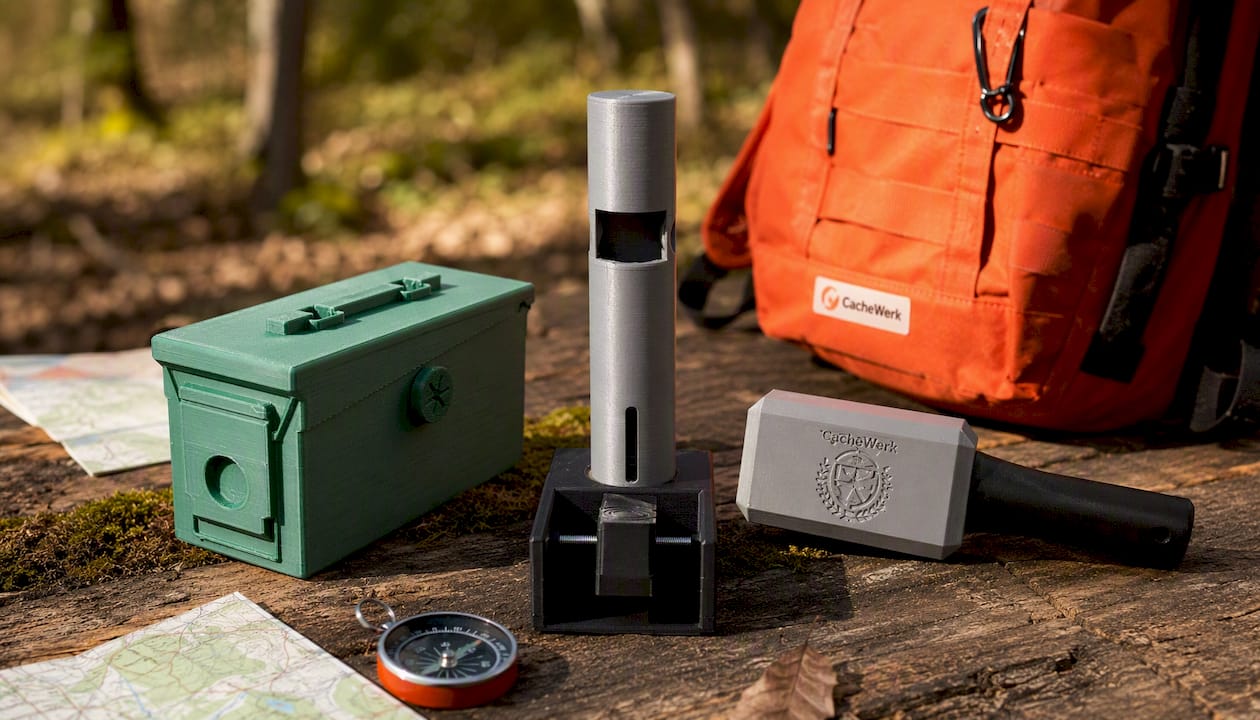
The Blind Maze Tube makes opening itself a puzzle: Cachers have to navigate an invisible ball through a labyrinth before the container opens. Ideal as the finale of a brain-teaser cache, because the experience at the find location extends the theme of the listing. The Geocaching Ammo-Box Hide Trick Edition is weatherproof, spacious and at first glance looks like an ordinary ammunition box. For forest hides with challenging terrain, it's the most reliable choice. And the Mini Hau-den-Lukas Trick Hide conceals the logbook in the hammer handle: inconspicuous, playful, and perfect for urban spots where a classic container would immediately stand out.
Check out all three products in the Cachewerk shop and find the container that suits your puzzle concept.
Useful Links and Sources for Germany
Further resources for cache owners who want to delve deeper:
- Official guide to hiding your first geocache: The official Geocaching blog explains the entire process from site selection to reviewer communication.
- How to win the heart of a puzzle cache lover: Practical tips on puzzle mechanics, playtesting, and coding methods directly from the Geocaching blog.
- Formulating hints correctly: Why a good hint is crucial and how to formulate it.
- Mysteries at Opencaching: Special features in designing mystery caches on the Opencaching platform, including coordinate integration.
- Discussion on rule changes for Mystery Caches: GeoClub forum with discussion on stricter requirements for listing content and solution paths.
- Free Escape Room Puzzles as a Source of Inspiration: Collection of puzzles and mechanics from the escape room sector that can be easily transferred to geocaches.
- Cachewerk Blog: Creative Hides with 3D Printing: Practical DIY instructions and product examples for self-made and 3D-printed hides.