
Tips for Marking Caches: How to Do It Right
A well-hidden cache is only half as good if you can no longer find it yourself or your finders wander around cluelessly. The right marking determines whether a geocache is found or remains undiscovered, leading to frustration. It's not about putting up a signpost. The best tips for marking caches show you how to cleverly combine discoverability and camouflage without disturbing nature or ruining the gaming experience. This is exactly what we will show you in this article.
Table of Contents
- Key Takeaways
- 1. Tips for Marking Caches: Knowing the Right Criteria
- 2. Natural Marking Methods: Discreet and Effective
- 3. Physical Aids and DIY Markings
- 4. Comparison Table: Cache Marking Techniques at a Glance
- 5. Technical Aids: The Geocaching App as a Marking Tool
- 6. Recommendations Based on Cache Type and Area of Use
- 7. Professional Hides as a Marking Solution
- 8. Best Practices for Durable Markings
- My Experiences with Marking Caches
- Creative Hides and Equipment from Cachewerk
- FAQ
Key Takeaways
| Point | Details |
|---|---|
| Balance camouflage and discoverability | The right combination of visibility and environmental compatibility is crucial for a successful hide. |
| Consider weather resistance | Markings should be weather-resistant to function reliably even in rain, frost, and heat. |
| Use app features | The Geocaching app has offered direct support for marking and submitting caches since 2026. |
| Consider cache type | Traditional caches, multi-caches, and puzzle caches require different marking strategies. |
| Professional hides are worthwhile | High-quality hides significantly increase durability and camouflage, saving effort in the long run. |
1. Tips for Marking Caches: Knowing the Right Criteria
Before you start marking, it's worth taking a quick look at the basics. Because good cache marking techniques don't happen by chance. They follow clear rules.
The most important criteria at a glance:
- Compliance: Geocaching platforms like Groundspeak have clear guidelines. Markings must not cause damage to the environment and must be reversible.
- Environmental compatibility: Paints, stakes, or adhesive tapes that remain permanently in nature are problematic. Natural or recyclable materials are the better choice.
- Weather resistance: Containers and markings must be resistant to rain, frost, and UV radiation, otherwise your cache will hardly be discoverable after one winter.
- Visibility for finders: The marking must be recognizable to informed seekers without attracting the attention of muggles (non-geocachers).
- Documentation: Record coordinates and marking details in writing or digitally so that you still know what you did months later.
Since March 2026, Geocaching App Version 10.7.0+ offers a new feature: direct marking of hide locations and submission of Traditional Geocaches directly from your smartphone. You'll find it under the "Hides" tab and the "+" symbol. This simplifies the entire process enormously.
Pro Tip: Always combine at least two marking methods. A digital coordinate marking in the app protects you if the physical marking in the field is damaged or removed.
2. Natural Marking Methods: Discreet and Effective
Natural markings are the classic way to mark a cache. They blend into the surroundings and do not attract the attention of muggles.
Popular natural methods include cairns (small stone piles), artfully arranged branches, moss pieces, or specific piles of leaves. The problem: Natural markings like cairns are popular but carry the risk of confusion and can impair the nature experience if too many of them are created.
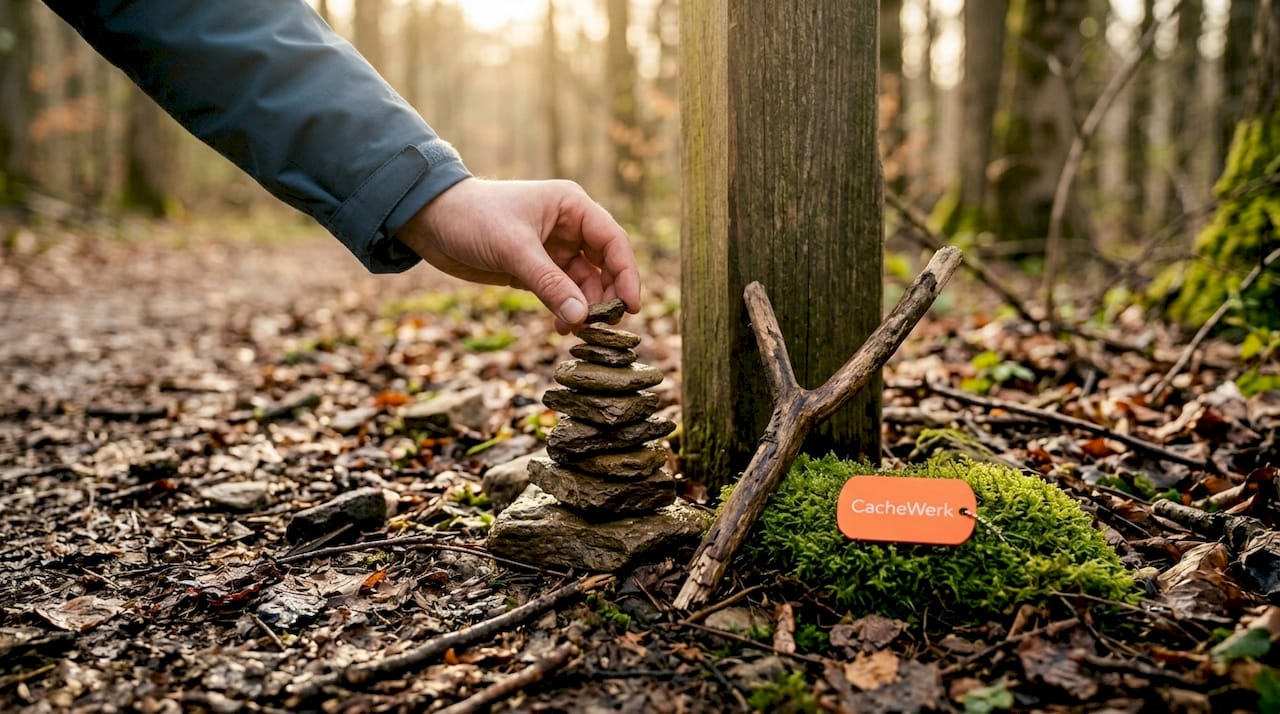
It makes more sense to choose a unique, site-specific sign that cannot be accidentally replicated. A single, unusually shaped stone at a clearly described location works more reliably than a classic cairn.
Advantages of natural markings:
- No material needed
- Blends with the surroundings
- Easy to build and adapt
Disadvantages:
- Can be altered by weather or visitors
- Risk of confusion with other natural structures
- Not suitable for urban environments
3. Physical Aids and DIY Markings
In addition to natural signs, there are a number of physical aids that you can build or buy yourself. These methods are more robust and often more precise.
Classics include small wooden stakes with carved symbols, waterproof paint on a stone, or weatherproof stickers on hidden surfaces. For urban environments, magnetic mounts or small metal clips in inconspicuous places work particularly well.
The advantage over natural methods: Physical markings remain constant. A weatherproof sticker under a park bench will still be in the same place after six months as it was on the first day.
Pro Tip: For physical markings, use only materials that you can remove without leaving any residue. Permanent paint on a natural rock is not an acceptable cache marking technique and violates Geocaching guidelines.
For more creative approaches, 3D-printed small parts are ideal. These can be individually designed, are weatherproof due to PETG plastic, and are hardly noticeable. Cachewerk offers such special solutions for ambitious cache owners.
4. Comparison Table: Cache Marking Techniques at a Glance
| Technique Type | Durability | Conspicuousness / Camouflage | Application Example | Effort and Costs |
|---|---|---|---|---|
| Natural Marking (Stones, Branches) | Low | Good camouflage, but risk of confusion | Forest cache, rural environment | No effort, free |
| Weatherproof Sticker | Medium to High | Inconspicuous on smooth surfaces | Urban cache, park bench | Low, low cost |
| 3D-printed symbol (PETG) | High | Very inconspicuous, customizable | All cache types | Medium, moderate costs |
| Magnetic Mount with Marking | High | Ideal for metal surfaces | City, industrial environment | Low to medium |
| Professional Hide (e.g., Tree Fungus) | Very High | Perfect camouflage, durable | Forest cache, nature park | Medium to High |
| App-supported Coordinate Marking | Very High (digital) | Invisible to muggles | All cache types | No effort, free |
The table shows: There is no universally best method. The right choice depends on the environment, the cache type, and your personal preferences.
5. Technical Aids: The Geocaching App as a Marking Tool
Digital tools are becoming increasingly important for cache placement. And since 2026, the Geocaching app has been a serious tool for anyone who wants to mark caches effectively.
App version 10.7.0+ now supports entering coordinates, difficulty ratings, and attributes directly during the hiding process. This means: You stand at your hiding spot, open the app, tap "Hides" and then "+". You can then document everything and submit it directly, without having to do any follow-up work on your computer later.
This is particularly useful for cache owners who maintain multiple hides. Digital marking complements physical marking in a meaningful way: You can see on the map where you have placed which cache, without having to search in the field.
Pro Tip: When placing a new cache, always take a screenshot of the GPS coordinates in the app and save it in a note as well. Coordinates can sometimes shift slightly due to app updates.
The combination of digital and analog markings demonstrably increases both discoverability and user-friendliness for everyone involved.
6. Recommendations Based on Cache Type and Area of Use
Not every cache needs the same marking. Here are specific instructions for cache marking for the three most common cache types:
Traditional Caches: Traditional caches are located in a fixed spot. Here, a combination of physical marking on site (e.g., a small symbol under a stone) and digital coordinate placement works best. The finder arrives with precise coordinates and only needs a small orientation aid.
Multi-Caches: In multi-caches, one clue leads to the next. Discreet but clear markings are crucial here to avoid confusing players. Each stage needs a recognizable marking that is only visible to informed seekers. Numbered small parts made of weatherproof material are well suited.
Puzzle Caches: Here, creativity is paramount. The physical marking itself can be part of the puzzle. A hidden symbol that is only recognizable upon closer inspection makes the cache particularly interesting.
Further recommendations by environment:
- Forest and Nature: Natural markings or camouflaged hides like the tree fungus work best. Avoid anything that disturbing changes the natural experience.
- Urban Environment: Magnetic mounts, inconspicuous stickers, or fake traffic signs are the smarter choice. They are hardly noticeable in the city.
- Nature Parks: Special rules often apply here. Check local regulations and rely exclusively on temporary, reversible markings.
Pro Tip: For multi-caches, combine digital waypoints with physical markings. This provides a backup solution in case a stage is damaged, and you can track via the app if finders report problems at a specific stage.
7. Professional Hides as a Marking Solution
A professional hide is both a container and a marker. This is precisely what makes it so efficient.
Professional cache hides like tree fungi or fake traffic signs significantly increase durability and camouflage. A tree fungus hide looks like a real mushroom from a distance, is weatherproof, holds a logbook capsule, and lasts for years. The finder enjoys a creative experience. The cache owner enjoys minimal maintenance.
For urban environments, there are similarly creative solutions: A fake traffic sign in the city is absolutely inconspicuous to muggles. Only those who know where to look will find the hollow space behind it.
Such hides come with higher costs than a self-built container. However, they save time and hassle in the long run because the quality is right and fewer touch-ups are needed. Professional geocaching equipment significantly facilitates the marking and maintenance of caches.
8. Best Practices for Durable Markings
Markings age. What was clearly visible in spring may be barely recognizable after a damp winter. Therefore, regular maintenance is one of the best practices for cache markings.
Plan a check every three to six months. Check for the following:
- Is the physical marking still present and legible?
- Do the stored coordinates match the actual location?
- Is the container still watertight and the logbook dry?
- Has the environment changed (e.g., due to tree felling or construction work)?
Those who read their logs regularly will quickly notice when finders report problems. A "Couldn't find the cache" log often indicates that the marking is no longer correct.
In short: A well-maintained cache brings more joy. Both for the finders and for the owner.
My Experiences with Marking Caches
Over the past few years, I've tried many different marking methods. And I can tell you: the most common mistake is over-reliance on a single method.
I myself created a multi-cache with exclusively natural markings. After the first winter, two stages were no longer discoverable. Branches were cleared away, cairns were knocked over. The result: frustrated finders and a lot of effort for me to fix things.
What I've learned since then: a physical marking without digital backup is like a plan without a backup. The new app function has completely changed my workflow. I now document every cache directly in the app when placing it and no longer rely solely on what I've set up in the field.
My advice to beginners: Start simple, but think twice. A simple, well-documented cache with clear marking beats any elaborately designed cache that no one finds.
And for those who want the best of both worlds: Check out professional hides. The effort in placing them is minimal, the impact on finders is enormous.
— Benedikt
Creative Hides and Equipment from Cachewerk
Do you want to take your cache marking to the next level? Cachewerk has exactly the right assortment for it.
Whether you are looking for a tree fungus as a hide for your next forest cache or a fake traffic sign for a creative urban hide: At Cachewerk, you will find products that truly work. All hides are made of high-quality, weatherproof materials and designed for continuous outdoor use. This saves you time in the long run on touch-ups and makes your caches a real experience for all finders. Take a look around the Cachewerk shop now and find the right hide for your next cache.
FAQ
How do you mark a cache correctly?
The best method combines a physical marker on site (e.g., an inconspicuous symbol or a professional hide) with digital coordinate recording in the Geocaching app. This way, you're covered even if the physical marker is damaged.
What are the best methods for marking caches in the city?
In an urban environment, magnetic mounts, weatherproof stickers on smooth surfaces, and creative hides like fake traffic signs are best. They are inconspicuous to muggles and withstand the urban climate well.
What materials are suitable for weather-resistant cache markers?
PETG plastic, stainless steel, and special weatherproof stickers are the most durable. Natural materials like branches or stones are free but less reliable in harsh weather conditions.
Can I use the Geocaching app to mark caches?
Yes. Since app version 10.7.0 (March 2026), you can mark hide locations directly in the app, save coordinates, and submit Traditional Geocaches without detours. You'll find this function under the "Hides" tab.
How often should I check my cache marking?
Checking every three to six months is recommended. Pay attention to weather damage, changed environments, and clues from your finders' logs.
