
Types of Outdoor Cache Boxes: The Ultimate Comparison
Outdoor cache boxes are specialized containers designed to withstand extreme environmental conditions, thus forming the foundation for any durable outdoor geocache. Choosing the right type determines whether your cache will still function perfectly after a year or fail after the first winter. Materials like PETG, ASA, and IP67-certified plastic enclosures set the standard. Understanding the different types of outdoor cache boxes allows for smarter, lower-maintenance, and more compliant placements.
1. What types of outdoor cache boxes are there?
Outdoor cache boxes can be clearly distinguished by material and construction. Each category has its strengths and is suitable for specific application scenarios.
Classic plastic containers like Tupperware or Lock&Lock containers are the entry point for many geocachers. They are inexpensive, readily available, and come in many sizes. However, they quickly reach their limits with continuous outdoor use: seals wear out, lids become brittle, and UV radiation causes the material to yellow after a few seasons.
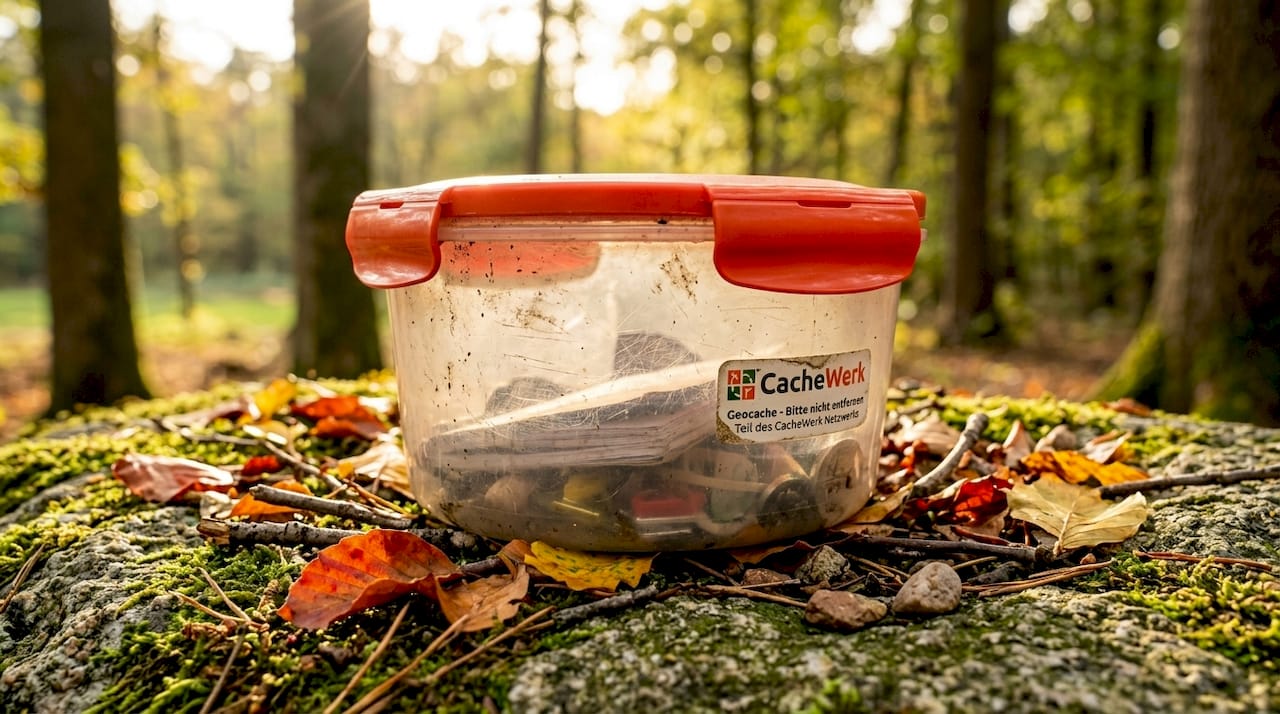
IP67-certified boxes offer significantly more protection. This certification guarantees complete dust-tightness and protection against immersion up to one meter deep for 30 minutes. Such boxes, like the Bunker Tough series, are made from recycled plastic and feature multi-point locking systems. This makes them the first choice for damp or exposed locations.
3D-printed cache containers made from PETG or ASA are the most creative category. PETG is considered a better outdoor option than PLA due to its durability, UV and water resistance. ASA even surpasses PETG in terms of UV resistance, making it particularly suitable for locations permanently exposed to the sun. Cachewerk offers precisely these types of 3D-printed specialty items that can be customized.
Metal boxes made of stainless steel or aluminum are the most durable option. They do not rust, are mechanically robust, and last for decades. Their disadvantage: weight and cost are higher, and metal boxes can appear more conspicuous in certain environments than camouflaged plastic variants.
Here's a quick overview of the types:
- Classic plastic containers: inexpensive, widely available, limited durability
- IP67-certified boxes: waterproof, dustproof, robust for extreme locations
- 3D-printed containers made from PETG or ASA: customizable, weather-resistant, creative
- Metal boxes: maximum durability, heavier and more expensive
2. Ingress Protection Ratings and Weather Resistance Compared
The IP (Ingress Protection) code describes how well an enclosure is protected against foreign objects and water. The first digit stands for dust protection (6 = completely dust-tight), the second for water protection (7 = immersion up to 1 meter). IP67 is therefore the minimum standard for cache boxes placed in damp forests, near streams, or close to the ground.
UV resistance is an often underestimated factor. Direct sunlight degrades plastics over months. ASA offers superior UV resistance compared to standard materials like PLA, making it the better choice for caches on exposed rocks, fences, or building facades. PETG also withstands UV radiation well, but over the long term, it is slightly more susceptible than ASA in extreme sun exposure.
| Feature | Classic Plastic Container | IP67 Box | PETG 3D Print | ASA 3D Print | Metal Box |
|---|---|---|---|---|---|
| Waterproofness | Low | Very High | Medium to High | Medium to High | High |
| UV Resistance | Low | Medium | Medium | Very High | Very High |
| Durability | 1 to 3 Years | 5 to 10 Years | 3 to 7 Years | 5 to 10 Years | 10 Years and More |
| Weight | Light | Medium | Light | Light | Heavy |
| Price | Low | Medium | Medium | Medium | High |
Waterproofness alone is not enough. Temperature changes cause seals to shrink and expand, leading to leaks over time. Boxes with silicone lips or integrated sealing rings stay sealed longer than those with simple snap-on lids.
Pro Tip: Test every new cache box before placing it: place a paper tissue inside, seal the box, and submerge it in a bucket of water for 30 minutes. If the tissue is dry, the box is truly watertight.
3. Size and Design: How Camouflage and Functionality Interplay
The size of a cache box determines where you can hide it and what you can put inside. Cache sizes range from Nano (under 100 ml) to Regular (1 to 20 liters), with each size having its typical areas of use. This is not a matter of taste, but of strategy.
Nano and micro containers are suitable for urban caches: under benches, on fences, behind signs. They are hard to spot but only have room for a rolled-up logbook. Small caches (100 ml to 1 liter) are all-rounders. They fit into tree hollows, under roots, or in rock crevices and offer space for a logbook and pen. Regular caches (over 1 liter) allow for trade items and are ideal for forest caches away from busy paths.
Design and color play a crucial role in camouflage:
- Earth tones (brown, green, gray) make boxes disappear into natural surroundings
- Textured surfaces mimic bark, stone, or moss
- Unusual shapes like screws, stones, or branches distract muggles
- Transparent boxes are suitable for hiding in foliage or underwater
3D-printed containers offer the greatest design flexibility here. Internal partitioning, logbook holders, and locking mechanisms can be precisely matched to the location. Cachewerk prints such special containers from PETG, enabling caches that no mass producer offers.
Pro Tip: Plan the internal layout before printing or purchasing. A logbook that jams or swells frustrates finders and damages the box from the inside.
4. Placement Rules and Geocaching Ethics in Box Selection
The choice of a cache box is not purely a technical decision. Geocaching placement rules require a physical, waterproof container with a logbook, as well as a minimum distance of 161 meters between caches. These rules directly limit material selection: a non-waterproof box is against the rules.
Ethics go beyond the minimum requirements. Good geocachers obtain permission from the landowner before placement, avoid damage to nature by digging or pruning, and choose containers that pose no danger to animals or muggles. Caches should not be buried and must be regularly maintained.
You should check the following points before placement:
- Is the box completely waterproof and does it contain a logbook?
- Have you obtained permission from the landowner?
- Does the box maintain the minimum distance of 161 meters from other caches?
- Does the placement cause any damage to plants, animals, or structures?
- Can you regularly maintain the box and replace it if necessary?
“The focus in geocaching is often on creative hiding places, but lasting accessibility and rule compliance are crucial for sustained success.” (Geocaching Placement Rules)
Geocachers should find at least 20 different caches before placing their first one. This experience sharpens the understanding of material selection, location choice, and the expectations of finders. Anyone who has searched for many caches themselves knows what makes a good box.
5. Practical Comparison: Which Cache Box Suits Which Adventure?
The best outdoor hiding box is one that fits the location. Here are specific recommendations by use scenario.
Extreme Environments and Long-Term Use: IP67-certified boxes are the first choice for locations near streams, in marshes, or on the coast. Their multi-point locking mechanism and IP67 certification keep them sealed even in constant humidity and mechanical stress. For caches that need to survive years without maintenance, there's no better option.
Creative Hides in Urban or Temperate Environments: 3D-printed containers made from PETG or ASA are unbeatable here. They can be camouflaged as a rock, screw, or tree stump and adapt to the location. The PETG 3D Printing Guide from Cachewerk explains how to optimally use the material for your cache. For locations with direct sunlight, ASA is the better choice compared to PETG.
Entry-Level and Simple Placements: Classic plastic boxes or simple metal containers are suitable for beginners and locations with little weather exposure. They are inexpensive, easy to obtain, and sufficient for first experiences with hiding. Those who want to place caches in Pfaffendorf and its surroundings will find natural locations that work well with simple containers.
| Scenario | Recommended Type | Advantage | Disadvantage |
|---|---|---|---|
| Damp, permanently exposed | IP67 Box | Maximum water protection | Higher price, heavier |
| Urban, creatively camouflaged | 3D print PETG or ASA | Individual shape, light | Sealing depends on print quality |
| Forest, temperate climate | Plastic container or Small box | Inexpensive, readily available | Limited lifespan |
| Long-term hide, nature | Metal box | Maximum durability | Heavy, expensive, more conspicuous |
| Nano hide, urban | Micro container | Very small, easy to camouflage | No space for trade items |
Pro Tip: Combine a robust outer container with an inner zip bag for the logbook and pen. This keeps the contents dry even if the outer seal fails.
6. Material Selection for 3D-Printed Cache Boxes in Detail
3D-printed outdoor cache boxes are not all created equal. The material determines lifespan, appearance, and suitability for the location. PLA is less suitable for outdoor use due to UV sensitivity and brittleness in cold temperatures. This is a common mistake among beginners who use inexpensive PLA prints as cache boxes.
PETG combines good impact resistance with solid UV resistance and is easier to print than ASA. It is suitable for most outdoor locations in Central Europe. ASA is the professional's choice for permanently sun-exposed or hot locations. It shrinks more during printing and requires more experience, but delivers the most durable results. The material and manufacturing method must be tailored to outdoor requirements for a cache box to truly be durable.
Cachewerk deliberately uses PETG for its 3D-printed products because it offers the best balance of printability, weather resistance, and dimensional stability. Those who print themselves should choose wall thicknesses of at least 2 mm and post-process sealing surfaces to prevent water ingress.
7. Maintenance and Care of Outdoor Cache Boxes
A good cache box requires regular care. Even IP67-certified containers lose their seal over time if gaskets dry out or closures become damaged. Plan for maintenance at least twice a year, ideally in spring after winter and in autumn before the first frost.
During a maintenance visit, check seals for cracks, clean closures of dirt and leaves, replace the logbook, and swap out wet or damaged contents. Silicone spray on sealing rings significantly extends their lifespan. For 3D-printed boxes, it's worthwhile to rework threads and sealing surfaces with a fine file if they have warped due to temperature changes.
Maintenance is also an ethical duty. Neglected caches with soaked logbooks or damaged boxes frustrate finders and harm the reputation of the entire community. Anyone who places a cache takes responsibility for its condition.
Key Takeaways
The most durable outdoor cache box combines IP67 protection or UV-resistant materials like ASA with regular maintenance and compliant placement.
| Point | Details |
|---|---|
| Material choice is crucial | PETG and ASA significantly outperform PLA and standard plastic in outdoor durability. |
| IP67 as minimum standard | For damp or exposed locations, IP67 certification offers the most reliable protection. |
| Match size and camouflage | From Nano to Regular, cache size determines location, content, and camouflage strategy. |
| Know and follow rules | Waterproof container, logbook, and 161-meter minimum distance are mandatory, not optional. |
| Don't forget maintenance | Bi-annual inspection maintains watertightness and protects the logbook and finder experience. |
My Assessment After Years with Outdoor Caches
I've seen many cache boxes come and go. The most common cause of damaged caches isn't vandalism, but poor material choice. If you take a cheap plastic container from the supermarket and bury it on a north-facing slope in the forest, don't be surprised if it looks like a sponge after two winters.
What truly surprised me: ASA as a printing material is still significantly underrepresented in the community. Most self-printers opt for PETG because it's easier to process. This is perfectly fine for most locations. But if you're planning a cache on a south-facing wall or a rock, you shouldn't shy away from the extra effort for ASA. The durability is noticeably better.
Another often underestimated point: the internal construction. A box that is perfect on the outside but doesn't hold a proper logbook inside will cause frustration for every finder. I always recommend securing the logbook and pen in a separate zip bag, even if the box is officially waterproof. Seals eventually fail, and then the zip bag is the last line of defense.
My honest advice: find at least 20 to 30 caches before you place your first one. You'll learn more about good boxes from that experience than from any article. You'll see what still works after years and what doesn't. And you'll understand why rule compliance and material quality are not bureaucracy, but respect for the community.
— Benedikt
Discover suitable outdoor cache boxes at Cachewerk
You now know what matters when it comes to outdoor hiding boxes. Cachewerk offers you precisely the products that meet these requirements.
In our assortment, you will find creative special hides made of PETG, including disguised containers in various shapes and sizes that you can use directly. For beginners and pros, there is also geocaching equipment and accessories, from logbooks to camouflage materials. All products are designed for durability and outdoor suitability. Drop by and expand your hiding possibilities with products that truly deliver on their promises.
FAQ
What is the best type of outdoor cache box?
IP67-certified boxes and 3D-printed containers made of ASA or PETG are the most reliable types for outdoor use. The choice depends on the location: humid areas prefer IP67, creative camouflage benefits from 3D printing.
Which material is most durable for outdoor cache boxes?
ASA and PETG significantly outperform PLA and standard plastic in terms of UV resistance and weather resistance. Stainless steel metal boxes are mechanically the most durable but are heavier and more expensive.
What are the rules for placing a cache box?
Geocaching placement rules require a waterproof container with a logbook and a minimum distance of 161 meters from other caches. Additionally, permission from the property owner is required.
How often do I need to maintain my outdoor cache box?
At least twice a year, ideally in spring and autumn. During this time, you check seals, replace the logbook, and clean latches.
Where can I buy high-quality outdoor cache boxes?
Cachewerk at cachewerk.de offers specialized geocaching hides and accessories, including 3D-printed containers made of PETG and creative special hides for various locations.