
Urban Camouflage: Step-by-Step Guide
The first time you think about urban camouflage how-to, you quickly realize: A camouflage pattern from the military store doesn't help much in the city. Instead of hiding, it acts as a giveaway. Urban environments have their own colors, textures, and lighting conditions. Concrete gray, asphalt, metal reflections, streetlights. No forest, no bushes. This guide shows you how to truly camouflage yourself in urban environments: with the right equipment, the right colors, specific techniques, and the often underestimated factor of behavior.
Table of Contents
- Key Takeaways
- Urban Camouflage How To: Basics and Equipment
- Step-by-Step: Effective Urban Camouflage
- Common Urban Camouflage Mistakes
- Effectiveness Check and Camouflage Adjustment
- My Experiences with Urban Camouflage
- Urban Camouflage with the Right Accessories from Cachewerk
- FAQ
Key Takeaways
| Point | Details |
|---|---|
| Colors are crucial | Grays and neutral tones blend better with the city than green or brown military patterns. |
| Think multi-sensory | Good camouflage must work optically, thermally, and in the near-infrared spectrum. |
| Behavior trumps pattern | Even the best pattern won't help if movement or posture stands out. |
| Avoid reflective surfaces | Matte fabrics and surfaces significantly reduce visibility under streetlights. |
| Regularly check | Camouflage effectiveness can be easily checked with a smartphone camera or line-of-sight test. |
Urban Camouflage How To: Basics and Equipment
Before you start putting together clothes or creating an urban camouflage pattern, you need a good understanding of the urban environment itself. Cities are visually chaotic. Walls, cobblestones, shop windows, pipes, signs. This sounds like a good backdrop for hiding. But it is precisely this diversity that makes camouflage difficult, because no pattern fits all contexts.
In 1987, the US Army analyzed urban color ranges pixel-based using a Terrain Analysis System to develop camouflage patterns. The result: Urban environments show a surprisingly narrow color palette. Gray dominates, complemented by beige, weathered white, and dark brown. Strong colors are rare.
Materials and Fabrics
For camouflage clothing for the city, a clear basic rule applies: no shiny surfaces. Reflections from metal or glass make you instantly visible, especially under street lighting or drone optics. Matte, textured fabrics such as cotton, corduroy, or technical fleece are the first choice.
Here is an overview of the most important material requirements:
| Category | Requirement | Examples |
|---|---|---|
| Fabric | Matte, low reflection | Cotton, Ripstop without shine |
| Color | Neutral tones, gray | Anthracite, light gray, beige |
| Texture | Irregular, pattern-breaking | Knitted fleece, textured jackets |
| Sensorics | Low near-infrared, insulating | Special textiles or layers |
| Accessories | Matte black or gray | Belts, bags, shoes |
Important equipment points:
- Matte shoe soles and dark shoe colors for ground-level camouflage
- No shiny zippers or metal buckles
- Caps or hats with unstructured shapes for silhouette disruption
- Gloves in neutral tones if hands are visible
The German Bundeswehr emphasizes that camouflage must be multi-sensory. This means: A pattern that looks good optically can immediately fail in a thermal imager. Thermal signatures, near-infrared reflection, and visual visibility are three separate problems that must be addressed simultaneously.
Step-by-Step: Effective Urban Camouflage
This is the core of this urban camouflage guide. These steps will take you from preparation to finished camouflage.
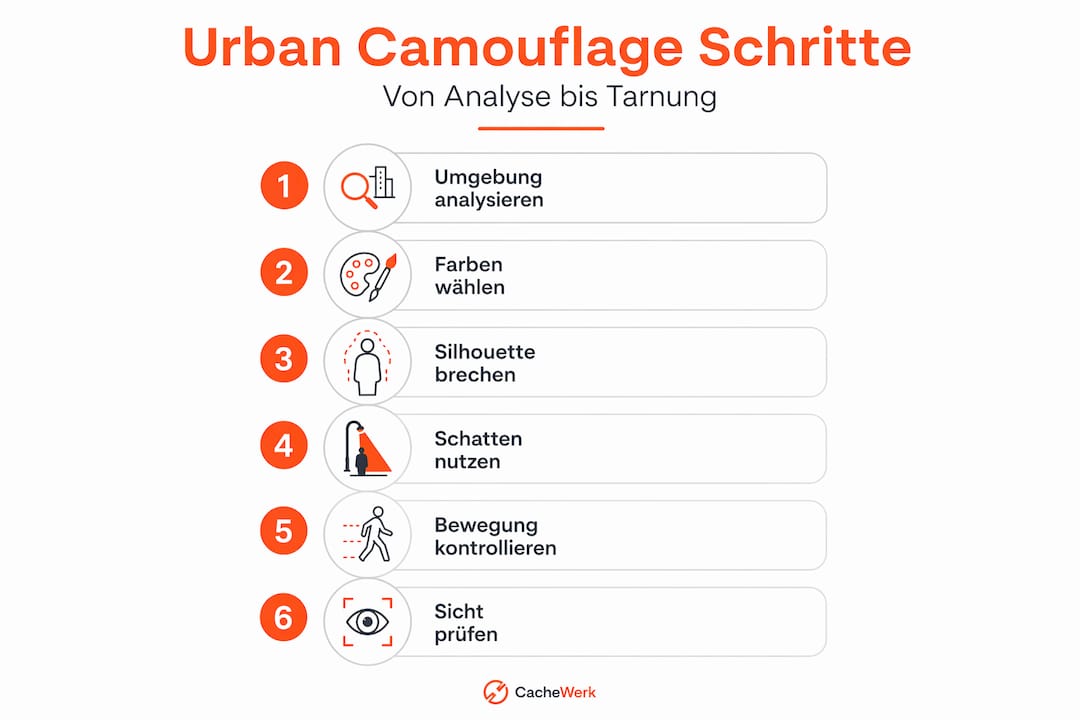
Step 1: Analyze the environment
Look at the exact location where you want to camouflage yourself. What colors dominate? What is the lighting like, day and night? Are there shadows, walls, or ledges? Take photos of the surroundings and compare the colors with your clothing on the display. This sounds simple, but it makes the biggest difference.
Step 2: Choose appropriate colors
Modern patterns like Urban MARPAT use pixelation and multi-level grays to break up silhouettes. You don't have to buy a military camouflage pattern. A dark gray top with medium gray pants and beige shoes will blend into almost any urban environment better than any camouflage jacket.
Step 3: Break up your silhouette
A clear body silhouette makes you recognizable, even if the colors are right. Use oversized or layered clothing to break up your body shape. Position yourself next to posts, walls, or vehicles, never freely in the middle of an open space.
Step 4: Actively use shadows
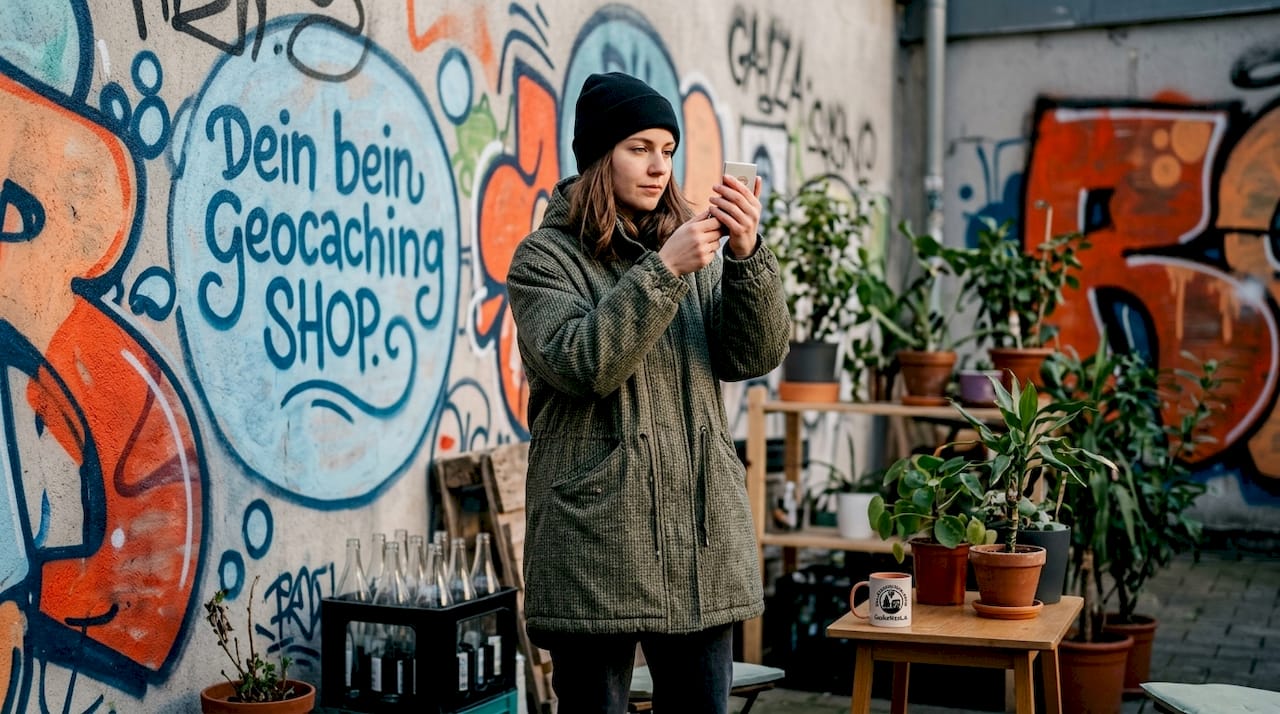
Shadows are your best friend for camouflage in urban environments. Building shadows, underpasses, niches. Instead of standing in the light, always move along the edge of the shadow line. This is where the contrast reduction is strongest.
Step 5: Control movement
Jerky, fast movements attract attention. Slow, even movements are much less conspicuous. And when you stand still: No fidgeting, no swaying. Stand like a part of the environment.
Step 6: Visibility check
Photograph yourself from 10 to 20 meters away. Do you immediately recognize that you are a person? Does the color match the background? If so, the camouflage is effective. If not, adjust the color or position.
Pro Tip: Photograph your camouflage clothing against typical urban surfaces like concrete walls or asphalt and zoom to 50 percent. What you see there roughly corresponds to the perception from a medium distance by an inattentive observer.
Common Urban Camouflage Mistakes
Many fail at camouflage in urban environments not because of the camouflage pattern itself, but because of avoidable mistakes. Here are the most common ones.
Wrong pattern for the environment
Multicam replaces flecktarn in urban areas because flecktarn is too high-contrast for cities. The garish green and brown of the classic military pattern stand out clearly against concrete and asphalt. Anyone working in the city with flecktarn is more visible than someone in plain dark gray.
Other common mistakes:
- Bright or high-contrast accessories like white sneakers or colorful backpacks
- Reflective sunglass lenses or shiny watch straps
- Relying solely on optical camouflage without considering thermal signatures
- Too rigid behavior: appearing too still or too controlled also draws attention
Behavior as a weak point
Camouflage alone is not enough. Anyone wearing a perfectly matched gray but nervously tapping on their phone, constantly turning around, or making abrupt movements will still stand out. Behavior is the crucial factor that most people underestimate.
Adapt culturally and socially to the environment. Are you in a train station? Move like someone looking for their train. In a park? Walk relaxed like someone strolling. This principle is called social camouflage and is just as important as optical camouflage.
Lack of consideration for sensor technology
In 1994, the US Army developed prototypes for urban camouflage solutions that were not widely implemented. The reason: the complexity of thermal and near-infrared requirements had been underestimated. For everyday life, this means: If you know that thermal imaging cameras are in use, simple aids like screens or glass panes can help reduce thermal signatures.
Pro Tip: Test your camouflage clothing at night with your smartphone's night mode. Many fabrics reflect much more strongly in the near-infrared than they do optically. What looks gray during the day can look almost white on camera at night.
Effectiveness Check and Camouflage Adjustment
A good urban camouflage strategy doesn't end with putting on clothes. Anyone who never checks their camouflage cannot know if it works. The good news is that checking is easier than you think.
Various methods allow for self-assessment of camouflage effectiveness without expensive equipment. The following table shows the most important control methods in comparison:
| Method | Effort | Depth of Insight | Recommended for |
|---|---|---|---|
| Smartphone photo from a distance | Low | Optical visibility | Beginners and quick checks |
| Smartphone night mode | Low | Near-infrared reflection | Night camouflage and sensor check |
| Line-of-sight test with observer | Medium | Realistic perception | Advanced |
| Thermal imaging camera | High | Thermal signature | Professionals with equipment |
| Video recording during movement | Low | Movement conspicuousness | All levels |
The most practical is a combination of photo test and night mode. Take a photo from 15 meters away in daylight and then one with night mode without flash. The differences are often astonishing.
Adjustments are useful if you change locations, the time of day or weather conditions change, or you get new information about the context. No universal urban camouflage pattern is perfect. Good camouflage is always situational.
Also check out the resources on urban hiding and camouflage if you want to apply these techniques in geocaching.
My Experiences with Urban Camouflage
I have built and placed many geocaching hides in cities. In doing so, I have experienced one thing again and again: The most common mistake is believing that a great pattern is enough.
In practice, it's the exact opposite. A plain dark gray hide that matches the wall and has no reflection is found much less often than an elaborately patterned one that doesn't fit the context. Camouflage is not a costume. It is an adaptation to the space.
What surprised me most: Behavior is at least as important as optics. I have observed muggles walking past a perfectly camouflaged cache, but still hesitating briefly because the person next to it was standing unnaturally still. The brain doesn't just recognize colors. It recognizes anomalies.
My personal tip for anyone who wants to delve deeper: Learn how light falls in your specific environment. Morning, noon, evening. Each time of day creates different shadows and different reflections. Whoever understands this makes better decisions about color, position, and material selection, without needing expensive equipment.
The limits of modern camouflage technology are not in the material, but in the context. The best camouflage pattern won't help you if you are in the wrong place or move incorrectly. First learn about the environment, then the pattern.
— Benedikt
Urban Camouflage with the Right Accessories from Cachewerk
Do you want to apply urban camouflage techniques not only for yourself, but also to perfectly hide your geocaches? Then Cachewerk is the right place for you. We offer specially developed accessories for urban environments that implement exactly the principles described in this article: adaptation to the cityscape, matte surfaces and context-appropriate shapes.
From creative special caches for the city to well-thought-out geocaching camouflage accessories, you'll find everything you need for your next urban cache at Cachewerk. A highlight is the Fake Hydrant Sign camouflage hide, which blends almost invisibly into any cityscape. Let yourself be inspired and discover how professional camouflage and creative geocaching go together. All products are weatherproof, durable and made in Germany.
FAQ
What is urban camouflage and what is it used for?
Urban camouflage refers to camouflage techniques and clothing specifically adapted to urban environments. It is used for tactical, military, and leisure applications such as geocaching to remain inconspicuous in the cityscape.
Which colors work best in the city?
Grays, anthracite, beige, and weathered white blend best with urban surfaces such as concrete, asphalt, and stone. Green or brown military patterns appear too high-contrast in cities and increase visibility.
Is a good camouflage pattern alone sufficient for effective camouflage?
No. According to research and military practice, camouflage must also include behavior and context. Movement, posture, and social adaptation are at least as crucial as the visual pattern.
How can I test my camouflage myself?
Photograph yourself from 15 to 20 meters away in daylight and use your smartphone's night mode for a near-infrared check. Simple methods like these allow for quick self-assessment without expensive equipment.
How does geocaching camouflage differ from military camouflage?
In geocaching, the camouflage of caches is paramount, not people. The basic principles are similar: color matching, matte surfaces, and context-appropriate shapes. Cachewerk offers products specially developed for this purpose, which are perfectly integrated into the cityscape.