
Why Fakes and Decoys Make Geocaching Better
Fakes and camouflage objects in geocaching are intentionally designed hiding places or deceptions that deliberately mislead seekers while protecting the cache from unwanted discovery. The technical term is camouflage cache or cammo cache. Both concepts use the same basic principle: the human brain recognizes objects as familiar more quickly when they fit into the context. This is precisely why fakes and camouflage objects are so effective. Anyone who wants to make their hiding places more creative and durable cannot ignore the psychological mechanisms behind these methods.
Why are fakes and camouflage objects so effective in geocaching?
Fakes work because the brain recognizes patterns rather than analyzing. Neuromarketing expert Rasimus describes that the brain assumes a consistent story as soon as all elements fit together. For geocachers, this means: A camouflage object that visually, contextually, and haptically matches its surroundings will simply be overlooked by the seeker.
Four psychological mechanisms explain the effect:
- Confirmation Bias: Seekers expect branches, stones, and bark on a forest path. A cache in the form of a stone confirms this expectation and is not questioned. Timo Lenk from TU Dortmund proves that manipulative messages confirm expectations rather than changing them.
- Emotional Trust Facade: A camouflage object does not sell the object itself, but the feeling that there is nothing unusual to be found here. This emotional credibility is the decisive factor.
- Overconfidence Effect: People massively overestimate their ability to recognize fakes. The average hit rate in distinguishing between real and fake content is only about 56 percent. This is equivalent to a coin toss.
- Time Pressure and Excitement: Those who search excitedly think less critically. The most critical moment for fake recognition is the phase before evaluation, when emotional excitement clouds thinking.
Pro-Tip: Design your camouflage object not only to fit visually, but also haptically. A resin stone feels different from a real stone. Eliminating this difference significantly increases the deception effect.
The same principle applies to custom-made caches: the more consistent the overall picture, the longer the cache remains undiscovered.
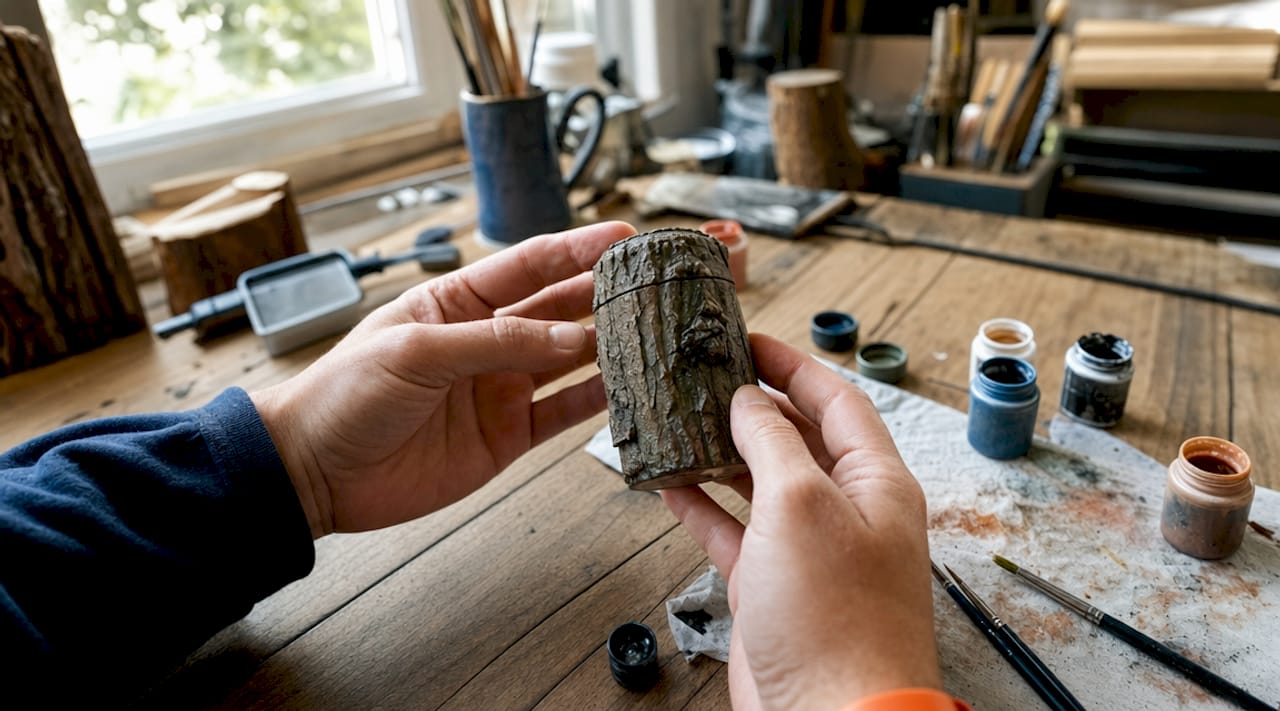
How AI is changing the design of camouflage objects
Artificial intelligence is changing the way fakes are created and recognized. This affects not only digital content, but increasingly also the physical design of geocache hiding places. Anyone who understands the technology can use it specifically for better camouflage.
Here are the most important developments at a glance:
- AI generates realistic templates: AI tools make it possible to create deceptively real texts and images with little effort. For geocachers, this means: background stories, signs, and labels for camouflage objects can be created quickly and professionally.
- Deepfakes as a benchmark: By the end of 2026, over 33 percent of all viral misinformation on social networks will be AI-generated. This trend shows how realistic digital deceptions have become. Physical camouflage objects can learn from this quality benchmark.
- Detection becomes more difficult: The better the tools, the harder the detection. A meta-analysis of over 86,000 people shows that the hit rate for fake detection is about 56 percent. This means that even attentive geocachers are regularly deceived by well-designed camouflage objects.
- Objective testing methods become necessary: If you can't rely on your gut feeling, you need a method. Cognitive reflection and awareness of one's own recognition errors are the most effective protection against deception.
The practical benefit for geocachers is clear: AI-generated labels, signs, or hint texts make a camouflage object more authentic. A sign with a weathered look and local reference, created with an AI image generator, appears more convincing than a handwritten note.
Fakes vs. Camouflage Objects: What's the Difference?
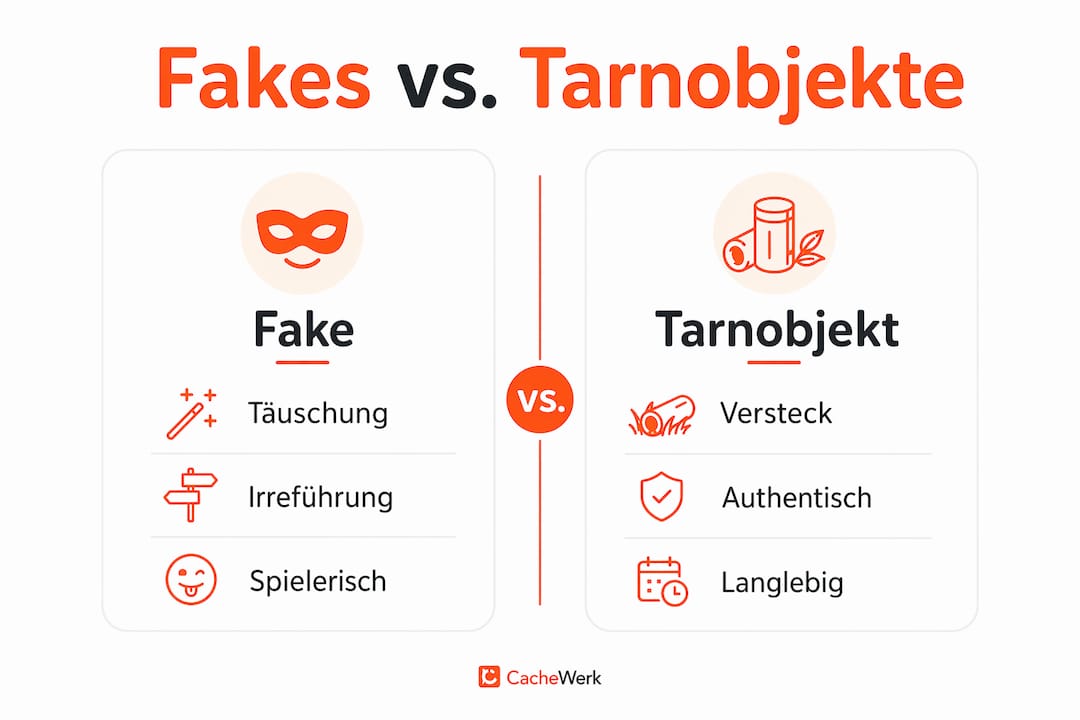
Both terms are often used synonymously in geocaching, but they describe different concepts. Understanding these differences will help you choose the right tool for your hide.
| Feature | Fake | Camouflage object |
|---|---|---|
| Definition | Deception object that pretends to be another cache | Object that conceals the real cache |
| Goal | Mislead seekers | Make cache invisible |
| Example | Apparent magnetic strip without content | Resin stone with hollow space |
| Psychological Effect | Frustration and surprise | Invisibility through context |
| Advantage | Increases difficulty | Protects the cache long-term |
| Disadvantage | Can annoy seekers | Requires precise material selection |
A consistent overall picture of history, local reference, and design makes camouflage objects credible. For geocachers, the backstory is just as important as the quality of the camouflage. A tree fungus as a camouflage object looks convincing in the forest. The same tree fungus in a town square looks out of place and is immediately noticeable.
Fakes, on the other hand, are a playful tool. They increase the difficulty of a cache and create the typical geocaching moment where you laugh because you've fallen for a deception again. The role of camouflage in geocaching thus goes far beyond mere hiding. It actively shapes the gaming experience.
Practical tips for convincing camouflage objects
Good camouflage objects don't happen by chance. They are the result of a conscious decision for material, context, and story. These tips will help you take your next hide to a new level.
Material selection and design:
- Choose materials that match the environment. PETG plastic from 3D printing can be painted, weathered, and textured.
- Pay attention to weight and haptics. A stone that is too light or a branch that is too smooth will stand out.
- Use local colors and textures. A gray stone in a sandstone area looks suspicious.
- Weather new objects artificially with sandpaper, paint, and dirt before placing them.
Backstory and context:
A credible backstory makes a camouflage object authentic and is more important than the pure aesthetics of the object. A sign with a local reference, a supposed maintenance sign, or a seemingly forgotten tool create context. This context activates the seeker's confirmation bias and makes the object appear self-evident.
Pro-Tip: Visit the planned hiding place at different times of day and in different weather conditions. What is invisible in the shade in the morning can immediately stand out in the sunlight at noon.
Overcoming your own confirmation bias:
Anyone looking for a cache should actively work against their first impression. The most critical moment for fake detection is the phase before evaluation. Rasimus recommends pausing briefly and consciously asking: What would I not expect here? This method works both when searching and when designing hiding places.
Checklist for inspecting a camouflage object:
- Does the object match the environment in color, texture, and size?
- Does it look convincing from all sides?
- Can it withstand weather, moisture, and temperature fluctuations?
- Is access to the cache container inconspicuous?
- Is there a plausible story why this object is here?
For creative DIY ideas and practical instructions, you will find many directly implementable inspirations at Cachewerk.
Safety and protection against unwanted fakes
Not every fake in geocaching is fun. Poorly designed or misleading objects can endanger seekers, confuse uninvolved parties, or permanently damage the cache. Safety begins with planning.
- Clear labeling in the listing: Describe in the cache description on Geocaching.com that fakes or camouflage objects are present. Seekers should be surprised, but not endangered.
- No dangerous materials: Do not use sharp edges, toxic paints, or materials that could be mistaken for the environment and endanger animals.
- Regular maintenance: Camouflage objects age. Paint peels off, materials break. Check your hide at least twice a year and after extreme weather events.
- Involve the community: Platforms like Geocaching.com offer reviewers and community feedback. Actively use this feedback to identify problems early.
- Consider sustainability: Use weather-resistant and durable materials like PETG plastic. A cache that disintegrates after a winter leaves trash in nature and harms the reputation of the geocaching community.
For protection against vandalism, the following applies: The more inconspicuous a camouflage object, the less likely it is to be removed or damaged by uninvolved parties. Camouflage therefore protects not only against seekers, but also against accidental destruction.
Key findings
Fakes and camouflage objects work because they activate the seeker's confirmation bias and create trust through consistent design, context, and story.
| Point | Details |
|---|---|
| Psychology is crucial | Confirmation bias and overconfidence make well-designed camouflage objects almost invisible. |
| Story trumps aesthetics | A credible backstory is more convincing than pure design. |
| AI as a design tool | AI tools help create realistic labels and backstories. |
| Fakes and camouflage objects differ | Fakes deceive about the location, camouflage objects hide the cache itself. |
| Safety requires planning | Regular maintenance and clear listings protect seekers and nature. |
My assessment of fakes and camouflage objects in geocaching
What surprised me most after years in the geocaching community: The most elaborate camouflage objects are rarely the most effective. A simple PETG branch that precisely imitates the texture and weight of a real branch beats any elaborately painted artificial stone. The reason is simple: perfection stands out. Natural imperfection does not.
I see a clear trend towards AI-supported camouflage. Geocachers use image generators for weathered signs and language models for credible hint texts. This is exciting, but it carries a risk: If everyone uses the same AI tools, similar camouflages will emerge. Originality then becomes a real competitive advantage.
What I wish for the community is more awareness of the balance between creativity and fairness. A cache with ten fakes and one real container can be frustrating if the clues in the listing are missing. Creativity and transparency are not mutually exclusive. They complement each other.
My advice: Invest more time in the backstory of your camouflage object than in its appearance. And test your hide with someone who doesn't know the location. That person's reaction is more honest than any self-assessment.
— Benedikt
Your next hide with professional camouflage
You now know how fakes and camouflage objects work psychologically and what matters in their design. The next step is to implement them with the right material.
Cachewerk has developed the tree fungus geocache specifically for this purpose. This camouflage object made of high-quality PETG plastic looks like a real tree fungus, is weatherproof, and can withstand harsh winters. It fits perfectly into forest environments and activates exactly the confirmation bias you now know. The tree fungus is one of the most popular camouflage objects in the Cachewerk range because it combines optics, haptics, and durability. Take a look at the hide directly and take your next cache to a new level.
FAQ
What is the difference between a fake and a camouflage object?
A fake deceives about the position or existence of a cache, while a camouflage object conceals the actual cache container. Both use the seeker's confirmation bias, but pursue different goals in game design.
Why are camouflage objects so difficult to recognize?
The average detection rate for fakes is only about 56 percent. Well-designed camouflage objects fit so precisely into their context that the brain automatically accepts them as part of the environment.
What materials are best suited for camouflage objects?
PETG plastic from 3D printing is weatherproof, dimensionally stable, and can be painted and textured. For urban camouflage, magnetic hides and everyday objects like screws or cable boxes are also suitable.
How do I create a convincing backstory for my camouflage object?
A credible story needs a local reference, a plausible reason for the object, and consistent details. AI tools like ChatGPT help create short and authentic-looking texts for signs or listings.
How do I protect my cache from accidental discovery by uninvolved parties?
Choose materials and shapes that exactly match the environment, and place the cache so that uninvolved parties have no reason to touch the object. Regular maintenance and a clear listing on Geocaching.com further reduce the risk.