
What is the cache center in geocaching?
The cache centroid is the geographical center of all geocache locations in a specific area. Technically, this concept is also known as a geo-centroid: the calculated center of gravity for a group of GPS coordinates. If you want to know where the majority of caches are concentrated in a region, the cache centroid provides a precise answer. Tools like GSAK and GC-Project automatically calculate this point from your GPS data. This article explains how the calculation works, the practical benefits of the centroid, and how you can use it for your next geocaching tour.
What is a cache centroid and how is it calculated?
The cache centroid, also known as a geo-centroid, is the geographical center of a group of caches. It is created by averaging all GPS coordinates of the caches in question. The result is a single point on the map that describes the central location of the entire collection.
Mathematical background
The calculation follows a simple principle: All latitudes are added together and divided by the number of caches. The same applies to longitudes. In a small area, for example within a city, this method provides very accurate results. Over very large areas, such as entire countries, spherical corrections are necessary because the Earth is not a flat disk.

Known tools for calculation
For practical use, there are several proven programs:
- GSAK (Geocaching Swiss Army Knife): GSAK calculates the cache centroid directly from the imported GPS data and displays it on a map. Plugins extend the function with visualizations and export options.
- GC-Project: A web-based tool that manages geocaching data and calculates the geo-centroid for selected cache groups.
- Geocaching.com Statistics: The official platform displays approximations for the personal cache centroid in profiles and statistics.
- Self-calculation: With a simple spreadsheet like Microsoft Excel or Google Sheets, the centroid can be manually determined from exported coordinates.
Different calculation methods lead to slightly different results, depending on the weighting of the caches or the underlying algorithms. Therefore, it is worthwhile to know the tool you are using and its method.
Difference from the geographical center
The cache centroid is based on the actual cache positions. It thus differs from the geographical center of an area, which simply describes the center of a surface. A city park may be geographically in the center of a city, but the cache centroid shows you where the caches are actually concentrated. This is the decisive difference for route planning.
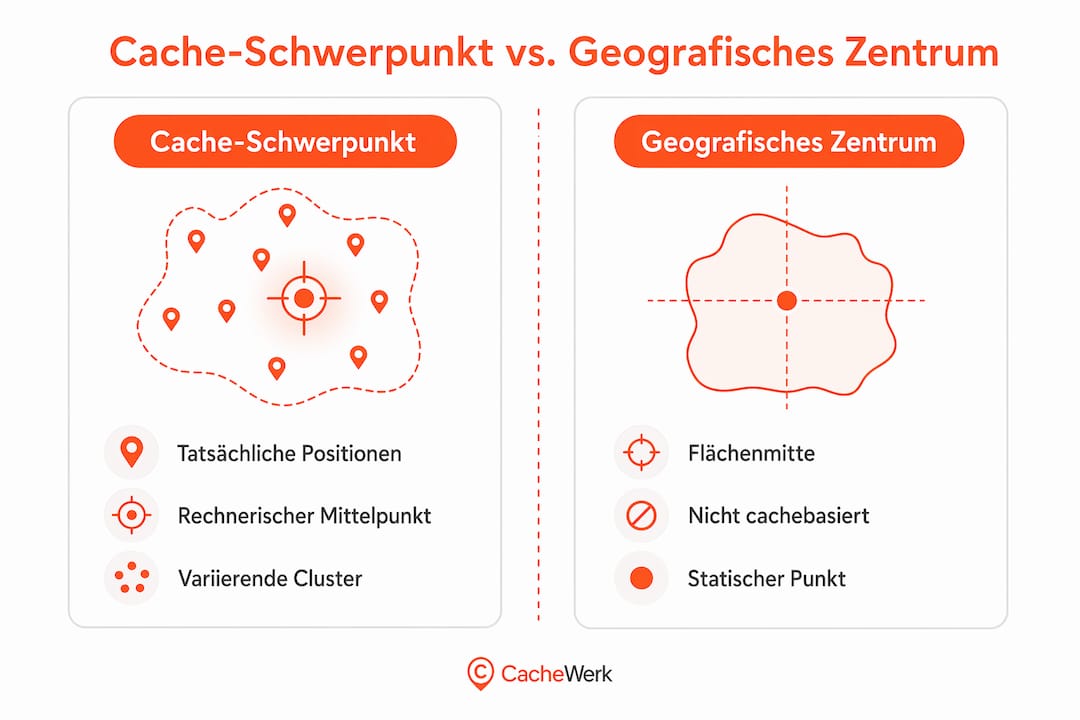
Pro Tip: Export your found caches from Geocaching.com as a GPX file and import them into GSAK. With just a few clicks, you can see your personal geo-centroid on the map.
What is the significance of the cache centroid for geocachers?
The cache centroid helps with route planning and provides central orientation in areas with many geocaches. Those exploring a new area can quickly see where caches are dense and where gaps exist. This saves time and makes searching more efficient.
Practical benefits at a glance
The geo-centroid fulfills several specific tasks in geocaching:
- Route optimization: You start your tour from the centroid and reach most caches with shorter distances.
- Area overview: For large cache collections, the centroid shows whether the caches are evenly distributed or concentrated in one sub-area.
- Estimate cache density: Geographical clusters of caches become visible, which improves strategic searching.
- Personal statistics: Many geocachers track their own centroid over the years. If it moves north, they have recently searched for more caches in the north.
- Planning new caches: Those who place caches themselves can see from the centroid where there are still gaps in the area.
What the centroid does not do
The cache centroid is not a promise that a cache is located at that exact point. It is a calculated value, not a physical location. Anyone navigating to the centroid will not automatically find a cache there. The point serves as an orientation aid, not a destination. Having this expectation clear prevents frustration during the search.
A high-quality geo-centroid significantly facilitates orientation and filtering for large numbers of caches. This is appreciated by speedcachers, who want to find as many caches as possible in a short time, as well as casual seekers, who want to explore an area at their leisure.
Cache Centroid versus other geocaching concepts
The cache centroid is one of several concepts that geocachers use for orientation. The following table shows the main differences:
| Concept | Description | Main Benefit |
|---|---|---|
| Cache Centroid (Geo-Centroid) | Calculated center of all cache coordinates | Route planning, area overview |
| Geographical Center | Geometric center of an area or region | Cartographic reference |
| Popular Cache | Cache with many favorite points | Quality-oriented search |
| Mystery Cache Coordinates | Calculated target coordinates after puzzle solution | Single cache search |
| Cache Cluster | Group of caches in close proximity | Efficient multiple search |
Centroid versus Cluster
A cache cluster describes a collection of caches in a small area. The centroid shows where the center of all caches is, even if they are widely dispersed. Both concepts complement each other: The centroid provides direction, while the cluster shows the densest locations.
Connection with cache types
Traditional caches, multi-caches, and mystery caches all equally contribute to the centroid calculation, provided their coordinates are known. For mystery caches, the target coordinates are often only known after solving the puzzle. This means that a centroid based on unsolved mystery caches is less precise than one based on traditional caches. If you want accurate results, you should only include caches with verified coordinates.
How can you practically use the cache centroid?
The calculation and application of the Geo-Centroid follows a clear procedure. Here is a step-by-step guide for practical use:
- Export caches: Download your desired caches or found caches from Geocaching.com as a GPX file.
- Import file: Open GSAK and import the GPX file. The program automatically reads all coordinates.
- Calculate centroid: Use the statistics function or a GSAK plugin to calculate the Geo-Centroid. The result appears as a coordinate pair.
- Check coordinates on the map: Transfer the centroid to a map app like Google Maps or OsmAnd. This way, you can immediately see where the point is located.
- Plan route: Start your tour from the centroid or use it as the center for a search radius.
- Adjust results: Filter your cache list by type, difficulty, or terrain and recalculate the centroid. This way, you get a Geo-Centroid that perfectly matches your search profile.
Recommended apps and tools
In addition to GSAK and GC-Project, there are other useful helpers. c:geo is a free Android app that manages geocaching data and displays simple statistics. Cachly performs the same function for iOS users. For pure coordinate calculation without software, an online centroid calculator is sufficient, into which you manually enter the coordinates.
Pro Tip: Calculate the centroid separately for different cache types in an area. This way, you can see if traditional caches and mystery caches are concentrated in different zones. This helps you to focus your tour specifically on one type.
The method can be adapted flexibly. If you are only looking for caches of a certain difficulty level, filter the list accordingly and recalculate the centroid. The result then shows exactly where the suitable caches are located. This flexibility makes the Geo-Centroid a real planning tool, not just a statistical gimmick.
Key takeaways
The cache centroid is the most effective tool for area overview in geocaching because it transforms GPS data into a single, actionable point of orientation.
| Point | Details |
|---|---|
| Definition of Geo-Centroid | The cache centroid is the calculated center of all GPS coordinates of a cache group. |
| Best Tools for Calculation | GSAK and GC-Project automatically calculate the centroid from imported GPX files. |
| Main Benefit for Geocachers | The centroid improves route planning and shows cache density at a glance. |
| Important Limitation | There is no cache at the centroid itself. It is a calculated value, not a physical destination. |
| Flexible Use | Filter by cache type or difficulty and recalculate the centroid for more precise results. |
My experiences with the cache centroid in practice
I've been using the geo-centroid for years, and my honest assessment is: most geocachers massively underestimate this tool. Many look at a map, zoom in, and search intuitively. That works for ten caches. With a hundred caches in an unknown area, you quickly lose track without a centroid.
What particularly surprised me: The centroid not only shows where the caches are, but also where they are not. In dense urban areas, I often found that the geo-centroid differed significantly from the geographical city center. This means that the cache community favored certain neighborhoods and avoided others. This is information that no map provides at first glance.
However, there is a limit that I want to clearly state: The centroid is only as good as the data you input. If you include unsolved mystery caches, you get a distorted value. If you only export a small part of the available caches, you only see a snapshot. The tool is precise, but the quality of the result depends on your preparation.
For everyone who wants to place cache containers and hides themselves: The centroid is also useful when placing new caches. You immediately see whether your planned location fills an existing gap or whether you are placing it in an already dense area. This makes your hide more interesting for other seekers.
— Benedikt
Start your next tour with the right equipment from Cachewerk
You now know how the cache centroid works and how to use it for your route planning. The next step is to set off well-equipped. Cachewerk offers you exactly what you need for starting or expanding your equipment: high-quality, durable products developed for urban and rural geocaching tours.
The Geocaching Starter Bundle 1 contains a PETling, logbook, and holder. Everything you need to place your first own cache around your calculated centroid. If you want more flexibility, opt for the Geocaching Starter Bundle 2 with additional suspension. Both bundles are ready for immediate use and perfect for anyone who wants to approach their hobby with well-thought-out equipment.
FAQ
What does Cache Centroid mean in Geocaching?
The cache centroid, also known as a geo-centroid, is the calculated center of all GPS coordinates of a group of geocaches. It indicates the central location of caches in an area and serves as a reference point for route planning.
Which tool best calculates the cache centroid?
GSAK is the most used program for calculating the geo-centroid. It imports GPX files from Geocaching.com and automatically calculates the centroid from all contained coordinates.
Is there always a real cache at the cache centroid?
No. The centroid is a calculated value, not a physical location. There is usually no cache at this point. It serves solely as an orientation aid for planning.
How does the cache centroid differ from the geographical center?
The geographical center describes the center of an area. The cache centroid is based on the actual cache positions and takes their distribution into account. Both points can be far apart if caches are unevenly distributed.
Can I calculate the cache centroid separately for different cache types?
Yes. Filter your cache list in GSAK or GC-Project by type, difficulty, or terrain and calculate the centroid for each group separately. This will give you more precise results for your specific search profile.