
What is Urban Camouflage? Camouflage for the city
Many people immediately think of green spots in the forest when they hear the word camouflage. This is understandable, but in urban environments, it works differently. Urban camouflage, as it's known in English, follows completely different rules. It's not about becoming completely invisible, but about blending into the environment and being harder to spot. Whether you're geocaching, interested in military history, or simply curious about the concept: this article explains what urban camouflage means, how it works, and why it has taken on a whole new meaning in Geocaching 2026.
Key Takeaways
| Point | Details |
|---|---|
| Basic principle of urban camouflage | Urban camouflage adapts colors and shapes to urban environments, not to nature or forests. |
| Military versus recreation | Military patterns often remained experimental, while geocaching uses creative everyday camouflage solutions. |
| “Hidden in Plain Sight” in geocaching | Caches in 2026 are disguised as everyday objects and thus hidden right before the eyes of passers-by. |
| Observe legal limits | Urban camouflage must comply with local laws and geocaching guidelines to avoid problems. |
| Know the pros and cons | Urban camouflage is very effective depending on the context, but quickly fails in dynamically changing urban areas. |
The Role of Urban Camouflage in Urban Spaces
Urban camouflage refers to camouflage patterns and methods specifically designed to make people or objects harder to detect in urban areas. The crucial difference from classic natural camouflage lies in the color spectrum and the structures used. While forest camouflage works with green, brown, and earthy tones, as well as organic shapes, urban camouflage relies on shades of gray, beige, off-white, hard edges, and geometric patterns. This corresponds to the typical appearance of concrete, masonry, facades, and road surfaces.
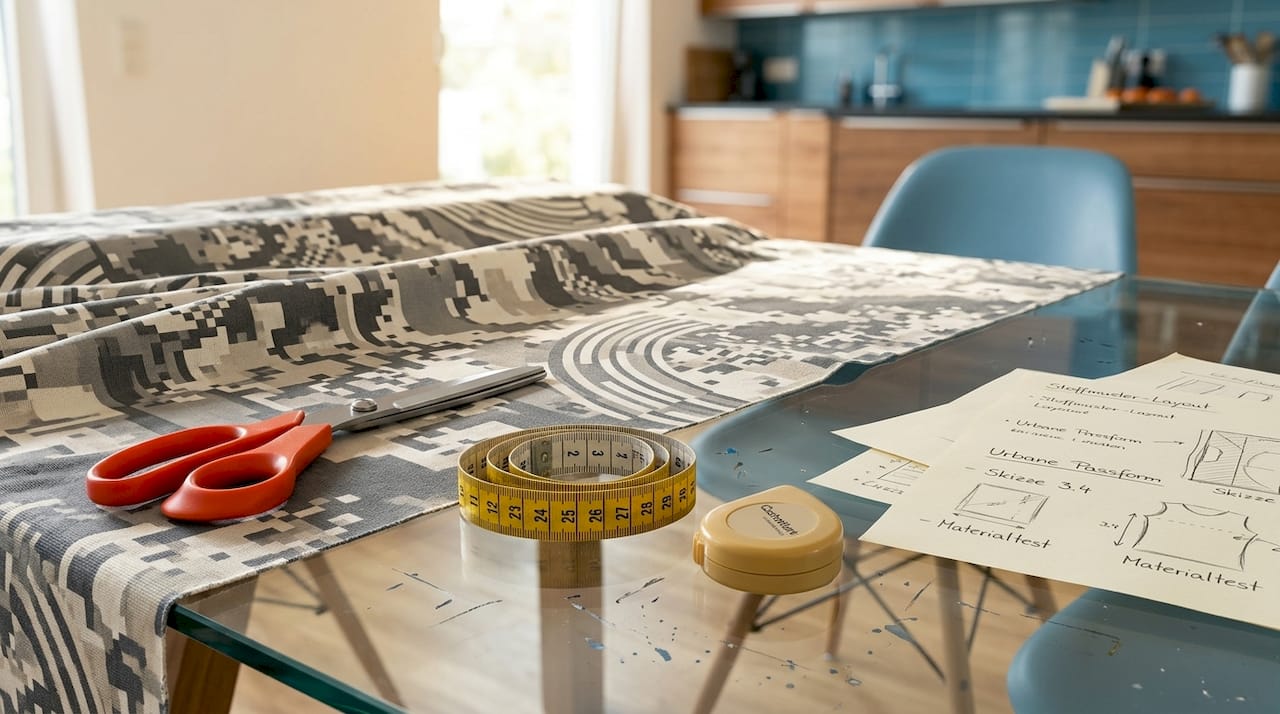
The function of urban camouflage is less about complete disappearance. Rather, it's about not attracting the attention of the surroundings. That sounds subtle, but it's the core of the concept. In a city, there are no dense bushes to hide behind. Instead, there are street signs, manhole covers, electrical boxes, and house walls. Anyone camouflaging here must appear to be part of this environment.
Specifically, the function of urban camouflage works with the following principles:
- Color adaptation: Gray, beige, and brown tones dominate because urban surfaces are rarely intensely green or brown.
- Structural mimicry: Patterns mimic masonry, asphalt, concrete cracks, or plaster surfaces.
- Form disruption: Clear contours are optically broken up by patterns, so body shapes are less immediately recognizable.
- Context integration: The camouflaged object or person blends into the typical visual noise of the city.
Militarily, urban camouflage is primarily used in scenarios referred to as MOUT. This stands for "Military Operations on Urban Terrain." Police special units and security forces use similar concepts.
Pro Tip: If you're developing camouflage solutions for geocaches yourself, take a close look at the color palette of your target environment. A cache that's well camouflaged in downtown Hamburg will immediately stand out in a small-town pedestrian zone.
Historical Development in the Military
The history of military urban patterns is characterized by experiments that mostly did not make their way into widespread equipment. This shows how difficult the topic is.
- MOUT Programs of the 1990s: During the urban warfare debates after the Cold War, the US military began developing and testing specific patterns for urban environments.
- Urban Warrior Experiments: In the mid-1990s, the US Marine Corps tested the "Urban Warrior" program, which also included new camouflage technologies and patterns for urban operations.
- Dual Texture Pattern: This pattern combined two different texture levels to imitate surfaces like concrete or rubble. It was tested but never officially introduced.
- Urban Woodland: A variation of the well-known Woodland pattern, adapted with darker gray tones and reduced green content. This pattern also remained experimental.
- T-Block Pattern: A pattern with block-like, pixelated structures designed to break up a person's outline in urban spaces.
The main reason why these patterns were not widely introduced was often impracticability. Urban environments are extremely diverse. A pattern that works well in a bombed-out building completely fails in a modern shopping street. The US military ultimately opted for so-called "Universal Patterns" that perform acceptably in both urban and other environments. The best example is the ACU pattern (Army Combat Uniform), which found wide application but was often criticized by soldiers as unsuitable.
Nevertheless, these historical attempts paved the way for later developments. Digital pixel patterns, as found in many armies today, conceptually trace back to these experiments.
Urban Camouflage in Geocaching 2026
This is where it gets really exciting for you as a geocacher. The concept of urban camouflage has found a completely new stage in 2026. Geocaching.com has announced the first hiding theme of the year under the motto “Hidden in Plain Sight: Urban Edition”. The goal: to embed caches in urban environments in such a way that they are directly in front of the eyes of passers-by and yet are hardly found.
What's fascinating about this is how close this concept is to the original military idea. Not invisibility, but seamless integration. In geocaching, urban camouflage is used creatively by disguising caches rather than simply hiding them.
Typical methods in urban geocaching include:
- Magnetic attachments: A small container with a magnet adheres to metal posts, sign holders, or railings. It looks like part of the object or like casually placed material.
- Mimicry of urban objects: Caches are designed as screw heads, door locks, city seals, or street signs. Those who aren't specifically looking will simply walk past.
- Integration into everyday elements: Books on shelves in front of bookstores, plant pots, electrical boxes, or barriers offer camouflage opportunities.
- Flip-up closures and secret compartments: The mechanism is hidden, the external appearance remains 100 percent city-appropriate.
The review of the first hiding theme of 2026 shows particularly creative examples. Caches were attached to public fences as door locks or placed on historical buildings as city crests. One cache looked deceptively real like a manhole cover sticker with a small hollow space underneath.
What these examples have in common: they combine credible object visibility with hidden mechanics. That is the essence of urban camouflage in geocaching.
Pro Tip: Photograph the target environment of your planned cache hide from different perspectives before you build it. Pay attention to recurring objects, colors, and structures. Your cache should appear to be one of these elements at first glance, not a foreign object.
Further tips for creative hiding spots in the city can be found directly on the Cachewerk blog.
Legal and Ethical Aspects
Urban camouflage in geocaching sounds like pure creativity. But there are clear boundaries that you must know and adhere to.
Geocaching.com expressly emphasizes compliance with local laws and guidelines for urban caches. This is not an empty hint, but has practical consequences. Anyone who places a cache in an unauthorized location risks trouble with authorities, claims for damages, or damaging the reputation of the entire geocaching community.
You should always keep the following points in mind:
- Check for permits: Public spaces, monuments, and building facades are often protected. When in doubt, ask the responsible authority.
- Do not damage property: A camouflage must never require permanent attachment that damages the surface. Magnets and adhesive strips are often acceptable; screws or glue are not.
- No confusion with dangerous objects: A cache that looks like an unmarked package or technical device can trigger a police response. Dangerous appearances are absolutely taboo.
- Respect platform cache guidelines: Geocaching.com has clear rules for placement. These rules apply even if local laws are more permissive.
- Transparency when finding: Anyone looking for or placing a cache should act discreetly so as not to alarm or startle uninvolved parties.
Adhering to these basic rules ensures that urban camouflage in geocaching remains a positive experience for everyone. The treasure hunt as a team event also shows how well-thought-out and rule-compliant urban puzzles can work in a professional context.
Advantages and Limitations of Urban Camouflage
Not every camouflage strategy fits every environment. Urban camouflage has clear strengths, but also significant weaknesses.
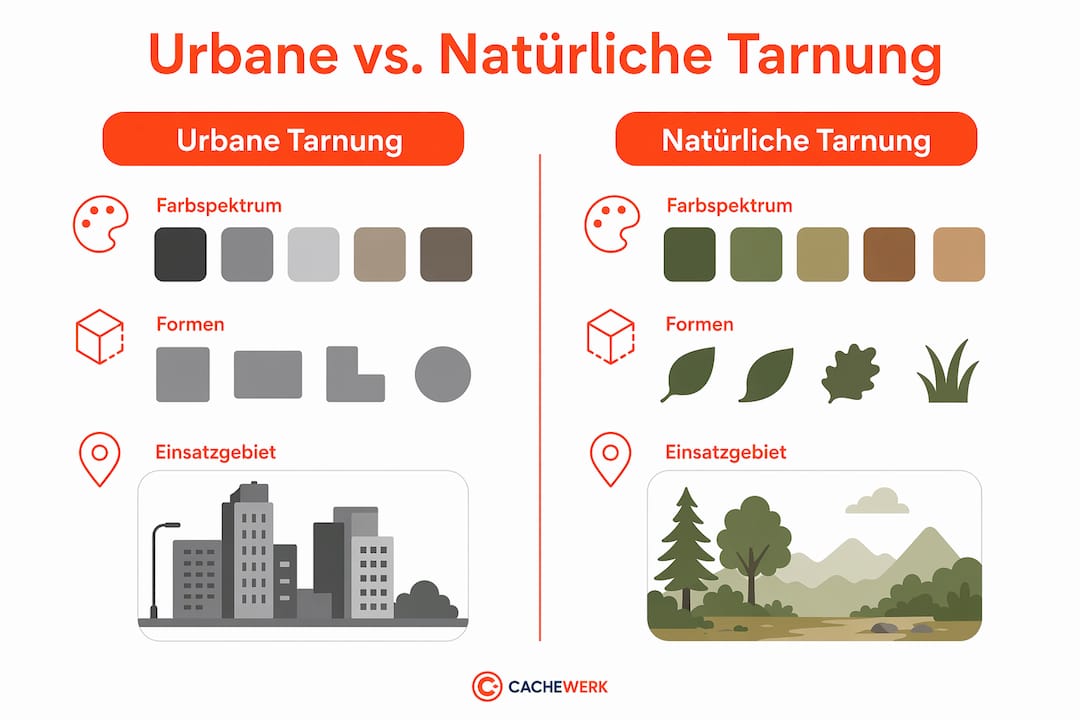
| Criterion | Urban Camouflage | Natural Camouflage |
|---|---|---|
| Color Spectrum | Gray, Beige, White, hard edges | Green, Brown, earthy tones, organic shapes |
| Effect in the city | High, if environment is consistent | Low to none |
| Effect in nature | Low to counterproductive | High |
| Flexibility | Limited, context-dependent | More versatile in forests and fields |
| Application in geocaching | Very good for urban caches | Good for forest and nature caches |
Natural camouflages work with organic colors and shapes, while urban camouflages work with hard edges and shades of gray. These differences make direct transfer between environments almost impossible.
The particular challenges in urban areas lie in their dynamism. A city is constantly changing. New graffiti, freshly painted house walls, or seasonal decorations can render carefully planned camouflage useless overnight. A cache that looked perfect in October can stand out conspicuously in December with Christmas decorations around it.
At the same time, urban camouflage offers advantages that natural camouflages cannot provide. In a city, no one looks twice if something looks like a screw head, a wall rosette, or a street sign. This social invisibility is more powerful than any color adaptation pattern.
“The most effective camouflage in the city is not the best pattern, but the most convincing object.” This applies equally to military and geocaching.
Future prospects point to even more refined methods. 3D printing with PETG and other weather-resistant materials allows urban objects to be reproduced deceptively realistically. Cachewerk uses precisely this technology to produce custom-made camouflage casings that fit into real urban environments.
My Experience with Urban Camouflage
By Benedikt
I've been using urban camouflage in geocaching for years, and frankly, at first, I made the same mistake as many others. I thought it was enough to take a gray container and stick it to a gray wall. That doesn't work. What really works is the convincing power of the object.
The best caches I've ever placed or found didn't look like caches. They looked like something that was supposed to be there. An old screw on a metal railing. A sticker on an electrical box. A small metal sign on a barrier.
What I've learned from military history: no pattern or color can replace a convincing object. The U.S. military experimented with elaborate patterns and ultimately still opted for universal solutions because urban diversity is too great. This lesson is directly transferable to geocaching.
My honest advice to anyone who wants to start with urban camouflage: Look at the city with new eyes. What belongs there? What do you no longer notice after passing it a hundred times? That's exactly your hiding place.
— Benedikt
Your Equipment for Urban Geocaches
You now know what urban camouflage is all about and how you can use it creatively. Now comes the practical part. Cachewerk offers you exactly the products you need for convincing urban hiding places. From magnetic mini-containers to 3D-printed PETG camouflage housings and custom-made urban surface imitations: the range is specially designed for geocachers active in urban areas. You'll also find trackables and accessories for multi-stage caches with hidden mechanisms. Check out the entire geocaching equipment at Cachewerk and find your next hiding project. For further inspiration on innovative camouflage techniques, it's also worth taking a look at the Cachewerk blog.
FAQ
What exactly does urban camouflage mean?
Urban camouflage refers to camouflage methods that make people or objects harder to detect in urban environments. It uses shades of gray, hard edges, and geometric patterns to blend in with concrete, facades, and road surfaces.
How does urban camouflage work in geocaching?
In geocaching, urban camouflage is used by disguising caches as everyday urban objects, such as screws, door locks, or city signs. The camouflage combines a credible appearance with a hidden mechanism.
What advantages does urban camouflage have over forest camouflage?
Urban camouflage is significantly more effective in urban environments than forest camouflage because it is adapted to the specific colors and shapes of a city. In nature, the same camouflage would immediately stand out.
Are there any legal restrictions on urban camouflage in geocaching?
Yes. Caches must comply with local laws and must not damage property or have dangerous optics. Geocaching.com prescribes clear placement guidelines that must always be followed.
Why were military urban patterns often not introduced?
Military urban camouflage patterns such as Dual Texture or Urban Woodland mostly remained experimental because urban environments are too diverse to be covered by a single pattern. The US military therefore opted for universal patterns with broader applicability.