
Placing a Geocache Discreetly: Workflow, Legality, and Equipment
The most efficient way to discreetly place a cache follows a clear 6-step process: Plan → Obtain Permission → Prepare → Camouflage → Deploy → Document and Maintain. For this, you'll need a compact core set including a waterproof container, a logbook in a zip-lock bag, inconspicuous camouflage, a GPS or smartphone with a power bank, a small tool kit, and a stash note with your contact details. Start today: choose a location, secure permission, and get started with a step-by-step geocaching guide as a Traditional cache.
- Step 1: Plan location (surroundings, muggle risk, accessibility)
- Step 2: Obtain permission (landowner, forestry office, nature conservation)
- Step 3: Prepare container and test for watertightness
- Step 4: Prepare camouflage and formulate hint
- Step 5: Place discreetly during muggle-free times, average GPS coordinates
- Step 6: Create listing, insert logbook, establish maintenance plan
Pro Tip: Place your first cache as a Traditional. CacheWiki recommends this because it helps you avoid coordinate errors and unsolvable puzzles that beginners often incorporate into more complex types.
Key Takeaways
A legally sound, low-maintenance workflow for discreet cache placement begins with obtaining permission, relies on waterproof containers, and concludes with a fixed maintenance schedule.
| Topic | Details |
|---|---|
| Permission first | Contact landowner and forestry office before deciding on a location. |
| Pack waterproof | Always put the logbook in a zip-lock bag, even with seemingly sealed containers. |
| Average GPS | At least five measurements, ideally on two different days. |
| Choose muggle-free time | Place early morning or evening, avoid weekend peak hours. |
| Cachewerk as equipment source | Rusty Bolt Cache and Fake Water Shield are ready-to-use solutions for urban hides. |
Table of Contents
- What legal aspects do you need to check before placing a cache?
- Which hide type suits which environment?
- Which containers are truly watertight and for how long?
- How does on-site placement proceed step-by-step?
- How often do you need to maintain your cache and what does the reviewer expect?
- Legal Notice: What you need to know as a cache owner in Germany
- What I've truly learned after years in geocaching
- Suitable Cachewerk products for your core set
- Sources
What legal aspects do you need to check before placing a cache?
The right to access forests allows you to enter the forest. However, it does not permit you to permanently leave objects there. This is an important distinction that many beginners overlook.
Basic rule for Germany: The consent of the landowner is required in most cases. In state forests in Rhineland-Palatinate, consent may be considered granted under certain conditions if you adhere to the rules for nature-compatible geocaching. Forestry offices can provide information on ownership.
Practical checks before placement:
- Determine landowner: ask forestry office, municipality, or land registry office
- Exclude nature reserves, national parks, and bird sanctuaries
- Maintain minimum distances from paths, cemeteries, and playgrounds
- Read and adhere to the reviewer rules of the Geocaching Listing Requirements
- Place a stash note with your name and contact information in the cache so authorities can reach you
The cache owner bears full responsibility. Reviewers check the listing but do not provide legal advice. A cache in an illegal location will be archived.
Which hide type suits which environment?
The choice of hide type directly depends on the environment. What works in the forest will immediately stand out in the city.
Forest: Choose hides that can be found with one or two simple actions. Intensive searching leaves visible damage and can lead to archiving. Precise coordinates and a clear hint are more important than tricky camouflage. Maintain distance from wildlife crossings and breeding grounds.
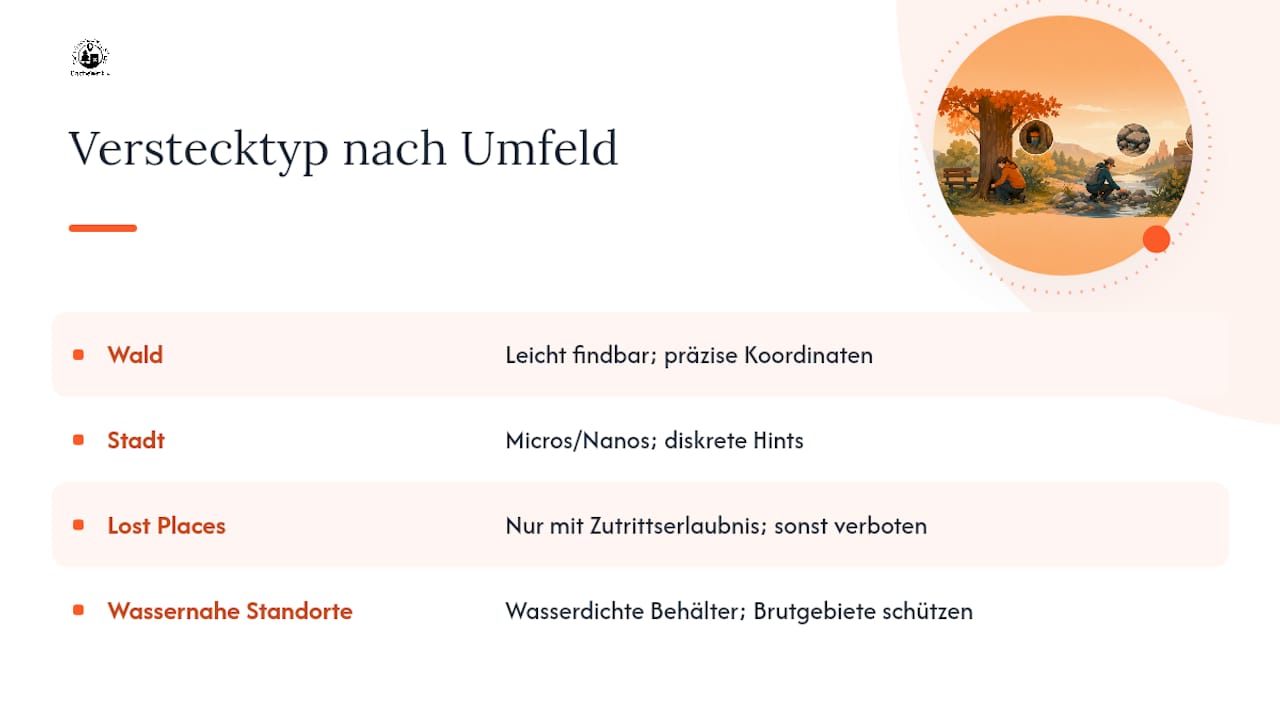
City: Micros and nanos are the first choice here. According to the state capital Düsseldorf, urban cache owners should prioritize discretion and formulate hints to avoid long, conspicuous searching. Urban furniture like lampposts, signs, or benches are suitable if the camouflage is truly effective.
Lost Places: Here, legal review comes first. If there is a prohibition of entry, placing a cache is not permitted, regardless of how interesting the location is. No cache without legally compliant access permission.
Water-adjacent locations: Waterproof containers are mandatory. Protect banks and breeding grounds, ensure safe accessibility without climbing.
Pro Tip: Before publishing, ask two or three independent geocachers to test your cache. They will find coordinate errors and camouflage issues that you might not notice because you already know the location.
Which containers are truly watertight and for how long?
Not every container survives a German winter. UV radiation, frost, and moisture quickly degrade cheap plastic.
| Container Type | Typical Size | Water Protection | Robustness | Maintenance Effort |
|---|---|---|---|---|
| PETling | Nano to Regular | Good (screw cap) | Medium (UV-sensitive) | Low |
| Film canister / Nano | Nano | Moderate | Low | Medium |
| Magnetic container | Nano to Micro | Good (if sealed) | High | Low |
| Plastic waterproof container | Micro to Large | Very good | High | Very low |
| PETG printed parts | Variable | Good | Very high (UV-stable) | Low |
Containers and camouflage printed from PETG are more UV and frost resistant than standard PLA and last significantly longer. The logbook should always be in a zip-lock bag, even if the container is considered waterproof. Waterproof containers are essential, and protecting the logbook with a zip-lock bag is one of the simplest measures you can implement immediately.
- PETling plus freezer bag for the logbook: proven combination for forest hides
- Magnetic container: ideal for urban furniture, but check seal regularly
- Uncomplicated, robust camouflage increases lifespan and reduces damage by finders
How does on-site placement proceed step-by-step?
This procedure works equally well for forest and urban caches. Stick to the sequence.
- Confirm location: Check on-site if the planned spot is truly suitable. Assess muggle traffic, check sightlines.
- Average GPS: At least five measurements at the same spot, ideally on two different days. Note coordinates and cross-check with a map app.
- Seal test: Close container, shake briefly, check for leaks. Insert logbook into zip-lock bag.
- Prepare camouflage: Have camouflage material ready before placing the container. Avoid long fiddling at the hide location.
- Place discreetly: Short duration of stay. No onlookers. Restore camouflage immediately.
- Spoiler photo: Only if necessary for the listing. No photo that draws muggle attention to the cache.
- Insert logbook and stash note: A stash note with your name and contact belongs in every cache.
Tool checklist for placement:
- GPS device or smartphone with offline map and power bank
- Small tool kit (pliers, screwdriver)
- Spare logbook and zip-lock bags
- Gloves (protect you and leave no traces)
- Inconspicuous bag or backpack
Pro Tip: Place early in the morning or just before dusk. Avoid weekend peak times between 10 AM and 4 PM. Fewer muggles mean less risk of being observed while hiding.
How often do you need to maintain your cache and what does the reviewer expect?
Maintenance is not an option; it's a duty. A neglected cache harms the community and can be archived.
Recommended maintenance intervals:
- Urban micros: check every four to six weeks
- Forest traditionals: every two to three months, immediately after severe storms
- After any indication of a problem in the logbook: respond within two weeks
Typical maintenance tasks:
- Check logbook for completeness and moisture, replace if necessary
- Inspect seal and closure
- Check camouflage for damage and repair
- Confirm cache availability in the listing
If you know you won't be able to maintain a cache for an extended period, set the listing to "temporarily unavailable." Reviewers expect owners to respond to problem reports. Caches that are permanently unmaintained or cause environmental damage will be archived. Forestry offices and nature conservation authorities can have caches removed if necessary. This is why a stash note with your contact details belongs in every cache.
More on logbook care and long-term maintenance can be found in Cachewerk's practical guide to cache maintenance.
Legal Notice: What you need to know as a cache owner in Germany
Personal responsibility: As a cache owner, you bear sole responsibility for the lawful placement of your cache. This article provides general information and does not substitute for legal advice. In case of uncertainties, contact the relevant forestry office or the lower nature conservation authority of your district.
Key points at a glance:
- Nature reserves, national parks, and FFH areas are generally off-limits
- Property rights also apply in the forest: right of access ≠ right to deposit objects
- Forestry office and lower nature conservation authority are the right contacts for questions about location and permission
- If requested by authorities, the cache must be removed immediately
What I've truly learned after years in geocaching
The most common mistake I see among new cache owners: too much effort on camouflage, too little on preparation. A spectacular hide is useless if the coordinates are ten meters off or the container is full of water after the first rain.
My advice: Start with a Traditional. CacheWiki and community experience clearly show that beta testing by independent geocachers significantly improves the quality of a new cache. A low-maintenance urban micro that runs smoothly for two years brings more joy than an elaborate hide that gets archived after three months.
Suitable Cachewerk products for your core set
To get started with discreet cache placement, you don't need a huge amount of equipment. Two products from the Cachewerk range directly cover the most common use cases.
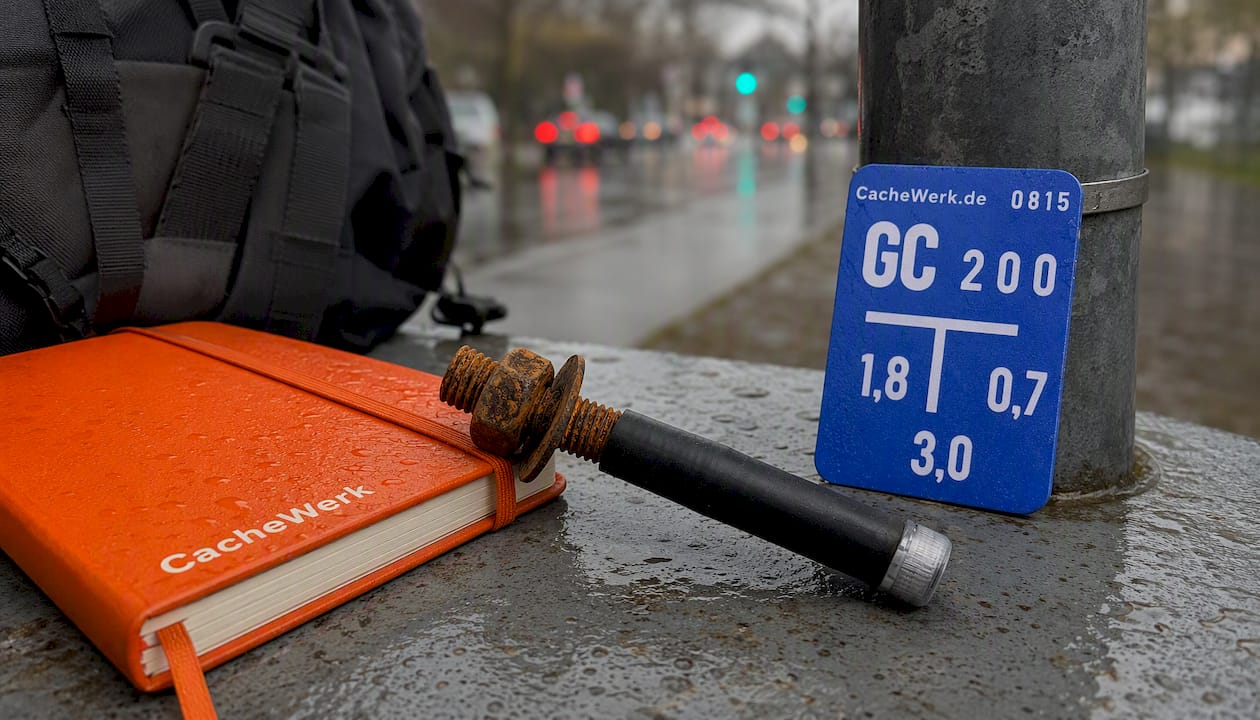
The Rusty Bolt Cache is a rusty bolt with an integrated nano container. It looks like an ordinary bolt on a wall or railing and goes unnoticed even by attentive muggles. Perfect for busy urban areas where a classic magnetic container would be too conspicuous.
The Fake Water Shield is an urban camouflage hide with a post holder. It blends seamlessly into the cityscape and can be attached to lampposts or signposts. Anyone looking to place a cache in the city center that truly remains invisible will find a well-thought-out solution here.
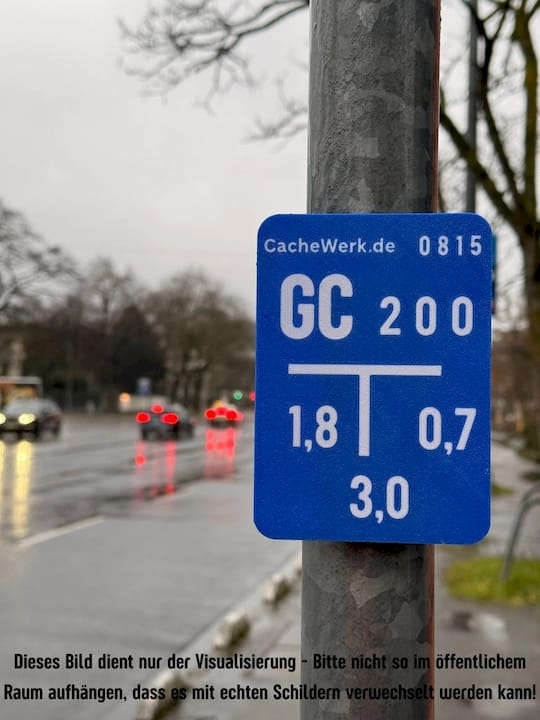
Both products are available in Germany and can be ordered directly from the Cachewerk shop. For creative camouflage ideas, it's also worth taking a look at the Cache Design Guide. The Cachewerk team is happy to help with any questions about the right product for your hide.
Sources
- Hiding Geocaches – CacheWiki
- Cache Maintenance – Opencaching‑Wiki
- Germany - Geocaching.com Wiki - Confluence
- Rules for nature-compatible geocaching in RLP – Landesforsten RLP
- Placing & Hiding Geocaches: Tips & Help for Beginners #1 – Geocaching‑Magazine
This article contains general information and does not replace advice from a qualified attorney. Consult a qualified legal professional regarding your personal situation before acting on the basis of this content.