
Understanding the Role of Cloaking in Caching
Camouflage in geocaching means far more than just sliding a container under some leaves. The role of camouflage in caching encompasses the entire interplay of material selection, on-site behavior, listing design, and game design. Those who understand this don't just place a container. They create an experience. Good camouflage protects the cache from curious eyes without frustrating genuine finders. Poor camouflage costs the cache its life. This article shows you which methods truly work, which rules you need to know, and how to make your hides durable and secure.
Table of Contents
- Key Takeaways
- Fundamentals and Rules of Camouflage in Geocaching
- Camouflage Methods and Examples of Hides
- Digital Support for Hiding
- Sustainable and Secure Camouflage in Practice
- Camouflage as Part of Game Design
- My Assessment of the Art of Camouflage
- Take Your Camouflage to the Next Level with Cachewerk
- FAQ
Key Takeaways
| Point | Details |
|---|---|
| Camouflage is not an end in itself | It protects the cache from muggles and must simultaneously give genuine finders a fair chance. |
| Compliance with rules is mandatory | No cache may imitate dangerous objects. Waterproofing and clear labeling are indispensable. |
| Digital tools prevent errors | The Geocaching App from version 10.7.0 supports coordinates, attributes, and photos directly when hiding. |
| Repeatability is decisive | Camouflage that doesn't hold up after the third rain harms the cache more than no camouflage at all. |
| Listing and camouflage belong together | Visual camouflage without suitable listing hints causes confusion. Both levels must be coordinated. |
Fundamentals and Rules of Camouflage in Geocaching
Camouflage in geocaching describes all measures that make a cache container invisible or uninteresting to non-geocachers, i.e., muggles. It's not about fundamentally hiding the cache. It's about placing and designing it so that it blends completely into its surroundings.
The geocaching etiquette emphasizes inconspicuous behavior and the exact re-hiding of the cache after each find. This means: camouflage doesn't start with the container. It begins with the person searching for or placing it. Anyone frantically digging in a bush on a busy street endangers the cache, no matter how well it's hidden.
Clear obligations apply to all cache owners:
- The cache must be waterproof or at least withstand local weather conditions.
- It must not imitate dangerous objects, such as weapons, ammunition, or suspicious packages.
- It must be identifiable as a geocache, at least by an official label or a note inside.
- The exact re-hiding by finders is mandatory. For this, camouflage must be designed so that it can be reproducibly used.
Pro Tip: Include a small note with the text "This is a Geocache" in the cache. This clarifies its purpose to finders and prevents authorities from reporting the find as suspicious.
Those who know these basic rules already have a clear advantage. Many poorly maintained caches fail not due to the idea, but due to a lack of care in precisely these points.
Camouflage Methods and Examples of Hides
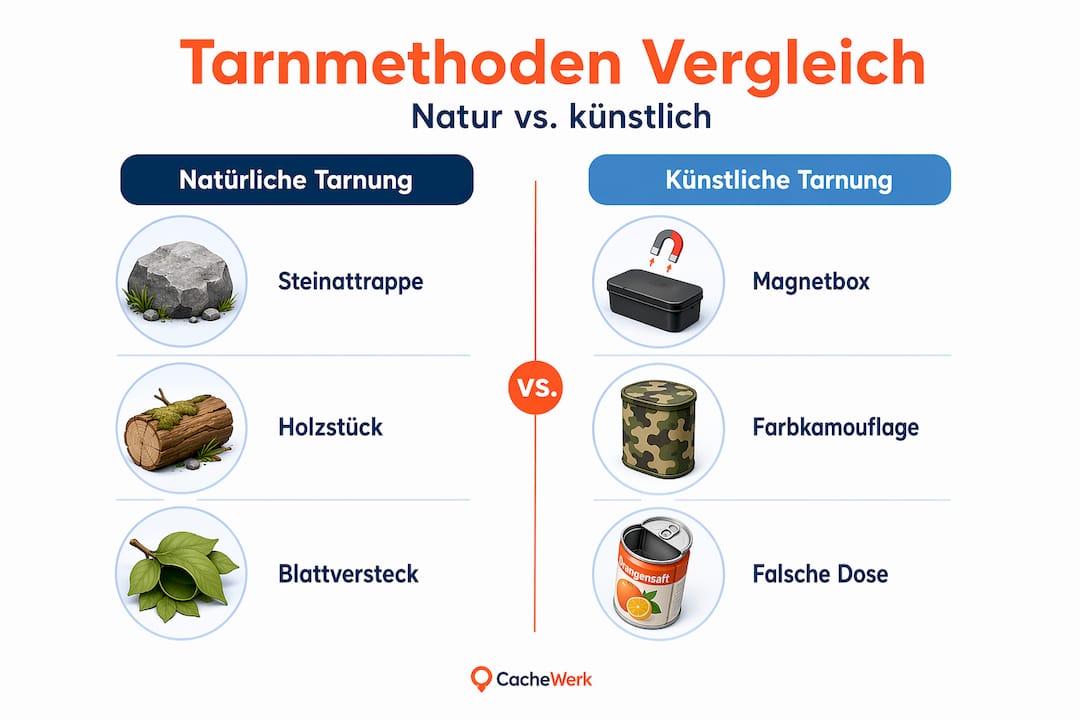
The variety of camouflage methods is impressive. Beginner guides list many camouflage approaches as inspiration, but practice shows: not every method suits every location. Here's an overview of the most common approaches, so you can decide what fits your cache concept.
Nature-like Camouflage:
- Tree root optics made from PETG print, seamlessly blending into the soil
- Resin stones with a hollow interior
- Bark pieces or leaf dummies placed over small nano-containers
Urban Camouflage:
- Magnetic containers that look like screw heads or bolts
- Everyday objects like transformer box dummies, paving stones, or manhole cover dummies
- Sign camouflage, for example, a realistic fake hydrant sign with an integrated logbook
These categories differ not only visually. They also differ in maintainability, weather resistance, and finder-friendliness.
| Camouflage Type | Advantages | Disadvantages |
|---|---|---|
| Natural stone replica | Inconspicuous, robust, weather-resistant | Can shift with falling leaves or snow |
| Magnetic dummy | Very compact, ideal for metal surfaces | Can be accidentally removed by muggles |
| Tree root optics | Very deceptive, strong WOW effect upon finding | More expensive to produce, requires precise location |
| Fake sign | Perfect urban camouflage, immediately explainable context | Requires precise listing details to avoid confusion |

Important: How you communicate the camouflage in the listing directly influences whether finders are successful or give up. Visual camouflage and listing text must work together. A magnetic screw without the hint "magnetic" in the listing leads to frustration.
Digital Support for Hiding
Those who want to professionally place their cache have had a real advantage since 2026 with the Geocaching App. The app from version 10.7.0 allows mobile coordinate entry directly at the hiding spot, setting attributes, and inserting photos for the listing.
Initially, this sounds like a convenience feature. In practice, however, it prevents common errors. Those who enter coordinates on the computer risk deviations. Those who capture them directly at the location with a smartphone save search time for later finders. Photos from the app also help you reconstruct the camouflage position later if you need to maintain or re-camouflage the cache.
Digital tools like the app greatly facilitate adherence to hiding standards. You can assess difficulty levels and terrain ratings directly on-site, instead of estimating them afterward. The result: more precise listings, fewer failed searches, more satisfied finders.
Pro Tip: When hiding, take three photos. One showing the camouflage position from the finder's perspective, one the context (tree, lantern, wall), and one a detailed view of the camouflage. This way, you can reliably maintain the cache even after months.
A stepped strategy combines visual camouflage with precise listing attributes and supporting images. This is not an extra; these are the fundamentals of good cache maintenance.
Sustainable and Secure Camouflage in Practice
Even the most creative camouflage is useless if it looks abandoned after the first winter. Repeatability and weather resistance are the decisive factors for long-term functional camouflage.
Here are five concrete steps you should keep in mind for every new cache project:
- Choose weather-resistant materials. PETG prints, resin stones, or weatherproof magnets withstand rain, frost, and heat better than simple PLA or unglued natural replicas.
- Subject the camouflage to a stress test. Place the container with camouflage in moist soil for three days and then check if the camouflage is still in place and if the logbook has remained dry.
- Include clear labeling inside. As the rules for cache containers show, even 3D-printed camouflage containers must be clearly identifiable as a geocache.
- No imitation of dangerous objects. Hand grenade optics, packages with wires, or containers that look like explosives are not only forbidden but can also trigger police deployments.
- Plan maintenance intervals. After placing the cache, set a fixed date for the first inspection, for example, after three months.
Pro Tip: Test your camouflage with a non-geocaching friend before submitting the cache. If they find the hide strange or suspicious, you need to rework it.
Common practical mistakes include loosely attached camouflage elements, moisture-permeable connections, and missing labels. Community experience shows that camouflage that elicits a positive logbook entry strikes the right balance: inconspicuous to muggles, clear to finders. You can get creative DIY ideas for hides from Cachewerk if you're looking for inspiration for your next project.
Camouflage as Part of Game Design
This is where it gets really interesting. Most cache owners only think of the container when it comes to camouflage. But the efficiency of camouflage in caching only becomes fully apparent when camouflage is conceived as part of the overall game concept.
In multi-caches, for example, camouflage functions as information design. Intermediate stations distract the eye from the final hide. The actual camouflage is not just achieved by the container, but by managing attention along the route. Finders focused on a puzzle are more likely to overlook the final. This is intentional.
What makes camouflage particularly strong in game design?
- Gradual approach: The first station is easy to find, the last station is perfectly camouflaged. This creates suspense.
- Context as camouflage: A cache located in a place where people normally stand or sit does not appear suspicious to muggles.
- Puzzles distract: Anyone pondering a puzzle isn't looking for the cache. This protects the hide.
- Utilize community feedback: Logs praising particularly successful camouflage are valuable indicators of what works in your concept. Inconspicuous labeling is positively rated by the community because it increases enjoyment without drawing attention.
The interplay of physical camouflage, puzzle design, and listing text is what separates a good cache from an average one. Those who see camouflage only as the last step are thinking too short-sightedly.
My Assessment of the Art of Camouflage
I've placed caches that I thought were perfect, and they were muggled within a week. And I've placed hides that I thought were simple and that have survived for years. The difference? The simple hides had camouflage that belonged in the environment. The elaborate ones had camouflage that drew attention to itself.
My experience shows: too much is just as bad as too little. A super-detailed tree root replica on a bare concrete wall immediately looks suspicious. Always think from the environment, not from the container.
What I've also learned: camouflage alone is not enough. On-site behavior protects the cache just as much as the material itself. Not even touching the cache in the presence of muggles is often the best decision.
My advice to anyone wanting to place their first cache: don't start with the most elaborate camouflage hide. Start with a camouflage that you can reproduce yourself after six months without instructions. And make sure the listing and the camouflage form a unit. A cache is not a solitary work of art. It's an experience for real people.
— Benedikt
Take Your Camouflage to the Next Level with Cachewerk
You now know what good camouflage entails. Cachewerk has the right products for it. Whether you're looking for a realistic fake hydrant sign for your urban hide or weatherproof camouflage modules for the forest, at Cachewerk you'll find solutions that not only look good but also last. All products are specially developed for geocaching requirements, often made from robust PETG material, and designed for durability. Also, check out the complete geocaching equipment and discover how much easier camouflaging becomes when you have the right tools. Your next cache deserves more than an empty film canister under a rock.
FAQ
What exactly does camouflage mean in geocaching?
Camouflage refers to all measures that make a cache container uninteresting or invisible to non-geocachers. This includes material selection, placement, and inconspicuous behavior on-site.
Which camouflages are forbidden in geocaching?
Containers that imitate dangerous objects such as weapons, ammunition, or suspicious packages are forbidden. They can trigger police deployments and violate community rules.
How do camouflages influence the geocaching experience?
Good camouflage enhances the fun for genuine finders and protects the cache from muggles. Too much camouflage without suitable listing information, however, leads to frustration and failed searches.
How does the Geocaching App help with camouflaging?
The app from version 10.7.0 allows coordinates to be captured directly on-site, attributes to be set, and photos to be inserted. This significantly reduces errors in listing and camouflage position.
How long does good cache camouflage last?
This strongly depends on the material and maintenance. Weather-resistant materials like PETG or resin last significantly longer than simple natural materials. Regular maintenance intervals are crucial for sustainable camouflage.
