
Clever Use of Geocache Accessories: Tips for Finds
TL;DR:
- The right accessories, such as tweezers, log rollers, and UV lamps, are essential for successful geocaching.
- Creative hides made from 3D prints, natural materials, and magnetic containers increase visibility and longevity.
- A targeted selection and combination of high-quality tools significantly facilitate searching and hiding.
Imagine this: You're standing right at the correct spot, the coordinates are accurate, and yet you can't find the cache. Or you finally have it in your hand, but the tiny log can't be removed without tweezers without damaging it. Many geocachers know such moments. Often, it's not due to a lack of instinct, but simply the wrong or missing accessories. With the right geocache accessories, you'll fundamentally change your experience. You'll find more, you'll hide better, and your caches will last longer. This guide shows you which equipment truly matters and how to combine it smartly.
Table of Contents
- Fundamentals and Categories of Geocache Accessories
- Indispensable Tools for Finders: Smart Searching & Logging
- Innovative Accessories for Creative Cache Hides
- What Matters When Choosing and Combining Accessories
- Our View: What is Often Underestimated in Geocaching Accessories
- Achieve Your Next Cache Success with the Right Accessories
- Frequently Asked Questions about Geocache Accessories
Key Insights
| Point | Details |
|---|---|
| TOTT for every terrain | With the right tools, every cache find becomes easier and protects log sheets and containers. |
| Creativity in hiding | Innovative accessories enable cache hides that surprise and last for a long time. |
| Combination is key | Only those who cleverly combine tools and hides will succeed even in challenging terrain. |
| Quality over quantity | High-quality, practical accessories prove more valuable in the long run than large, expensive complete sets. |
Fundamentals and Categories of Geocache Accessories
Before you head to the store or open your toolbox, it's worth getting a clear overview. Geocaching accessories include TOTT (Tools of the Trade) for finders and special containers as well as holders for hiders. These two groups have different requirements, but they complement each other perfectly.
TOTT are all the tools you need as a seeker to find, open, and log caches. These include tweezers, log rollers, UV lamps, headlamps, and grabbers. Hider tools, on the other hand, include everything that makes a cache secure, inconspicuous, and durable: weatherproof containers, magnetic mounts, camouflage material, and creative 3D-printed hides.
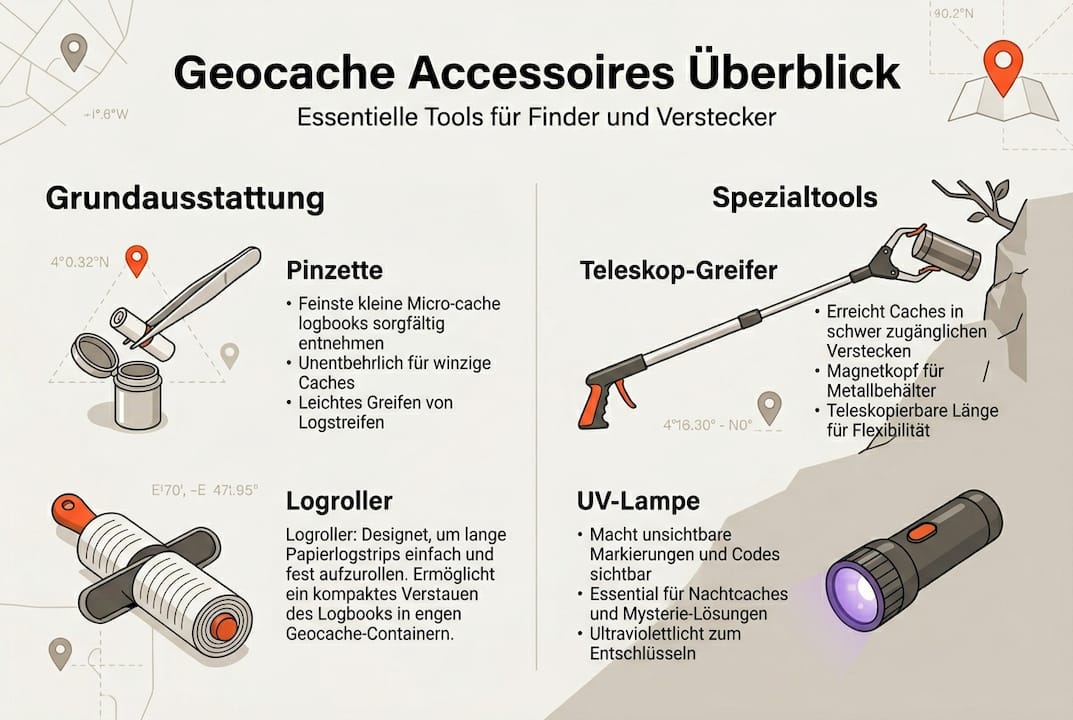
For urban environments, particularly inconspicuous containers that blend into the cityscape are required. In rural areas, robustness and weather resistance are more important. Here's a quick overview:
| Category | Examples | Area of Application |
|---|---|---|
| TOTT (Finder) | Tweezers, log roller, UV lamp, grabber | All cache types |
| Container (Hider) | Nano box, magnetic tin, film canister | Urban and rural |
| Camouflage material | Moss, bark, paint, tape | Nature and city |
| Special hides | 3D print, guard rail nut, artificial stone | Creative hides |
The most important insight: Finders and hiders benefit from coordinated accessories. Hiders who know which tools finders use build better caches. Finders who know common hiding tricks search more effectively. This interaction makes geocaching so exciting.
A common beginner's mistake is buying too much at once. It's better to start with a few high-quality basics and expand your set based on experience. Quality beats quantity, especially for tools that are used daily in the field.
Indispensable Tools for Finders: Smart Searching & Logging
With a basic understanding in hand, let's get down to business. What tools do you really need when you go searching? The answer depends on the cache type, but some tools are almost always useful.
Tweezers and log rollers are absolutely indispensable for micro and nano caches. These tiny logs can hardly be removed without tools without tearing the paper. A damaged log means frustration for the next finder and annoyance for the hider. Good tweezers are narrow, long, and have a fine tip. Log rollers made of metal or plastic neatly roll the log up and down.
UV lamps and headlamps open up whole new worlds. UV light makes invisible markings visible, which serve as clues for puzzles or mystery caches. Headlamps are essential for night caches, keep your hands free, and allow you to read coordinates in the dark. Invest in quality here: cheap models often flicker exactly when it matters most.
Here's how to systematically approach a difficult micro cache:
- Recheck coordinates and narrow down the area
- Feel surfaces with your hand (magnets often reveal themselves with a slight pull)
- Use a UV lamp if there are hints of puzzle elements
- Have tweezers ready before opening the container
- Carefully remove the log with the roller, sign it, and roll it back up
- Return everything exactly as you found it
Without the right tools, you risk damaging logs or missing caches entirely. This harms the community and the experience of everyone involved.
Pro tip: Always keep tweezers and a log roller handy in a small outer pocket of your backpack. Having to search for them wastes time and nerves, especially when muggles (uninitiated passers-by) are nearby. You can find more useful tips on Micro-Log Tips in the active geocaching community.
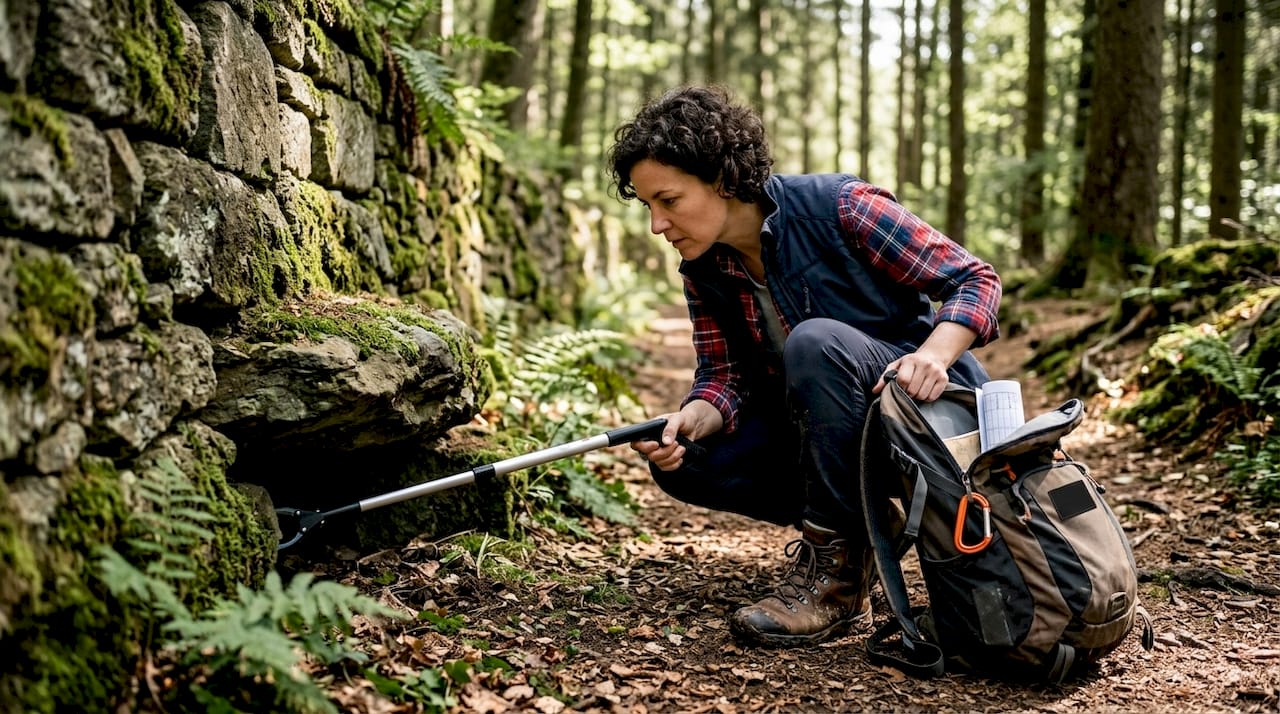
An often underestimated tool is the telescopic grabber. It allows you to reach caches in crevices, under bridges, or at heights that are inaccessible by hand. Especially for Terrain 5 caches, it is sometimes the only way to success.
Innovative Accessories for Creative Cache Hides
After presenting the finder tools, let's now turn to the other side: How do you, as a hider, create a hide that truly impresses?
The most exciting caches are often those where you look twice and still see nothing. 3D-printed hides like cubes, snails, pinecones, stones, or guard rail nuts are perfect examples of creative, inconspicuous hides in urban and rural settings. They look deceptively real and blend seamlessly into their surroundings.
Here are the most popular innovative accessories for hiders:
- 3D-printed art objects: Snails, stones, cones, or screws made of PETG plastic are weather-resistant and durable.
- Magnetic containers: Small tins with strong magnets adhere to metal supports, railings, or signs.
- Fake screws and bolts: Perfect for urban environments where real screws won't stand out.
- Natural materials as camouflage: Real moss, bark, or branch replicas make containers invisible in the forest.
- Waterproof nano-containers: For hides in damp environments or under stones.
| Feature | DIY Accessories | Standard Accessories |
|---|---|---|
| Creativity | Very high | Medium |
| Cost | Low to medium | Medium to high |
| Customizability | Full | Limited |
| Durability | Depends on material | Often standardized |
| Effort | Higher | Low |
The 3D-printed hides guide shows you how to implement your own designs with a 3D printer and PETG filament. PETG is particularly recommended: it is UV-resistant, waterproof, and can withstand harsh winters without breaking.
You can best find new ideas in the community, on geocaching platforms, and in specialized blogs. See what other hiders in your area are hiding, and consider how you can make it even more original. The difference between a forgotten cache and a favorite often lies in a single creative detail.
What Matters When Choosing and Combining Accessories
After concrete examples of tools and hides have been given, the systematic selection now follows. Because the best individual tool is of little use if the combination is not right.
TOTT are essential for micro caches (tweezers, roller), for high terrain (grabber), and for night or puzzle caches (UV light). Anyone who is out and about without these aids risks damaged logs or missed finds. This sounds simple, but it is astonishingly often ignored.
The most important points when choosing:
- Consider the terrain: You need different tools for forests and nature than for the city.
- Know the cache type: Micro, nano, regular, multi, and mystery have different requirements.
- Plan for the weather: Weatherproof pens and waterproof containers are not a luxury.
- Optimize weight: Too much equipment slows you down, too little makes you fail.
- Quality over quantity: One good log roller is better than three cheap ones.
For longer tours where you also use a bicycle, it's worth looking at Outdoor Bicycle Tips to combine accessories and equipment sensibly.
A practical checklist for your geocaching kit:
- Log roller and tweezers (always with you)
- Weatherproof pen (at least two, one always gets lost)
- UV lamp with fresh batteries
- Headlamp for night and dusk caches
- Telescopic grabber for hard-to-reach places
- Small replacement logs for damaged originals
- Ziploc bags to protect logbooks in the rain
Pro tip: Don't buy expensive complete sets from the hardware store. You'll never need most of the parts in them. Instead, invest specifically in one or two high-quality specialized tools that you actually use. This saves money and weight in your backpack.
Our View: What is Often Underestimated in Geocaching Accessories
Following the practical guide, here's our honest assessment. We see geocachers assemble their equipment every day, and one thing consistently stands out: a lot of accessories sound sensible when purchased, but turn out to be superfluous in the field.
The best geocachers we know carry surprisingly little. But what they do carry is perfectly adapted to their favorite routes and cache types. This is no coincidence. It's the result of experience and conscious omission.
A common misconception: beginners believe that expensive accessories automatically lead to better results. In fact, often a simple, well-fitting pair of tweezers makes the difference, not an expensive multi-tool. Those who want to creatively design DIY hides primarily need ideas and some patience, not a large budget.
Our advice: Start small, learn from every cache you find or place, and adjust your kit accordingly. The most creative solutions often arise from limitations, not from unlimited resources.
Achieve Your Next Cache Success with the Right Accessories
You now know which accessories truly matter and how to combine them smartly. The next step is simple: look at your current kit and consider what's missing or should be replaced.
At Discover Geocaching Accessories you'll find everything you need as a finder: from tweezers and log rollers to UV lamps and weatherproof pens. If you prefer to hide caches yourself, you'll find what you're looking for at View Special Hides: 3D-printed art objects made of PETG, magnetic containers, and creative camouflage solutions for urban and natural environments. Get inspired and make your next cache a real experience for the community.
Frequently Asked Questions about Geocache Accessories
What are the most important accessories for geocaching beginners?
Essential basics are a log roller and tweezers, as well as weatherproof pens and a UV lamp. With these, you are well-equipped for most cache types.
How do I find innovative cache hides and what accessories do I use to implement them?
With 3D-printed containers like snails, artificial stones, or guard rail nuts, and complementary magnetic solutions, original hides can be realized in urban and natural environments.
Why are special tools indispensable for micro and night caches?
Only with special tools like tweezers or a UV lamp for night caches can you remove logs undamaged or uncover hidden clues without damaging the cache.
Can I make geocache accessories myself?
Yes, with a little DIY skill and common materials, many tools and containers can be customized. 3D-printed hides like cubes, snails, or pinecones are a good example.