
Geocache Maintenance Process: How to Optimize Your Geocache
You hid your cache months ago, and the first logs were enthusiastic. But suddenly, entries like "logbook wet" or "container damaged" are piling up. Without regular maintenance, even the best cache quickly loses quality. Many owners underestimate the importance of a structured maintenance process. Moisture, wear and tear, and full logbooks are the most common problems that frustrate finders and lower your health score. This article shows you step-by-step how to keep your cache in top condition long-term. You'll learn what materials you need, how to perform maintenance efficiently, and how to verify the success of your measures.
Table of Contents
- Key Points of the Geocache Maintenance Process
- Preparation: What You Need for Efficient Maintenance
- Execution: Step-by-Step Guide for Effective Cache Maintenance
- Monitoring and Improvement: How to Verify Maintenance Success
- Discover Durable Geocaching Hides at CacheWerk
- Frequently Asked Questions about Geocache Maintenance
Key Insights
| Point | Details |
|---|---|
| Regular Maintenance is Essential | Without regular maintenance, moisture protection, wear and tear, and camouflage deteriorate, making a structured maintenance process necessary. |
| Cache Owner's Responsibility | The cache owner is primarily responsible, and third-party maintenance is only used in exceptional cases. |
| Robust Containers | Low-maintenance containers increase durability and reduce ongoing maintenance efforts. |
| Logs Indicate Problems | Logs often report maintenance needs and point to immediate actions. |
| Good Health Score | A high health score signals a well-maintained container and better logs. |
Preparation: What You Need for Efficient Maintenance
Before you set out for maintenance, you should proceed systematically. Good preparation saves time and prevents you from arriving on-site with incomplete equipment. Basic equipment includes weatherproof replacement containers, new logbooks in various sizes, pencils or waterproof pens, and sealing rings or tape for repairs. Depending on the cache type, you may also need tools like screwdrivers, pliers, or cable ties. A notepad will help you document the condition and plan future improvements.
The location of your cache significantly influences maintenance needs. Caches near water or under trees are more exposed to moisture than those in protected places. Urban caches often suffer from vandalism, while rural hides are more likely to be damaged by weather and animals. These factors determine which materials you should choose. For exposed locations, robust containers with reliable seals are recommended. When selecting geocache material, durability and weather resistance play the main role.
A checklist structures your maintenance and ensures you don't forget anything. Before you leave, note which caches you want to visit and what specific problems are known from the logs. Pack at least one spare logbook for each cache, even if none has been reported. Surprises are common. Also, remember trash bags to dispose of old debris or damaged parts. Maintaining multiple caches in one day saves travel time and effort.
Pro Tip: Use durable containers like PETlings or Clip’n’Close for less maintenance. These containers reliably keep out moisture and last several years outdoors without problems. It's better to invest in quality once than to constantly replace cheap containers.
| Container Type | Durability (Years) | Suitability | Maintenance Effort |
|---|---|---|---|
| PETling | 4-6 | Urban, Forest | Very Low |
| Clip’n’Close | 3-5 | Universal | Low |
| Lock’n’Lock | 5-8 | All Environments | Very Low |
| Film Canister | 1-2 | Dry, Protected | High |
| Tin Can | 2-3 | Forest, Hidden | Medium |
| Tupperware (Standard) | 1-3 | Protected Locations | Medium to High |
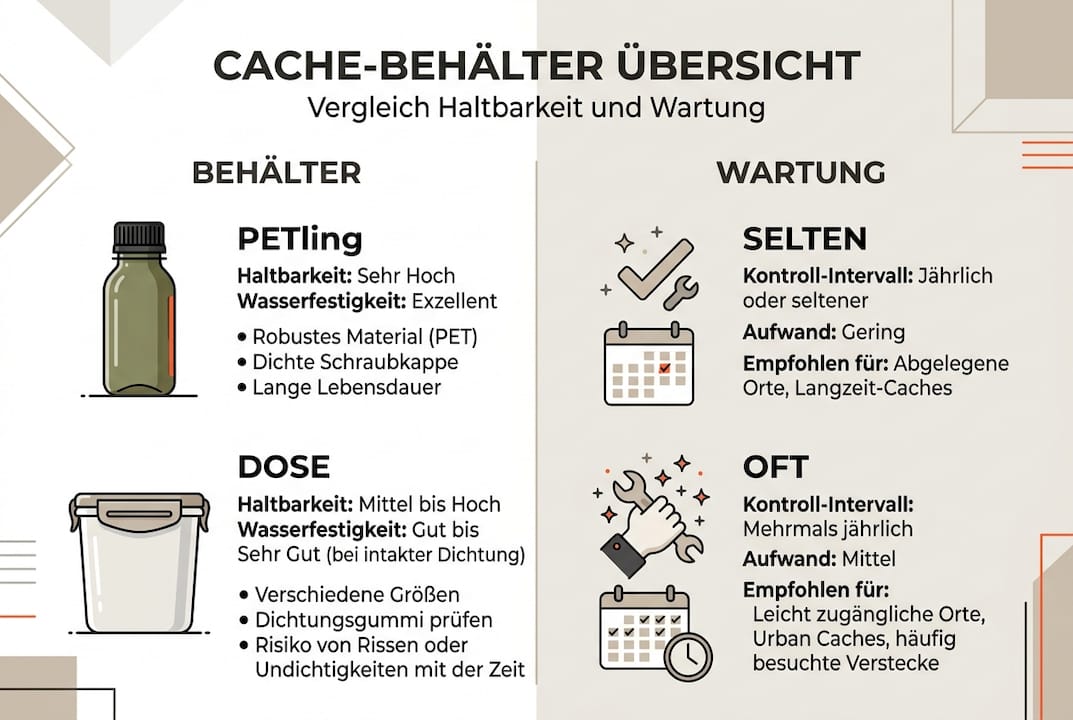
The table shows that high-quality containers drastically reduce maintenance effort. A PETling lasts four times longer than a simple film canister and saves you several maintenance trips. Material choice is an investment in your cache's future. Those who prioritize quality from the start will need to intervene less often and receive better logs long-term.
Execution: Step-by-Step Guide for Effective Cache Maintenance
The actual maintenance follows a clear procedure that ensures you don't overlook anything. A systematic approach prevents errors and makes the work more efficient. Here is the proven sequence of steps:
- Retrieve the cache and check the condition of the hide. Is the camouflage still intact? Is the cache exposed or has it been moved?
- Open the container and check for moisture. Even small amounts of water can ruin logbooks.
- Remove the logbook and leaf through it. Check if it is wet, full, or damaged. Count the remaining free lines.
- Inspect the container inside and out for cracks, seal damage, or wear. Test the closure several times.
- If there are problems, replace parts. Thoroughly dry damp containers before inserting new logbooks.
- Rehide the cache and restore the camouflage. Make sure everything looks as it did before.
- Write an online log with maintenance details. Inform the community about the measures taken.
During execution, there are typical mistakes you should avoid. Many owners forget to replace the logbook in time, even though only a few lines are left. This leads to finders having no space left and leaving frustrated. Another mistake is improper repair without suitable materials. Provisional solutions like cling film or rubber bands rarely last longer than a few weeks. Caches should be regularly checked for defects and wet or full logbooks.
Common maintenance mistakes you should avoid:
- Only replacing the logbook when it's completely full, instead of when it's 80 percent full.
- Not fully drying damp containers before inserting new logbooks.
- Ignoring damaged seals and hoping they'll last a while longer.
- Bringing replacement logbooks of the wrong size that don't fit in the container.
- Not documenting maintenance in the online log, so other owners can't see what was done.
- Repairing other people's caches without contacting the owner.
The last point is particularly important. Cache finders should log "Needs Maintenance", and only perform third-party maintenance in exceptional cases. If you find another person's cache that urgently needs help, contact the owner first. Only if they don't respond or explicitly ask for help should you intervene. Respect property rights and avoid misunderstandings.
Pro Tip: Have replacement logbooks and seals ready early to avoid downtime. Keep a small stock of standard sizes at home. This way, you can react immediately during spontaneous maintenance trips without having to get materials first. A well-stocked maintenance kit with weatherproof geocache material makes you flexible and saves valuable time.
The quality of your maintenance will be reflected in subsequent logs. If finders give positive feedback after your visit and problems no longer appear, you've done a good job. Make sure you describe exactly what you did in the owner log. This gives finders confidence and shows that you care. A simple "Maintenance performed" is not enough. Be specific: "New logbook inserted, seal replaced, container dried."

Monitoring and Improvement: How to Verify Maintenance Success
After maintenance, the important phase of success control begins. Only systematic evaluation allows you to improve your maintenance process and identify problems early. The Geocache Health Score measures cache health based on logs such as "Needs Maintenance" and "Did Not Find." A high score indicates good maintenance and attracts more finders. Check your score regularly and react quickly to negative developments.
The Health Score is calculated from various factors. Positive logs like "Found it" and "Favorite" increase it, while "Needs Maintenance," "Did Not Find," and "Temporarily Disabled" decrease it. The system weights current logs more heavily than old ones, so a quick response to problems is particularly important. A cache with many DNFs in a short period will rapidly lose score, even if the overall statistics look good. Observe the development over several weeks and identify patterns.
| Log Type | Meaning for Maintenance | Action Required |
|---|---|---|
| Found it | Cache works perfectly | No action required |
| Needs Maintenance | Specific problem reported | Immediate maintenance required |
| Did Not Find | Possible hide or condition problem | Check after 2-3 DNFs |
| Write Note | Note without rating | Check information |
| Temporarily Disabled | Owner has disabled cache | Maintenance before reactivation |
| Owner Maintenance | Maintenance documented | Positive signal to community |
The table shows how you should interpret different log types. A single DNF is normal, but three in a row indicate a real problem. Perhaps the camouflage has shifted, or the hide has been discovered and removed. Don't panic at every DNF, but don't ignore them either. A healthy balance between calmness and attentiveness is important.
You can derive specific improvements from the logs. If several finders report "logbook damp," your seal is inadequate. If comments like "hard to open" accumulate, you should revise the closure mechanism. Use community feedback as free quality management. Finders invest time in their logs because they want your cache to improve. Take their hints seriously and implement them.
Tips for improvement based on Health Score and feedback:
- If score is below 70 percent: perform immediate maintenance and root cause analysis
- Regular DNF waves: clarify hints in the listing or improve camouflage
- Repeated moisture problems: replace container with a higher quality model
- Vandalism reports: move hide to a safer location or camouflage better
- Positive logs with suggestions for improvement: take feedback seriously and implement it
- Score stagnant despite maintenance: review listing description or difficulty rating
Continuous improvement makes the difference between an average and an outstanding cache. Owners who actively respond to feedback and optimize their maintenance process receive more favorite points and better ratings. This not only motivates you but also finders who see that their feedback makes a difference.
“A high Health Score leads to more Finds and Favorites. Caches with a score above 90 percent are searched twice as often as those below 70 percent. Invest in regular maintenance, and your cache will become a popular destination.”
This quote illustrates the direct connection between maintenance quality and success. A well-maintained cache is not just a matter of pride but pays off in concrete numbers. The time you invest in maintenance returns in the form of positive logs and increasing visitor numbers. Those who take their Geocache Health Score and material seriously will build a strong reputation in the community long-term.
Discover Durable Geocaching Hides at CacheWerk
You have now learned a complete maintenance process that will keep your cache in top condition long-term. The right materials make the difference between constant repairs and years of reliability. At CacheWerk, you'll find a wide selection of Geocaching special hides, specifically designed for durability and low maintenance. Our hides made from high-quality PETG withstand extreme weather and reliably keep out moisture.
In addition to innovative hides, we offer practical Geocaching equipment and accessories that facilitate your maintenance. From waterproof logbooks to replacement seals and special tools for urban caches – we have everything you need for efficient cache care. Invest in quality, and your cache will thank you with less maintenance and better logs. Discover our products now and make your caches lower maintenance.
Frequently Asked Questions about Geocache Maintenance
How often should I maintain my geocache?
Maintenance frequency depends on location and popularity. Heavily visited caches in exposed locations should be checked every three months, while quieter hides in protected places can be checked biannually. Monitor the logs and react immediately to problem reports, regardless of the planned interval.
What should I do if I find a defective cache?
Log "Needs Maintenance" with a specific problem description so the owner knows what to do. Additionally, contact the owner via message if the problem is urgent. Only repair the cache if the owner explicitly asks you to or is unreachable and the cache would otherwise be archived.
Can I take over maintenance for other people's caches?
Third-party maintenance is generally the exception, not the rule. Each owner is responsible for their own caches. Only intervene if an owner has not responded for a long time or explicitly asks for help. Document any third-party maintenance in the log and inform the owner.
Which containers are particularly low-maintenance?
PETlings, Lock’n’Lock containers, and high-quality Clip’n’Close containers are the most low-maintenance options. They reliably keep out moisture and last several years without problems. Avoid simple film canisters or standard Tupperware in exposed locations, as these quickly become leaky.
How do I know if my cache is healthy?
The Health Score on Geocaching.com gives you an objective overview. Scores above 80 percent indicate good care, while below 70 percent indicates a need for action. Additionally, you should read the logs from recent months and look for patterns: If DNFs or maintenance notices accumulate, a check is due.