
Geocaching Logbooks: Purpose, Benefits, and Practice
Many geocachers see the logbook as a mere formality: scribble in a nickname, add the date, close the cache again. But anyone who thinks that way misses out on one of the most valuable functions in geocaching. The physical logbook is far more than just proof of your find. It's a living communication tool between cacher and owner, an early warning system for maintenance issues, and a piece of the cache's history. This article shows you how to use logbooks meaningfully, both as a finder and as an owner, what formats are available, and why good log management strengthens the entire community.
Table of Contents
- Basic Function and Importance of Logbooks in Caching
- Different Logbook Formats and Their Application
- Obligations and Good Practice When Signing the Logbook
- Logbook as a Maintenance Tool for Owners and the Community
- Our View: Why Proper Log Management Strengthens the Community
- Finding the Right Logbooks and Accessories for Perfect Caches
- Frequently Asked Questions About Geocaching Logbooks
Key Insights
| Point | Details |
|---|---|
| Logbook is a Must and Added Value | It not only documents finds but also strengthens cohesion and cache maintenance. |
| Choose the Right Format | The size and design of the logbook should match the cache type and be as low-maintenance as possible. |
| Quality Entries Help Everyone | Relevant and clear logbook entries facilitate use and maintenance for owners and cachers. |
| Report Problems Correctly | For full or damaged logbooks, special online types help enable quick maintenance. |
Basic Function and Importance of Logbooks in Caching
The logbook is as essential to geocaching as the compass is to navigation. Without it, the core of the game is missing. But what exactly is a logbook? Essentially, it's a small piece of paper inside the cache container where finders record their visit. Logbooks serve to physically document the find with your geocaching handle and the date.
This simple act has surprisingly many functions. For the finder, it's personal, unchangeable proof that they were actually there. Especially in disputes about invalid online logs, the physical entry counts as proof. For the owner, the logbook is a direct reflection of the cache's condition: How many cachers have visited the cache? Are there any indications of problems? Was anything important mentioned recently?
"A logbook tells the story of a cache, entry by entry. Anyone who reads it carefully learns more about their cache than from ten online logs."
It's important to distinguish between the physical log and the online log. The physical entry in the container is the original proof. The online log on geocaching platforms is the digital addition. Both complement each other, but neither fully replaces the other. Especially in case of discrepancies, the note in the container is the original.
The history of the logbook is as old as geocaching itself. When Dave Ulmer hid the first cache in 2000, he immediately included a notebook. This principle has hardly changed in over 25 years, although the technology around it has made huge advances. This shows how fundamental and indispensable the logbook is to the game.
The most important functions of the logbook at a glance:
- Physical proof of the find for the cacher
- Documentation of visit frequency for the owner
- Communication channel for maintenance notes
- Mood barometer: feedback directly from the field
- Historical document of the cache's life
There are caches that have been active for years and whose logbooks are veritable archives. Hundreds of entries, nicknames from all over the world, small notes from different seasons. This is community in its purest form.
Different Logbook Formats and Their Application
Now that it's clear what logbooks are for, the question arises of which format makes sense for which cache. The selection is larger than most beginners think. And choosing the right format can make the difference between a low-maintenance cache and a problem cache.
The Most Common Formats at a Glance
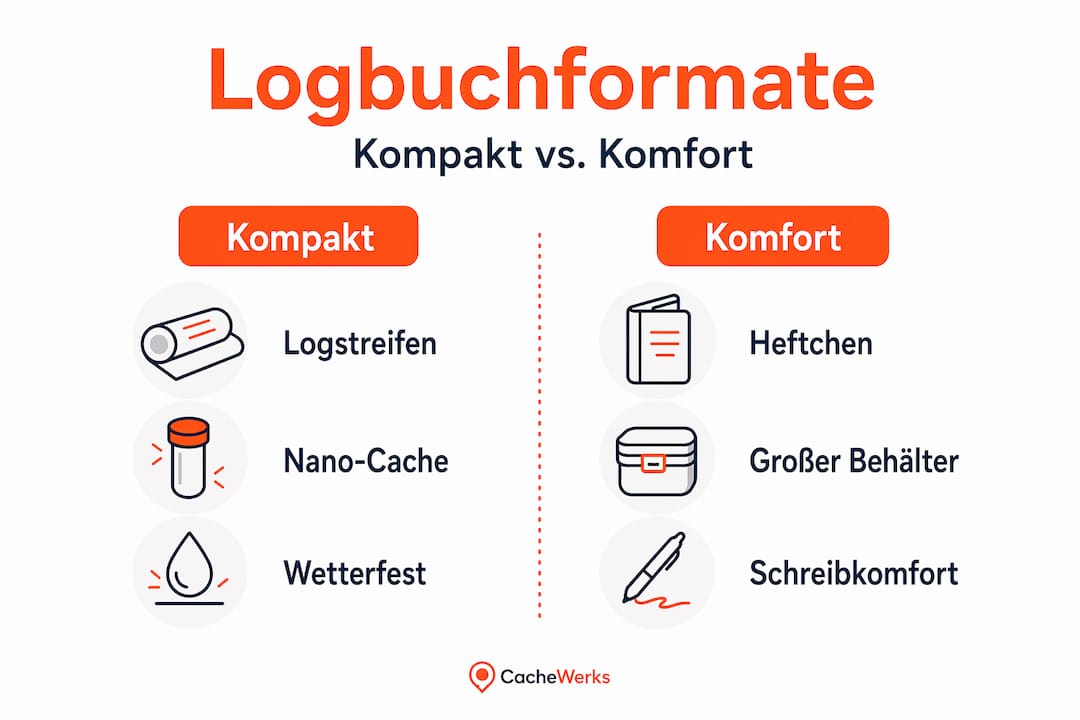
Log strips are the most compact solution. They fit into nano caches, magnetic hides, and the smallest containers. A log strip is essentially a narrow, rolled-up piece of paper that is written on with a pen or even a ballpoint pen. The big advantage: minimal space requirements. The disadvantage: writing comfort is low, and the area per entry is very small. In heavily frequented caches, strips fill up quickly.
Notebooks and booklets are the classic format for regular and large caches. They offer plenty of space, good writing comfort, and feel more valuable. Many owners design the first page as a title page with the cache name, coordinates, and hints. This is a nice detail that finders appreciate. The format also makes entries much more readable than tiny scribbles on strips.
Special forms include water-resistant logbooks made of coated paper or even synthetic paper. These are particularly suitable for caches in damp environments or with containers that are not completely waterproof. The right size and arrangement directly influence how low-maintenance the cache remains. A logbook that is too small in a heavily visited cache means the owner constantly has to refill it.
| Format | Container Size | Space | Writing Comfort | Weather Resistance |
|---|---|---|---|---|
| Log Strip | Nano, Micro | Very Low | Low | Low to Medium |
| Small Booklet | Micro, Small | Low to Medium | Medium | Medium |
| Notebook | Regular, Large | High | High | Medium to High |
| Special Logbook | All Sizes | Variable | Medium to High | High |
Materials and Quality
The material plays a crucial role. Normal printer paper swells in humidity, becomes mushy and illegible. Water-resistant papers or coated variants are much better suited for outdoor caches. Some owners swear by so-called stone paper, which is made of calcium carbonate and even withstands direct water contact.

For the correct selection of geocache materials: The container protects the logbook, but no container is sealed forever. Plan ahead and choose a logbook that can withstand brief moisture.
Pro-tip: Wrap the logbook in a small plastic bag (e.g., zip-lock bag) before placing it in the container. This costs almost nothing but effectively protects against unwanted moisture and significantly extends the logbook's lifespan.
Other practical selection criteria for logbooks:
- Do the size and number of pages match the expected visit frequency?
- Is the paper robust enough for the environment?
- Is there enough space per entry so that notes are legible?
- Does the logbook fit into the container in such a way that it can be easily removed?
A small booklet that gets stuck causes frustration for every cacher. So don't just think about space requirements, but also about handling on site.
Obligations and Good Practice When Signing the Logbook
Now you know what the logbook looks like. But how do you use it correctly? The next section clarifies this. There are clear expectations within the geocaching community regarding what constitutes a good entry.
What Belongs in Every Entry
The minimum content is simple and clear: Geocaching handle and date. This is the absolute basic. The handle is important because the owner needs to be able to track who was there. The date helps to assess the frequency and to pinpoint any problems in time.
A short note is not mandatory, but worth its weight in gold. Especially if something is noticed: The logbook is almost full. The cache was hard to open. There's water in the container. These hints save the owner time and help the community.
Clear, relevant information in the logbook is the heart of a functioning geocaching community. What good is the most beautiful cache if the owner doesn't know that the logbook is swollen?
Write in this order:
- Clearly write your Geocaching handle (nickname)
- Date of the find (day, month, year)
- Optional: short note on the condition or find
- Optional: feedback, greeting, or small comment
What Should Be Avoided
No private data. Full names, addresses, or phone numbers do not belong in the logbook. The logbook is in a publicly accessible place and can be read by strangers.
No copy-paste. Anyone who writes exactly the same text in every cache, without reference to the respective location, helps no one. Such entries tell the owner nothing useful. The community clearly recommends not cluttering online logs with irrelevant content so that maintenance hints remain discoverable. The same applies to physical entries.
No lengthy texts. The logbook is not a diary. If you write three pages about your journey, there will be no space left for the next cacher. Short, precise entries show more respect for the community than verbose prose.
Pro-tip: Actively use the logbook as a quick maintenance tool. For example, write "Logbook half full, as of 05.06.2026" or "Cache was open, closed again". Such information greatly helps the owner and is highly appreciated by the community.
What distinguishes good entries from bad ones:
- Legible handwriting vs. illegible scribble
- Specific date vs. no date
- Short note on condition vs. no information
- Own nickname vs. anonymous entry
- Respectful tone vs. negative comments without added value
Good entries are not an art. They take a maximum of one minute more than a simple abbreviation. But the difference for owners and subsequent cachers is enormous.
Logbook as a Maintenance Tool for Owners and the Community
Entries don't end with your own find. They are essential for the care and preservation of caches. The following section shows how owners and cachers can jointly manage cache conditions.
The logbook is one of the most important sources of information for the owner. Status reports via logs are a central maintenance and quality feedback mechanism. If the logbook is wet, muddy, or full, the owner will learn about it most quickly from observant cachers.
The Connection Between Physical and Online Log
Many cachers don't know that there are special online log types specifically designed to point out problems. In addition to the normal "Found it," there are types like "Needs Maintenance" or direct indications that the logbook is full. Problems with the logbook or container are communicated via such appropriate online log types so that the owner can take targeted action.
This interplay is clever. The physical entry provides information directly on site. The online log informs the owner digitally, even if they are not currently on site. Both channels together provide a complete picture.
Overview: Reporting methods for cachers in case of problems
| Problem | Physical Logbook | Online Log Type |
|---|---|---|
| Logbook full | Note: "Logbook full" | "Needs Maintenance" or "Logbook is full" |
| Logbook wet | Note: "Logbook damp" | "Needs Maintenance" with description |
| Container damaged | Note: "Cache broken" | "Needs Maintenance" with details |
| Cache not at coordinates | Not possible | "Didn’t find it" with hint |
| Everything in order | Brief confirmation | "Found it" with positive note |
Respecting the Owner's Property
An important principle: The logbook and the entire cache belong to the owner. Cachers are guests. This means that interventions, such as independently replacing the logbook, should only be done in consultation with the owner.
What cachers can and should do:
- Comment on the condition of the logbook
- Submit a maintenance request online
- Send a direct message to the owner
- Document noticeable defects when found
What cachers should avoid:
- Replacing the logbook without consultation
- Changing or deleting other cachers' entries
- Removing items from the cache without a trade
- Leaving negative comments without constructive feedback
The community thrives on mutual respect. Owners often invest a lot of time and creativity in their caches. Those who respect this and communicate constructively contribute to a better geocaching experience for everyone.
If a logbook is permanently in poor condition because the owner is not responding, a friendly direct message via the platform is the best way. Sometimes the owner simply hasn't realized that the logbook needs to be replaced.
Our View: Why Proper Log Management Strengthens the Community
We at CacheWerk regularly experience it: As soon as we talk to active cachers about their favorite caches, one topic always comes up. Not the most spectacular cache or the most elaborate container, but the cache where everything simply works. Clean, well-maintained, clearly logged. This is no coincidence.
Poor logbook management is one of the most common reasons why caches "fall asleep." The owner sees many finds, but not a single hint about the actual condition. They assume everything is fine. Then suddenly, someone complains that the logbook has been a wet lump for months. If a cacher had written "Logbook damp, please check" three months earlier, the problem would have been quickly resolved.
This sounds trivial but has a real impact. Owners who are informed quickly and precisely react faster and maintain their caches better. Better maintained caches mean better experiences for all finders. It's a simple cycle that, unfortunately, is too rarely consciously lived.
We have observed that many cachers also find the physical logbook bothersome because they have already left an online log. But this way of thinking falls short. The online log reaches the owner. The physical logbook documents the condition of the cache directly on site, visible to all subsequent finders. Both have their raison d'être.
Another point we would like to emphasize: Anyone who is careful with logbook management shows respect for the owner's work and the game principle as a whole. Geocaching is voluntary, unpaid, and collaborative. The logbook is the simplest means of living this community spirit.
And anyone who relies on robust cache materials also lays the foundation for logbooks to remain legible and usable for longer. A good container that is truly watertight not only protects the contents but also significantly reduces the maintenance effort for owners.
In our experience, the best caches often have the most meticulous owners, and these owners almost always have an active, attentive community around them. The logbook is the common thread that holds it all together.
Finding the right logbooks and accessories for perfect caches
Now that you know how valuable a well-maintained logbook is, the next step is to find the right equipment for your cache.
At CacheWerk, you'll find exactly what you need. From suitable logbooks and weatherproof log strips to robust containers and creative accessories for all geocaching situations. Whether it's a small nano-cache in an urban environment or a classic container in the forest, we have the right solution. Discover the full range of geocaching equipment and accessories now and put the recommendations from this article directly into practice. Your cache community will thank you.
Frequently asked questions about logbooks in geocaching
What should I definitely write in the logbook?
You should write your geocaching handle and the date of your find. Logbooks are used to record this physical proof of visit with your handle and date. A brief note is optional but very helpful.
Can I log the find if there's no more space in the logbook?
Yes, you can still log the find online. You can communicate problems like a full logbook using the appropriate online log type so the owner is informed and can react.
Who replaces the logbook if it's wet or damaged?
The owner is responsible for replacing it. Logbooks and containers may only be replaced by the owner or after explicit agreement with them. Cachers should report the defect online or via direct message.
Are entries like "TFTC" or funny sayings allowed in the logbook?
Short abbreviations and humorous comments are completely common in the community. However, they should be understandable and respectful. Relevant and clear hints are most useful for owners and the community, so feel free to add a brief note about the condition if needed.