
Custom Caches: Greater Success in Geocaching
Many geocachers still reach for film canisters from hardware stores or standard plastic containers and wonder why their caches break after a few months or elicit little enthusiasm. Yet the world of custom-made caches is closer and more affordable than you think. With 3D printing, clever material selection, and a bit of creativity, you can create hiding places that last longer, are better camouflaged, and truly surprise finders. In this article, we'll show you why individual solutions make all the difference, which materials prove their worth, and how you can immediately start your first own cache project.
Table of Contents
- The Fundamentals of Custom Caches and Their Popularity
- Individual Customization: Camouflage, Shapes, and Theme Caches
- Cost-Effectiveness and Sustainability of Custom Caches
- Material Selection, Technology, and Longevity in Practice
- Why the DIY Trend in Caches Will Replace Classic Solutions
- From Guide to Perfect Cache – Your Next Steps with CacheWerk
- Frequently Asked Questions About Custom Geocaches
Key Insights
| Point | Details |
|---|---|
| Creativity and Camouflage | Custom caches can be individually adapted and offer original hiding places that guarantee real search fun. |
| Costs and Longevity | DIY saves money and, thanks to the right material choice, often lasts longer than industrial solutions. |
| Technology is Key | Print settings and the correct material selection are crucial for weatherproof, durable outdoor hiding places. |
| Sustainability | Individually manufactured caches can be resource-efficient and reusable, benefiting the environment. |
The Fundamentals of Custom Caches and Their Popularity
The geocaching market has changed significantly in recent years. Film canisters used to be king. Today, cachers want more: more creativity, more longevity, more surprise. Custom-made caches are individually designed containers or hiding places developed specifically for a location, a theme, or a particular target group.
What makes them so special? They adapt perfectly to their surroundings. A well-printed tree bark cache looks like real wood. A magnetic screw cache on a metal railing goes unnoticed by anyone. This flexibility is hardly achievable with mass-produced goods.
The trend is clearly measurable: Over 35% of active geocachers now use 3D-printed components for their caches. This is no longer a niche. This is a real movement within the community.
The most popular options for individual cache building:
- Freedom of form: Round, angular, organic shapes are all possible
- Theme caches: From knight's castle to spaceship, anything can be implemented
- Camouflage optimization: Adapt color, texture, and shape exactly to the location
- Mechanical puzzles: Integrate locks, rotating disks, hidden compartments
- Micro-caches: Extremely small containers for urban hiding places
“The community is evolving rapidly. Anyone who still relies exclusively on standard containers today is missing out on the most exciting developments in geocaching.”
Especially the guide to PETG and 3D printing shows how accessible entry into self-made cache production has become. You don't need an expensive printer or an engineering degree. Simple files from free databases, an affordable 3D printer, and some patience are all you need to get started.
Experienced crafters also report that building the cache is just as much fun as hiding it. The creative process, adapting to the terrain, and the reactions of finders are an experience in themselves. This is an aspect many underestimate.
Individual Customization: Camouflage, Shapes, and Theme Caches
Standard solutions like PETlings (small cylindrical containers made of PET plastic) or film canisters have their justification. They are inexpensive, readily available, and generally functional. But they have a crucial weakness: everyone knows them. Experienced cachers recognize a PETling from ten meters away.
Custom-made containers solve this problem directly. Individual design allows for perfect adaptation to the environment, and unique shapes are generally easier to camouflage than standard shapes.
Comparison: DIY Cache vs. Standard Cache
| Feature | DIY Cache | Standard Cache |
|---|---|---|
| Camouflage Potential | Very high | Low to medium |
| Cost | 0.15 to 1.50 € | 2 to 10 € |
| Longevity | 3 to 5 years | 1 to 2 years |
| Uniqueness | Unique | Mass-produced |
| Customizability | Complete | Hardly possible |
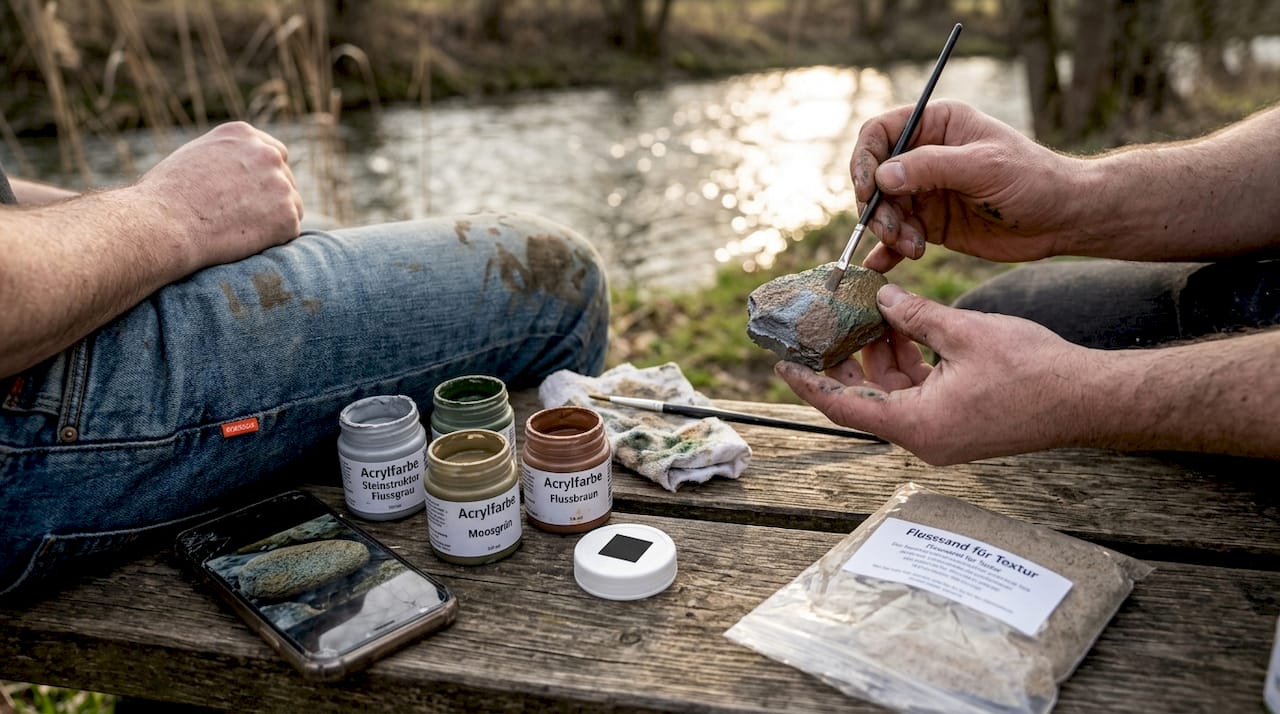
Camouflage isn't just about color. Shape, texture, and weight all play a role. A rock cache must feel like a real rock. A cap cache must fit like an original cap.
Pro Tip: Visit the planned location before printing and photograph typical surfaces and colors. Use these photos as a template for the texture and color scheme of your cache.
Theme caches are particularly popular with families and beginners. They tell a story. A pirate chest cache in a city park or an alien lab in an industrial area create experiences that finders will remember for a long time. Geocaching stickers can also be used for individualization to creatively design lids, logbooks, or containers.
Tips for better camouflage and uniqueness:
- Location analysis before design, not after
- Use natural materials as a template for texture and color
- Multi-layered camouflage with shape plus color plus positioning
- Incorporate surprise effects, such as sounds, light, or mechanics
Material selection and creativity are inextricably linked when designing custom caches. Those who master both build caches that finders will talk about for months to come.
Cost-Effectiveness and Sustainability of Custom Caches
Now to the specifics. How much does a self-built cache really cost? The answer surprises many: a self-printed micro-cache costs only 0.15 to 0.50 euros, while industrial containers cost 3 to 8 euros.
For a series of 20 caches, this results in savings of 50 to 150 euros. The filament for the printer is inexpensive, and one kilogram is enough for many dozens of micro-caches.
Cost Comparison at a Glance:
| Cache Type | Material Costs | Lifespan | Cost per Year |
|---|---|---|---|
| 3D Print PETG | 0.15 to 0.50 € | 3 to 5 years | less than 0.15 € |
| PETling Standard | 2 to 4 € | 1 to 2 years | approx. 2 € |
| Film Canister | 0.50 to 1 € | less than 1 year | over 0.80 € |
| Metal Can (purchased) | 5 to 10 € | 2 to 3 years | approx. 3 € |
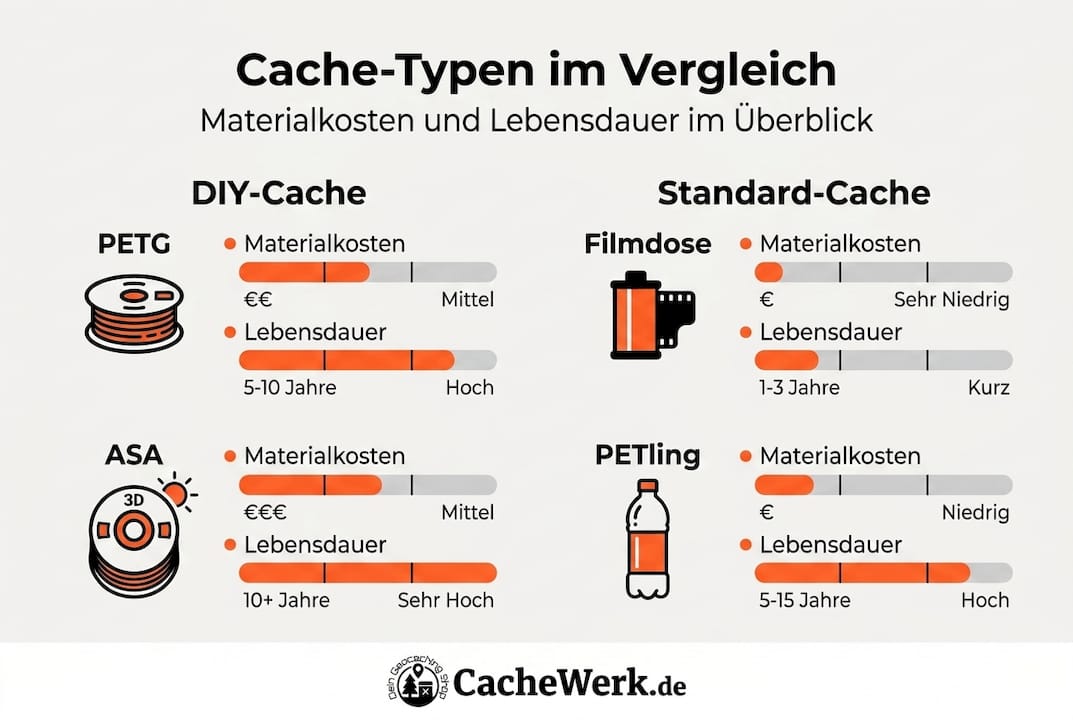
The numbers speak for themselves. Sustainability is another important point. Mass-produced goods generate more waste because they need to be replaced faster. PETG as a material is also recyclable and requires less energy in the production process than many industrially manufactured plastic containers.
How to build a simple, inexpensive micro-cache:
- Download a simple capsule shape from a free tool or database
- Load the file into your slicer (the printing program) and set the wall thickness to at least 3 mm
- Set infill to 50 to 100%, depending on desired stability
- Print with PETG filament, temperature according to manufacturer's recommendation
- After printing, seal all seams with acrylic paint or superglue
- Roll up the log strip and close the cache
Sustainability also means reusability. A well-made cache can be repaired, repainted, or redeployed at another location if needed. This is simply not possible with film canisters. Material selection and longevity are therefore directly linked to cost savings.
Material Selection, Technology, and Longevity in Practice
Not every plastic is suitable for outdoor adventures. Here's a direct comparison of the three most common materials:
PETG is the clear favorite for geocaches. PETG lasts 3 to 5 years in outdoor tests and remains stable at temperatures from minus 20 to plus 70 degrees Celsius. It is moisture-resistant, impact-resistant, and easy to post-process.
PLA is cheaper and easier to print, but unsuitable for outdoor use. It softens with heat, deforming at temperatures as low as 60 degrees Celsius. In summer, a PLA cache on a rock in the sun won't last a week.
ASA is the alternative for extreme conditions. It is more UV-stable than PETG and doesn't yellow as quickly. The disadvantage: It's harder to print and requires an enclosed print chamber.
Pro Tip: For most outdoor caches, PETG is the best choice. However, if your hiding place is permanently in direct sunlight or on a coast, ASA is worthwhile despite the increased effort.
Optimal print settings for watertightness are crucial for the long-term success of your cache. The following technical tips will help:
- Wall thickness: At least 3 perimeters, preferably 4 to 5 for water-bearing areas
- Infill: 40 to 100% depending on stress; always 100% for bottoms and lids
- Print temperature: PETG at 230 to 245 degrees, bed at 70 to 80 degrees
- Layer height: 0.2 mm for good sealing, finer layers increase quality
- Post-processing: Cover all seams with acrylic paint, treat lid contact surfaces with petroleum jelly or a rubber gasket
“Practical test after 18 months: PETG caches in a forest hiding place with direct rain exposure showed no moisture damage. The logbook remained dry. PLA comparison pieces were unusable after one winter.”
The 3D printing tips for PETG go into even greater detail if you want to use specific printers or filament brands.
Why the DIY Trend in Caches Will Replace Classic Solutions
After years of dozens of our own DIY projects and feedback from our community, we can clearly say one thing: standard containers aren't broken, but they've become boring. Finders recognize them immediately. Experienced cachers instinctively look under fake rocks and in utility boxes. While classic hiding ideas still work, the element of surprise is gone.
DIY caches often last longer than industrial solutions in tests and are more flexibly adaptable. Cachers who have started their own projects feel this clearly. The feedback from finders is more enthusiastic, and the favorite list entries are more frequent.
The typical beginner's mistake: getting too complex too quickly. Many start with elaborate mechanisms or huge enclosures and fail due to watertightness or stability. Our recommendation: Experience with DIY solutions shows that simple shapes are the most reliable. Only after five to ten successful caches should you try complex mechanics. In the long term, DIY creativity will dominate the geocaching scene because it offers exactly what makes finding exciting: surprise.
From Guide to Perfect Cache – Your Next Steps with CacheWerk
You now have the knowledge. The next step is your first own cache or upgrading your existing hiding places. CacheWerk supports you in exactly that.
Whether you are looking for custom geocaching special hiding places that are ready for immediate use, or if you want to equip your project with suitable accessories: You will find both with us. Our assortment includes ready-made solutions for urban and rural locations, camouflage material, logbooks, and everything you need for creative caches. Browse our equipment and accessories and let yourself be inspired. Your best hiding place yet is waiting to be built.
Frequently Asked Questions About Custom Geocaches
Which materials are the most durable for custom outdoor caches?
PETG is the first choice for outdoor caches: It lasts 3 to 5 years and withstands temperatures from minus 20 to plus 70 degrees Celsius without problems. ASA is a good alternative for extreme UV exposure.
How much cheaper are self-built caches compared to purchased containers?
The difference is considerable: a self-printed micro-cache costs only 0.15 to 0.50 euros, while ready-made containers in stores cost 3 to 8 euros.
How do I prevent moisture damage in self-built caches?
A wall thickness of at least 3 mm, 100% infill in critical areas, and sealing with acrylic paint ensure reliable watertightness. A rubber gasket on the lid also helps.
Are custom caches allowed and safe for geocaching?
Yes, individual caches are expressly allowed and desired, as long as no dangerous materials are used and the cache is clearly recognizable as a geocache.
Are there special tips for beginners in 3D printing geocaches?
Start with simple capsule shapes and PETG as material. Experience and material choice determine success, so it's better to build three simple caches before tackling complex mechanisms.