
Outdoor Cache Accessories: Best Ideas for Creative Geocaches
Finding the perfect outdoor cache accessories is not easy. Rain, frost, UV radiation, and curious eyes make life difficult for every cache container. Those who skimp or choose the wrong material here will experience an unpleasant surprise after just a few months: soggy logbooks, rusting latches, or a container that simply can't be found anymore because the camouflage has faded. This article clearly and practically shows you which criteria truly matter, which classics have proven their worth, and how modern 3D printing technology elevates your caches to a new level.
Table of Contents
- Important Criteria for Outdoor Cache Accessories
- Classics Among Outdoor Cache Containers
- Creative Solutions: 3D-Printed Cache Containers
- Direct Comparison and Decision-Making Aid
- Practical Experiences and an Uncomfortable Truth Test
- Discover Accessories for Creative, Secure, and Unique Geocaches
- Frequently Asked Questions About Outdoor Cache Accessories
Key Findings
| Point | Details |
|---|---|
| Watertightness is crucial | Not every cache container reliably keeps out rain and moisture – always check the seal. |
| Adapt material choice | Choose PETG or ASA for extreme weather conditions, metal for maximum robustness. |
| Creativity through 3D printing | 3D-printed containers allow for inexpensive and flexible realization of individual camouflages. |
| Keep an eye on costs | Nano-caches can be made for a few cents – high-end solutions are only worthwhile for special requirements. |
| Test before deployment | Always check for watertightness and stability beforehand so the cache brings long-term enjoyment. |
Important Criteria for Outdoor Cache Accessories
Once the objective is clear, it is crucial to understand the most important selection criteria for ideal outdoor cache accessories. Only by paying attention to the right characteristics from the start can you save yourself work and frustration later on.
Environmental Influences Affecting Every Cache
Three factors put every container to the test: water, temperature, and UV radiation. Water penetrates through tiny crevices, making logbooks unreadable. Temperature fluctuations from frost in winter to heat in high summer cause materials to shrink and expand, damaging seals in the long run. UV radiation makes many plastics brittle and fragile, especially if the cache is openly exposed on a south-facing wall or in an open field.
Material Selection: Plastic, Metal, 3D Printing
The choice of material determines how long your cache will withstand the elements. Here's a quick overview of the most important options:
- Plastic (e.g., HDPE, PP): Lightweight, inexpensive, good corrosion resistance. Not every type withstands UV radiation permanently.
- Metal (Aluminum, Steel): Robust and durable, but heavy and sometimes prone to corrosion if the coating is damaged.
- 3D Printing (PETG): PETG tolerates temperatures from minus 20 to plus 70 degrees Celsius, is easily moldable, and can be excellently camouflaged.
- 3D Printing (ASA): ASA is particularly UV and weather resistant, ideal for locations with strong sunlight or extreme weather conditions.
Mechanics: Seal and Closure
A good locking mechanism is at least as important as the material itself. Screw caps with O-ring seals (a rubber ring that seals the gap between the lid and the container) are significantly more reliable than simple snap closures. The closing force should be neither too loose nor too tight, so that even finders without tools can open the cache. Especially with robust geocache containers, an integrated overflow protection is a clear advantage.
Adjust Cache Size and Environment
The size of the container must match the location. Adapting the size to the hiding spot specifically means: micro-containers for urban environments where space is limited and there are many eyes, and large-containers for extensive multi-caches or forest hideouts where more space for logbooks and trade items is useful.
Pro Tip: Test every new container for watertightness before placing it. Simply put some toilet paper inside, close the lid, and submerge the container in a bucket of water for 30 minutes. Dry paper means: ready for use.
Classics Among Outdoor Cache Containers
With this set of criteria in mind, let's take a detailed look at the proven classics and explain what matters in everyday outdoor use.
Pelican Container: The Premium Standard
When it comes to watertightness and robustness, there's no getting around Pelican containers. Pelican containers are considered the Rolls Royce among cache boxes: ultra-robust, with integrated seals, stainless steel hinges, and even a pressure equalization valve that prevents a vacuum from forming due to temperature fluctuations. The only real disadvantage is the price. A small Pelican container can quickly cost 15 to 23 euros, making it expensive for frequent cachers.
For caches in particularly exposed locations, such as directly on water, in damp caves, or in extreme frost conditions, this investment is absolutely worthwhile. The container literally lasts for years without maintenance.
Ammunition Boxes (Ammo Cans): Space Wonders with Charm
Ammo Cans are classics among geocachers: robust, with good sealing, offering plenty of space for large logbooks and trackables (small objects that travel from cache to cache), and have a loyal fan base. The lever lock with an integrated rubber seal holds remarkably tight. If you want to create a true "treasure find" effect for finders, use Ammo Cans.
The disadvantage is obvious: Ammo Cans are large, conspicuous, and unsuitable for urban caches. In cities or on busy paths, they immediately stand out. Furthermore, older specimens rust at the hinge locks if not regularly maintained.
Pro Tip: Metal containers like Ammo Cans benefit from annual maintenance. Lightly oil hinges (e.g., with WD-40 or silicone spray), check rubber seals for cracks, and re-treat with silicone grease if necessary. This significantly extends the cache's life without subsequent damage.
Mighty Mega and Mini Decon: Practical, but with Limitations
The Mighty Mega Cache Container made of aluminum is considered super robust and appears very tight at first glance. In practice, however, it turns out that it does not always remain 100% waterproof, especially after heavy rainfall or if the lid is slightly warped by frost. The Mini Decon, a cylindrical plastic container, struggles with similar sealing problems in long-term use.
Both containers are popular because they are compact, relatively inexpensive, and quick to handle. For dry locations or as additional protection with an inner Ziploc bag, they work well. In permanently damp environments, however, it is better to choose an alternative.
Here is a quick overview of the main advantages and disadvantages:
- Pelican Container: Extremely waterproof, pressure equalization, expensive (15 to 23 euros)
- Ammo Cans: Plenty of space, classic feel, large and conspicuous
- Mighty Mega (Aluminum): Robust, compact, sometimes leaky in extreme weather
- Mini Decon: Small, inexpensive, watertightness questionable in long-term use
For those looking for more creative options beyond the classics, DIY outdoor cache solutions offer exciting and more individual alternatives. A well-planned outdoor escape concept, as also used in outdoor escape adventures, shows how much more creativity can go into design.
Creative Solutions: 3D-Printed Cache Containers
In addition to the established classics, modern technology offers entirely new possibilities for customizing and enhancing the durability of geocaching.
Why 3D Printing is a Perfect Fit for Geocaching
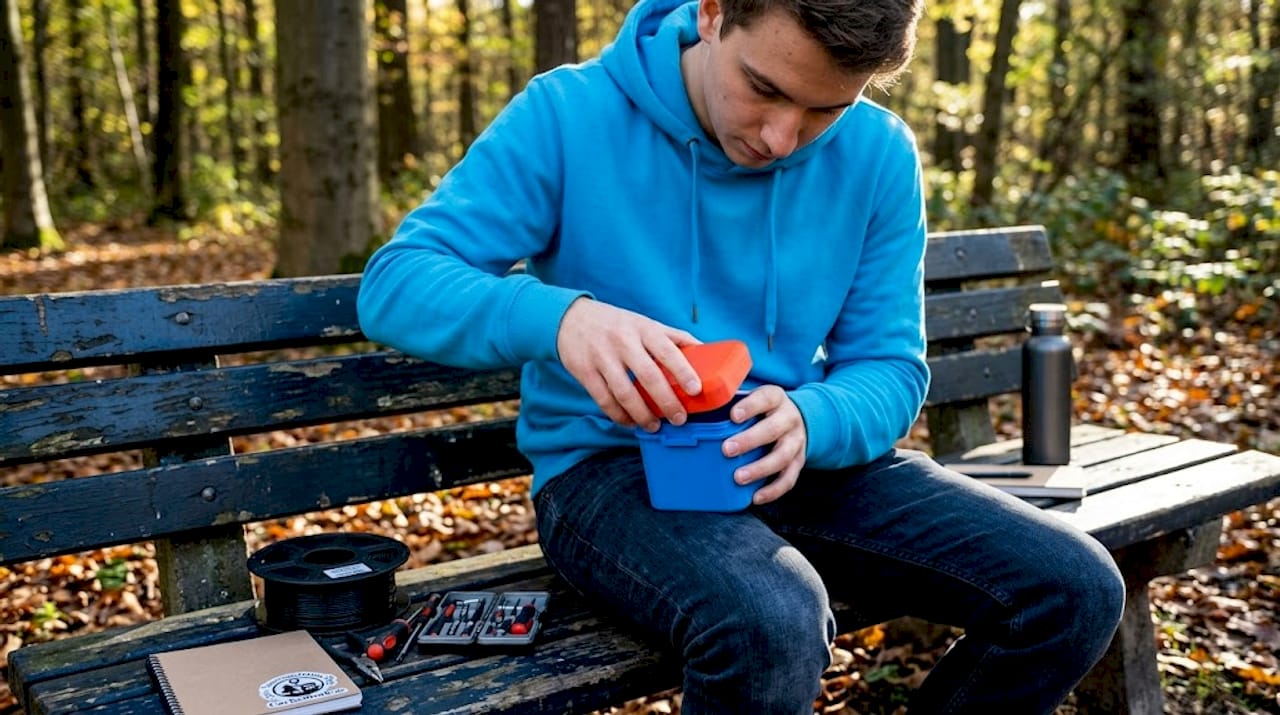
3D printing and geocaching are a natural combination. You can shape containers into any form, such as a deceptively real-looking stone, a mushroom, an acorn, or even a rusted bolt. The camouflage is perfect from the start, without elaborate gluing or painting. 3D-printed containers made of PETG or ASA offer creative camouflage, are cost-effective to produce, and truly waterproof when printed with the correct parameters.
PETG (Polyethylene terephthalate glycol) is the most popular material. It combines the flexibility of simpler plastics with significantly better heat and moisture resistance. ASA (Acrylonitrile Styrene Acrylate) goes a step further and is particularly ideal for highly UV-exposed locations, such as on rocks in full sunlight.
Costs and Print Parameters in Comparison
One of the strongest arguments for 3D printing lies in its cost. A nano-cache from a 3D printer only costs 0.10 to 0.15 euros in material per piece, while a ready-bought nano-cache costs between 2 and 4 euros. This is a huge difference, especially if you're placing many caches at once.
For personalized printing experiences, there are interesting parallels in other areas, such as with personalized camping accessories, where individual design and practical use also go hand in hand.
Here are the most important print parameters at a glance:
| Parameter | Micro-Cache | Macro-Hide |
|---|---|---|
| Material | PETG or ASA | PETG |
| Infill | 100% | 30 to 50% |
| Wall Thickness | 2 mm | 2.5 to 3 mm |
| Layer Height | 0.15 mm | 0.20 mm |
| Print Temperature PETG | 230 to 240°C | 230 to 240°C |
Pro Tip: When printing micro-caches with screw-on lids, it's worth planning for a 0.2 mm tolerance between the lid and the housing. This ensures the lid fits snugly enough for watertightness but can still be opened without tools. An O-ring in the groove makes the container truly waterproof.
Practical Examples: Micro to Macro
A micro-cache in the shape of a nut hangs on a branch and is practically invisible to non-geocachers (also known as Muggles). A macro-hide, like a large stone by the roadside, fits perfectly into the natural environment of a forest path. Both concepts benefit from the fact that with the PETG 3D Printing Guide, you can find exactly the right parameters and material recommendations for your specific deployment location.
Direct Comparison and Decision-Making Aid
To keep an overview, a direct comparison of the most important solutions in a table with practical recommendations follows.
Comparison Table of All Important Cache Containers
| Container Type | Robustness | Camouflage | Weather Resistance | Price | Recommended for |
|---|---|---|---|---|---|
| Pelican Container | ★★★★★ | Medium | ★★★★★ | 15 to 23 € | Extreme locations, water, frost |
| Ammo Can | ★★★★☆ | Low | ★★★★☆ | 5 to 12 € | Forest, multi-caches, large trading zones |
| Mighty Mega (Alu) | ★★★★☆ | Medium | ★★★☆☆ | 8 to 15 € | Forest, dry areas |
| Mini Decon | ★★★☆☆ | Medium | ★★☆☆☆ | 2 to 5 € | Dry locations, beginners |
| 3D Print PETG | ★★★★☆ | ★★★★★ | ★★★★☆ | 0.10 to 1 € | Urban, forest, creative camouflages |
| 3D Print ASA | ★★★★☆ | ★★★★★ | ★★★★★ | 0.15 to 1.50 € | UV exposure, extremes |
Classics like Ammo Cans and HDPE containers are practical and inexpensive, but often too conspicuous and large for urban environments. High-end options like Pelican containers are robust and expensive. 3D-printed variants offer flexibility, but only if the print parameters are correct.
Recommendations for Specific Situations
Not every situation fits into a single category. Here are concrete recommendations for common edge cases:
- City Cache (Urban): 3D-printed micro-container made of PETG, disguised as a traffic sign bolt, chewing gum container, or rock. Inconspicuousness is paramount.
- Forest and Nature: Ammo Can or Mighty Mega for large containers, ASA-printed stones or mushrooms for small and medium-sized caches.
- Extreme Weather (Alps, Coast): Pelican Container or ASA print with O-ring are the first choice here. No compromises on watertightness.
- Multi-Cache with Trading Zone: Ammo Can offers space for logbook, pen, trackables, and trade items. Perfect for extended tours.
- Budget Cacher with Many Hides: 3D-printed PETG nano-caches are unbeatable in terms of cost, at under 20 cents per piece in material.
Practical Experiences and an Uncomfortable Truth Test
After the comparative analysis, an honest look at practice is worthwhile, and it clears up widespread assumptions.
Many geocachers believe that the most expensive container is automatically the best. This is not always true. A Pelican container is fantastic, but it lies unnoticed in the forest for days if its silver or black surface is poorly camouflaged. A cheap 3D-printed mushroom, on the other hand, lies unnoticed for months because it simply looks like a real mushroom. Camouflage often trumps pure material quality, at least regarding the long-term stability of the hide.
We have monitored caches in real-world tests through rainy periods, winter frost, and summer UV exposure. The result was clear: not the price, but the combination of sensible camouflage, cleanly processed closure, and regular checks determines longevity. A container that is maintained once a year, meaning the seal is checked, the logbook is replaced, and the closure is cleaned, easily lasts five years or more.
The biggest misconception we observe repeatedly: "I'll put out the cache and don't have to do anything else." Even the best materials age. O-rings become brittle. Hinges rust. Snap closures lose their strength. Those who check once a year save themselves complaints on the platform and keep the experience fresh and inviting for finders.
The truly decisive question is not "Which container is the best?" but "Which combination of container, camouflage, and location works for my specific hide?" A very good container in the wrong place is worse than a mediocre container that perfectly matches the terrain. This is not a contradiction, but experience from hundreds of placed caches.
Anyone who delves deeper into DIY experience tips quickly realizes: The community openly shares this knowledge. Use it actively. Learn from others who have already made mistakes and drawn conclusions from them. This saves time, money, and nerves.
Discover Accessories for Creative, Secure, and Unique Geocaches
If you want to improve your own caches or are looking for interesting accessories right now, you'll find sophisticated and proven products for every requirement and terrain in the shop.
At cachewerk.de you can specifically search for what truly makes your next hide special. Whether you're looking for classic accessories, creative camouflage solutions, or unusual specialty products: The selection is tailored to genuine geocaching needs. Browse through the Geocaching accessories and find exactly the products that suit your next adventure. For maximum deception in an urban environment, the creative geocaching hide as a fake traffic sign is an absolute highlight that completely fools muggles and delights finders.
Frequently Asked Questions about Outdoor Cache Accessories
Which outdoor cache container is truly waterproof?
Pelican Containers are extremely waterproof, thanks to an integrated seal, stainless steel hinges, and a pressure equalization valve. Mighty Mega and Mini Decon do not reliably meet this standard in practice, especially in persistently damp conditions.
How can I make 3D-printed cache containers long-lasting and stable?
Use PETG or ASA as material, print with 100% infill and at least 2 mm wall thickness, and test the container for watertightness in a water bath before placing it. With the correct printing parameters, the container will remain waterproof and last for years outdoors.
How much does a robust nano-cache from a 3D printer cost?
The material costs are only 0.10 to 0.15 Euros per piece, which means enormous savings compared to purchased nano-caches for 2 to 4 Euros, especially for larger series.
What size is ideal for my hide?
Adapting the size to the terrain is the most important rule: Micro for urban environments with little space and many passers-by, Large for rural or remote locations where you can use more space for logbook and trade items.
What should be paid particular attention to when it comes to the closure?
A screw lid with an O-ring guarantees significantly better long-term watertightness than simple snap closures, which lose their tension over time. Integrated seals should be checked annually for cracks or brittleness and treated with silicone grease if necessary.