
Roles of Cache Containers: Innovative Solutions for Geocaching
Many geocachers pay little attention to the logbook in the container until the first copy becomes illegible after just a few weeks. Yet, there is more technique involved in the seemingly simple act of rolling up a logbook than meets the eye. Tight windings, the wrong paper, or an unfavorable container diameter can cause log strips to tear, create "fraying" ends, and lead finders to store the logbook incorrectly. This guide shows you which mechanical principles are truly important, which materials and constructions make a difference, and how the community avoids common mistakes with pragmatic solutions.
Table of Contents
- Fundamentals of Mechanics in Rolling Cache Containers
- Material Selection and Construction: Simple Solutions for Complex Requirements
- Practical Care and Maintenance: Dealing with Damage and Third-Party Maintenance
- Rolling Cache Containers: Innovations, Community Practice, and Best Practices
- My Own Perspective: What Practice Truly Teaches
- Discover Innovative Cache Container Solutions from CacheWerk
- Frequently Asked Questions About Rolling Cache Containers
Key Insights
| Point | Details |
|---|---|
| Optimal Logbook Geometry | A suitable strip shape prevents material damage and facilitates handling in the cache container. |
| Material and Construction | The logbook's lifespan directly depends on appropriate materials and container design. |
| Care and Maintenance | Regular checks and clear communication for third-party maintenance ensure clean caches for all finders. |
| Community Best Practices | Innovative stowing instructions and rolling mechanisms increase the quality and durability of cache containers. |
Fundamentals of Mechanics in Rolling Cache Containers
When creating a new cache, one first thinks about the suitable container, location, and camouflage. The logbook often comes last. And that's precisely the problem. Because logbooks and their handling influence a cache's longevity more than many other factors.
Why Rolling is So Crucial
In geocaching, the idea of "rolling" is not limited to a single container type. It primarily concerns the log strip and its mechanical handling within the respective cache container. A log strip rolled too tightly creates constant pressure on the paper fibers. Each time it is unrolled, microscopic tears occur, accumulating over time.
Particularly critical: When finders re-roll the logbook after signing, they rarely do so with the same care as the cache owner. The result is uneven windings that overstress the strip at individual points.
"In geocaching, the idea of 'rolling' is not limited to a single container type, but primarily concerns the logbook (log strip) and its mechanical handling within the respective cache container."
The optimal width of a log strip depends on the container's inner diameter. A rule of thumb: The rolled strip should have at least 3 to 4 millimeters of clearance to the inside of the container. This allows it to be removed and reinserted without force. You can find more on the topic of optimal roll distribution in our blog.
Mechanical Influencing Factors at a Glance
The following table shows which factors directly influence rolling behavior and what consequences arise from them:
| Factor | Influence on Rolling Behavior | Consequence of Incorrect Choice |
|---|---|---|
| Paper Thickness | Thicker paper rolls up thicker | Gets stuck in the container |
| Strip Width | Too wide blocks the opening | Difficult to remove |
| Container Diameter | Determines maximum roll diameter | Too tight a strip tears |
| Paper Quality | Coated paper is more resistant | Normal paper rots when wet |
| Winding Technique | Evenly rolled lasts longer | Uneven rolling creates creases |
The most important points summarized:
- Tight windings significantly increase the risk of material fatigue.
- Log strips that are too wide block the container opening and tempt finders to handle them roughly.
- Poor paper quality deteriorates rapidly when exposed to moisture.
- Uneven windings create creasing points that tear after a few uses.
- Missing stowing instructions lead to the logbook being stored incorrectly.
This sounds like a lot of detail for a piece of paper. But it is precisely these details that determine whether your cache will function smoothly for one year or five years.
Material Selection and Construction: Simple Solutions for Complex Requirements
Now that we understand the mechanical fundamentals, let's move on to concrete design decisions. Material choice and geometry are the two levers you, as a cache owner, directly control.
Which Material Truly Lasts
Normal printer paper (80 g/m²) is the most common choice for log strips. It's cheap, readily available, and easy to cut. But it has a clear disadvantage: when wet, it becomes soft, expands, and sticks together. A single raindrop penetrating through a poorly sealed lid can render the logbook unreadable.
Better alternatives:
- Synthetic paper (e.g., Rite in the Rain): waterproof, tear-resistant, more expensive, but significantly more durable.
- Parchment paper: slightly water-repellent, inexpensive, suitable for short-to-medium-term use.
- Coated paper (e.g., matte photo paper): water-repellent, but difficult to write on.
- Special geocaching log paper: optimized for durability and writability.
For DIY and intricate container designs, the rolling and re-rolling mechanism details can greatly influence the logbook's lifespan. This means: Not only the material matters, but also how tightly the strip needs to be rolled in relation to the container's inner diameter.
Geometry as a Design Principle

The geometry of the log strip is no accident. It is a conscious decision you should make correctly once when setting up a new cache.
Here's a direct comparison of common configurations:
| Configuration | Diameter (inner) | Strip Width | Rating |
|---|---|---|---|
| Nano tube (minimal) | 8 mm | max. 5 mm | Very tight, high wear rate |
| Standard tube | 25 mm | max. 20 mm | Easy to handle |
| Film canister | 33 mm | max. 28 mm | Comfortable, plenty of space |
| Lock & Lock / Petling | 55 mm | max. 48 mm | Ideal for long strips |
| PET bottle container | 65 mm | max. 55 mm | Generous, recommended |
Pro Tip: Always cut log strips slightly narrower than the inner diameter of the container. As a rule of thumb: strip width = inner diameter minus 5 mm. This allows the strip to roll up loosely, making it easy to remove and reinsert without getting stuck.
The geometry of rolled logbooks also plays a role in choosing the container shape. Tube-shaped containers are better suited for long log strips than flat boxes because the strip remains evenly rolled and does not crease.
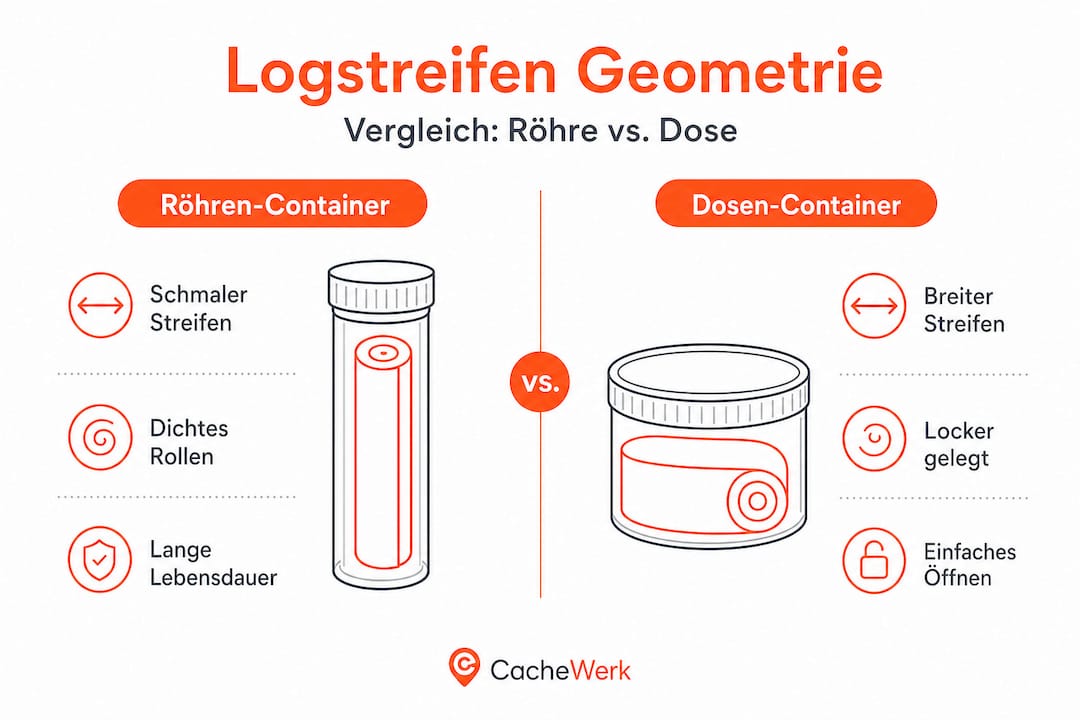
Step by Step: Rolling Log Strips Correctly
Careful rolling technique makes more of a difference than the best material. Here is the proven method:
- Cut the strip to size: Choose length and width to match the container. Round off corners to prevent creases.
- Start loosely: Do not roll the strip tightly immediately. Start loosely and evenly first.
- Maintain even tension: Apply constant but light pressure when winding.
- Check the roll: The finished roll should slide into the container without force.
- Allow for buffer: The roll should sit in the container with 3 to 5 mm of play.
- Note stowing instructions: Explain in the listing or on a small note in the container how to correctly insert the logbook.
These six steps sound simple. But in practice, careful preparation saves numerous maintenance interventions.
Practical Care and Maintenance: Dealing with Damage and Third-Party Maintenance
Even the best-prepared cache will eventually reach a point where maintenance is needed. This is normal. What's important is how you handle it.
Recognizing and Classifying Damage
The most common damage to logbooks results from moisture, mechanical wear, or improper handling by finders. This can be recognized by:
- Damp or wet entries: Ink runs, paper expands, pages stick together.
- Torn ends: A typical sign of rolling too tightly or too frequent unrolling and re-rolling.
- Black edges: Mold growth due to prolonged moisture in the container.
- Illegible entries: Caused by moisture, dirt, or mechanical abrasion.
- Crease lines across the strip: Occur when the logbook is reinserted incorrectly.
The interface between the container and the logbook is crucial here. A poorly sealing lid, a damaged O-ring profile, or an overly wide opening significantly increases maintenance effort.
"In practice, securing and care also involve the container/logbook interface: replacement and third-party maintenance are discussed as pragmatic options when the logbook or container is damaged."
How the community views logbook exchange during cache maintenance is clear: exchange is acceptable if the logbook is already soggy or wet. But communication with the owner remains important.
Pro Tip: If you, as a finder, discover a damaged logbook, take a photo of it before replacing it. Send the photo along with a message to the cache owner via geocaching.com. This way, the owner knows exactly what happened, and you have documented the exchange.
Third-Party Maintenance: When Is It Allowed?
The topic of third-party maintenance is controversial in the geocaching community. Most platforms allow finders to replace a damaged logbook if it prevents cache operation. Nevertheless, clear limits apply.
The following basic rules have proven effective:
- Replace logbook: Allowed in case of obvious damage (dampness, mold, full). Always with owner information.
- Replace container: Only in exceptional cases and after explicit consultation with the owner.
- Redesign hide: Not allowed without the owner's permission.
- Remove content: Only in case of obvious trash or safety risk.
- Do not change coordinates: Never, even if there is an obvious error.
The following overview shows typical damage cases and the recommended reaction:
| Damage Case | Immediate Action | Owner Information |
|---|---|---|
| Wet logbook | Replace with your own spare | Yes, always |
| Full log strip | Replace or leave a note | Yes, recommended |
| Damaged container | Secure makeshift solution | Yes, urgent |
| Missing writing aid | Leave your own pen | Optional |
| Displaced hide | Restore original position | Yes, always |
With these tips for maintaining cache containers, you can act appropriately as both an owner and a finder.
Rolling Cache Containers: Innovations, Community Practice, and Best Practices
The best solutions rarely come from individuals. They arise within the community, through experimentation, discussion, and mutual learning. Here are the most proven practices of the geocaching community.
What Really Works
Over the years, the community has learned which small details make the biggest difference. Some of the most important insights:
- Precise log orientation: The log strip should always be inserted with the beginning facing up. This way, the next finder quickly finds space for their entry.
- Stowing instructions in the listing: A simple sentence in the listing like "Please roll up the logbook loosely and insert it with the beginning facing up" significantly reduces incorrect handling.
- Integrate pen holders: Small pen holders in the lid or on the container prevent the pen from getting lost and the logbook from being damaged.
- Use color coding: Different colors on log strips or container parts help quickly identify the correct insertion position.
- Perform a test run: Before activating a new cache, remove and reinsert the logbook several times to identify weaknesses.
- Buffer for expansion: Coated paper expands minimally with temperature changes. This buffer should be considered in the design.
The following aspect, which many cache owners underestimate, is particularly important:
"If the logbook gets stuck in the container or opening or is difficult to access, the probability of careless handling by finders increases. Therefore, precise log orientation and easily reproducible stowing instructions in the listing are a true quality lever."
This insight from practice regarding building cache containers oneself shows: Not the container alone decides, but the entire system of container, logbook, and usage instructions.
Innovative Designs from the Community
Community practices around innovative container designs show how creative geocachers are in solving practical problems:
- Magnetic closure log holder: Small magnets hold the rolled-up log strip in position without crushing it.
- Telescopic mechanisms: Extendable inner sleeves allow for longer log strips in short containers.
- Double-tube design: An inner tube holds the log strip, while the outer forms the waterproof seal.
- Spiral-cut log strips: Instead of a straight strip, a spiral-shaped strip is cut from a sheet, allowing more entries in a smaller space.
- 3D-printed inserts: Holders made of PETG precisely matched to the container, which keep the log strip in the correct position.
In particular, 3D-printed PETG solutions have proven to be particularly reliable in the community. PETG is moisture-resistant, dimensionally stable to temperature changes, and easy to process with standard 3D printers. For cache owners who regularly set up new hiding places, the investment in such inserts pays off multiple times.
My Own Perspective: What Practice Really Teaches
After years of dealing with logbooks, containers, and community discussions, one realization has emerged that surprises many geocachers: most problems arise not from poor materials, but from a lack of communication.
Why Common Solutions Often Fall Short
Many cache owners invest in high-quality containers, expensive seals, and waterproof paper. This is sensible. But they forget the most important thing: to explain to the finder how to handle the logbook correctly. A simple sentence in the listing would prevent foreign maintenance and material damage in numerous cases.
At the same time, community reality shows: "Securing" doesn't just mean material choice, but also clarity in rules and ownership. As the discussions around cache maintenance and logbook exchange show, a logbook exchange in the forum is described as acceptable, especially in case of damage and wetness. But owner approval or at least information remains important. This is not a bureaucratic detail. It is respect for the cache owner and the geocaching community.
The Underestimated Power of Clear Ownership Rules
Conflicts almost always arise where responsibilities are unclear. A cache owner who clearly communicates in the listing what to do in case of damage avoids most misunderstandings. Specifically, this means: providing contact details, integrating a maintenance note, and actively responding to community messages.
Anyone who reads practical experience reports quickly realizes: The most successful cache owners are not those with the most expensive materials. They are the ones who actively maintain their caches, react to finder feedback, and communicate clear rules. This is the real difference between a cache that is archived after one year and one that functions for ten years.
Innovation is important. Material is important. But community and communication are the foundation on which everything else stands.
Discover Innovative Cache Container Solutions from CacheWerk
You have now learned about the mechanical basics, the right materials, and community best practices. Now the question is: Where can you find containers and accessories that meet all these requirements from the start?
At CacheWerk, you'll find exactly that: well-thought-out, durable cache solutions designed for practical use. Whether you're looking for a particularly inconspicuous hideout or are a creative DIY builder who needs inspiration: the range covers both. Browse through the discover special hides and be inspired by innovative designs. Those who love urban hides should definitely take a look at the Fake Hides from CacheWerk. Practical, creative, and made from high-quality PETG.
Frequently Asked Questions about Cache Container Rolls
Why does the logbook fray so quickly when rolled tightly?
Tight rolling leads to material fatigue and makes the ends of the log strip frayed. The geometry should be chosen so that the logbook does not have to be rolled unnecessarily tightly.
What to do with a wet or damaged logbook?
If the logbook is muddy or wet, replacement is recommended. It is best to inform the cache owner promptly via geocaching.com.
How can I improve logbook maintenance in the listing?
Storage instructions can be easily integrated into the listing and help finders handle the logbook correctly. A simple sentence is enough to prevent many mishandlings.
Are there special rolling techniques for DIY containers?
A gradual rolling technique, where it is first loosely wound and then gradually tightened, prevents excessive wear and significantly extends the life of the log strip.