
The roles of creative hiding places: Geocaching 2026
The roles of creative hiding places describe the various functions and design principles that make a cache much more than a simple container. Instead of just placing a container somewhere, each hiding place takes on a clear task: camouflage, surprise, telling a story, or posing a challenge. Structured treasure hunts with 7 to 8 stations often last over 60 minutes because each station fulfills its own role and actively engages seekers. Those who understand and consciously apply these roles design geocaching adventures that thrill participants long after the find.
What functions do the roles perform in creative hiding places?
Geocaching jargon knows the term "cache design," but the idea of roles goes deeper. Every creative hiding place performs at least one of five core functions that together shape the experience.
| Role | Description | Practical example | Effect |
|---|---|---|---|
| Camouflage | Hiding place blends into the surroundings | Magnetic capsule under a park bench | Seekers overlook the obvious |
| Challenge | Mechanical or cognitive stimulus | Combination lock, number puzzle | Increased tension and sense of achievement |
| Storytelling | Narrative embedding in a story | Envelope as a "secret mission" | Emotional connection to the cache |
| Interaction | Active action required | Magnetic hiding place, folding mechanism | Haptic experience, longer engagement |
| Surprise | Unexpected element | Fake apple, disguised screw | Aha moment and replay motivation |
These five roles are not mutually exclusive. A magnetic hiding place under a street sign simultaneously takes on the role of camouflage and interaction. Seamless hiding places like fake apples extend the discovery time by two to three times because seekers have to actively rethink. It is precisely this combination of roles that creates synergies that a simple rock hiding place could never achieve.
The role of storytelling is particularly underestimated. The dramaturgical staging of a hiding place is just as important as its physical location. A cache disguised as a "stolen document" and hidden in an old file folder tells a story. Seekers become detectives, not just coordinate trackers.
- Camouflage is most effective when the hiding place is placed at eye level. Hiding places at eye level are instinctively less noticed because the brain classifies them as part of the normal environment.
- Challenge increases the value of the find. Whoever solves a puzzle experiences the find as a personal success.
- Interaction physically engages seekers. Mechanical hiding places require active haptic searching, which intensifies the gaming experience.
How to adapt hiding place roles to different difficulty levels?
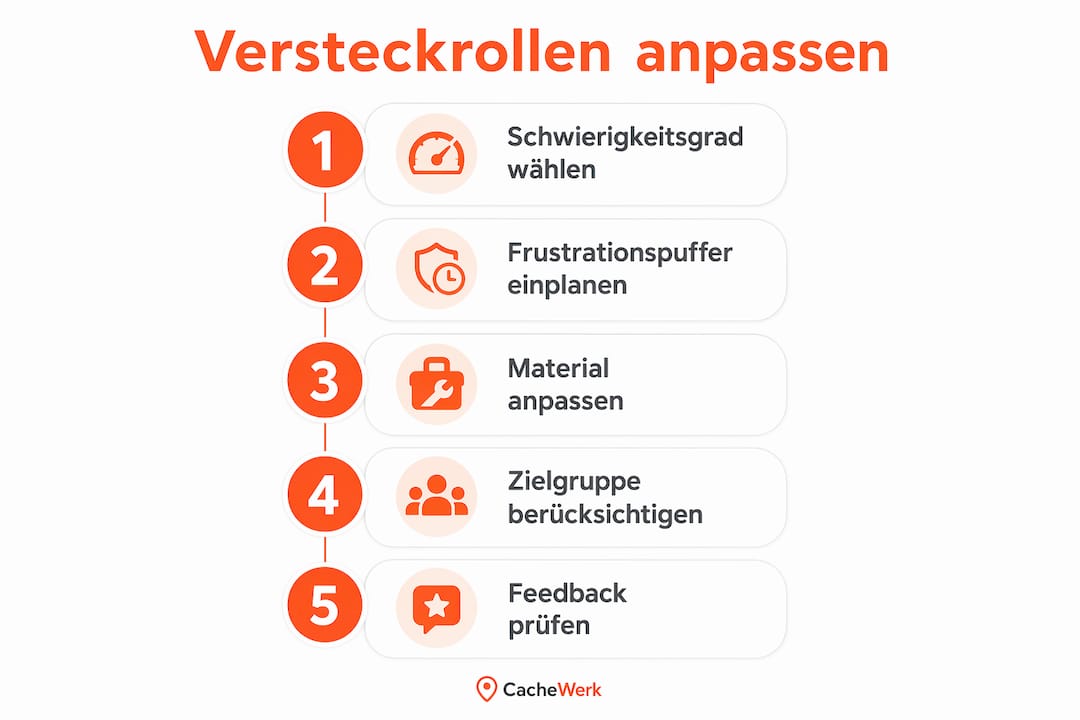
Creative hiding place ideas only work if they suit the target group. An expert hiding place frustrates beginners, a too-simple hiding place bores experienced geocachers. The solution lies in a clear stratification with appropriate role assignments.
-
Beginners (D1 to D2): The main role is camouflage through simple integration into the environment. Magnetic capsules under benches, small containers under stones, or classic film canisters in tree hollows are suitable here. The challenge lies in finding, not in solving. Seekers need a quick sense of achievement to stay motivated.
-
Advanced (D3): Here, roles like challenge and interaction are added. Chain hiding places with 2 to 3 stations significantly increase the difficulty, as each station presents a new task. Combination locks, simple puzzles, or coordinates that are only calculated on site fit into this level. The storytelling role begins to play an important function here.
-
Experts (D4 to D5): All five roles interlock. Mechanical triggers, narrative chain hiding places with five or more stations, and hiding places that require knowledge of physics belong in this category. Role-playing games with hiding places, where seekers take on a character or task, are particularly effective here. The surprise role is used specifically to amaze even experienced geocachers.
Pro Tip: Plan a "frustration buffer" for each difficulty level. This means: Place a small clue near a difficult hiding place that is not immediately visible but can be found if someone is truly stuck. This keeps the tension high without discouraging seekers.
Hide-and-seek games for children follow the same principles, but with adapted roles. The surprise role and colorful design are in the foreground, while complex mechanisms are omitted. A clear role assignment in the planning team, as recommended for creative projects, prevents a cache from accidentally becoming too difficult or too easy.
What techniques and tools effectively implement hiding place roles?
Combining roles and hiding places works best when the right tools and materials are used. Here are the most proven techniques from practice.
UV markings for the surprise role
UV pens cost around 8 euros and open up a whole new dimension for the surprise role. Clues that are only visible under UV light transform a normal surface into a secret information carrier. Seekers who have a UV flashlight experience a real aha-moment. This technique is particularly suitable for urban caches where conspicuous markings are quickly removed.
Magnetic fastenings for the camouflage role
Magnetic hiding places are the most reliable method for the camouflage role in urban environments. A nano-cache with a strong neodymium magnet adheres invisibly to metal posts, benches, or railings. Mechanical and magnetic hiding places are haptically effective and more durable than purely optical camouflages. The key lies in the placement: at eye level, but in a spot no one instinctively touches.
Everyday objects for maximum camouflage
- Screw heads made of resin, which look like real screws but conceal a hollow space
- Resin stones that are visually indistinguishable from real stones
- Plastic tree stumps for forest hiding places with a waterproof interior
- Disguised keychains that look like normal objects
Weather protection for durability
A creative hiding place is useless if it becomes unusable after the first rain. Weather protection is not an option, but a must. Silicone sealing rings, waterproof PETG plastic containers, and screw caps with O-ring seals reliably keep moisture out. Cachewerk offers 3D-printed PETG hiding places specifically for this purpose, which are both weather-resistant and durable.
Pro Tip: Creative hiding place ideas don't have to be expensive. With a UV pen (approx. 8 euros), a magnetic capsule (approx. 3 euros), and a waterproof film canister container (approx. 2 euros), a complete hiding place with three combined roles can be created for under 15 euros.
For those looking for creative gift ideas for outdoor hobby lovers, UV pens and magnetic capsules are also popular souvenirs for geocaching enthusiasts.
How do role-playing and storytelling enrich creative hiding places?
Storytelling in geocaching transforms individual hiding places into active experience stations that tell a story instead of just concealing a container. This insight changes how you plan and place a cache.
A continuous story script connects all stations into one experience. Imagine: Station 1 contains a letter from a fictional researcher asking for help. Station 2 conceals a key element that can only be found with the knowledge from Station 1. Station 3 reveals the solution. Each station plays a clear role in the narrative arc.
- Prop items like folded letters, small maps, or mini-objects give substance to the story. Immersive role-playing games with prop items provide a narrative framework and significantly increase participants' engagement.
- Role distribution within a group enhances group dynamics. Those who search as a "detective," those who read coordinates as a "cartographer," and those who collect clues as an "archivist" experience the same cache completely differently.
- Narrative chain hiding places use the storytelling role to organically increase the difficulty level. Each station reveals a new puzzle piece.
"Strong hiding places tell a story and demand active participation from seekers. The 'why' of the hiding place is just as important as the 'where'."
Projects with clearly defined roles simultaneously promote creativity and efficient implementation. This applies to geocaching just as much as to professional creative projects. Those who determine within the planning team who is responsible for storytelling, who for technology, and who for weather protection create better caches in less time. The optimal role distribution in a geocaching team is an often underestimated success factor.
Role-playing games with hiding places are particularly effective with groups. Families, school classes, or company teams experience the cache as a shared adventure if each person has a task. The player experience becomes more intense, and the memory lasts longer. This is the difference between a cache that is found once and one that is talked about months later.
Key Takeaways
Creative hiding places unleash their full potential when each station takes on a clear role, technology and storytelling interact, and the difficulty level matches the target group.
| Point | Details |
|---|---|
| Define five core roles | Camouflage, challenge, storytelling, interaction, and surprise form the foundation of every creative hiding place. |
| Adjust difficulty levels | Beginners need quick successes, experts expect combined roles and mechanical stimuli. |
| Utilize affordable technology | UV pens, magnetic capsules, and waterproof containers enable creative hiding places for under 15 euros. |
| Incorporate storytelling | Narrative chain hiding places with prop items increase participant engagement and make caches unforgettable. |
| Distribute roles within the team | Clear responsibilities for technology, storytelling, and weather protection improve the quality of every cache. |
What I've learned after years with creative hiding places
I've tested many caches, from simple magnetic capsules to multi-hour chain caches with escape room elements. And I'll tell you honestly: most mistakes don't happen with the technology, but with the role planning.
The most common mistake is trying to cram too many roles into a single hiding place. A cache that simultaneously camouflages, surprises, tells a story, and offers a mechanical challenge overwhelms seekers. The result is frustration instead of excitement. My experience shows: two to three clearly defined roles per hiding place are the maximum for a coherent experience.
What truly surprised me: the surprise role is the most effective, but also the most difficult to implement. A hiding place that genuinely amazes seekers requires an understanding of human perception. We see what we expect to see. A fake screw head on a metal plate is ignored because the brain classifies it as "normal." That's precisely what makes it the perfect hiding place.
Many geocachers underestimate the storytelling role because it seems elaborate. But a simple letter describing a task is enough. You don't need a professional script. You just need a clear question: Who is looking here, and why? If you answer this question before you place the hiding place, the cache will automatically be better.
My personal advice: Start with the storytelling role, even if you're only planning a simple cache. Write three sentences that explain who hid this cache and why. These three sentences change everything.
— Benedikt
Implement creative hiding places with the right equipment from Cachewerk
You now know what roles creative hiding places take on and how to plan them. The next step is to implement them with the right equipment.
Cachewerk offers exactly what you need for every hiding place role: magnetic capsules for the camouflage role, weather-resistant PETG containers for durability, UV pens for the surprise role, and specialized camouflage materials for urban and rural environments. All products are designed for durability and practicality, so your caches continue to function even after months. Check out the complete selection of geocaching equipment and accessories at Cachewerk and get creative hiding places that truly inspire.
FAQ
What do "roles" mean in creative hiding places in geocaching?
Roles in creative hiding places describe the function that a cache performs in the experience: camouflage, challenge, storytelling, interaction, or surprise. Each role influences how seekers perceive the cache and how long they engage with it.
How many roles should a single hiding place assume?
Two to three clearly defined roles per hiding place are optimal. More roles lead to overwhelming and frustrating seekers, while fewer roles make the cache less memorable.
Which technique is best suited for the surprise role?
UV markings with a UV pen (approx. 8 euros) are the cheapest and most effective method for the surprise role. Clues only visible under UV light create a strong "aha" moment for seekers.
How do role-playing games with hiding places work for groups?
Role-playing games with hiding places assign specific tasks to group members, such as detective, cartographer, or archivist. This role distribution enhances group dynamics and makes the same cache an individual experience for each participant.
Are creative hiding places also suitable for hide-and-seek games for children?
Creative hiding places are excellent for hide-and-seek games for children if the roles are adapted. The surprise element and colorful design are paramount, while complex mechanical challenges are omitted. Structured treasure hunts with 7 to 8 stations keep children actively engaged for over 60 minutes.
