
Secure Caching Tips: Creative Geocaching Hides
Geocaching is great fun, but hiding a cache also comes with real responsibility. A poorly placed hide can harm the environment, endanger others, or cause legal problems. The good news is that safety and creativity are not mutually exclusive. In this article, we'll show you which safety criteria really matter, how to camouflage creatively and environmentally friendly, and which practical hide types have proven successful in practice. Whether you're placing your first cache or are an experienced geocacher, here you'll find concrete ideas and clear rules for responsible geocaching.
Table of Contents
- Important Safety Criteria for Geocaching Hides
- Creative Camouflage Methods: Hiding Naturally and Inconspicuously
- Practical Examples of Safe and Creative Hides
- Environmental Awareness in Caching: Acting Sustainably and Considerately
- Experiences from Practice: What Really Works
- Your Next Step: Safe Caching Accessories and Creative Hides
- Frequently Asked Questions about Safe Geocaching Hides
Key Takeaways
| Point | Details |
|---|---|
| Adhere to safety rules | Always maintain distance from sensitive areas and follow official guidelines for geocaches. |
| Utilize natural camouflage | Use natural materials for inconspicuous but effective geocache hides. |
| Respect the environment | Prioritize sustainable hides that do not harm flora and fauna. |
| Creativity and practice | On-site inspiration and personal testing ensure unique and safe hides. |
Important Safety Criteria for Geocaching Hides
Before you even begin to build and camouflage a cache, you should know the basic safety rules. These protect not only the environment but also you and other seekers.
The first and most important point: keep your distance. Caches must not be placed near schools, kindergartens, playgrounds, or railway tracks. These places are off-limits for good reason. Anyone who hides a cache there risks not only trouble with authorities but can also put uninvolved people in uncomfortable situations.
Nature reserves are also a clear no-go. According to the official placement rules: no hides in dangerous or forbidden areas, no environmental damage. This also means that you are not allowed to bury anything without appropriate permission. A buried cache leaves traces and can permanently damage the habitats of animals and plants.
Here is an overview of the most important prohibited zones and rules:
- Schools and kindergartens: Caches near facilities for children are generally not allowed.
- Playgrounds: Even well-camouflaged caches can arouse suspicion and cause problems.
- Railway tracks and railway facilities: Absolutely forbidden for safety reasons.
- Nature reserves: No placement without written permission from the competent authority.
- Habitats of endangered species: Caution is advised even outside official protected areas.
- Buried caches: Only allowed with explicit permission.
Another important aspect is personal responsibility as a cache owner. You are responsible for regularly maintaining your cache. A rotten container that is broken open and leaves trash is not a good cache. So, plan for a weatherproof, sturdy container from the start.
Safety Fact: More than 60% of all reported cache problems arise from poor placement, not poor camouflage. Knowing the basic rules avoids the majority of common mistakes.
The official guidelines of geocaching platforms like Geocaching.com provide a clear framework. Read them completely before publishing your first cache. This sounds obvious but is skipped by many beginners.
Creative Camouflage Methods: Hiding Naturally and Inconspicuously
Now comes the creative part. If the safety rules are clear, the exciting question arises: How do you camouflage a cache so that geocachers can find it, but muggles (non-geocachers) completely overlook it?
The basic principle is simple: The cache should disappear into its surroundings. Natural camouflage using paint, moss, bark, or magnets is more effective than any artificial disguise, and it does not harm the environment. A green-painted tin lying under real moss is hardly noticeable. A silver plastic box wedged between roots, however, is.
Here are proven camouflage methods at a glance:
- Bark camouflage: Real or artificial bark is glued or tied to the container. Looks like a branch from the outside.
- Moss cover: Small container is covered with dry moss. Works particularly well on damp forest floor.
- Magnetic containers: Attached to metal structures, e.g., under benches or on bridge railings.
- Color matching: The container is painted in the color of the surroundings, e.g., stone gray or bark brown.
- Natural embedding: The cache is integrated into a natural structure, e.g., placed in a tree fork and covered with branches.
Important: Never place the word “Geocache” or a logo on the outside of the hide. This immediately reveals the hide to uninvolved parties. Only the logbook inside should be labeled accordingly.
Pro tip: Test your camouflage by asking a friend who doesn't know where the cache is located to inspect the spot. If that person notices nothing, you've done a good job.
For DIY camouflage, you'll find many step-by-step instructions on our DIY Geocache Camouflage blog. Additionally, geocaching stickers for secure containers help label the inside professionally without compromising the outer camouflage.
The goal is always: The cache should be a joy for seekers, but remain invisible to everyone else.
Practical Examples of Safe and Creative Hides
Theory is good, practice is better. Let's take a closer look at three proven hide types and compare their strengths and weaknesses.
According to an overview of creative hide types, hollow logs, fake rocks, and urban magnetic solutions are among the most popular and effective methods worldwide.
The three top hide types in comparison:
| Hide Type | Advantages | Disadvantages | Suitable Environment |
|---|---|---|---|
| Hollow Log | High surprise effect, natural look | Limited availability in nature | Forest, park |
| Fake Rock | Perfect integration, very low find rate | More expensive to purchase | Natural environments, paths |
| Urban Magnetic Container | Flexible, easy to attach | Can be removed | Cities, bridges, railings |
Now for the practical step-by-step process for a well-executed cache:
- Choose location: First check all safety and environmental criteria. Are there prohibited zones nearby?
- Select hide type: Which type suits the environment? In the forest, hollow logs are suitable; in the city, magnetic solutions.
- Prepare container: Choose a weatherproof container, equip it with a logbook and, if necessary, small trade items.
- Camouflage: Apply suitable camouflage that matches the natural or urban environment.
- Test: Search for the cache yourself before publishing, check camouflage and accessibility.
- Publish: Create a listing, realistically assess the difficulty, and provide clear hints.
Fake rocks are particularly exciting: these are stones that look like ordinary stones from the outside but are hollow and house a cache. Without a hint, the find rate is less than 1%. This is proof that good camouflage is worth more than an elaborate hide.
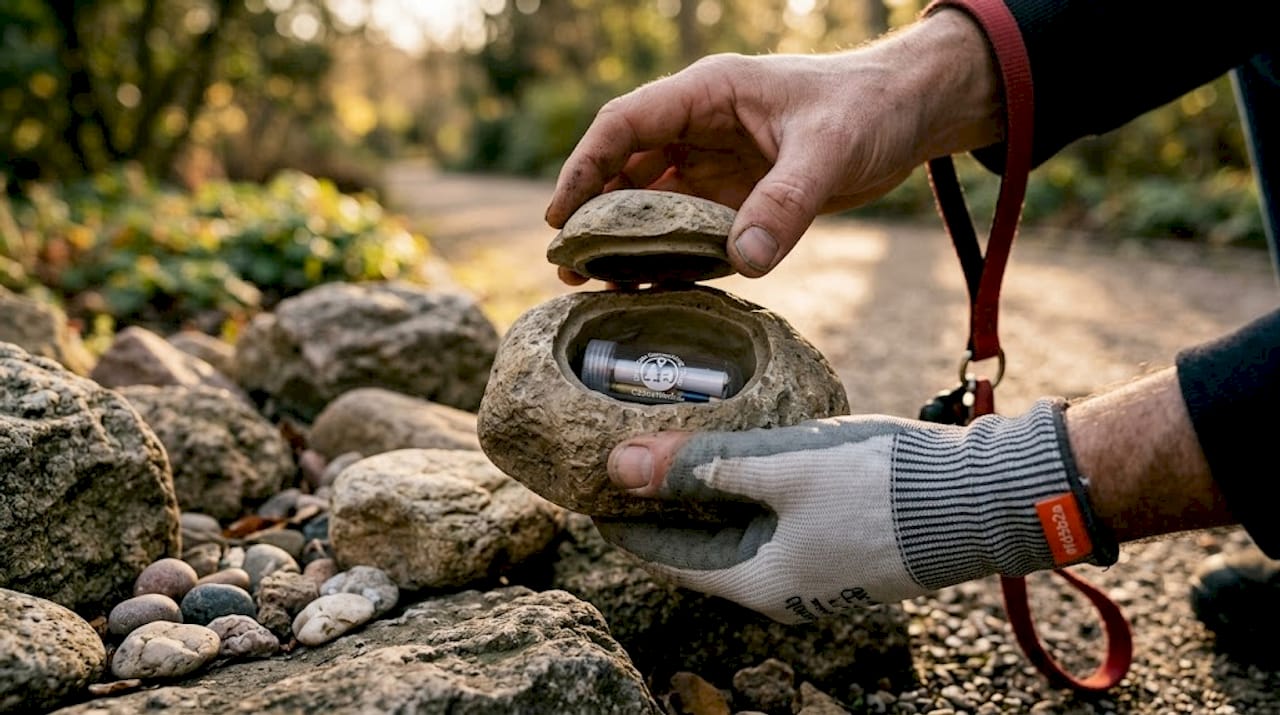
Further creative ideas and ready-made solutions can be found in our Outdoor Cache Hide Guide, which covers various environments and difficulty levels.
Environmental Awareness in Caching: Acting Sustainably and Considerately
Creativity in geocaching stops where nature suffers. Unfortunately, it happens again and again that caches leave damage that could have been avoided.
The most important rule is clear: no hides in nature reserves or near endangered species. This also applies to areas outside official protected areas where rare plants or animals live.
Pro tip: Visit your cache location at different times of the year before placing it. What seems harmless in summer can be an important breeding ground in spring.
Do's and Don'ts for sustainable caching:
- Do: Use paths and avoid trampling vegetation.
- Do: Choose containers made of weather-resistant material such as PETG or robust plastic.
- Do: Maintain the cache regularly and replace or remove it immediately if damaged.
- Don't: Break branches, pull out plants, or permanently move stones.
- Don't: Dig holes or disturb the soil, not even for small containers.
- Don't: Use plastic bags without a container, as these quickly become leaky and leave plastic waste.
Here is an overview of recommended materials for environmentally conscious caching:
| Material | Advantage | Durability |
|---|---|---|
| PETG (3D printing) | Robust, weatherproof, individually shapeable | Very high |
| Aluminum cans | Light, rust-free, durable | High |
| Coated plastic | Inexpensive, versatile | Medium |
What happens when caches are poorly maintained? Rotting containers attract animals, leave plastic waste, and can release dangerous substances. This not only harms nature but also the reputation of the entire geocaching community.
For environmentally friendly camouflage tips and choosing the right material, we recommend our detailed blog posts, which also address the specific characteristics of different seasons.
Experiences from Practice: What Really Works
Many well-intentioned tips only work to a limited extent in practice. A common mistake: too obvious camouflage on frequently used paths. A green-painted can lying directly next to the main path immediately catches the eye of muggles because it looks out of place.
Our experience shows: The best hides are not created at the desk, but on site. Those who know the location well know which materials truly fit the environment and which spots are frequented daily by uninvolved people.
Another practical tip: Only publish your cache after you have visited it yourself at least twice, at different times of day. This way, you can see if the camouflage holds up under different lighting conditions.
We also recommend using proven camouflage ideas as a starting point and then adapting them to the specific location. An imitative approach is good, a site-specific one is better. The combination of experience, local knowledge, and sustainable thinking leads to the caches that finders talk about for years.
Your Next Step: Safe Caching Accessories and Creative Hides
You now know what really matters in safe and creative geocaching. The next step is simple: get the right material and get started. At CacheWerk, you'll find everything you need, from weatherproof containers to unusual camouflage solutions and special 3D-printed PETG hides.
Check out our complete range of Geocaching Equipment and Accessories and discover creative solutions for every location. Our Geocaching Hide as a Fake Road Sign is particularly popular, fitting perfectly into urban environments and guaranteed to fool muggles. Start your next cache with the right equipment and make it a real experience for all seekers.
Frequently Asked Questions about Safe Geocaching Hides
Which places are explicitly forbidden for geocaching?
Sensitive areas such as school grounds, playgrounds, railway tracks, nature reserves, and habitats of endangered species are forbidden. The prohibited zones are clearly defined in the official placement rules.
How can I camouflage a geocache container inconspicuously?
Natural colors, moss, bark, or magnetic attachment make a cache inconspicuous to non-geocachers. Natural camouflage is more effective and does not harm the environment.
How do I prevent environmental damage from my cache?
Avoid damaging plants or digging holes, and place caches in a way that creates no permanent changes. The rule is: no harm to the environment or permanent alterations.
Are fake hides allowed?
Yes, fake hides like fake rocks or camouflaged signs are allowed, as long as they are safe and adhere to the rules. Creative hides like fake rocks are explicitly permitted by the platforms.