
10 Tips for Safe and Creative Cache Placement
TL;DR:
- Caches must be at least 161 meters from other caches and require permission.
- Robust, waterproof containers are crucial for longevity and a good experience.
- Careful site selection, accurate coordinate measurement, and meticulous listing ensure success.
Hiding an exciting geocache sounds easier than it is. You want to inspire seekers, respect nature, and adhere to all rules at the same time. First-time cache placers often underestimate how many details need to align: the choice of container, the exact location, the listing, and long-term maintenance. Mistakes happen, but many can be easily avoided. In this article, you'll find tried-and-tested tips that will guide you from planning to publishing your cache, ensuring your hide brings joy for a long time.
Table of Contents
- Framework for Secure Cache Placement
- Choosing the Right Container and Protection from Environmental Influences
- Location Selection: Creativity, Maintenance, and Accuracy
- Listing, Hints, and User Guidance: For Finders and the Environment
- Common Mistakes and How to Avoid Them
- Our Experience: What Really Makes Secure Cache Placement Successful
- Practical Geocaching Accessories and Support
- Frequently Asked Questions about Secure Cache Placement
Key Insights
| Point | Details |
|---|---|
| Permission is Mandatory | A cache may only be hidden with the landowner's consent and with due regard for protected areas. |
| Choose Robust Containers | Waterproof and weather-resistant containers make the cache durable and low-maintenance. |
| Accuracy Matters | Accurate coordinate measurement and good maintenance planning ensure a positive experience for all geocachers. |
| Provide Good Hints | Clear listings and helpful hints protect nature and make it easier to find the cache. |
Framework for Secure Cache Placement
Before you even carry a container into the woods, you should know the basic rules. Geocaching has clear rules, and they are not optional. They protect nature, other geocachers, and yourself.
The most important principle: Caches must be at least 161 meters from other caches. This sounds simple, but in popular urban areas, it can become a real challenge. Carefully check the map on Geocaching.com before deciding on a spot.
Another point many overlook: Permission from the landowner is absolutely necessary. This applies to private properties as well as areas owned by municipalities or companies. A quick chat or email is often enough, and many owners are even enthusiastic about the idea.
Nature conservation is not a topic that can be ignored. Caches must not be placed in nature reserves or protected biotopes. In Germany, there are numerous such areas, and unknowingly placing a cache there can have legal consequences. In case of doubt, check local maps or inquire with the responsible authority.
This also applies to how the cache is attached: No nails in trees, no interference with nature. Magnetic mounts, cords, or special clamps are the right choice.
Geocaching thrives on respect: respect for nature, for fellow human beings, and for the rules. Only then does it remain a beautiful experience for everyone.
Here is an overview of the most important framework conditions:
- Maintain a minimum distance of 161 meters from other caches
- Obtain permission from the landowner
- Do not place in nature reserves or protected biotopes
- Choose only publicly accessible and safe locations
- Do not damage trees, walls, or other structures
- Place the cache so it is not accidentally found
Those who inform themselves well beforehand will find many more useful tips for getting started in the Geocaching Guide.
Choosing the Right Container and Protection from Environmental Influences
Now that the most important framework conditions have been clarified, it's time to select the appropriate cache container. The choice of container determines how long your cache lasts and how good the experience is for finders.
Robust, waterproof containers in the largest possible size for the respective location are the first choice. Why? Because a soggy logbook is frustrating, and a damaged cache is quickly archived. Quality really pays off here.
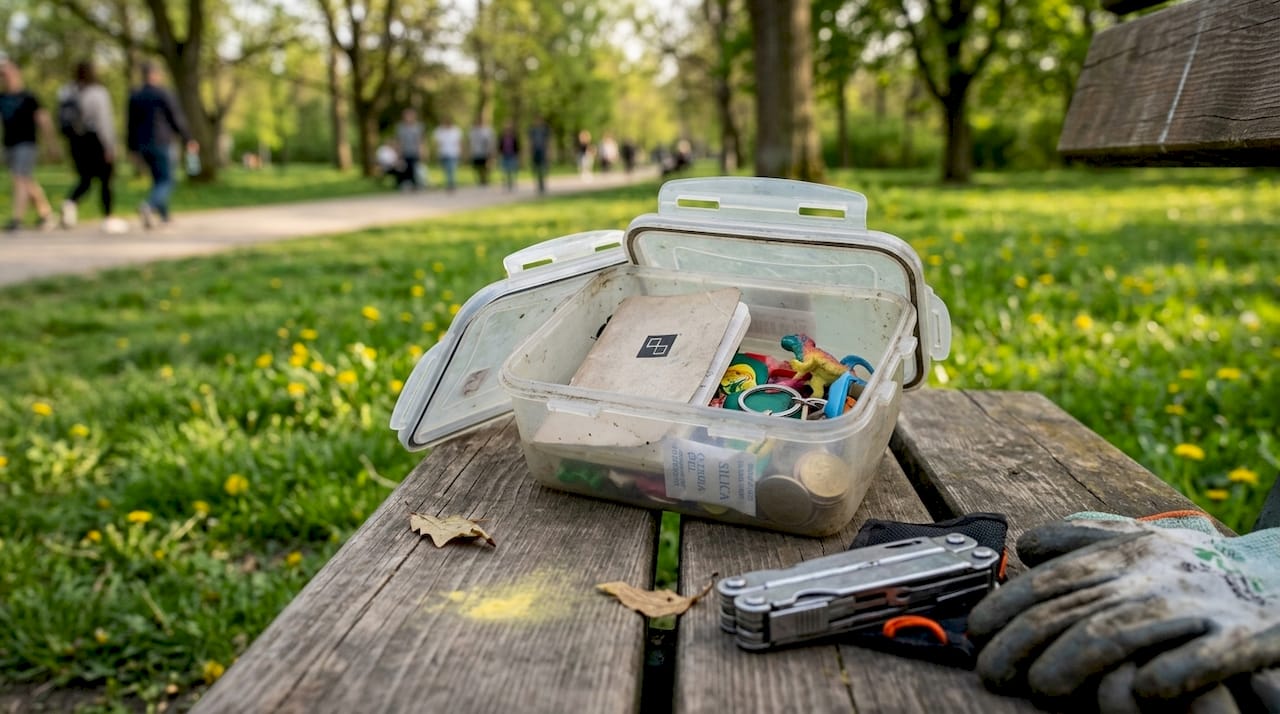
Comparison of common container types:
| Container Type | Advantages | Disadvantages | Ideal for |
|---|---|---|---|
| Lock'n'Lock Box | Very waterproof, robust, inexpensive | Large, difficult to camouflage | Nature, forests |
| PETling | Small, light, inconspicuous | Little space, more delicate | Urban hides |
| Metal tin | Durable, usable with magnets | Can rust, heavier | City caches |
| Film canister | Very small, classic | Often leaky, little space | Nano caches |
| Special 3D print (PETG) | Individual, weather-resistant, creative | Higher price | Themed caches |
When it comes to camouflage: The container should visually blend into its surroundings. A green plastic container in a bush is better than a white one. Special camouflage films or natural materials like bark or moss can help, without damaging nature.
A frequently underestimated factor is protection from animals. Mice, squirrels, and insects can destroy logbooks and contents. Stable containers with well-sealing lids are therefore not a luxury, but a necessity.
- Always test containers for leaks before hiding them
- Wrap the logbook in a small plastic bag
- Deposit spare logbooks in the cache
- Adjust container size to the hideout location
- Do not place food or strong-smelling items inside
Pro Tip: Fill your container with a silica gel packet. It absorbs moisture and protects the logbook even if some water gets in. Small packets are inexpensive online.
For creative DIY tips for cache containers, take a look at our blog, where you'll find many ideas for individual hides.
Location Selection: Creativity, Maintenance, and Accuracy
Once the container is chosen, the location significantly determines the quality of the caching experience. A great container in a bad location yields little. An inconspicuous container in a magical place, however, remains in the memory of seekers for a long time.
Creativity is required, but it has limits. The location must be accessible to everyone, including geocachers with less mobility, if you indicate a low difficulty level. Also consider different seasons: a hide perfectly camouflaged in summer can be immediately visible in winter due to missing leaves.
Proven location ideas:
- Magnetic hides on metal structures in the city
- Hollow trees or natural rock crevices in the forest
- Under bridges or on railings (with permission)
- Behind loose stones in old walls
- In flower pots or planters in public squares
The coordinates are the heart of every cache. Incorrect coordinates are the most common reason for frustrated finders. Measuring coordinates multiple times under different conditions is therefore not a recommendation, but a must. Measure on different days, at different times of day, and in different weather. Average the results for maximum accuracy.
The following table shows how various factors influence GPS accuracy:
| Factor | Impact on Accuracy | Recommendation |
|---|---|---|
| Cloud cover | Medium | Measure in clear weather |
| Tree cover | High | Measure multiple times, average |
| Proximity to buildings | Very high | Keep distance or average |
| Time of day | Low | Often better in the morning |
| GPS app | Medium | Compare several apps |
Maintenance is a topic that many suppress when placing a cache. Yet it is crucial: a cache close to home helps immensely with regular checks. Plan from the start how often you can visit your cache and choose the location accordingly.
Pro Tip: Use the "Needs Maintenance" feature on Geocaching.com as an early warning system. If finders report problems, react quickly. A well-maintained cache receives better ratings and remains active longer.
There are even more tricks for measuring at the cache hideout, which we explain in detail in our blog.
Listing, Hints, and User Guidance: For Finders and the Environment
Once you've found the perfect spot, the last step is the correct listing and wisely placed hints. A good listing is more than a mandatory task. It's your business card as a cache owner.
Good listings with details significantly enhance the user experience. Describe the location, tell a story, explain the background. Geocachers love it when a cache has a soul. At the same time, the description should not contain direct spoilers that make searching unnecessary.
Hints are an underestimated tool. A good hint helps seekers who are truly stuck, without completely spoiling the fun. Meaningful hints and spoiler images prevent seekers from frantically poking around, inadvertently disturbing plants or animals.
A good hint is like a safety net: it should be there, but you hope not to need it.
Spoiler images should be used judiciously. A photo showing the exact hiding place takes away the thrill. A photo showing the general surroundings helps without giving it away.
Checklist for a good listing:
- Clear, complete description without direct spoilers
- Realistic assessment of difficulty and terrain ratings
- Encrypt and formulate hints meaningfully
- Spoiler image only if necessary and not too detailed
- Provide contact information for questions
- Regular updates for changes to the cache
If you are unsure about describing caches, you will find concrete examples of wording and templates in our blog.
Common Mistakes and How to Avoid Them
Finally, it's worth looking at the most common mistakes and how to effortlessly avoid them. Even experienced geocachers sometimes make mistakes when placing new hides. The good news: most of them are known and easily preventable.
Overview of the most common mistakes:
- Not reading the guidelines: Many problems arise because the official rules are not fully known. Read the Geocaching.com guidelines completely before placing your first cache.
- Unsuitable containers: Cheap containers that leak after a winter frustrate finders and create work. Invest in quality from the start.
- Too far from home: A cache you can rarely check quickly becomes a problem. Maintenance takes time, plan it in.
- Too complicated for beginners: Those hiding their first cache should start with a simple Traditional. Complex Multis or puzzles require a lot of experience.
- Coordinates not checked: Measuring once is not enough. Wrong coordinates are the number one frustration factor.
An important piece of advice from the community: gain experience, attend events, and search at least 20 to 50 caches before placing your first one. Those who have searched a lot themselves understand what makes good and bad hides.
Pro Tip: Talk to an experienced geocacher from your region before publishing. Many are willing to do a test run and give honest feedback. This saves you later corrections.
If you want to avoid common mistakes, you will find a detailed error analysis with concrete solutions in our blog.
Our Experience: What Really Makes Secure Cache Placement Successful
After all the facts and lists, we want to share a personal assessment. In the geocaching community, the idea circulates that spectacular hides are automatically the most popular. This is not always true.
We have observed that caches with regular maintenance and active owners are rated significantly better in the long run than elaborate constructions that are neglected after a year. A well-maintained Traditional beats a neglected Mystery every time.
Simple Traditionals are the best entry point. They teach you how geocachers think, what they expect, and how to react to feedback. Only when you master this is it worth investing in more elaborate concepts.
Our personal tip: Contact your local reviewer early. Reviewers know the region, are aware of local peculiarities, and provide valuable feedback before you invest too much time. This is not a sign of insecurity, but of professionalism.
You can find more insights and practical experience reports in our blog.
Practical Geocaching Accessories and Support
If you want to get creative yourself now, you will find the right tools and services here. Professional equipment makes a real difference: caches last longer, are easier to maintain, and offer finders a better experience.
At CacheWerk, you'll find everything you need for creative and secure hides. From weatherproof Geocaching equipment to special camouflage materials and 3D-printed PETG special parts. If you are looking for special ideas, you should check out our creative hide ideas. Whether you're planning your first cache or want to expand your collection: We support you with products that really work.
Frequently Asked Questions about Secure Cache Placement
How do I find a legal and safe cache location?
Choose publicly accessible, safe locations, always obtain permission, and avoid nature reserves. According to CHIP research, many caches are placed illegally because permissions and nature conservation rules are ignored.
What are the most important rules for hiding a geocache?
The cache must be at least 161 meters from the next one and must not endanger the environment. In addition, the landowner's permission is always mandatory.
What's the best way to measure coordinates?
Measuring coordinates multiple times under different weather conditions with GPS apps provides the most accurate data. Average all measurements for a reliable result.
Which containers are particularly suitable for durable caches?
Robust, waterproof containers such as Lock'n'Lock boxes or special PETlings are ideal for durable caches. PETG 3D prints also offer individual shaping with high weather resistance.