
Urban Caches: Creative Hides and Challenges
Cities are full of hidden treasures, and that's exactly what makes urban geocaching so fascinating. Behind an inconspicuous lamppost or an old wall, a perfectly camouflaged cache might be waiting for you to be the first to find it, or even to have placed it yourself. Caches in urban environments combine creative hiding skills with the discovery of hidden places, while also promoting tourism and lively city exploration. In this article, we'll show you how to best plan urban caches, which creative hiding spots really work, what you need to consider legally, and how to master typical challenges.
Table of Contents
- The Importance of Caches in Urban Areas
- Creative Cache Hides: Everyday Objects and Architecture
- Rules and Legal Framework for Urban Geocaching
- Typical Challenges and Solutions in Urban Caching
- Why Urban Caching Shapes the Future of Geocaching
- How We Support Your Urban Geocaching Adventures
- Frequently Asked Questions about Urban Geocaching
Key Insights
| Point | Details |
|---|---|
| Urban Caching Promotes Innovation | Urban caches offer creative hiding possibilities and new adventures for experienced and professional geocachers. |
| Observe Legal Requirements | Local rules, coordination, and no-go zones are essential for long-term success in urban geocaching. |
| Muggle Protection is Crucial | Discreet camouflage and robust containers help protect urban caches from curious onlookers and weather. |
| Tourism and Commerce Benefit | Urban geocaching attracts visitors and strengthens retail and the tourist appeal of cities. |
The Importance of Caches in Urban Areas
Geocaching in the city isn't a fleeting trend. It's a distinct form of play that uses the urban environment as its playground, thrilling both locals and tourists. While rural caches are often well hidden in nature, cities present their own unique challenges: dense traffic, curious passers-by (so-called muggles), and strict municipal regulations.
What makes urban caches so special is their connection to the place itself. A cache in a historic old town often tells more about a city's history than any travel guide. Geocachers discover nooks and crannies unknown even to locals. This is no coincidence: good cache placers think like urban historians and architects at the same time.
The added value of urban caches becomes particularly clear when considering the economic aspect. Urban caches significantly boost local retail and tourism, as geocachers deliberately seek out parts of the city they would otherwise never visit. This is also politically interesting: an increasing number of municipalities are consciously using geocaching as a tool for revitalizing city centers.
For creative urban cache ideas, the city is a paradise. The following characteristics make cities an optimal playground:
- Architectural Diversity: Old buildings, bridges, fountains, and monuments offer countless hiding possibilities.
- Dense Infrastructure: Lampposts, benches, manholes, railings, and signage are everyday objects with high camouflage potential.
- Cultural Integration: Caches can be linked to local knowledge, for example, through puzzles about city history or local personalities.
- Tourist Attraction: Well-placed caches lure visitors to lesser-known city areas and stimulate the local economy.
- Community Experience: Urban caches are often part of larger tours where geocachers explore cities together.
"Geocaching in the city center is not just a game, but an interactive city marketing tool that opens up new perspectives on familiar places for visitors."
The emotional dimension should not be underestimated. When you discreetly search for a nano-cache in a busy pedestrian zone and finally find it without a single passer-by noticing, that's a unique sense of accomplishment. Professional geocachers particularly appreciate this interplay of cunning, local knowledge, and a steady hand.
Creative Cache Hides: Everyday Objects and Architecture
The best urban caches are those that amaze even experienced geocachers. A well-camouflaged cache isn't just hidden; it blends so perfectly into its surroundings that it becomes invisible. Creative hides such as on lampposts, benches, or in historical buildings enrich every city exploration and elevate the geocaching experience to a new level.
Here are the most popular categories of urban hides, sorted by frequency and creative potential:
- Lamppost Caches: The classic. The base of a street lamp often has a screw connection behind which a magnetic hide can be concealed. Simple, effective, and almost invisible to muggles.
- Benches and Seating: Nano-containers or small tins can be attached under seats, to screws, or behind backrests.
- Historic Buildings and Walls: Facade indentations, old inscriptions, or niches offer natural hiding possibilities without structural alterations.
- Art Objects and Sculptures: Public art often has hollow spaces or pedestals that are suitable for very small containers, provided permission is obtained.
- Urban Greenery: Flowerpots, tree surrounds, or planted beds in the city center provide natural camouflage for weather-resistant containers.
A direct comparison of the most common camouflage strategies helps in making a choice:
| Hide Type | Camouflage Effect | Maintenance Effort | Muggle Risk |
|---|---|---|---|
| Magnetic Nano on Lamppost | Very High | Low | Low |
| Bolt Cache | Very High | Low | Very Low |
| Stealth Container in Flowerbeds | Medium | Medium | Medium |
| Container Under Bench | Medium | Medium | Medium |
| Historic Building Niche | High | High | Low |
Stealth containers, meaning containers specifically designed to blend into their surroundings, are indispensable in urban areas. A black magnetic container on a black metal railing is almost invisible. However, hiding a conventional green film canister in a crack in the pavement quickly risks muggle discovery.
Pro Tip: Use cache hiding ideas from the community and combine different levels of camouflage. A bolt cache that looks like a real screw and is also attached to an unnoticed railing surpasses any conventional container. Always think from a muggle's perspective: what would a pedestrian actually look at more closely?
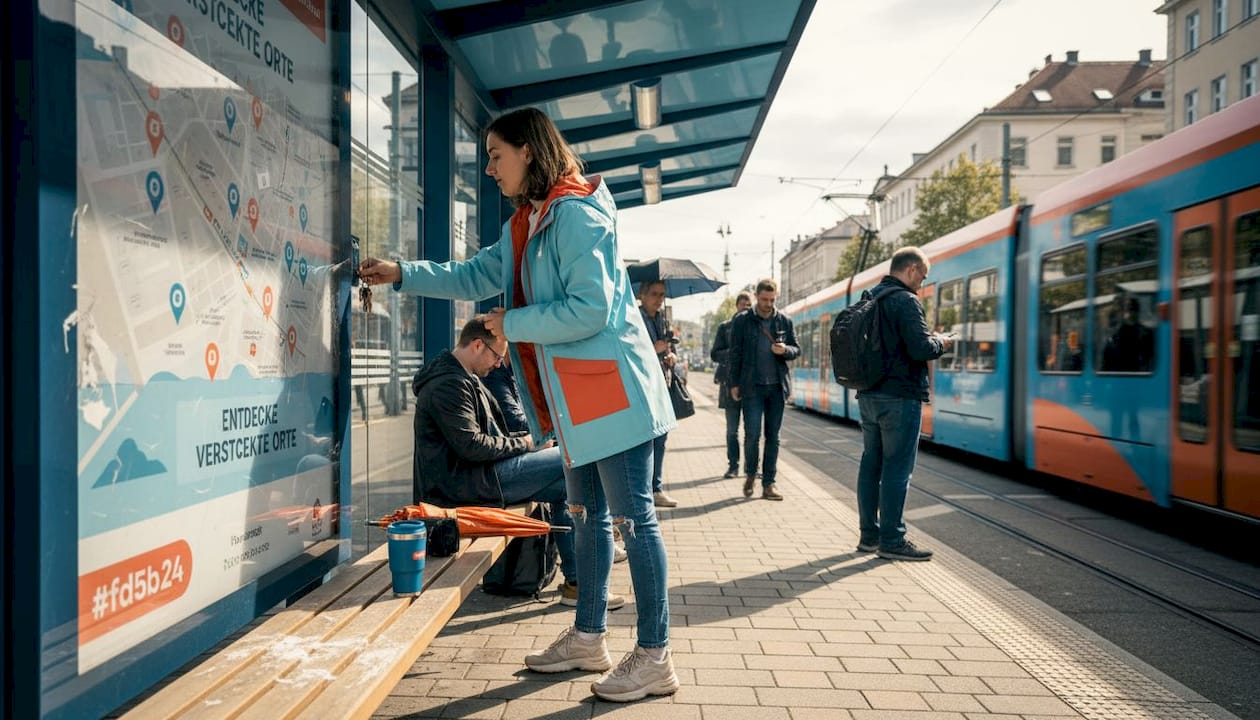
Unusual places deserve special attention. A hidden niche behind an advertising display, a hook on the underside of a bridge railing, or an art installation with a hollow space are ideas that delight geocachers and simultaneously transform cities into new experiential spaces. The combination of visual camouflage, functional placement, and a creative concept makes an urban cache truly unforgettable.
Rules and Legal Framework for Urban Geocaching
Creativity is important, but without the right rules, every cache becomes a problem. Urban geocaching operates within a legal framework that you must understand before placing a single container.
The most important principle: Public space is not automatically permitted. Many geocachers assume that a public place is accessible to everyone and therefore suitable for caches. This is not true. Authorities, property owners, and operators of public facilities have the final say.
Particular caution is required in the following locations:
- Schools and Kindergartens: Proximity to schools or playgrounds requires at least 150 feet of distance, sometimes more depending on local rules.
- Train Stations and Airports: Security areas are absolutely forbidden, often even outside the security zone.
- Listed Buildings: Without written permission from the competent authority, any attachment of a cache here is prohibited.
- Private Property: This also applies even if the property appears public, such as shopping centers or parking garages.
- Military Installations: Completely forbidden, no exceptions.
| Location | Allowed | Restriction |
|---|---|---|
| Public Park | Yes, with permission | No damage, no attachment |
| Near School (under 150 feet) | No | Forbidden by platform rules |
| Historic Monument | Only with permission | Written permission required |
| Train Station | No | Security concerns |
| Private Property | Only with permission | Owner must agree |
Checking local rules and avoiding violations is not an option, but a duty. Violating rules not only risks the archiving of your cache but also legal consequences and harms the entire geocaching community.
Especially in cities with high muggle density, another problem arises: a found or removed cache can arouse suspicion among bystanders and lead to police intervention. Therefore: inform the responsible municipality in advance, coordinate your cache with local groups, and ensure clear labeling of the container so that finders know what they have found.
Practical preparation protects you and your cache. Obtain written permissions, document your location with photos, and include the cache owner's contact details in the container. This way, clarification is always possible in case of doubt, without an intervention being necessary.
Typical Challenges and Solutions in Urban Caching
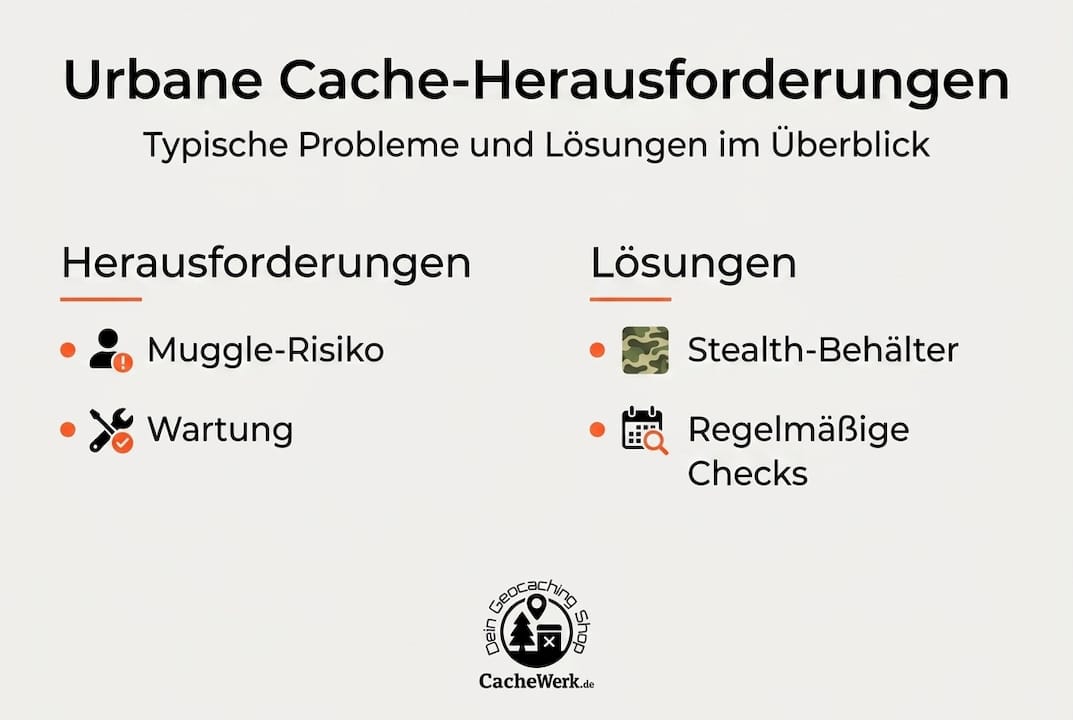
Anyone who has ever hidden an urban cache knows the problem: what was perfectly camouflaged yesterday can be gone tomorrow. Urban caches disappear faster than rural hides because the combination of muggles, weather, and urban construction work is particularly challenging.
The most common problems and how to solve them:
- High Muggle Density: Choose locations that give muggles little reason to look closer. Corners, niches, and inconspicuous fixtures at eye level are often ignored.
- Theft or Vandalism: Inexpensive containers are easy to replace. Never use expensive contents. Instead, use weather-resistant, inconspicuous containers that do not signal value.
- Construction Sites and Urban Redevelopment: Risks in cities also include unexpected construction projects that can render a well-placed cache inaccessible or destroyed overnight. Check your hides regularly, at least monthly.
- Seasonal Changes: A cache that disappears perfectly between bare branches in winter will be exposed in summer. Plan camouflage for all seasons.
- Weather Protection: Rain, frost, and direct sunlight quickly ruin simple containers. PETG printing or high-quality waterproof containers are a must in the city, not an option.
Pro Tip: Always create a maintenance plan when placing a new urban cache. Add reminders to your calendar, check the logbook, and respond quickly to Needs-Maintenance reports. A well-maintained cache remains active and builds reputation.
Choosing the right container is crucial. In the city, the following are particularly suitable:
- Nano-containers and Micro-tins: For attachment to metal or under benches.
- Bolt Caches (screw imitations): Almost invisible, very muggle-proof, ideal for railings and metal structures.
- Magnetic containers: Quick to attach, easy to remove, perfect for metal surfaces.
- Weather-resistant film canisters in camouflage look: For hides in green areas or under leaves.
Regular checks and quick responses to community feedback are key to a long-lasting urban cache. Tips on urban caching from the scene help avoid typical beginner mistakes and make experience-based decisions.
Why Urban Caching Shapes the Future of Geocaching
For years, we've observed how long-term trends in urban caching are transforming the entire geocaching scene. And our clear opinion is: urban caching is no longer a niche topic, but the engine driving the community forward.
Why? Because the city as a playground knows no bounds. While forest caches often rely on similar camouflage patterns, the urban environment forces true inventiveness. A new urban development project creates new possibilities. An old industrial building becomes a creative playground. The city is constantly changing, and urban geocachers must adapt.
This is also a community experience. Urban cache tours bring people together who explore cities together and inspire each other. This community aspect is stronger than with many other outdoor activities. Whoever places an outstanding urban cache today leaves a piece of their creativity in the city, for all who seek it after them. This makes urban geocaching more than just a game. It is active urban design.
How We Support Your Urban Geocaching Adventures
Now that you know what urban geocaching really means, the next step is getting the right equipment. Without suitable gear, even the most creative cache idea will fall flat.
At CacheWerk, you'll find everything you need for your next urban cache. From high-quality geocaching equipment to specialized camouflage containers and 3D-printed PETG special containers that withstand even demanding locations. Our suitable cache solutions have been specifically developed for urban challenges. Whether it's a bolt cache, magnetic container, or individually designed stealth container, you'll find exactly what makes your urban cache a hit with us. Take a look and get inspired!
Frequently Asked Questions about Urban Geocaching
Which locations are particularly suitable for urban caches?
Hides like lampposts, benches, or historical buildings and art objects are ideal because they appear commonplace and are hardly noticed by muggles.
What special rules do I need to observe for urban caches?
Proximity to schools or playgrounds is prohibited (minimum distance 150 feet), and you must always check local rules and, if necessary, register caches with the municipality.
How can I protect an urban cache from Muggles?
Rely on stealth containers and discretion, and choose locations that give passersby little reason to look more closely.
How do urban caches affect tourism?
Urban caches strengthen local retail and tourism by attracting visitors specifically to areas of the city that are otherwise rarely visited.