
Ultimate Guide to Innovative Geocache Hides
Anyone who has ever found a nano magnet under a park bench knows the feeling: brief joy, quick check-off. Standard hides have long become routine in many cities and forests. That's precisely the problem. A truly memorable cache excites, surprises, and amazes finders. This guide shows you step-by-step how to plan, build, and maintain an innovative, compliant, and durable hide. From the initial idea to community release.
Table of Contents
- Fundamentals and Rules for Creative Geocache Hides
- Materials and Tools: What You Really Need for Innovative Hides
- Step-by-Step Guide: Building and Implementing Your Own Innovative Hide
- Practical Test and Maintenance: How Your Hide Remains Durable and Successful
- Almost Everyone Makes These Mistakes: What Really Matters in Innovative Hides
- From Idea to Pro Cache: Your Support at CacheWerk
- Frequently Asked Questions about Innovative Geocache Hides
Key Insights
| Point | Details |
|---|---|
| Compliant and Safe | Innovative hides must always be legal and environmentally friendly. |
| Material Choice Matters | Robust, weather-resistant materials ensure durable and frustration-free caches. |
| DIY with System | With a structured step-by-step guide, every hide becomes unique. |
| Practical Tests | Only through repeated inspection and maintenance will your cache remain a highlight for the community. |
Fundamentals and Rules for Creative Geocache Hides
You now know why imaginative hides create loyalty and fascination. For your cache to be well-received, it's important to consider key fundamentals and conditions.
A creative geocache hide is more than just an original container. It combines clever camouflage with practical function, weather-resistant material, and a safe, nature-compatible placement. Ignoring these basics not only risks quick discovery but also legal problems or a maintenance call from the community.
What truly makes a hide "innovative"
Innovation in geocaching doesn't necessarily mean high-tech. It means finders pause, look twice, and are ultimately thrilled. Specific characteristics of innovative hides include:
- Clever Camouflage: The hide looks like a normal object in its environment.
- Functional Mechanism: An opening, a sliding mechanism, or a magnetic clasp makes finding an experience.
- Weather Resistance: The logbook and contents remain dry even after weeks.
- Environmental Compatibility: No plastic that disturbs nature, no damage to plants or animals.
- Rule Compliance: Clear listing information, no digging, no restricted areas.
Rules & Safety in Geocaching clearly state: For all hide designs, do not place on private property without permission, do not create buried caches, and consistently maintain camouflage and watertightness. This sounds simple but is alarmingly often forgotten.
Important: Hides must be placed in publicly accessible places. Private property without explicit owner permission is taboo. Interventions in natural areas, such as digging up roots, permanently moving stones, or breaking off branches, violate nature conservation laws.
Understanding Legal Frameworks
Before you even choose a location, a quick check of the legal situation is worthwhile. Parks, forest paths, and public squares are allowed in most cases, as long as there are no explicit prohibition signs. Nature reserves and legally protected biotopes, however, require special scrutiny. In Rhineland-Palatinate, for example, there are clear rules for nature-compatible geocaching, which serve as a template for nationwide best practices.
Those who inform themselves beforehand and work creatively with creative geocaching products avoid nasty surprises later. Knowledge of rules is not an obstacle to creativity. It is its foundation.
Materials and Tools: What You Really Need for Innovative Hides
Once you know the rules, the practical question arises: Which materials and tools are suitable for an innovative hide that truly lasts?
The choice of the right material determines whether your cache survives three months or three years. Many beginners underestimate the influence of weather, vandalism, and frequent use. A poorly chosen container swells, rusts, or loses its watertightness after the first frost.
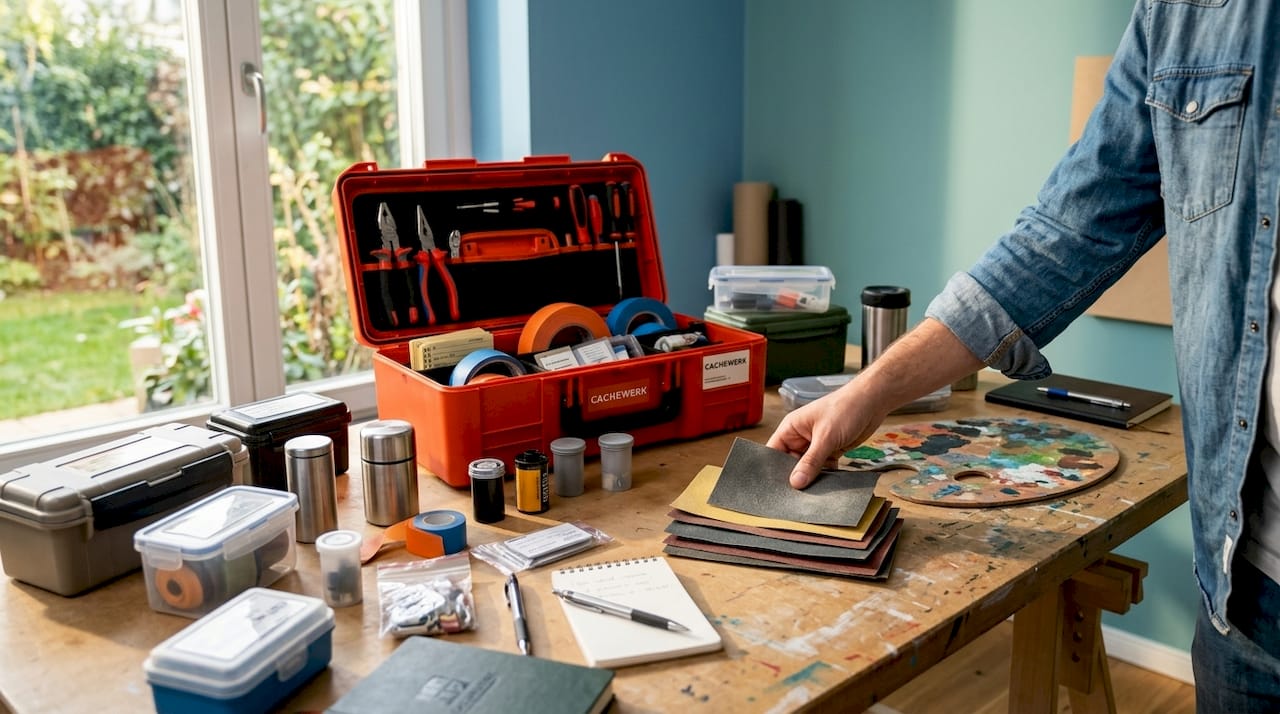
Container Materials in Comparison
| Material | Advantages | Disadvantages | Recommendation |
|---|---|---|---|
| PETG (3D Print) | Very weather-resistant, individually moldable | Requires 3D printer | Ideal for special hides |
| PVC Pipe with Lid | Inexpensive, waterproof, robust | Little creative potential | Good for rural hides |
| Metal Can (painted) | Durable, weight-stable | Can rust without protection | Usable with corrosion protection |
| Aluminum Box | Lightweight, robust, usable magnetically | More expensive than plastic | Excellent for urban caches |
| Wooden Box (impregnated) | Visually inconspicuous, natural | Requires regular maintenance | Perfect for forest hides |
PETG as a 3D printing material is currently the preferred material for professional DIY cachers. It is impact-resistant, UV-resistant, and can be formed into any desired shape. From an imitated tree stump to a deceptively real cable duct.
Tools and Aids
For simple hides, a utility knife, sandpaper, and spray paint are sufficient. For more demanding projects, the following are worthwhile:
- Hot Glue Gun: Quick bonding of camouflage materials such as bark, moss, or stoneware.
- Epoxy Adhesive: For permanent, waterproof connections between parts.
- Neodymium Magnets: For magnetic closures or attachment to metal surfaces.
- Heat Shrink Tubing: To protect cables or hinges from moisture.
- Sealing Tape (self-fusing): Secures container closures even with temperature fluctuations.
Pro Tip: Everyday objects like old thermoses, discarded metal door stoppers, or broken flashlights can be wonderfully converted into cache containers. They are already intended for outdoor use and hardly arouse suspicion among Muggles (non-geocachers).
Hiding a Cache: Instructions & Tips explicitly recommend weather-resistant containers and a correct listing for your first cache. The community reviewer will also thank you for complete, honest information.
Pro Tip: Never buy cheap cans from discounters for long-term hides. Cheap plastic becomes brittle and cracks after a few months. It's better to invest once in quality or make your container yourself from suitable geocaching materials.
Camouflage: More Than Just Color
Good camouflage starts with the shape, not the color. A round container lying in a square wall crevice immediately stands out. Shape your hide to match the environment or choose a finished design that already fits perfectly. Bark imitations, plastic street signs, or manhole cover optics are classic camouflage concepts that work well in the community.
Spray primer and matte paints help with visual adjustment. Important: Always choose matte instead of glossy surfaces. Glossy paint reveals a hide, especially when raindrops glitter on it.
Step-by-Step Guide: Building and Implementing Your Own Innovative Hide
With tools and materials ready, the actual implementation now follows. From the creative construction idea to the hidden practical project.
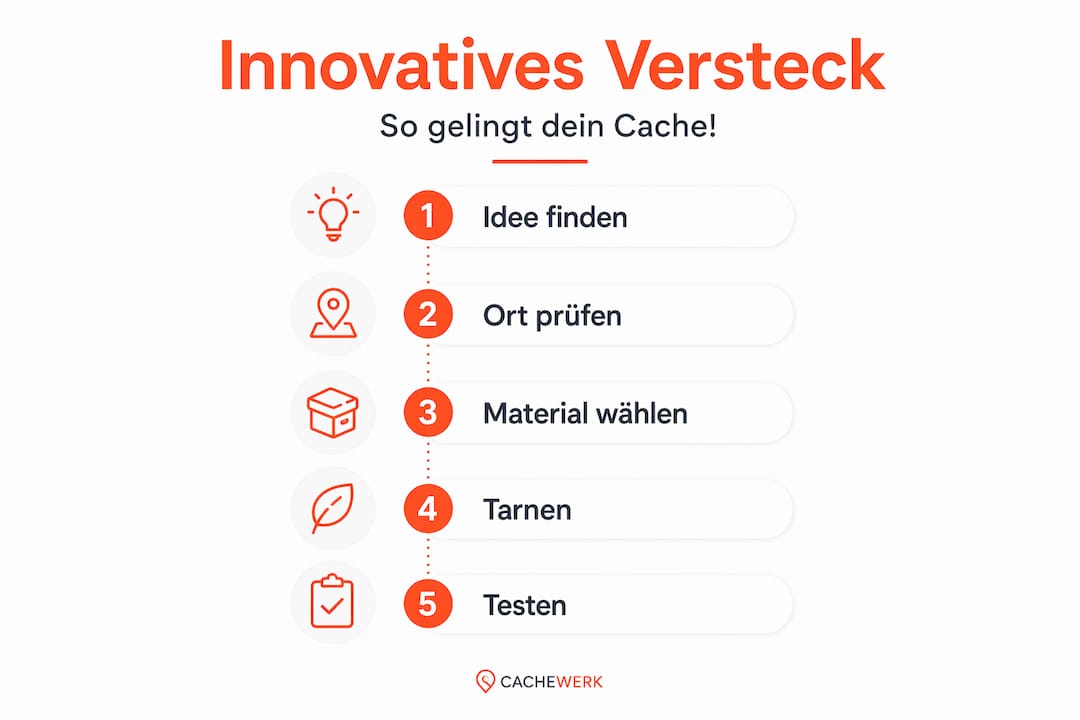
The 7-Step Model for Your Innovative Hide
- Develop Idea: Consider which concept suits the planned environment. Urban, rural, high up or at ground level? Write down three concrete ideas and evaluate them by effort and effect.
- Select Location: Personally scout the location. Consider Muggle frequency, weather protection from overhangs or trees, accessibility for all difficulty levels, and legal status.
- Test Material: Simulate rain, frost, and sun exposure at home. Place your container on the balcony for 48 hours in autumn and then check its watertightness.
- Choose and Adapt Camouflage: Match shape and color. Use real materials (bark, stone, moss) or printed imitations. The best camouflage is one that nobody is looking for.
- Build Mechanism: Plan the opening mechanism. Screw, magnet, slider, or push button? Each variant has strengths and weaknesses (see table below). Build at least two prototypes before deciding.
- Test Functionality: Test everything multiple times with different people. Can children handle it? Does it work with gloves? Does it open even after a rain shower?
- Integrate and Contact Reviewer: Prepare a complete listing. Double-check coordinates, clearly formulate hint texts, realistically state difficulty level. Then submit it to the community reviewer.
Comparison: Magnetic, Mechanical, and Simple
| Type | Strengths | Weaknesses | Best Environment |
|---|---|---|---|
| Magnetic Closure | Easy to use, no parts lost | Only usable on metal surfaces | Urban walls, lampposts |
| Mechanical Slider | Surprise effect, pleasant experience | Maintenance effort, can get stuck | Wooden platforms, tree stumps |
| Screw Cap | Absolutely waterproof, robust | Little "wow" factor | Forest, damp areas |
| Push-button Mechanism | Great for gadget cachers | Complex, susceptible to frost | Covered spots |
| Simple Socket Imitation | Perfect urban camouflage | Very specific application | City walls, building facades |
The Mini Pseudo Birdhouse DIY is a classic example: a small, realistically designed wooden birdhouse imitation with a hidden drawer. The birdhouse looks deceptively real, and the log container sits in the base of the house. Ideal for fence posts or tree trunks.
Another example: a magnetic wooden container that looks like weathered wood, but has a metal plate on the underside. Inside is the waterproof logbook. This type works particularly well on bridge railings or steel benches.
Pro Tip: Always test the accessibility and watertightness of your hide under real conditions before submitting the listing. Place the cache with a filled logbook in a bucket of water for 24 hours, or leave it outside overnight in freezing temperatures.
Practical Test and Maintenance: How Your Hide Remains Durable and Successful
After construction comes the practical test. For cachers to have fun and for your creation to last, targeted, repeated functional checks are crucial.
The Five Most Important Testing Stations
- Watertightness under Pressure: Submerge the closed container in water. No bubbles? Good. Bubbles mean leaks that must be fixed immediately.
- Mechanics in Cold and Wet Conditions: Cool the hide to below five degrees and test every mechanism. Many hinges and sliders become stiff or jam in the cold.
- Location Check in Everyday Life: Visit the planned location at different times of day and in various weather conditions. How many Muggles pass by the spot? Is it easily accessible even in snow or mud?
- Accessibility for All: Test opening with gloves, with limited visibility, with one hand. Cachers come in all age groups and with different abilities.
- Long-Term Durability: Leave the hide unattended at the location for a week. Afterwards, check: Is the logbook still dry? Has the mechanism changed? Are camouflage materials still firmly attached?
Common Mistakes and How to Avoid Them
The most common mistake is insufficient watertightness. A container that closes perfectly at home can expand in the field due to temperature differences and become leaky. Always use silicone seals or self-fusing sealing tape at critical points.
Creative Cache Ideas & Tech Stuff clearly show: Mechanical and gadget caches fail more often in operation than classic solutions. Moving parts, pull mechanisms, and release systems have more points of failure in practice than a simple screw cap.
Cacher Experience from the Community: "I once built an elaborate sliding mechanism that worked perfectly at home. After the first frost, the wood swelled, and the cache could no longer be opened. Three finders complained before I noticed."
Hiding a cache: Instructions & Tips advise consistently testing mechanisms against the main causes of failure: rain, frost, temperature fluctuations, and different usage patterns by various finders.
Planning Maintenance in Rhythm
A good geocache needs regular care. Plan fixed maintenance intervals from the start, at least twice a year, preferably after winter and after summer. Check the following:
- Watertightness and dryness of the logbook.
- Function of all moving parts.
- Condition of camouflage materials (color, adhesive, surface).
- Cleanliness of the location around the cache.
A repair-friendly design saves time and nerves. Build your hide so that you can replace individual parts without rebuilding everything. Modular constructions with interchangeable components are particularly recommended for cache maintenance and practical tests.
Almost Everyone Makes These Mistakes: What Really Matters in Innovative Hides
Maintenance is done, the cache is placed. But true innovation also means reflecting on your own mistakes and learning from them.
We see it time and again: Cachers spend many hours on a technically sophisticated hide, only to discover in frustration after a few weeks that no one likes it. Or worse: The cache is disabled because the mechanism has failed. Why does this happen so frequently?
Theory vs. Practice: What Shines in the Workshop Fails Outdoors
The problem often lies in the fallacy "works for me, works everywhere." One's own workshop is dry, warm, and controlled. Outside, UV radiation, temperature fluctuations from minus 15 to plus 35 degrees, rain, hail, curious children, and sometimes even vandals await. A hide that cannot withstand these conditions is not an innovative hide. It is a problem hide.
The most common practical mistake: overly complex mechanics. Many DIY cachers want to impress and build mechanisms that are fascinating in theory but overwhelming in use. A hide should be open in a maximum of 30 seconds once the finder knows the solution. Anything that takes longer is frustrating.
The Most Common Mistakes in Practice
- Overdesign: Three mechanisms in a row sound great, but triple the maintenance time.
- Poor Coordinates: A creative hide is useless if the finder searches ten meters away.
- Missing Directions: Innovative caches sometimes need a small hint in the description without revealing spoilers.
- Camouflage Without Context: A cable duct on a tree does not look natural. Camouflage must fit the surroundings.
- Ignoring Community Reactions: If the first three logs contain suggestions for improvement, act on them. The community is your best quality checker.
Simplicity as the Highest Form of Innovation
Here's the uncomfortable truth: The most popular and most logged creative caches are often the simplest. A stone that looks like all other stones but is hollow. A screw that has no thread but conceals a log tube. A sticker that conceals a socket container on the wall.
These hides work because they perfectly implement a single idea. Not ten mediocre ideas at once. Those who combine creativity with quality and keep the execution one hundred percent clean create a hide that finders will talk about for years to come.
A concrete example: An elaborate wooden house with a combination lock, hint sheet, and complex opening mechanism, which after the first winter completely froze and had to be disabled. The same cacher then placed a simple magnetic hide under a metal bridge. Hundreds of logs, zero problems.
Practical examples and pitfalls show that the most successful hides always combine a clear idea, solid material, and minimal maintenance. Innovation does not mean complexity. It means originality with reliability.
From Idea to Pro Cache: Your Support at CacheWerk
Do you want to try it yourself or are you looking for inspiration and proven solutions? Then you'll find exactly that at CacheWerk.
Your next hide doesn't have to be a work of art. But it should be well thought out, durable, and original. That's exactly why CacheWerk was created, out of a passion for creative geocaching and the desire for solutions that really work in practice.
Browse through the discover special hides and get inspired. Whether it's a magnetic hide, camouflage container, or 3D-printed special PETG custom-made product, here you'll find solutions for urban and rural, for beginners and pros. A special highlight, for example, is the fake fire hydrant sign as a hide: a deceptively real sign that fits perfectly into urban environments and muggles consistently ignore. Combine it with your own DIY ideas and you'll have a cache that the community will love.
Frequently Asked Questions About Innovative Geocache Hides
What mistakes should I avoid with innovative hides?
Avoid technology that easily fails in cold, moisture, or frequent use, and always check the long-term stability of your mechanics. Technical caches can fail more often in operation than classic solutions, which significantly increases maintenance effort.
How do I find the best place for my DIY hide?
The cache must be on legally accessible ground, protect nature, and not require intervention in the terrain. Publicly accessible places without private property and nature conservation restrictions are the safe choice.
What is considered an innovative hide?
Innovative hides are those that are cleverly camouflaged, functional, weatherproof, and originally built, while complying with all safety regulations. According to the central safety rules, camouflage and watertightness must be consistently implemented.
How do I best prepare my innovative hide before publication?
Test the mechanics, watertightness, and accessibility multiple times beforehand and check everything under real weather conditions. Weather-resistant containers and a complete, correct listing are the most important prerequisites for a successful submission to the community reviewer.