V2A vs. V4A for outdoor use: Which stainless steel alloy is suitable?

For most garden and patio applications, V2A (1.4301) is perfectly sufficient. If you are near the coast, have a pool, are exposed to road salt, or use aggressive cleaning agents, it is better to opt for V4A (1.4404 or 1.4571). In practice, the surcharge for V4A is often in the 20 to 30 percent range, which can often be offset over the years by lower maintenance and replacement costs.
In short:
- For garden furniture and pergolas in non-coastal areas, V2A is usually sufficient as it withstands rain and humidity well.
- In coastal regions, pool areas, and where road salt is used, you should opt for V4A to significantly avoid pitting corrosion caused by chloride ions.
- The price difference is 20 to 30 percent, but the longer maintenance intervals can often offset the extra costs of V4A.
- V4A contains about 2% molybdenum, which significantly increases corrosion resistance against chlorides, whereas V2A is sufficient primarily in environments with low salt exposure.
- Using the wrong material outdoors can lead to rust despite it being stainless steel, so always check material numbers and seek professional advice if necessary.
Table of Contents
- V2A vs. V4A: A brief comparison for outdoor use
- What do the abbreviations V2A and V4A mean chemically?
- Why molybdenum prevents pitting outdoors
- Where is V2A perfectly sufficient for your outdoor project?
- When is V4A absolutely necessary instead of V2A?
- How to avoid corrosion during installation and maintenance
- Why Cachewerk pays attention to the right material selection
- The material question is more important than most buyers think
- Weatherproof geocaching products for outdoor use in the Cachewerk range
- Sources
- FAQ
V2A vs. V4A: A brief comparison for outdoor use
Before you decide on an alloy, it is worth looking at the hard facts. V2A and V4A differ primarily in one point that makes the difference outdoors: chloride resistance.
-
Corrosion protection: V2A withstands rain and normal humidity; V4A is significantly more resistant to salt and chlorine.
-
Typical application: V2A for garden furniture and terrace railings; V4A for pool areas, coastal regions, and roads treated with de-icing salt.
-
Price: In practice, V4A often costs 20 to 30 percent more than V2A.
-
Processing: Both alloys are easy to weld, but V4A is more forgiving of mistakes in aggressive environments.
-
Maintenance: V2A requires more frequent cleaning in high-load areas; V4A performs with significantly less effort.
A word of caution: Steel grades 201 or 202 frequently appear on the market, which look deceptively similar to V2A. These alloys partially replace nickel with manganese and rust significantly faster outdoors. Therefore, always check the material number on the certificate, not just the visual appearance in the store.
As a rule of thumb: V2A is usually sufficient for gardens and covered terraces. For pool areas, coastal regions, or roads with winter maintenance, V4A is preferable.
What do the abbreviations V2A and V4A mean chemically?
V2A and V4A are colloquial names for specific chromium-nickel steels, which are identified in professional circles by their material numbers. These numbers are on every reputable test certificate and say more than the trade name.
- V2A (1.4301): approx. 18% chromium, 8 to 10% nickel, little or no molybdenum.
- V4A (1.4404, 1.4571): similar chromium and nickel content, additionally about 2% molybdenum, which noticeably increases resistance to chlorides.
- The "L" after the number (e.g., 1.4404 instead of 1.4401) stands for a lower carbon content, which is important when welding.
- 1.4571 is additionally stabilized with titanium, which improves corrosion resistance after welding.
A common misconception concerns strength classes like A2-70 or A4-70 for screws. The number 70 describes the mechanical tensile strength, not the corrosion protection. An A4-70 bolt is not automatically "stronger" than an A2-70 bolt; both can achieve the same tensile strength—the difference lies solely in the chemistry and thus in the rust protection.
Why molybdenum prevents pitting outdoors
Pitting corrosion is the most insidious form of corrosion in stainless steel outdoors. The surface often still looks flawless, while tiny holes eat their way into the depth underneath. The damage only becomes visible when the material is perforated or breaks.
Chloride ions from salt or chlorine specifically attack the thin passive layer that actually protects stainless steel. This is exactly where molybdenum comes in: it stabilizes this protective layer and makes it more resistant to chloride attacks. This is why V4A lasts significantly longer than V2A in environments with high levels of salt or chlorine.
Important to know: Pitting does not just occur on the open sea. Chlorine-containing pool air in indoor swimming pools or road salt on garden fences next to the road are enough to attack V2A over the years. Anyone planning a garden gate right next to a road salted in winter should factor in this effect, even if the sea is a hundred kilometers away.

Where is V2A perfectly sufficient for your outdoor project?
V2A is not a compromise; it is the more economically sensible choice for many situations. Anyone who automatically reaches for V4A for a garden fence or terrace roofing is often spending money unnecessarily.
- Garden furniture and pergolas in courtyards without direct road contact.
- Terrace railings in rural or urban locations far from the coast and salt-treated roads.
- Flower pots, plant rings, and decorative elements in the garden.
- Tool holders and fittings in covered areas.
For V2A to last a long time here, regular rinsing with clear water is sufficient to avoid so-called "dirt nests." Leaves, bird droppings, and dust bind moisture and can locally weaken the passive layer, even if the overall environment is unproblematic.
Pro tip: Clean V2A surfaces in the garden twice a year with clear water and a soft cloth. This removes deposits before they set in and only takes you a few minutes.
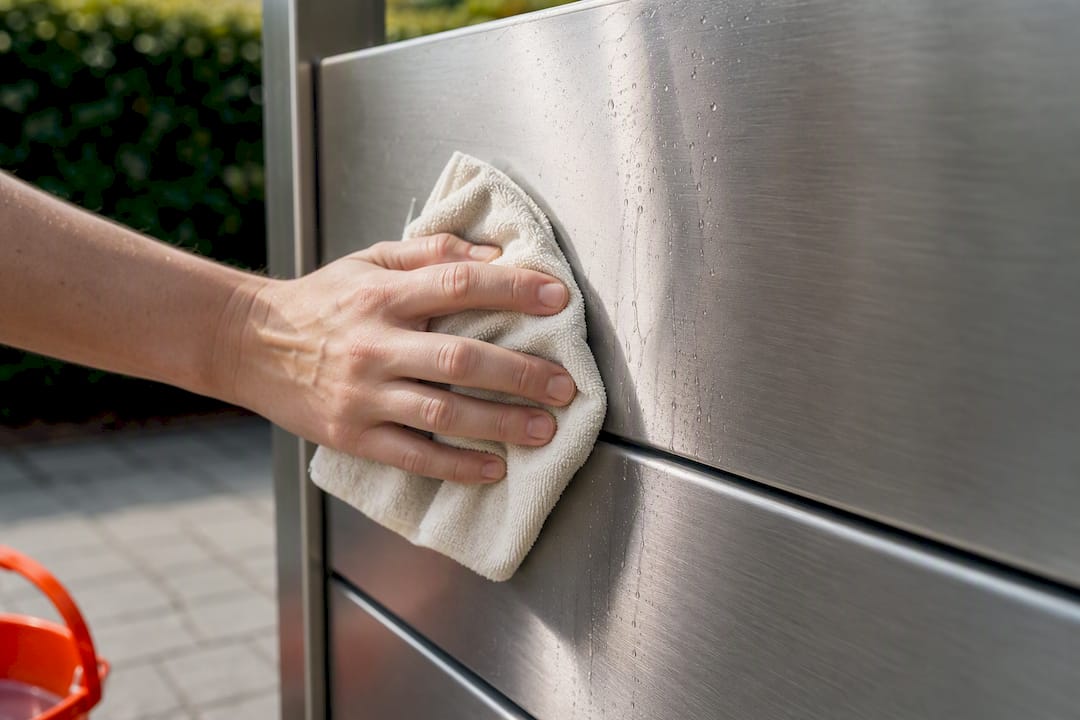
From an economic perspective, the surcharge for V4A is usually not worth it here. The total cost of ownership remains low with V2A in these scenarios, as long as the chloride load remains low.
When is V4A absolutely necessary instead of V2A?
Some environments do not forgive the wrong choice of material. Here, the investment in V4A is almost always worth it, even if the initial cost is higher.
- Near the coast: As a rule of thumb, use increased caution within about 10 to 20 kilometers of the coast; this value varies depending on wind direction and source.
- Pool and swimming pool areas: Chlorine-containing water and the air above it attack V2A over the long term, especially on ladders, railings, and fittings.
- Roads with winter maintenance: De-icing salt sprays further than many think. Fences and railings directly on busy roads should receive V4A.
- Industrial or heavily cleaned areas: Where chlorine-based cleaners or bleaches are used frequently, V2A is quickly overwhelmed.
- Load-bearing outdoor components: For safety-relevant structures such as balcony railings or staircase mountings, V4A is the more cautious choice, as failure due to unnoticed pitting corrosion can raise liability issues.
Technical tables for different media show clear differences in resistance depending on the application area, from drinking water to seawater. If in doubt, it is better to invest in molybdenum once too often than once too little.
How to avoid corrosion during installation and maintenance
The right alloy is only half the battle. Improper installation or aggressive cleaning can cause even V4A to age prematurely.
When purchasing, you should always ask for the material number, not just "stainless steel" or "rustproof." A reputable test certificate explicitly mentions 1.4301, 1.4404, or 1.4571. If this information is missing, it could be inferior 201 or 202 steel, which is almost indistinguishable visually.
- Request a material certificate with a material number when purchasing.
- Galvanically separate V2A and V4A if both are installed in the same structure to avoid contact corrosion.
- When welding V2A with V4A, use the appropriate welding filler, usually based on the higher-quality alloy.
- Design in such a way that no water collects in cavities or folds.
- Avoid chlorine-containing cleaners and bleaches, even with V4A.
Pro tip: After installation, use a mild, chlorine-free cleaner and additionally wipe weld seams with a stainless steel care product. This seals small irregularities in the passive layer before moisture can exploit them.
Why Cachewerk pays attention to the right material selection
Anyone who hides geocaches outdoors knows the problem: a latch that rusts after a year renders the most beautiful cache unusable. Cachewerk has been dealing with weatherproof solutions for exactly such situations for years, from PETling caps to outdoor accessories.
Practical guides on the correct coating and installation of hiding spots show what is important for long-term weather resistance. The comparison of different materials for outdoor caches also provides additional guidance if metal is not the only option. Product pages transparently name the materials used so that you can assess yourself whether a component is suitable for your location.
The material question is more important than most buyers think
The most common misconception about V2A and V4A is: "Stainless is stainless." That is simply not true. I see in forums and guidebooks again and again how people set up V2A garden furniture right next to a salted country road and wonder years later about rust spots that were supposedly "impossible" with stainless steel.
What many underestimate: The price difference between V2A and V4A seems larger on the hardware store shelf than it actually is over the service life. Anyone calculating based only on the purchase price often makes the wrong decision. Those who calculate over ten years of maintenance and potential replacement costs usually come to a different result.
My clear recommendation: Do not ask yourself "Which material is better?", but rather "What chloride load does my location actually have?" This one question replaces every general purchasing rule and protects you from bad purchases that only become apparent after years.
— Benedikt
Weatherproof geocaching products for outdoor use in the Cachewerk range
Anyone hiding caches outdoors needs material that can permanently withstand rain, sun, and temperature fluctuations, much like the choice between V2A and V4A. This is exactly where Cachewerk comes in: with well-thought-out, weatherproof products instead of mass-produced goods off the rack.

The aluminum outdoor drinking bottle accompanies you lightweight and robust on every tour, whether in the forest or on the coast. For the hiding spots themselves, the screw caps with an eyelet for PETlings are particularly suitable because they can be hung up and withstand wind and moisture without you having to worry about material corrosion as you would with metal components. And anyone wanting to make their garden geocaching-friendly will find a weatherproof element in the bird feeder made of sustainable PLA that enhances a balcony or garden bed.
If you build your own metal mounts for your hiding spots, keep the rules of thumb from this article in mind: plan for additional V4A fastenings near the coast or roads treated with salt; otherwise, the simpler variant is usually sufficient. Browse through the entire geocaching accessories collection and find the right piece for your next hiding spot.
Sources
- Overview Of Stainless Steel Grades For Tanks And Vessels
- What Do V2A And V4A Mean? Differences, Properties
- Stainless Steel V2A or V4A: When do you need which alloy?
FAQ
Which is better, V2A or V4A stainless steel?
Neither alloy is fundamentally better; they are suited for different environments. V2A is sufficient for normal garden and patio areas, while V4A is the more resistant choice in the presence of salt, chlorine, or road salt, because the molybdenum it contains makes pitting significantly more difficult.
Is V4A more expensive than V2A?
Yes, in practice, V4A often costs 20 to 30 percent more than V2A. However, this premium often becomes negligible when factoring in maintenance and potential replacement costs over several years.
Where is V4A used?
V4A is typically used near the coast, at pools, on roads treated with winter road salt, and in areas with frequent contact with chlorine-based cleaning agents. V4A is also the safer choice for load-bearing exterior components, where material failure would be risky.
Can V2A stainless steel rust?
Yes, V2A can also rust under certain conditions, especially when chlorides from salt or chlorine attack the passive layer. In environments with little salt, this risk remains low; near the coast or on roads treated with winter salt, it increases significantly.
How do I recognize low-quality stainless steel when buying?
Always look for the material number on the inspection certificate, such as 1.4301 for V2A or 1.4404 and 1.4571 for V4A. If this information is missing or if it is only labeled as "stainless," it could be inferior 201 or 202 steel, which partially replaces nickel with manganese and corrodes much faster outdoors.