
Workflow Cache Renewal: A Step-by-Step Guide
Workflow cache renewal is the process of deliberately updating cached data to significantly improve performance and data consistency in applications. In the geocaching context, this means that regularly renewing your cache workflow ensures that find locations, logbook entries, and coordinates always remain up-to-date. Systematic workflow renewal boosts efficiency by 5–15%. While this sounds technical, it directly affects every geocacher: outdated data leads to frustration, unnecessary failed searches, and a poor user experience. Those who know the right cache management strategies have a clear advantage.
What Do You Need for Workflow Cache Renewal?
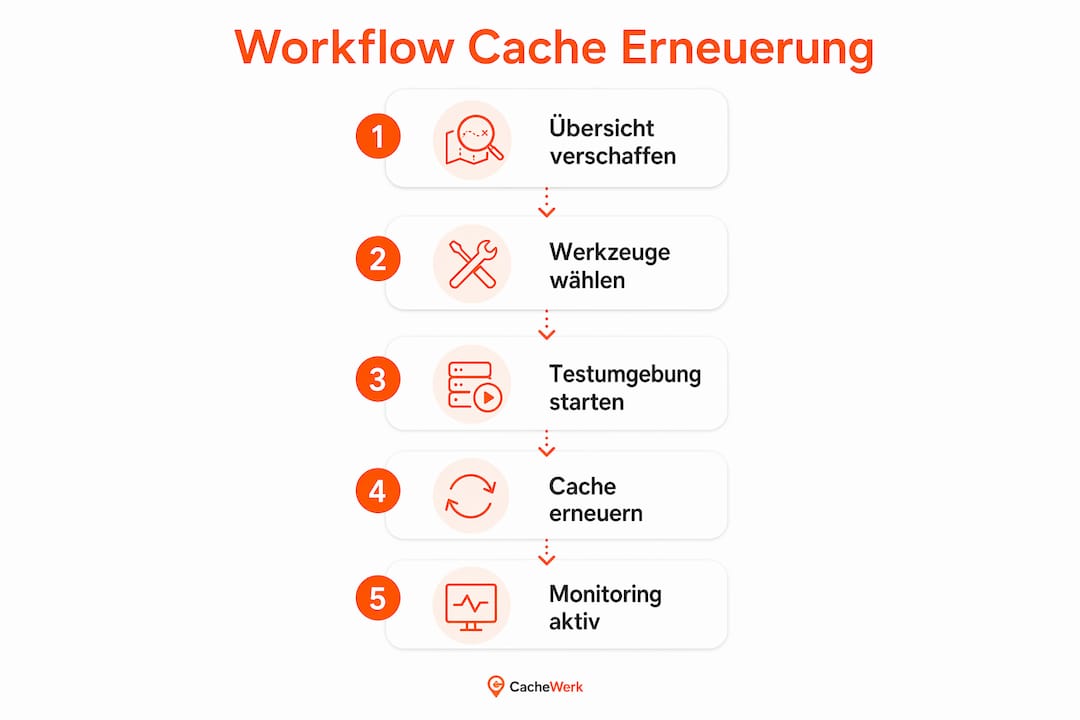
Before you can renew anything, you need a clear overview of your existing workflow. This applies to technical systems just as much as to daily geocaching. What data is cached? How long is it valid? Who updates it and when?
Key Concepts Briefly Explained
Three terms frequently come up in cache renewal:
- TTL (Time to Live): Specifies how long an entry remains valid in the cache before it automatically expires. A short TTL means fresh data but more load on the backend.
- Purge: The targeted deletion of individual cache entries, for example, when a cache location changes. Better than deleting everything at once.
- Cache-Aside Pattern (Lazy Loading): Considered a standard pattern for cache renewal in 2026. In case of a cache miss, the system queries the database and stores the result directly in the cache.
Checklist Before Renewal
Before you start, check these points:
- Which cache layers are active? (Application cache, CDN, HTTP cache)
- Which data changes frequently, which rarely?
- Are there documented TTL values for each content type?
- Who has write access to the cache?
- Is monitoring set up for cache hits and cache misses?
Pro Tip: Assign a unique key to each cache entry, for example, with a version number or date. This allows you to specifically renew individual entries without clearing the entire cache.
The choice of the right tools depends on the context. For web applications, Redis or Memcached are used. For geocaching platforms and apps, simpler mechanisms like HTTP cache headers or local databases are often sufficient. The crucial factor is not the tool, but the clear process design behind it.
| Tool Category | Typical Use | Strength |
|---|---|---|
| Redis | Application cache, session data | Very fast, flexible |
| CDN Cache | Static content, images | Significantly offloads servers |
| HTTP Cache Header | Browser-side caching | Simple, widely used |
| Local App Database | Offline geocaching apps | Works without network |
How to Perform a Workflow Cache Renewal?
A structured renewal always follows the same process. Skipping steps risks data loss or load spikes.
-
Inventory: Analyze all active caches. Note what data is stored where and for how long. The same applies to the outdoor cache workflow: first understand what exists, then act.
-
Classify data: Separate read-intensive from dynamic data. Read-intensive data benefits from aggressive caching, while dynamic data requires short TTL values. Geocaching coordinates rarely change, but logbook entries change daily.
-
Define invalidation strategy: Decide whether TTL or purge is the better choice. For static content, TTL is sufficient. If a cache location changes, the affected entry must be deleted immediately via purge.
-
Prevent cache stampedes: If many requests simultaneously hit an expired cache, the backend can be overloaded. Mutex locks prevent many parallel requests from recomputing the same entry at the same time. Only one request is allowed to refill the cache, all others wait briefly.
-
Implement a targeted purge strategy: Never delete the entire cache at once. Targeted invalidation avoids load peaks and unnecessary cold starts. Use cache tags or surrogate keys to delete only affected groups.
-
Set up monitoring: Measure cache hit rate, latencies, and error rate after renewal. Without measurement, you won't know if the renewal has worked.
-
Update documentation: Record what was changed and why. This helps immensely with the next iteration.
Pro Tip: Always start the renewal in a test environment. This way, you identify problems before they occur in live operation. For geocaching apps, this means: test new workflows first with a single test cache.
Monitoring is not an optional step. If you don't measure after renewal, you'll be in the dark again when the next problem arises. Set up alerts for unusually high cache miss rates.

Which Strategies Permanently Improve Cache Workflows?
A one-time renewal is not enough. Cache renewal is a continuous improvement process (CIP), not a one-off project. Understanding this allows you to build reliable workflows in the long term.
TTL-based or event-driven?
The choice of invalidation method depends on data volatility. TTL is sufficient for many standard contents, while Purge is necessary for targeted updates. Both methods have their place.
| Method | Strength | Weakness | Best Use Case |
|---|---|---|---|
| TTL-based | Simple, automatic | Data can become briefly stale | Static content, coordinates |
| Event-driven | Immediate freshness | More complex to implement | Logbook entries, status changes |
| Hybrid | Flexible, reliable | More planning effort | Mixed content |
Layered Caching and Key Versioning
Multi-layered caching can reduce latencies and database load by up to 90%. This means: CDN cache for static content, application cache for dynamic data, HTTP cache for the browser. Each layer has its own TTL and invalidation strategy.
Key versioning is a simple but effective principle. Instead of deleting an entry, it gets a new version in the key, for example, cache:coordinates:v2. The old entry expires automatically, and the new one is immediately available. This prevents gaps in the cache.
Further proven practices:
- Use negative caches: Briefly caching error messages reduces database load for erroneous requests. If a coordinate doesn't exist, the system doesn't have to recheck it for every request.
- Employ cache tags: Targeted cache tags and surrogate keys enable group-based purge strategies. All entries of a cache region can thus be renewed with a single command.
- Document data lifecycle: Record which data may be valid for how long. This prevents arbitrary TTL values.
No universal caching recipe exists. The strategy must fit the project and the data. What works for a large geocaching platform is often overkill for a small local app.
What Mistakes Should Be Avoided During Cache Renewal?
The most common mistakes don't happen out of ignorance, but due to time pressure. Acting quickly leads to costly errors.
Complete cache deletion is almost always the wrong approach. A complete cache flush immediately creates a massive load spike on the backend because all requests hit the database simultaneously. Targeted purge strategies are always preferable. This applies to technical systems just as much as to the geocaching workflow: if you reset all caches at once, you risk finders suddenly not seeing current data.
Typical pitfalls at a glance:
- Incorrect TTL values: Too long a TTL leads to outdated data. Too short a TTL creates unnecessary load. The correct length depends on how often the data changes.
- Missing invalidation for data changes: If you set a cache but never invalidate it, you will eventually deliver incorrect data. Cache invalidation must synchronize data and business logic.
- Ignoring cache stampedes: Without mutex mechanisms, an expired cache entry can overload the backend in seconds. This happens especially with popular geocaches that receive many simultaneous accesses.
- Confusing HTTP cache and application cache: Both have different invalidation mechanisms. If you mix them up, you'll wonder why changes aren't appearing.
- No monitoring after renewal: Without measurement, it remains unclear whether the renewal had any effect at all.
A frequently overlooked point: forgetting negative caches. If a request returns an error and the system doesn't briefly cache that, every repeat hit goes directly to the backend. This quickly adds up.
Key Takeaways
The most effective cache renewal combines targeted purge strategies, clear TTL values, and continuous monitoring, rather than relying on one-time complete deletions.
| Topic | Details |
|---|---|
| Workflow Cache Renewal | Targeted updating of individual cache entries is better than complete deletion. |
| Combine TTL and Purge | Renew static data via TTL, dynamic content via event-driven purge. |
| Prevent Cache Stampedes | Use mutex locks so that parallel requests do not overload the backend. |
| Use Layered Caching | Combine CDN, application cache, and HTTP cache to significantly reduce latencies. |
| Continuous Process | Repeat cache renewal regularly and accompany it with monitoring. |
What I've Learned After Years in Geocaching Workflow
I long believed that a good cache workflow primarily depended on the right technology. Wrong. Most problems arise from missing documentation and poor communication, not from the wrong tools.
The biggest mistake I've seen: geocachers resetting their entire workflow at once because "something isn't right." That creates chaos. It's better to check a single suspicious entry and renew it specifically. Patience pays off.
What truly helps is establishing a fixed rhythm for renewal. Not based on feeling, but on a plan. Those who regularly review their cache design workflow notice early on if something is going awry. Monthly checks are sufficient for most geocachers, and weekly checks for very active caches.
And another thing: automation does not replace clean process design. Automating a bad workflow results in a fast bad workflow. First clarify the process, then automate. That's the difference between a cache that works and one that causes problems.
— Benedikt
Cachewerk: Equipment for Your Next Cache
If you've renewed your workflow, you also want to make a physically convincing impression. A well-planned cache needs the right hiding spot.
At Cachewerk, you'll find exactly that: weatherproof, well-thought-out hiding spots for city and nature. The Ammo Box Trick Edition is a classic with a surprise effect, perfect for geocachers who truly want to amaze finders. For beginners, it's worth checking out the Starter Bundle with PETling and logbook, which contains everything you need for your first cache. All products are made from durable materials and designed for outdoor use. Take a look at the Cachewerk assortment and find the right hiding spot for your renewed workflow.
FAQ
What exactly is Workflow Cache Renewal?
Workflow Cache Renewal refers to the targeted updating or deletion of cached data to replace outdated content with current information. The goal is to simultaneously improve performance and data consistency.
How often should you renew the cache workflow?
The frequency depends on how often the underlying data changes. For most geocaching workflows, monthly reviews are sufficient, while weekly checks are recommended for very active caches.
What is the difference between TTL and Purge?
TTL allows a cache entry to expire automatically after a set time. Purge deletes an entry immediately and specifically, for example, when a cache location changes. Both methods complement each other.
What is a cache stampede and how do you prevent it?
A cache stampede occurs when many requests simultaneously hit an expired cache entry, and all of them overload the backend at the same time. Mutex locks prevent this by allowing only one request to refill the cache.
Why shouldn't you clear the entire cache at once?
A complete cache flush immediately creates a massive load spike because all requests hit the database simultaneously. Targeted purge strategies with cache tags are more reliable and gentler on the backend.
Recommendation
- Outdoor Cache Workflow 2026: Planning and Implementation – CacheWerk
- Cache Design Guide: 5 Creative Geocache Design Ideas – CacheWerk