How to correctly measure a Bison O-ring in under five minutes for geocachers

Most Bison and PETling tubes use O-rings with a varying inner diameter, which can differ depending on the model and lid size. Never rely on estimates: measure the old ring with calipers before ordering a replacement. Elastomer rings withstand moisture and temperature fluctuations better than cheap rubber compounds from a hardware store. The next section shows you how to measure precisely.
In short:
- For an exact O-ring replacement, the inner diameter, outer diameter, and cross-section must be precisely measured to avoid mismatches.
- Rings that are too thin will seal poorly, while rings that are too thick will prevent the lid from closing flush, making accurate measurement essential.
- Elastomer rings like EPDM are more durable outdoors and remain flexible with temperature fluctuations, making them ideal for outdoor use.
- When measuring, it is important to measure the old ring twice at different points to avoid invalid deformations.
- Replacement rings and kit offers are available in the geocaching shop; if measurements are unclear, contacting support is the most reliable solution.
Table of Contents
- How to measure the correct O-ring size for your PETling tube?
- What O-ring sizes are common for Bison tubes?
- Which material and care prolong the lifespan?
- What I repeatedly see go wrong when changing O-rings
- Where can you get suitable replacement rings and PETling sets?
- Sources
How to measure the correct O-ring size for your PETling tube?
Before ordering anything, you need three values: inner diameter, outer diameter, and cross-section (the thickness of the ring itself). With these three numbers, you will almost always make the right choice.
The following tools are completely sufficient:
- A caliper (digital or analog, available for just a few euros)
- A fine ruler as a backup solution if no caliper is available
- A toothpick or thin pin to carefully lift the ring out of its groove
- Optionally a measuring tape, if nothing else is available
Here's how to proceed step-by-step:
- Remove the old O-ring from the groove without stretching or twisting it.
- Lay it flat and measure the inner diameter (the opening in the middle).
- Calculate the outer diameter by adding twice the cross-section.
- Measure the cross-section itself, i.e., the thickness of the ring from one outer edge to the other.
- Check the ring for cracks, hardening, or permanent deformation before using it as a reference.
If you are unsure whether your measurement is correct, take a photo of the ring next to a ruler and send it to the support of your spare parts provider. This is often faster than three rounds of remeasuring and guessing.
A common mistake happens when removing it: if you stretch the ring too much, you will measure a larger diameter than the ring actually has. Additionally, it's worth checking the thread type of the PETling tube. Some models have a single-start thread, others a double-start thread, and this affects how deeply the lid closes and how much the ring is compressed.
Pro-Tip: Always measure the ring twice at different points around its circumference. Cheap rings deform unevenly, and a single measurement can mislead you.
A detailed guide with example measurements for common PETling models can be found in Cachewerk's step-by-step guide to PETling O-ring size.
What O-ring sizes are common for Bison tubes?
There is no single Bison O-ring size that fits every model. Different manufacturers and batches vary, and that's precisely why measuring is not a formality, but the actual core of replacement procurement.
As a rough guide, the inner diameters for small PETling tubes are often in the lower range, for medium-sized Bison tubes in the middle range, and larger containers may be above that. For the cross-section, deviations of half a millimeter are usually uncritical, as long as the ring does not visibly float in the groove or protrude under tension. A ring that is too thin seals poorly against rainwater. A ring that is too thick often cannot be properly pressed into the groove, and the lid does not close flush.
It gets particularly tricky with PETling variants with different threads. Some models deviate significantly from the standard in their diameter, as shown by a 3D print model of a PETling lid. Such outliers prove why a general size chart can be misleading in doubt and why your own measurement always takes precedence.
In short, what matters for selection:
- Inner diameter determines if the ring fits into the groove at all
- Cross-section determines the sealing pressure against the lid
- Material influences how long the seal lasts outdoors
- Thread type of the tube affects the required ring tension
If you want to delve deeper into size lists, you can find supplementary values in the internal guide to PETling O-ring size.
Which material and care prolong the lifespan?
Elastomer rings, often offered as EPDM compounds, remain flexible in frost and heat and absorb hardly any water. Product texts for replacement sets like the Maratac XL O-Ring Kit emphasize exactly this property as the reason for the material premium compared to simple hardware store rubber.
Little effort is needed for care:
- Clean the ring with clear water, no aggressive cleaners
- Occasionally apply a silicone care product to maintain elasticity
- Avoid any contact with solvents, petrol, or aggressive oils
- Store replacement rings cool, dark, and without draft, preferably flat in a tin
Replace the ring as soon as you notice cracks, noticeable hardening, or permanent deformation, i.e., when the ring no longer returns to its round shape after compression. A visibly shiny or sticky film is also a warning sign indicating a need for imminent replacement.
Pro-Tip: Keep a small supply of different ring sizes in your maintenance kit. A cache sitting out in the rain won't wait for you to order online.
Practical inspection intervals and further care instructions for the entire cache container are described in more detail in the Cachewerk guide to cache care.
What I repeatedly see go wrong when changing O-rings
The most common mistake is not choosing the wrong ring, but impatient measuring. Many cache owners grab the first suitable ring from the drawer instead of actually measuring the old one, and later wonder why the cache is damp after the first rain.
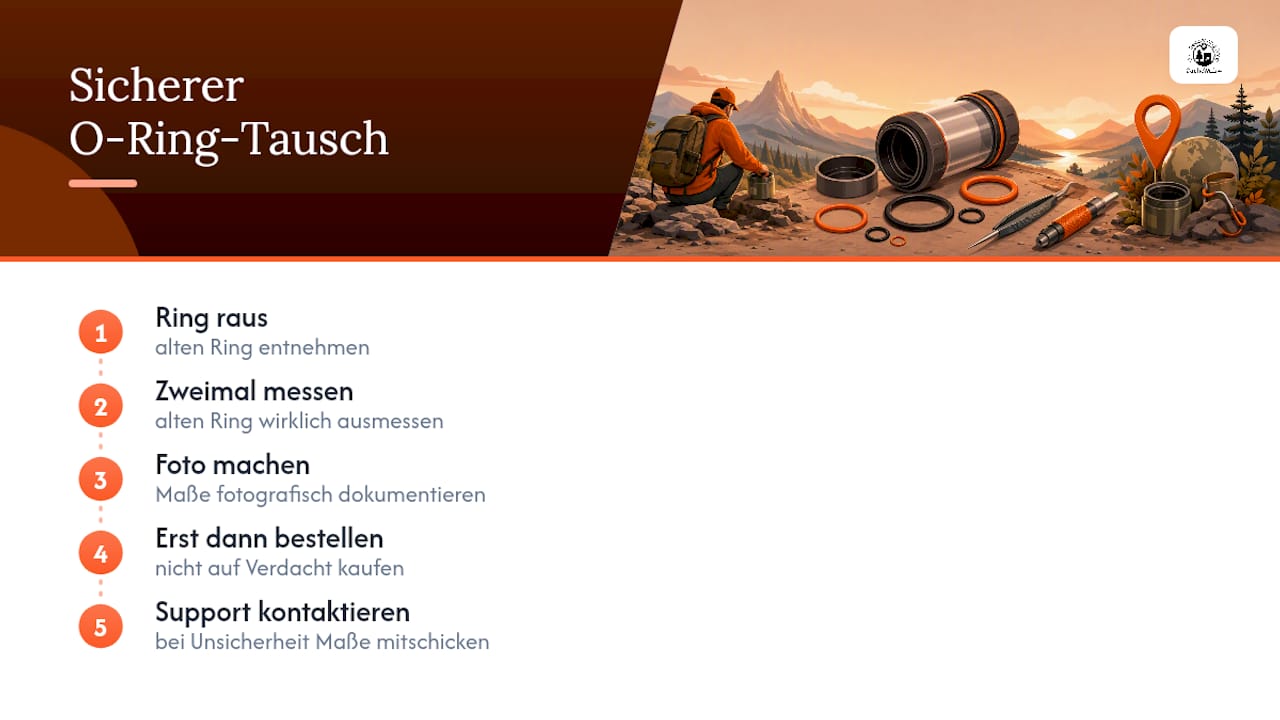
A simple procedure helps more than any table: take the ring out, measure it twice, take a photo, then order. For a PETling tube with an inner diameter of 22 mm, this is often enough for a clean replacement in under five minutes, without any guesswork at the find spot.
If you remain unsure, you should contact support and send them the measurements, instead of ordering on spec. This saves a second delivery and a second trip to the cache.
— Benedikt
Where can you get suitable replacement rings and PETling sets?
There are practical points of contact if you are looking not just for a ring, but a ready-to-use set, instead of assembling individual parts from various sources.

For a complete fresh start, it's worth checking out the Geocaching Starter Bundle 2 with PETling, logbook, and suspension, which combines several wear parts in one package. If you need a holder instead of suspension, Starter Bundle 1 offers the right alternative. Both bundles make sense if you are planning to deploy a new tube anyway. If it's just about a defective sealing ring on an existing tube, a single replacement ring, which you select specifically after measuring, is usually sufficient.
For creative hiding spots around your PETling base, the shop offers further options, such as the survey point cache with an integrated ground sleeve or the entire range of geocaching accessories. Take your time to look around and order the set that suits your next cache.

Sources
- Maratac Replacement XL O-Ring Kit for Vault Cache
- Geocache, Lid for PETling (approx. Ø 40 mm) with eyelet – Free STL | 3DSEARCH