Cache at a traffic sign: permitted, provided the hide and maintenance are appropriate

Yes, a cache at or on a traffic sign works well if you opt for inconspicuous, low-maintenance containers rather than complicated technology. A camouflaged PETling or a fake traffic sign serves exactly this purpose. Important: do not permanently glue or bolt anything; instead, mount it in a reversible way. You can read details on selection, attachment, and maintenance in the following sections.
In short:
- A weatherproof PETling is the most reliable choice as a cache container on traffic signs in urban areas, as it is weather-resistant and easily accessible.
- Camouflage methods such as fake traffic signs, magnetic mini-containers, or 3D-printed camouflage parts should be tested first to ensure their everyday suitability before publication.
- The installation of a cache must be reversible, using no permanent fixtures such as adhesives or screws, in order to comply with local municipal regulations.
- The first inspection should take place one to two weeks after publication, followed by monthly to quarterly maintenance intervals, depending on the frequency of Muggles on site.
- Caches on traffic signs must not cause any visual obstructions or damage and should be placed in inconspicuous, safe locations, with responsibility lying with the owner.
Table of Contents
- Which containers work reliably on signposts?
- Practical camouflage methods for traffic signs in urban settings
- How do you mount a cache safely and reversibly?
- How often should you check your cache on the traffic sign?
- Does a cache on a traffic sign require a permit?
- What should seekers and owners keep in mind when dealing with traffic signs?
- How do you incorporate traffic signs into multicaches and puzzles?
- CacheWerk perspective: practical instead of theoretical
- Fake traffic sign from Cachewerk: inconspicuous and low-maintenance
- Sources
- FAQ
Which containers work reliably on signposts?
The PETling has established itself as the standard for urban micro-hides. It is robust, small enough for a post, yet offers space for a logbook. Cachewerk’s PETling containers are considered weather-resistant and durable, which is especially important in high-traffic streets where rain, road salt, and vibrations from traffic take their toll on any material.
When it comes to material, there are two options: standard commercially available PETlings or 3D-printed PETG components. PETG scores points for dimensional stability and can be precisely adapted to the post diameter, though it takes more time to produce. A finished PETling is ready to use immediately and requires no printing experience.
Both variants must comply with Groundspeak's requirements. The guidelines for cache owners demand clear labeling of the cache inside the container as well as a logbook of sufficient size for multiple entries. Dangerous imitations are forbidden, and the container must not be permanently glued or screwed to the post.
For choosing between the formats, this overview helps:
- PETling (Standard): Ready to use immediately, weatherproof, enough space for a logbook and small trade items.
- PETling with magnetic mount: Additional fixation without drilling, ideal for metal posts in urban settings.
- 3D-printed PETG component: Precise camouflage, but higher effort for production and testing.
- Fake traffic sign: Larger camouflage surface, suitable for stable, easily accessible posts.
The practical test of PETling mounts by Cachewerk shows how a PETling with a magnetic mount performs in everyday life.
Practical camouflage methods for traffic signs in urban settings
Fake signs are particularly worthwhile on stable posts in densely built-up areas where additional signs rarely attract attention. At an intersection that already has ten signs, no one will notice a second traffic sign. On a lonely country road post, the same sign would be immediately suspicious.
Three camouflage methods have proven themselves in practice:
- Fake traffic sign with post mount: Simply slipped on or clamped, no drilling required, high camouflage effect in urban areas.
- Magnetic mini-containers: Quick attachment to metal posts, but risk regarding vibration and vandalism.
- 3D-printed screws or nuts: PETG as a material offers a good balance between weather resistance and printability, while the component remains light enough for inconspicuous mounting.
Every method has its price. The fake sign offers the largest camouflage surface but requires a post that actually accommodates it. Magnetic solutions are mounted quickly but do not last forever. Printed small parts are inconspicuous but sometimes disappear accidentally during road salt clearing operations.
Pro tip: Test every camouflage solution yourself for a week before you publish the cache. What looks inconspicuous on the craft table often looks different on the actual post.
How do you mount a cache safely and reversibly?
The most important principle first: nothing should be permanently glued or bolted. A traffic sign is public property, and any irreversible change creates trouble, no matter how good the intention was. Reversible clamping mounts or post mounts serve the same purpose without leaving marks.
These mounting options have proven effective:
- Post mounts made of PETG: Printed to fit precisely, held in place by clamping tension without tools.
- Cable ties in camouflage color: Cheap, quickly replaceable, inconspicuous if the right color is chosen.
- Magnetic mount with safety cord: Quick installation, additional cord prevents loss due to vibration.
In the listing, the hint text determines "Muggle security." A hint that is too obvious or a spoiler image that reveals the cache in plain view attracts non-cachers to the location as well. A good hint describes the environment without revealing the exact mounting location. If you use a spoiler image, it should be blurry or taken from a greater distance.
Pro tip: Photograph your setup from the seeker’s perspective before you release the cache. This way, you immediately recognize whether the camouflage holds up in daylight and from a direct viewing angle.
How often should you check your cache on the traffic sign?
The first inspection should be planned for one to two weeks after publication, as it is during this phase that weaknesses in mounting and camouflage become most apparent. Afterward, the interval depends on the Muggle frequency at the location: monthly in high-traffic inner-city areas, quarterly in quieter locations.
Typical errors often accumulate in the same order:
- Too complex a mechanism that jams in cold or humidity.
- Placement on posts with high municipal or cleaning frequency, leading to the cache being removed unnoticed.
- No backup owner if the original owner is traveling for an extended period.
- Community experience from relevant geocaching forums confirms: simple, low-maintenance solutions last significantly longer in urban environments than technically complex constructions. Anything that can break will eventually break in everyday life between bus traffic and construction work.
With every maintenance visit, the same quick check is worthwhile: seal intact, logbook dry and not full, camouflage still inconspicuous, mechanical parts like magnetic or clamping mounts still secure.
Does a cache on a traffic sign require a permit?
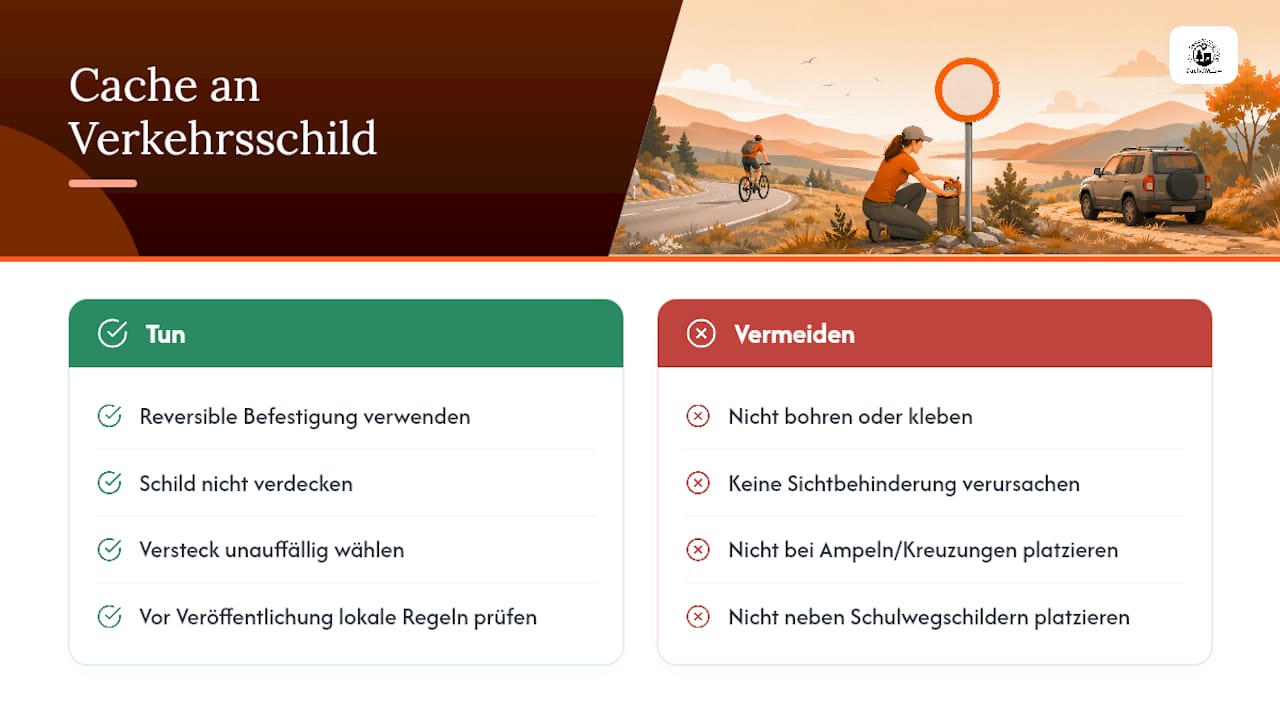
Traffic signs are on public property and usually belong to the municipality or the road maintenance authority. Someone who places a cache there is not changing the sign, but placing an additional, inconspicuous object next to or on it, without damaging it or impairing its function. This is precisely why the basic rule is: only reversible mounting, no drilling, no gluing, no visual obstruction of the signage itself.
The Groundspeak guidelines for cache owners require that a hide causes no property damage or danger. Anyone who takes this requirement seriously is automatically on the safe side, because a cache that obscures a traffic sign or impairs its stability violates both the listing rules and common sense.
If you are unsure about a specific location, a look at the CacheWiki hints for hiding geocaches helps: highly frequented or safety-relevant areas such as intersections with traffic lights or locations directly next to school zone signs are considered unsuitable. In principle, the responsibility remains with the owner to choose the location in such a way that it is neither conspicuous nor a cause for complaint. When in doubt, a quick look at local regulations of the respective municipality is worthwhile, especially for traffic signs on main roads or near schools.
What should seekers and owners keep in mind when dealing with traffic signs?
Safety comes before the joy of the find, especially on roads with traffic. A cache directly at an intersection or curve tempts seekers to park briefly on the side of the road or look across the road inattentively when they should actually be watching traffic. As an owner, you should consider this exact point when choosing the location: Is the post accessible from a safe sidewalk without anyone having to step onto the street?
The same caution applies in reverse for seekers. Even an exciting hint text does not justify moving across an intersection with a phone in your hand or stopping at an exit. Anyone searching for a cache on a traffic sign should pause briefly and check whether the location offers safe access before setting off.
Another aspect concerns the signs themselves. A traffic sign must never be covered, moved, or impaired in its legibility by the cache, because the safety of all road users depends on it in an emergency. A fake sign or camouflage is therefore always attached next to or below the actual signage, never above or directly in front of the sign face. This rule applies regardless of how clever the camouflage is otherwise designed.

How do you incorporate traffic signs into multicaches and puzzles?
Traffic signs naturally provide numbers and symbols that are excellent for puzzle stations. Distance information on a town sign, the number of a country road, or the height clearance of a bridge can be directly integrated into a coordinate formula without you having to attach artificial extra information.
A proven pattern for multicaches looks like this: At station one, the seeker reads a number from the traffic sign, such as the last two digits of a road number. This number is incorporated into the formula for the next coordinate. This way, you link several signs on a route into a coherent chain without having to hide a separate container at every station.
Important here: The station itself needs no cache container if it only serves to obtain information. This reduces maintenance effort considerably, as only the final station at the destination actually needs to be maintained. Especially in the city, where geocaching officially takes up urban camouflage as a hide theme in its own right, such chains of multiple traffic signs work particularly well because the necessary sign density in inner cities is usually present anyway.
Pro tip: Avoid numbers that can change due to construction work or sign replacements, such as temporary construction site signage. Rely instead on fixed information like road numbers or place names.
CacheWerk perspective: practical instead of theoretical
The discussion about caches on traffic signs in many forums revolves too much around legal gray areas and too little around the actual practical question: does the hide withstand everyday use? From our perspective at Cachewerk, it is not the cleverness of the camouflage that determines the success of a cache, but the ease of maintenance. A PETling with a magnetic mount, which we have tested ourselves, performs better in the city than any complex mechanism because it can be checked and replaced in seconds.
Anyone who decides on a fake traffic sign or an inconspicuous PETling should not view this as a one-time purchase, but as part of ongoing upkeep. Further ideas on urban hides can be found in the blog post on urban camouflage hides by Cachewerk.
— Benedikt
Fake traffic sign from Cachewerk: inconspicuous and low-maintenance
Cachewerk is the right address if you want not just to plan a cache on a traffic sign theoretically, but actually build it. The geocaching hide "Fake water sign" with post mount blends inconspicuously into the cityscape and requires no drilling, no glue, no permanent change to the post.
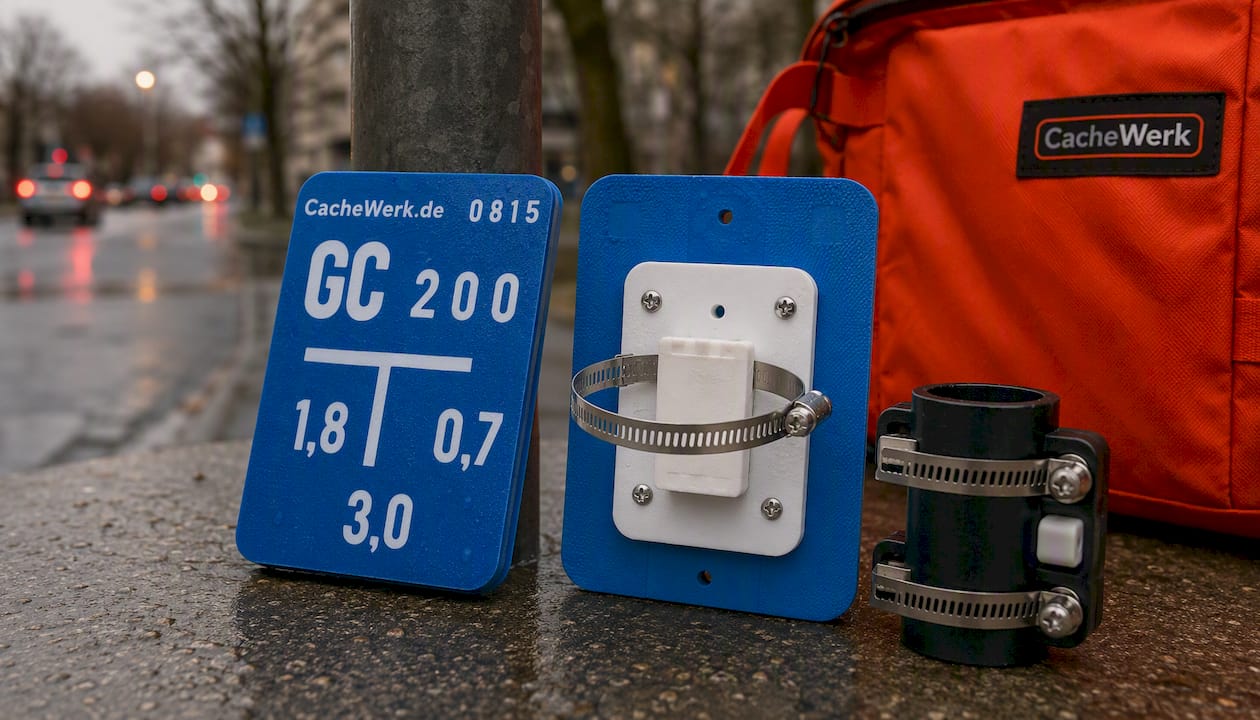
If you prefer an individual design, the customizable version of the fake traffic sign is the right solution for you: your own labeling, your own look, and the same unobtrusive effect in the streetscape. Both versions are designed for reversible installation and follow the maintenance principles described above. Take a look at the product pages, compare the dimensions with your planned post, and order the hide that fits your location.
Sources
- 3D Printing Archive: Geocaching 3D Printing Templates
- Geoclub Forum: Creative cache ideas & technical gear
- CacheWiki: Hiding geocaches
FAQ
Is a cache on a traffic sign generally allowed?
Yes, as long as the attachment remains reversible, the sign is not covered or damaged, and the Groundspeak guidelines regarding labeling and logbook size are followed.
Which container is best suited for posts?
A PETling is considered a robust standard for urban micro-hides because it is weatherproof and offers enough space for a logbook.
How often do I have to check my cache on the sign?
The first check should be scheduled one to two weeks after publication; after that, a monthly to quarterly rhythm is sufficient, depending on the frequency of Muggles.
Am I allowed to glue the fake sign to the post?
No, permanent gluing or bolting contradicts the listing rules. Instead, use a post mount or a clamp attachment, such as those used for fake traffic signs.
Can I incorporate a traffic sign into a multi-cache?
Yes, numbers and symbols on the sign, such as road numbers or mileage, can be incorporated directly into a coordinate formula for the next station.