
Letterbox Hybrid Caches: Puzzles and Adventure Combined
Many geocachers know the term "Letterbox Hybrid Cache" and have seen it on the map, but a closer look often brings up the same question: Is it just a cache with a stamp inside? Far from it. A Letterbox Hybrid combines letterboxing with geocaching and has very clear rules that many geocachers underestimate or simply don't know. This article will explain what truly defines this cache type, how it differs from other types, and what you as a finder or cache owner need to know to unlock its full potential.
Table of Contents
- Definition and History of Letterbox Hybrid Caches
- How Letterbox Hybrid Caches Work: Structure and Process
- Distinction from Other Cache Types and the Most Important Rules
- Practical Tips for Finders and Cache Owners
- My Perspective: What Truly Defines Letterbox Hybrid Caches
- More Geocaching Adventures with Suitable Accessories
- Frequently Asked Questions
Key Takeaways
| Point | Details |
|---|---|
| Hybrid Explained | Letterbox Hybrid Caches combine classic clues with GPS logic and must contain a stamp. |
| Stamp Rule to Observe | The stamp remains in the cache and is only used to mark your logbook. |
| Creativity and Rules | A Letterbox Hybrid must offer more than just a stamp – creativity and correct implementation of hybrid rules are crucial. |
| Process for Finders | Having your own stamp and logbook is practically mandatory; clear clues or coordinates guide you to the box. |
| Distinction from Other Caches | Key differences lie in the handling of clues, stamps, and logbook keeping. |
Definition and History of Letterbox Hybrid Caches
Letterboxing is one of the oldest outdoor treasure hunts. It originated in 1854 on Dartmoor in England, when a hiker hid a bottle containing his calling card in a bog. Since then, the tradition has evolved: participants follow handwritten clues to find a box with a stamp. They press the stamp into their own passport book, and their own stamp goes into the box's logbook.
Geocaching, on the other hand, began in 2000, shortly after the US government made precise GPS use available to the public. Combining both concepts was a natural step. The Letterbox Hybrid Cache merges coordinates or GPS data with the traditional stamping of letterboxing.
According to the Geocaching Wiki, a Letterbox Hybrid is a geocache type that combines elements of letterboxing with geocaching: coordinate-based searching meets clue navigation and stamp tradition. This makes it unique in the world of cache types.
Key Features at a Glance
- Fixed stamp in the cache: The stamp is permanently in the cache and not a trade item.
- Logbook present: Either in the cache itself or combined with online logging.
- Navigation variable: Coordinates, clues, or both are possible.
- Own stamp for finders: Cachers ideally bring their personal stamp.
- Rule-bound: Platform rules from Geocaching.com also apply.
"A Letterbox Hybrid connects two worlds: the technological precision of geocaching with the romantic puzzle logic of classic letterboxing."
Here is an overview of the most important distinguishing features compared to a standard cache:
| Feature | Letterbox Hybrid | Traditional Cache |
|---|---|---|
| Stamp in cache | Mandatory, permanently installed | Not provided |
| Navigation | Coordinates or clues | Coordinates |
| Own stamp needed | Recommended | Not necessary |
| Logbook | Present | Present |
| Trade items | Optional | Often present |
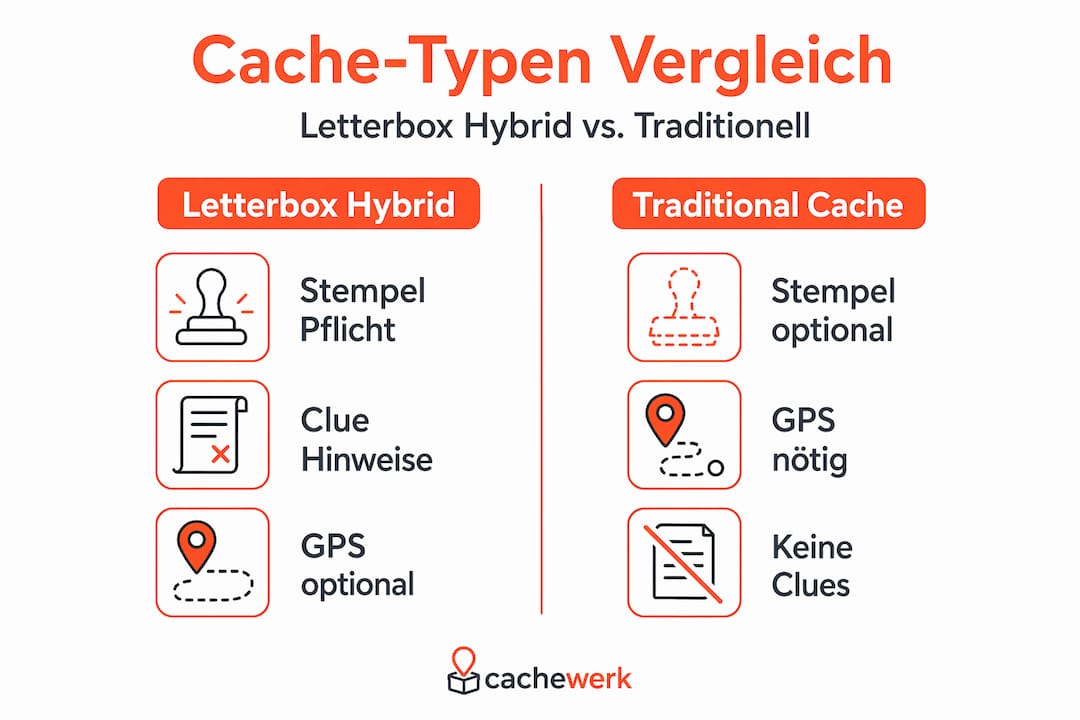
Those familiar with trick geocaches and rare cache types know that each cache type has its own logic and rules. With a Letterbox Hybrid, it's less about camouflage and more about a well-thought-out, multi-stage experience with a tangible conclusion.
How Letterbox Hybrid Caches Work: Structure and Process
A Letterbox Hybrid Cache, at first glance, functions like a normal cache. You open the app, see the coordinates, navigate there, and find the box. What happens next is different from most other cache types.
The cache must contain a stamp. This stamp is permanently installed and is not a trade item: it always stays in the box and must not be taken under any circumstances. This is the most important rule and also the most common misunderstanding among cachers.
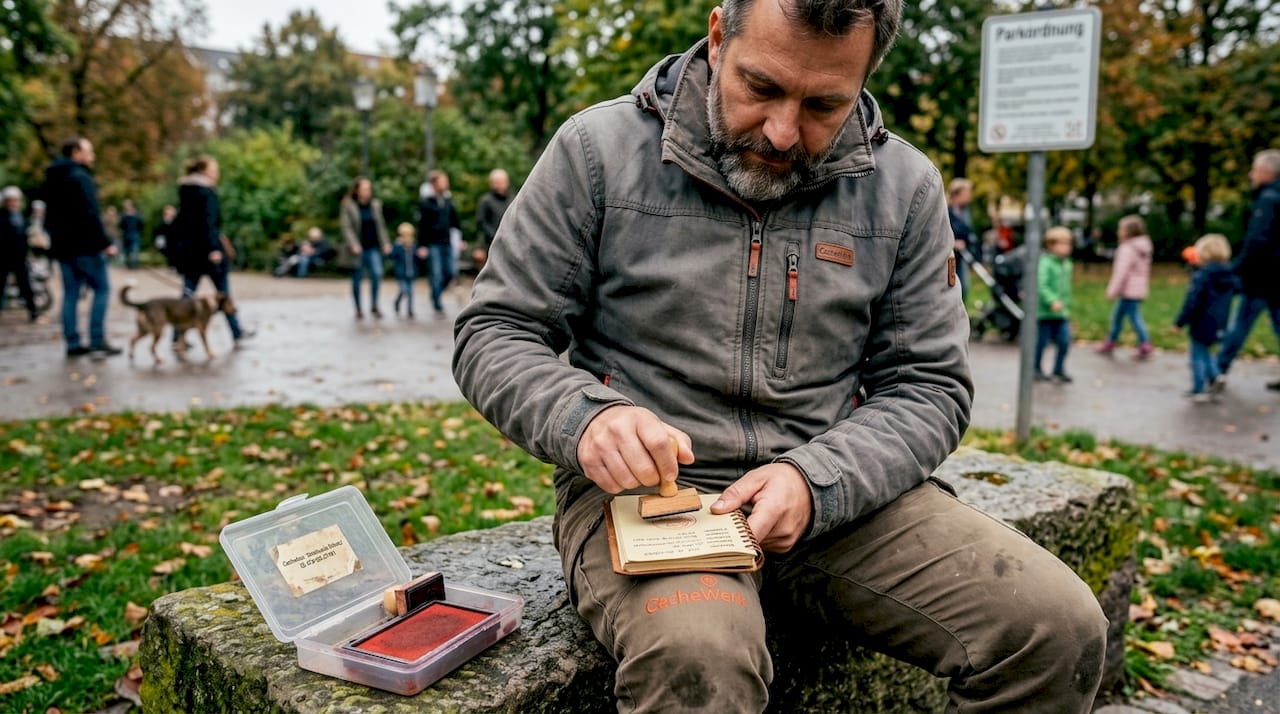
The navigation can vary: some listings lead you directly to the cache via coordinates. Others use classic letterboxing clues, i.e., text-based hints that guide you step-by-step to the destination. Many owners combine both for a particularly exciting experience.
Step-by-step: How the Search Works
- Read the listing: Carefully check the cache listing. Does it contain coordinates, clues, or both?
- Prepare equipment: Bring your own stamp, an ink pad, and a small logbook.
- Start navigation: Follow the coordinates or clues to the hide.
- Open the cache: Find the box and open it carefully.
- Use the cache's stamp: Press the stamp from the box into your own passport book or logbook.
- Your own stamp in the logbook: Press your personal stamp into the cache's logbook.
- Return everything as found: The stamp, logbook, and all materials remain in the cache.
- Log online: Record your find on the platform and share the experience.
"The stamp is the heart of it. It belongs to the cache like treasure to a treasure map."
Pro tip: Crafters and DIY enthusiasts can easily design their own personal stamp. Whether it's a linocut, rubber stamp, or a small 3D-printed design: your own stamp becomes a trademark and makes every find more personal. If you don't have one yet, you can find inexpensive stamp carving kits in craft stores. Make sure the stamp fits into a small pouch that you carry with you on every caching tour.
The same principle applies to trick geocaches as a practical example: good caches have a well-thought-out dramaturgy. The Letterbox Hybrid gives you exactly this dramaturgy with the stamp ritual, if you implement it consistently.
An important note on the cache's construction itself: the logbook should be waterproof, as moisture quickly destroys stamp impressions. Good owners use Ziploc bags or special protective covers inside the cache box. The stamp itself should also be protected from moisture, for example in a small container within the cache.
Distinction from Other Cache Types and the Most Important Rules
Here lies the most common misunderstanding in the geocaching community. Not every cache that contains a stamp is automatically a Letterbox Hybrid. And not every cache with puzzling clues belongs to this category.
An example from the Geocaching.com listing shows: The platform explicitly requires a unique, permanent stamp in the cache that is not a trade item. This stamp is used to mark a passport book or logbook. This is the official definition.
A Mystery Cache, on the other hand, can contain all sorts of things: puzzles, codes, hidden coordinates. It doesn't have to have a stamp and doesn't follow any letterboxing tradition. A Multi-Cache leads you through several steps and stations, but also has no stamp requirement.
Important clarification: Not every cache box with a stamp is automatically a true Letterbox Hybrid in the sense of letterboxing logic. The combination of navigation principle, stamp ritual, and correct categorization in the listing makes the difference.
Comparison Table: Cache Types at a Glance
| Property | Letterbox Hybrid | Mystery Cache | Multi-Cache |
|---|---|---|---|
| Stamp mandatory | Yes, fixed in cache | No | No |
| Navigation | Coordinates or Clues | Variable, often puzzles | Multiple stages |
| Letterboxing principle | Yes | No | No |
| Own stamp for finders | Recommended | Not common | Not common |
| Complexity | Medium | High | Medium to high |
| Target group | Letterboxers and geocachers | Puzzle fans | Adventurers |
The Most Important Rules at a Glance
- The stamp must remain in the cache and is never a trade item.
- The cache must be correctly listed as a Letterbox Hybrid, not simply as a Traditional with a stamp.
- The logbook must be present and accessible.
- Clues or coordinates must be understandable and compliant with rules.
- The stamp should be uniquely designed, meaning not a purchased standard stamp unrelated to the cache.
Pro tip: As an owner, you should consider whether your cache truly embodies the letterboxing principle or if you simply added a stamp. The difference lies in the intent and design. Create a listing that honors the letterboxing tradition: describe the stamp, explain the ritual, and give finders the feeling of participating in a long tradition. This makes your cache special.
Those interested in the distinction of rare cache types will find further examples and inspiration for their own cache design there.
Practical Tips for Finders and Cache Owners
Theory is good, practice is better. Here are concrete tips that will really help you as a finder and as an owner.
Checklist for Finders
When participating, finders typically bring their personal stamp and use it to leave their mark in the cache logbook. This is part of the ritual and should be taken seriously.
Pack the following items before each tour:
- Personal stamp: Your individual design, which you press into the cache's logbook.
- Ink pad: A small, portable pad with ink in your favorite color.
- Logbook or passport book: Your personal notebook into which you press the cache stamp.
- Pen: For additional notes or in case there is no stamp.
- Tweezers: Helpful for small or tightly packed caches.
Tips for Cache Owners in Steps
- Design the stamp yourself: Use the stamp as a creative means of expression. Show the location, an animal, a symbol, or a personal logo.
- Formulate clear clues: Whether coordinates or clues: make navigation unambiguous. Confusing listings frustrate finders.
- Protect the stamp: Pack the stamp in a small, waterproof container within the cache.
- Maintain the logbook regularly: Check every few weeks whether the logbook still has enough space and is dry.
- Complete the listing fully: Explain in the listing that a stamp is present and what equipment finders should bring.
- Use feedback: Read your finders' logs and adjust clues if several cachers describe the same spot as unclear.
Pro tip: Combine your stamp design with the theme of the cache location. A cache at the edge of the forest could feature a deer on the stamp, a cache in the city perhaps a city skyline. This makes the find unforgettable and leaves finders with a lasting impression in their passport book. Owners who go one step further can add a small story to the cache, explaining why this place is special.
For tips on crafting innovative caches, the same principle applies: creativity and rule compliance are not mutually exclusive. Especially with the Letterbox Hybrid, you as an owner have the freedom to create a real experience.
Common Mistakes and How to Avoid Them
Many owners make the same mistake: they place a stamp in a cache and list it as a Letterbox Hybrid. But the listing doesn't explain to finders what to do. The result: confusion, bad logs, and a cache that doesn't reach its full potential.
Another common mistake is poor stamp protection. Ink impressions in the logbook become illegible if moisture gets in. Invest a few cents in a small plastic container and store the stamp and logbook separately.
Finders, on the other hand, often underestimate the importance of their own stamp. Those who simply sign miss out on the actual experience. The stamp exchange is what differentiates this cache type from all others.
My Perspective: What Truly Defines Letterbox Hybrid Caches
We've made an interesting observation in the geocaching community: many Letterbox Hybrid Caches bear this name but don't truly embody the principle. Yes, they have a stamp. But the soul of letterboxing is missing.
True letterboxing works without GPS. Navigation happens through clues, through careful reading of descriptions and through observation of nature. In the geocaching context, GPS is standard, but that doesn't mean the clue tradition can simply be dropped. This is precisely the problem with many Letterbox Hybrids: they are geocaches with a stamp, but not true hybrids of both traditions.
A good Letterbox Hybrid should honor both. Coordinates lead you to the right area, and then classic letterboxing clues take over for fine navigation. This is what makes the type exciting and distinguishes it from Mystery or Multi-Caches.
We believe: The crux is the owner's attitude. Whoever builds a Letterbox Hybrid should read up on the letterboxing tradition and understand why the stamp exchange is more than a nice extra. It is the completion of a ritual. It says: I was here. This place was worth it.
For creative cache ideas, the same principle applies: the best cache isn't created by hiding a box, but by thoroughly thinking through an experience. What should the finder feel? What will they remember?
GPS coordinates are a tool. The stamp is the experience. And the path in between, whether by GPS or by clues, should be carefully designed. Owners who understand this build caches that finders still see in their logbooks years later and remember: This cache was different. This cache was special.
It's also a matter of respect for the Letterboxing community, which has maintained this tradition for over 170 years. Anyone who lists a Letterbox Hybrid sends a signal: I connect two worlds. Then that should be noticeable, not just on paper.
More Geocaching Adventures with Suitable Accessories
You are now well informed about Letterbox Hybrid Caches and know what really matters. The next step: the right accessories for your next adventure. Whether you want to upgrade your own stamp as a finder or build an unforgettable cache as an owner, the right equipment makes all the difference.
At CacheWerk, you'll find everything you need: from innovative hiding spots to creative camouflage and fancy accessories for every cache type. Discover Geocaching Equipment now and get inspired by creative Geocaching hiding spots. With the right accessories, your next Letterbox Hybrid can become a real highlight for the community.
Frequently Asked Questions
Is a Letterbox Hybrid Cache possible without GPS?
Yes, depending on the listing, the search can be purely clue-based. In the geocaching context, however, GPS-enabled starting points are often common, as the cache is listed on a platform.
May I take or trade the cache stamp?
No. The stamp must always remain in the cache. It is not a trade item and is part of the fixed inventory.
What should I bring as a finder to a Letterbox Hybrid Cache?
You should bring your personal stamp, an ink pad, and your logbook. Finders typically bring their own stamp to leave their mark in the cache logbook.
Does every Letterbox Hybrid Cache also have to offer clues?
No. Navigation can vary: coordinates alone are allowed, as are clues or a combination of both.