Fewer maintenance visits for geocaching: Logbook paper lasts two years

For most geocaches, PETling logbooks or A6 spiral-bound notebooks are a proven choice, while narrow log strips suffice for nanos. The crucial factor is not just the format, but the paper quality: Weatherproof paper significantly reduces maintenance, as it needs to be replaced less often due to moisture. Blank pages often provide space for stamps and creative entries. The following sections will guide you on how to optimally match the format and paper type to your cache size.
In a nutshell:
- Weatherproof special paper often lasts several years compared to standard paper, while normal office paper remains weatherproof for only a few months.
- For nano-caches, only narrow, rolled-up log strips or rolls are suitable to ensure space in the mini-hide.
- High-quality seals and smaller logbook sizes are crucial to prevent condensation and moisture damage in weather-exposed hides.
- Blank pages encourage creative entries and stamps, while pre-printed lines limit space for personal notes.
- For longer maintenance-free periods, investing in weatherproof and durable materials is worthwhile to reduce overall effort.
Table of Contents
- Logbook Paper Types in Geocaching: What Formats Are There?
- Logbook Paper Types: Standard, Weatherproof, or Film?
- Which Logbook Format Suits Which Cache Size?
- How Often Should You Replace Your Geocaching Logbook?
- What Owners Truly Learn About Logbooks in Practice
- How Sustainable Are the Different Logbook Papers?
- How to Properly Write In and Maintain Your Logbook
- Why Maintenance Effort Is More Important Than Perfect Paper
- Which CacheWerk Product Suits Your Hide?
- Sources
Logbook Paper Types in Geocaching: What Formats Are There?
In geocaching, you generally have five common logbook formats to choose from, each with its own justification. The choice almost always depends on the available space in the hide, not personal preference.
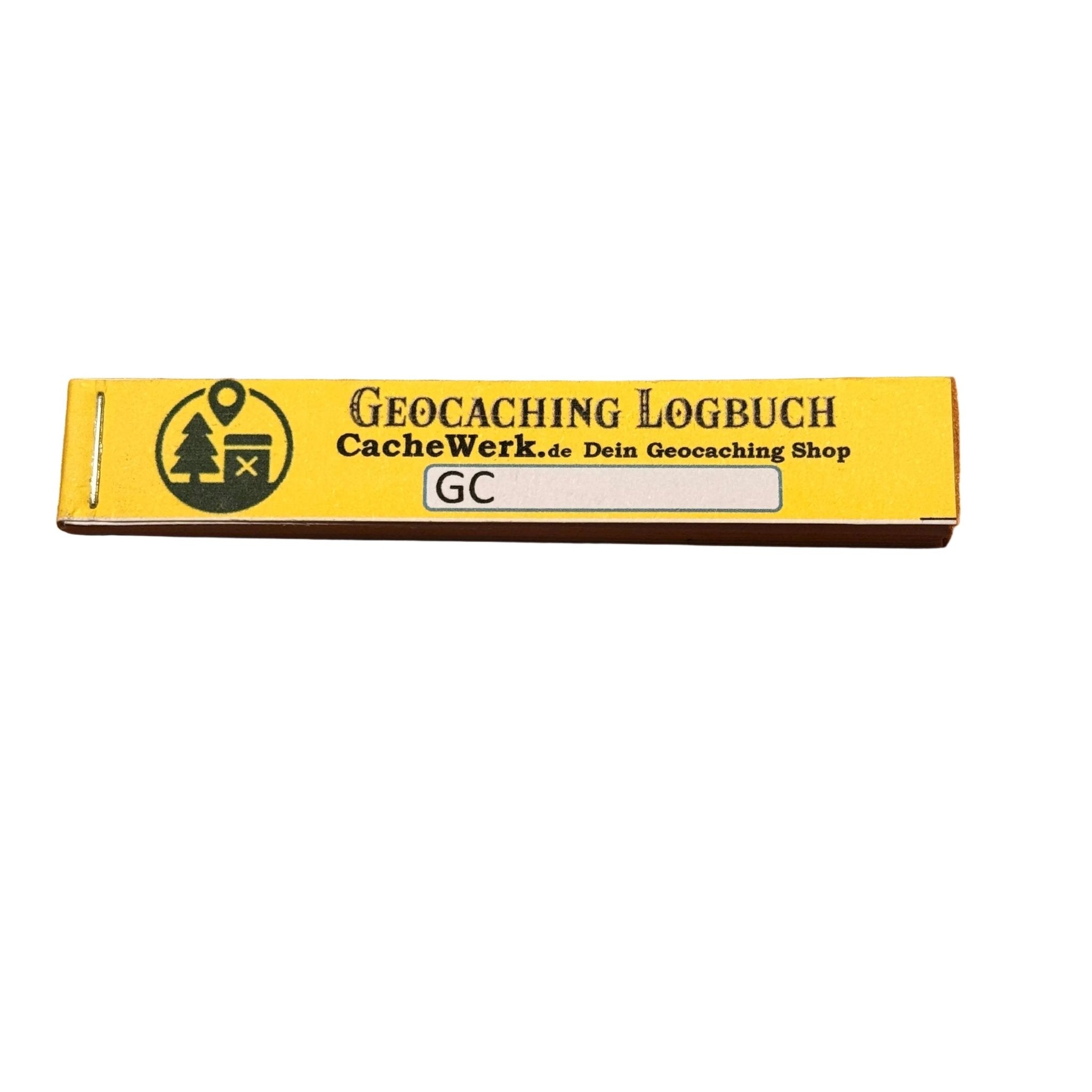
Log strips are narrow, rolled-up strips of paper. They fit even into the smallest containers, offer surprisingly much writing space, and are almost irreplaceable for nano hides. The catch: Rolling them up and back can be annoying in the cold or with numb fingers, and if someone brings a thick pen instead of a ballpoint, they might easily smudge the next line.
Rolled scrolls function similarly but are usually made of slightly thicker paper, making them more robust for continuous use. PETling logbooks are custom-cut mini-notebooks that fit exactly into the round film canister, thereby avoiding wasted space. Nano booklets go a step further, squeezing a few millimeters of paper onto a surface smaller than a fingernail. A6 or A7 notebooks, on the other hand, offer ample space for regular and large containers but take up more room in the cache.
Typical practical problems include:
- In tight nanos, log strips often get snagged if the finder tries to roll them back up with damp fingers.
- Damp hides can cause uncoated paper to swell and become illegible within a few weeks.
- Overly thick notebooks may no longer fit through the opening once several layers of condensation accumulate in the container.
- Spiral bindings made of cheap metal rust noticeably quickly near the coast or with constant dampness.
Logbook Paper Types: Standard, Weatherproof, or Film?
The type of paper determines the lifespan of a logbook more than its format. Standard paper, with a weight of 80 to 100 grams, like that used in office printers, absorbs moisture like a sponge and then swells. It works for dry, well-hidden caches for several months but is the weakest option outdoors.
Weatherproof special papers are a significantly more stable solution. Rite-in-the-Rain, Pretex, and Neobond from FiberMark are frequently recommended in community discussions. These papers are chemically treated or coated with a thin layer to make water bead off rather than soak in. However, you must write on them with a pencil or special ballpoint pens, as classic rollerball pens or felt-tip pens tend to smudge on the smooth surface.
Coated films and PVC or PE alternatives go even further: completely waterproof, but also completely different to handle. Stamping often doesn't work well on them because ink doesn't dry properly on smooth film and smears when opened again. If you operate a cache with an elaborate stamp motif, you should test this beforehand.
Pro Tip: When making your own logbooks, always include a sample sheet with the printer before ordering larger quantities. Pretex and Neobond feel different depending on the batch, and using the wrong pen can render the entire print run unusable.
Comparing acquisition costs against maintenance effort quickly reveals a pattern:
- Standard paper costs almost nothing but requires more frequent visits for replacement.
- Weatherproof special paper costs more per sheet but, according to experienced owners' experiences, often lasts many times longer.
- Films and PVC are usually the most expensive in terms of material costs but eliminate almost all maintenance visits due to moisture.
If you operate a cache in an exposed location that you can't visit monthly, you should take this calculation seriously. A more expensive logbook that lasts two years instead of two months is ultimately the more economical solution.
Which Logbook Format Suits Which Cache Size?
The cache size almost automatically dictates which paper and format are suitable. Here's the tried-and-tested categorization:
- Nano: Only tiny log strips or rolled-up scrolls will fit. Write on them with a thin gel pen, never a thick marker, otherwise there won't be enough space for the next finder. Ready-made sets like the Micro-Log Strips save you the trouble of cutting.
- Micro / PETling: Folded mini-booklets or suitably cut logbooks are standard here. A complete PETling set, including container, logbook, and holder, saves you the crafting work and is guaranteed to fit.
- Regular: A6 notebooks with spiral or ring binding have proven effective because the book can be fully folded back, allowing you to write even without a solid surface, as practical reports from Geocaching Magazine show. Blank pages instead of lined pre-prints offer more room for stamps and personal notes.
- Large: Here, an A6 or even A5 book with robust covers, supplemented by a film canister for additional moisture protection inside, is worthwhile. Double packaging, meaning a logbook in a bag inside a film canister, significantly extends its lifespan.
Important for all sizes: An additional, tightly sealed plastic bag around the logbook often makes the crucial difference between a dry book after a year and paper pulp after three weeks, according to CacheWiki.
How Often Should You Replace Your Geocaching Logbook?
As a rule of thumb: the higher the quality of the paper, the less often you'll need to replace it. Simple office printer paper in a damp forest hideout often lasts only a few weeks before the pages clump together. Weatherproof special paper in a well-sealed container, however, can survive for several years.
If you find a soaked logbook, there's a clear order of action: don't throw it away, but let it dry, contact the owner, and if possible, temporarily leave a replacement sheet. Many finders, with good intentions, simply discard a soaked book, even though the last readable entries might have been important to the owner.
This checklist helps with maintenance decisions:
- Paper feels damp or wavy: replace, don't just dry.
- Writing is illegible on more than half the pages: replace the entire logbook.
- Container itself shows moisture inside: add an extra plastic bag or seal.
- Last entries are older than a year for highly frequented caches: check paper quality and seal.
Pro Tip: Note the replacement date with a pencil on the last page of the old logbook before removing it. This way, you'll immediately see how long the paper actually lasted on your next visit.
More on ongoing maintenance can be found in our practical guide to logbook maintenance.
What Owners Truly Learn About Logbooks in Practice
Blank paper often wins out over pre-printed forms with lines or date fields, similar to how you can find suitable blank notepads at Note to self | Buy notepad online | Ulrike Wathling. The reason is simple: as soon as a finder wants to stamp or leaves a small drawing, any printed line interferes. For themed caches with a custom stamp motif, blank paper is practically mandatory.
In terms of binding, spiral binding has clearly prevailed over stapling. A stapled block always folds back when writing, while a spiral binding can be folded flat and works even on a knee or a rock edge.
An owner who switched from standard paper to weatherproof special paper for an exposed forest cache subsequently had to plan their maintenance visits about half as often, simply because the book no longer got soaked.
For such cases, ready-made PETling sets with a suitable logbook are ideal, as the container and paper are matched from the outset and do not need to be adjusted later.
How Sustainable Are the Different Logbook Papers?
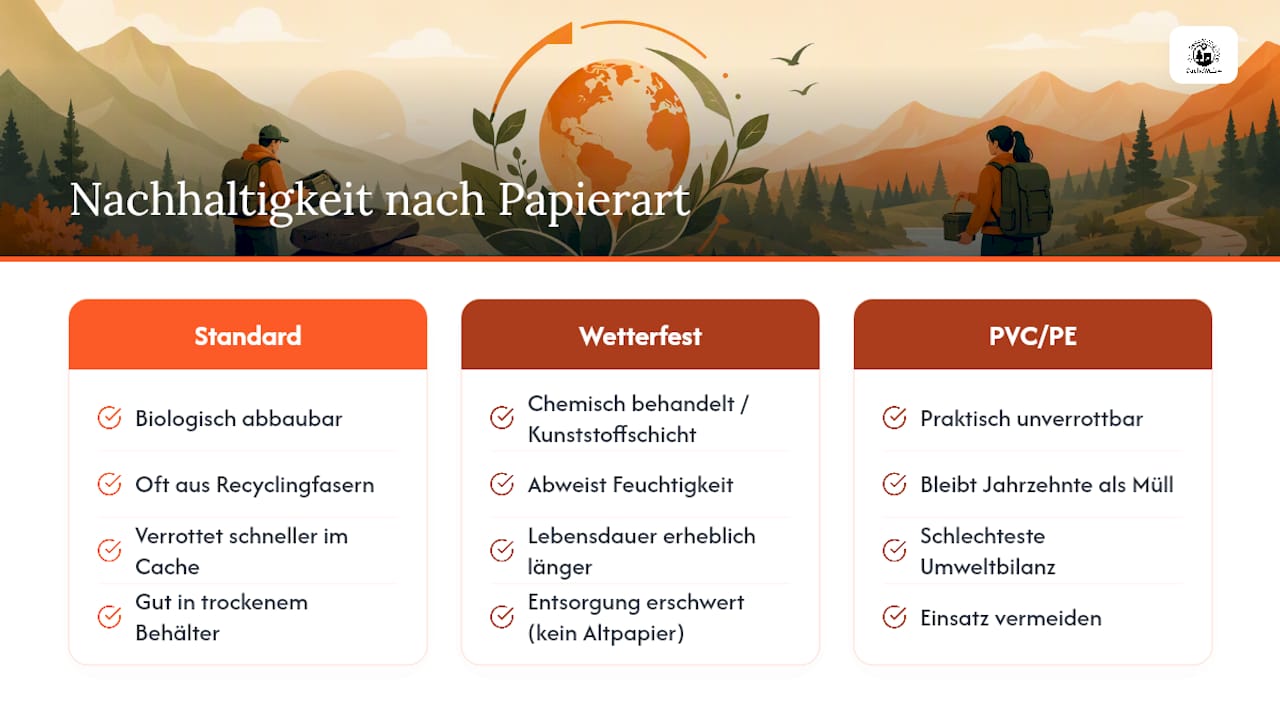
Paper consumption in geocaching is low compared to other outdoor equipment, but it's still worth looking at the environmental aspect of each paper type. Standard cellulose paper is biodegradable and often available from recycled fibers, but precisely because of this, it also rots faster in the cache itself, which in turn means more frequent replacement and more resource consumption over time.
Weatherproof special papers are often chemically treated or coated with a plastic layer to repel moisture. This significantly extends their lifespan but complicates disposal at the end of their life cycle because the material can no longer be recycled as traditional waste paper. PVC and PE films have the worst balance here: they are practically indestructible and, if they end up in the forest, remain as litter for decades.
The most sustainable solution is usually not the cheapest, but the most durable paper in the right place. A logbook that lasts three years instead of three months generally results in less material consumption and fewer car trips to the cache, even if the individual sheet was more elaborately produced. Owners who prioritize sustainability should therefore ask less about the paper type itself, and more about how well the logbook is actually protected at its specific location. A simple standard paper in a dry, well-sealed container can be more ecologically sound than expensive special paper in a hide that receives little moisture anyway.
How to Properly Write In and Maintain Your Logbook
The choice of pen often determines readability more than the paper type itself. On weatherproof special paper, pencils and pressure-sensitive ballpoint pens work best because the smooth coating does not absorb ink from regular felt-tip pens. On standard paper, it's the opposite: pencil fades over months, while a waterproof fineliner lasts significantly longer.
When making entries, a simple rule applies, which is also suggested by the c:geo manual for the connection between physical and online logs: date, nickname, and a brief note are perfectly sufficient; long novels take up space for other finders. If you want to use a stamp, you should first check whether the page offers enough surface and the correct paper structure for it.
Maintenance also includes never leaving the logbook open after opening it, even if it seems sunny for a short time. Condensation often collects in the container precisely when the lid has been open for a while. After making your entry, immediately put the book back into its protective cover or bag and tightly close the container before returning it to the hide. For spiral-bound notebooks, it's also worth occasionally checking the metal spirals, as rusting rings can tear out the first pages over time.
Why Maintenance Effort Is More Important Than Perfect Paper
Most logbook guides get lost in material comparisons, as if there were an objectively best type of paper. There isn't. What matters is the fit between paper type, cache location, and your own willingness to check in regularly.
An owner who visits their cache monthly can confidently use standard paper and save on the higher costs of special paper. However, someone who maintains a cache two hours' drive away should definitely invest in weatherproof paper and additional sealing, even if it triples the acquisition costs. This calculation is completely overlooked in many comparison articles.
The second blind spot is the blank page question. Pre-printed logbooks seem more professional but limit the creative entries that make geocaching interesting for many. For any cache with its own stamp or theme, I would clearly recommend unlined pages, regardless of the format.
— Benedikt
Which CacheWerk Product Suits Your Hide?
For PETling and Regular caches, our Geocaching Starter Bundles are the quickest solution because the container, matching logbook, and holder are already coordinated. You don't have to cut anything or make subsequent adjustments; you can place the cache directly. They are available with a holder or with a hanging mechanism, depending on how your hide is constructed.
For space-saving hides, it's worth checking out our Rusty Bolt Cache, a rust-camouflaged screw bolt with an integrated nano-container for urban environments. If, on the other hand, you're planning a weatherproof, long-term hide that should last for years without frequent maintenance, our Ammo Box with space for an A6 notebook or the Survey Point Hide with PETling and ground sleeve are suitable options.
When deciding between a bundle and an individual purchase, the seal is particularly important: check whether the lid or closure suits the planned environment, and choose a logbook size that is slightly smaller rather than too large, to prevent condensation from forming in the empty space later. Browse our range of geocaching accessories and find the perfect combination for your next cache.
Sources
- Logbook – CacheWiki
- Geocaching Logbooks - Geocaching Magazin
- Make your own logbook - which paper? | Geoclub - Geocaching Forum