Stop rust on magnetic container, screwed instead of glued for geocachers

Light surface rust on a magnet container can almost always be saved: remove, dry thoroughly, seal immediately. First, check whether the magnet is screwed or glued in place, as adhesive bonds show permanent damage much more frequently. If the structure is already rusted through or the coating is flaking off, only replacing the container will help.
In a nutshell:
- Surface rust on magnet containers with superficial flaking can be removed with vinegar, baking soda, or fine sandpaper and then sealed.
- Deep corrosion or flaking coatings usually require replacing the magnet container, as the rust continues to form underneath.
- When choosing materials, stainless steel or rubber-coated magnets are recommended for damp locations, while mechanical fastenings last longer than adhesive bonds.
- Regular checks every three to six months help to detect rust damage early and repair it if necessary.
- For permanently robust hides, weatherproof, screwed containers made of stainless steel are the best choice to permanently prevent rust and moisture damage.
Table of Contents
- Why do magnet containers rust at all?
- Immediate measures for rust on the magnet container
- Corrosion protection for magnet containers: choosing the right material and fastening
- Magnet container no longer holds: maintenance and inspection as routine
- When should a rusty magnet container be replaced?
- What I have learned from practice about rust on magnet containers
- Suitable replacement solutions from the CacheWerk range
- Sources
Why do magnet containers rust at all?
The culprit is almost always in the magnet itself. Neodymium magnets, or NdFeB for short, consist largely of iron and therefore rust at any point where their protective layer has a crack or gap. Manufacturers therefore rely on coatings such as Ni-Cu-Ni, epoxy resin or a rubber coating, which act as a barrier against moisture. As soon as this layer is damaged, for example by a scratch during installation or abrasion in the housing, oxygen penetrates and oxidation begins.
The container material itself also plays a role. Stainless steel withstands moisture significantly longer than galvanized steel, and painted surfaces eventually show micro-cracks in the paint. Contact points such as drill holes, rivet points or adhesive surfaces are particularly susceptible because the coating is thinnest there anyway.
A few environmental factors significantly accelerate the process:
- Damp locations such as forest floors, near streams or shady niches
- Salty air near the coast, which attacks metal particularly aggressively
- Frequent temperature changes that cause condensation to form inside the container
- Mechanical stress due to frequent opening, falling out or vandalism
Immediate measures for rust on the magnet container
Before you reach for tools, do a quick check. If the rust can be wiped off with your fingernail or a soft cloth and the metal underneath remains smooth, it is superficial rust. If, on the other hand, there are pits, porous areas or even holes, the structure is already damaged and a repair is usually no longer worthwhile.
For minor cases, the following order has proven effective:
- Put on gloves and safety glasses, especially when handling more heavily corroded magnets.
- Apply rust with vinegar or a baking soda paste and wipe off with a soft cloth.
- For stubborn spots, use very fine sandpaper (1000 grit or finer) instead of chemicals.
- Degrease with isopropyl alcohol so that the subsequent sealant adheres.
- Allow to dry completely, preferably overnight in a warm, dry place.
- Seal with clear varnish, epoxy resin, Plasti Dip or, if necessary, clear nail polish and adhere to the manufacturer's specified curing time.
Mild household remedies such as vinegar and baking soda are often sufficient for light rust, whereas strong acids also attack intact metal and do not belong in the repair kit. Equally important: no hot glue on NdFeB magnets, because the heat can permanently reduce magnetic performance. Two-component epoxy adhesives are a much more stable choice here.
Pro tip: Always carry a small kit of isopropyl alcohol, fine sandpaper, and a clear coat pen in your geocaching backpack. This allows you to repair superficial rust directly at the cache, instead of having to treat the container at home.
In case of deep corrosion with pitting or flaking coating, the rusting process often simply continues under a new layer. In such cases, replacing the container or the magnet is a more honest solution than a cosmetic repair.
Corrosion protection for magnet containers: choosing the right material and fastening
Anyone building or renovating a magnet container should consider rust protection from the outset, not just after the first rust spot. For locations with permanent moisture, such as in the forest or near the coast, stainless steel pays off in the long run. For drier, protected locations, galvanized steel is usually sufficient and saves costs.
The choice of magnet type also directly influences the susceptibility to rust:
- Rubber-coated NdFeB magnets offer an additional barrier and are particularly well suited for damp locations.
- Ferrite magnets practically do not rust, but have significantly less adhesive force than neodymium magnets.
- Samarium-cobalt magnets hardly corrode, but are more brittle and sensitive to impacts.
- Uncoated NdFeB magnets are not really suitable for continuous outdoor use.
For outdoor use, manufacturers explicitly advise additional protection or alternative magnet types, as untreated neodymium magnets only withstand constant weathering to a limited extent. There are clear gradations in the coating itself: Ni-Cu-Ni provides good protection against mechanical abrasion, epoxy scores with chemical resistance, and a rubber coating also dampens impacts during installation.
The type of fastening often determines the lifespan more than the material itself. Mechanical solutions such as magnets with internal threads or cap nut constructions completely avoid the weak point of adhesive surfaces, as moisture is most likely to attack there. Experience reports from the geocaching community repeatedly confirm this: screwed magnets last noticeably longer outdoors than pure adhesive bonds. Where gluing is unavoidable, it should be a high-quality two-component epoxy adhesive, applied to a carefully degreased and sanded surface.
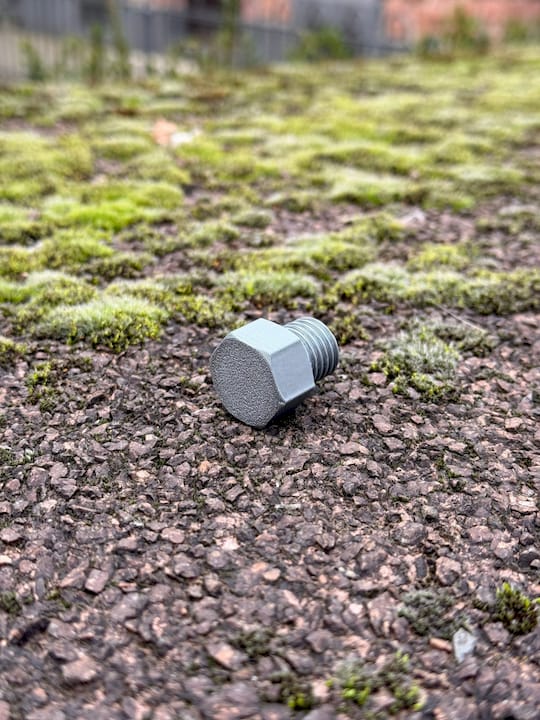
The CacheWerk guide to Petling magnet mounting shows step-by-step how a weatherproof fastening looks in practice.
Magnet container no longer holds: maintenance and inspection as routine
Rust rarely appears overnight. A quick check every three to six months is usually enough to detect damage early, before it becomes structural.
These are the points worth checking on every maintenance tour:
- Is the seal still tight or has it become brittle?
- Are there cracks or initial detachments at the glued joints?
- Does the magnet coating show visible scratches or rust spots?
- Is the adhesive force still the same as at the last visit, or is the container already wobbly?
Spare magnets and spare parts should be stored dry, preferably with a silica gel bag in the packaging. Dry environment, silica gel, and distance from the ground significantly reduce the risk of rust for stored magnets. Package magnets separately from other metal parts to prevent scratches in the coating during transport, and wear gloves when handling to keep skin oils off the surface.
Whether repair or replacement is worthwhile usually depends on the condition of the coating: small scratches can be sealed, but real pitting or cracks in the structure are a clear signal for replacement. You can find more about suitable magnet types and their DIY processing in the overview of geocaching magnet containers from CacheWerk.
When should a rusty magnet container be replaced?
Replacement is worthwhile if deep corrosion with pitting is visible, the adhesive force has noticeably decreased, or the coating is flaking off over a large area. In these cases, the rust usually continues to spread, even under a new coat of paint.
When disposing of old magnets: never simply throw them in the household waste and never burn them. Package the magnet in a sealed bag so that it does not adhere to other metal parts, and take it to your local recycling center or electronics recycling.
If you want to replace the container completely, you will find mechanically fastened alternatives in the range that are designed against rust from the outset, such as containers with screwed-on instead of glued-on magnets.
What I have learned from practice about rust on magnet containers
Most rust damage I see in geocaching forums and on my own hides is not due to bad magnets, but to poor fastening. If you glue instead of screwing, you almost always buy yourself a maintenance problem in the future. Mechanical solutions seem more complex to build, but they save every second repair round.
The classic beginner's mistake is to use hot glue because it is quickly at hand. This is exactly what weakens the magnetic performance and at the same time opens the door to moisture. A carefully prepared two-component epoxy adhesive costs a few minutes more patience, but lasts years instead of months.
If you want to delve deeper into the construction of weatherproof hides, the Geocache Magnet Construction Workflow is a good addition to this article.
— Benedikt
Suitable replacement solutions from the CacheWerk range
When repair no longer makes sense, it's worth looking at containers that are designed from the outset against moisture and rust.
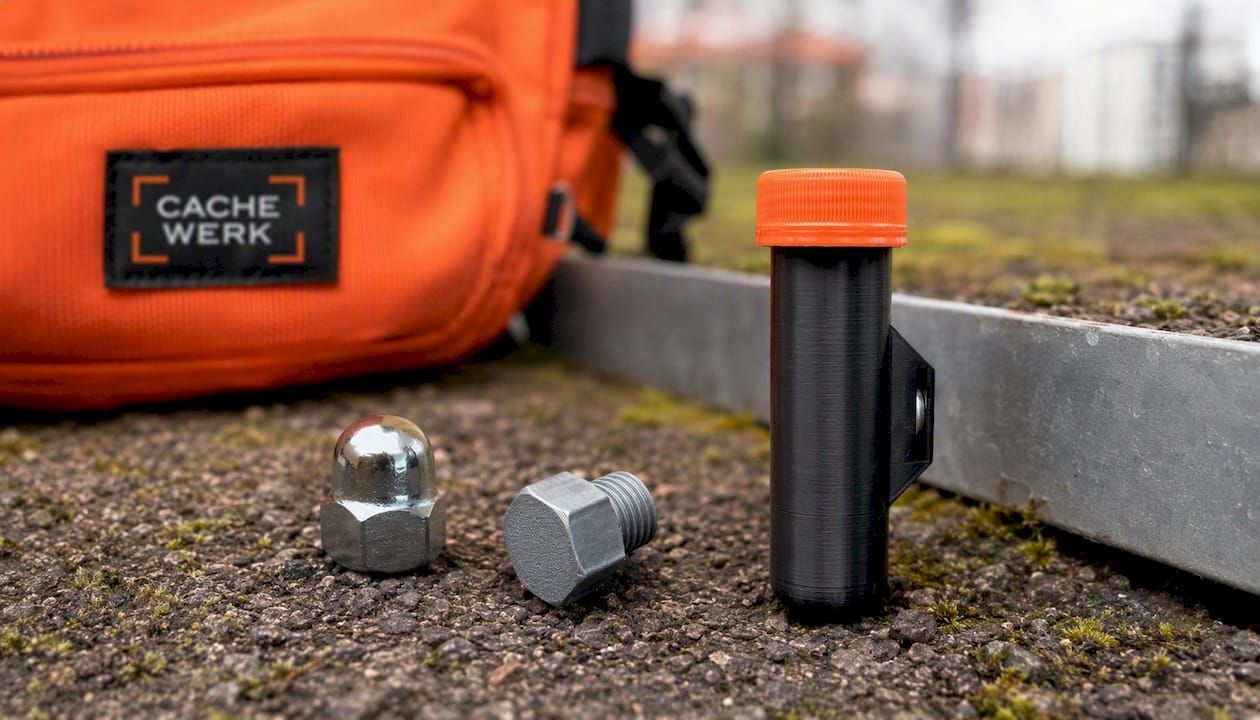
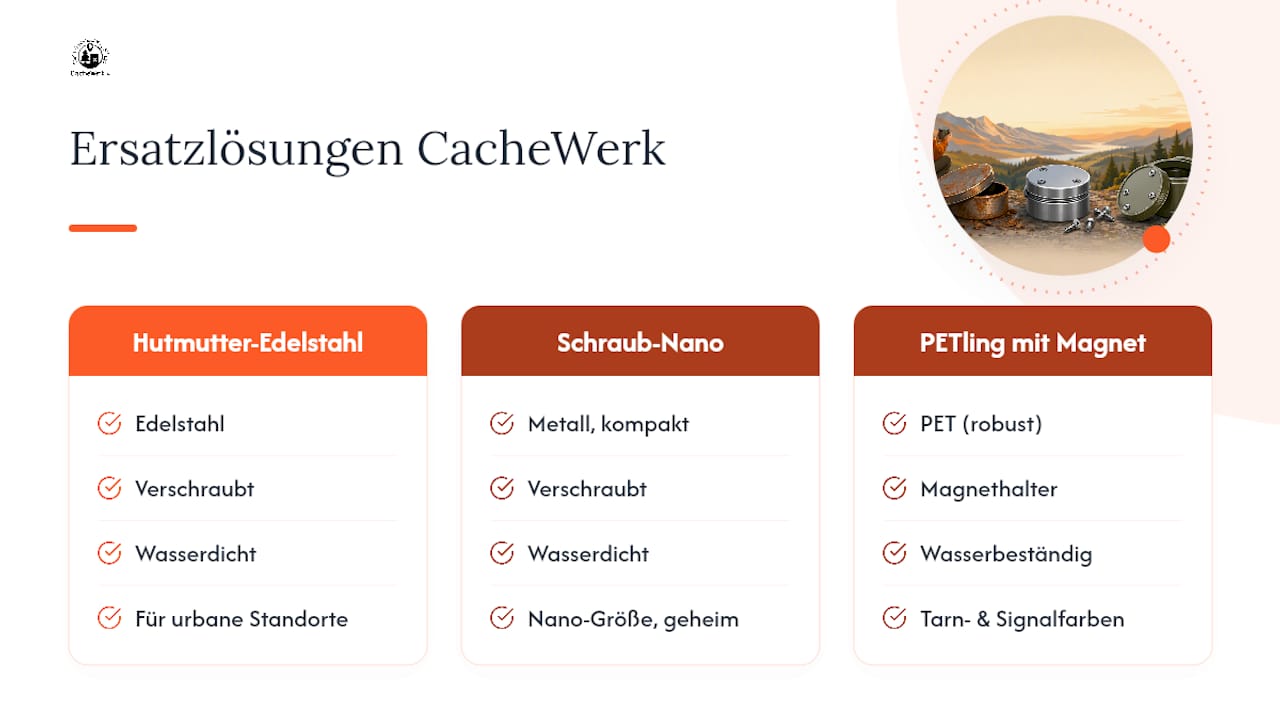
The stainless steel cap nut cache relies entirely on mechanical fastening instead of adhesive bonding and is waterproof, ideal for urban locations with frequent weather changes. The screw hide with a secret compartment offers the same screwing logic in a compact nano size and is suitable for owners who want to completely avoid adhesive joints. The PETling with magnet holder, in turn, is available in camouflage and signal colors and offers a robust alternative for anyone who wants to replace a proven Petling container with better magnet fastening.
All three options are designed for durability in outdoor use rather than a quick adhesive solution that causes problems again after the first rainy season. Visit the CacheWerk shop and find the right replacement for your next cache location.
Sources
The technical recommendations in this article are based on manufacturer's instructions for magnet coatings and corrosion protection, practical cleaning instructions for rusty magnets, and long-term experience from the geocaching forum on magnet fastenings. For in-depth construction instructions, the DIY guide to special cache fastenings is worthwhile.
- How to Prevent Magnets from Rusting? | WZ Magnetics
- Supermagnete
- Magnetplastic
- Attaching magnets | Geoclub - Geocaching Forum