
Tutorial: Building a Weatherproof Permanent Cache Hide
To create a durable, weatherproof geocache hide: you need a waterproof container, a reliable seal, camouflage appropriate for the location, and a fixed maintenance schedule. Without these four components, every hide will sooner or later become damp, visible, or disappear entirely.
Key components at a glance:
- Container: PETling, Lock&Lock-style box, or ammo can, depending on size
- Seal: Rubber gasket or silicone, plus an additional inner liner
- Maintenance: Check every three to six months, plus as needed after extreme weather
Pro-Tip: For most locations in Germany, a Lock&Lock box or a PETG container with a double protective cover is perfectly sufficient – more expensive rarely means better, just unnecessarily more complex.
Key Takeaways
A durable geocache hide only works when a waterproof container, a functioning seal, location-appropriate camouflage, and a fixed maintenance interval all work together.
| Topic | Details |
|---|---|
| Container choice | Lock&Lock for small to normal sizes, ammo can for large caches, PETG for extreme conditions. |
| Seal renewal | Regularly check rubber gaskets and re-tighten with silicone if necessary. |
| Average coordinates | Measure position multiple times from different directions and use the average. |
| Maintenance interval | Regular checks every few months are recommended, with additional checks during extreme weather. |
| Urban camouflage | CacheWerks Fake Water Shield and Fake Traffic Sign offer ready-made, inconspicuous hiding solutions for urban areas. |
Table of Contents
- Suitable Containers and Materials for Weather Resistance
- Step-by-Step: Creating a Weatherproof Cache
- Location Selection and Camouflage: Urban or Nature?
- How to Measure Coordinates Correctly?
- Maintenance, Typical Problems, and How to Prevent Them
- What Rules and Nature Conservation Regulations Apply?
- Recommended Solutions Available in Germany
- Ready-Made Camouflage Hides Directly from CacheWerk
- Sources
Suitable Containers and Materials for Weather Resistance
The choice of container determines the lifespan of a hide more than any other factor. For micro and small caches, PETlings have proven effective, while small film canisters are now only a last resort as their seals often become porous. For small to normal cache sizes, Lock&Lock-style boxes are the first choice; their rubber seal remains tight even in continuous rain and is easy to open. For large caches, an ammo can is recommended, being robust, stackable, and military surplus with a long lifespan.
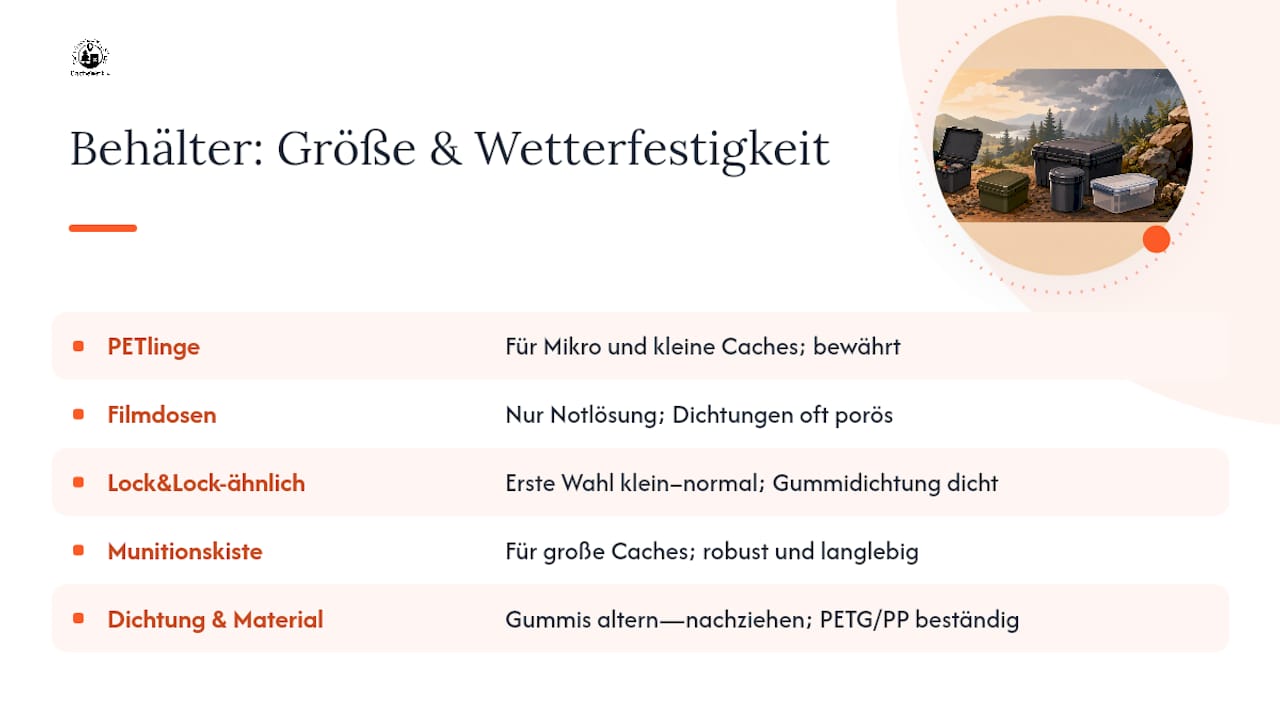
When it comes to the seal, a second look is worthwhile: original rubber gaskets age due to UV radiation and frost, so you should regularly re-tighten or treat them with silicone. An additional inner liner, such as a zip-lock bag around the logbook, catches residual moisture even if the outer seal weakens.
Material also plays a role. PETG and polypropylene resist UV light, frost, and, on the coast, even salt air significantly better than simple household plastic. This is why many owners now rely on 3D-printed PETG containers instead of improvised boxes from the supermarket.
Suitable containers and spare parts are available in Germany through specialized geocaching shops, hardware stores for standard boxes, or directly from CacheWerk.
Pro-Tip: Put together a small repair kit: spare seals, water-repellent grease for the rubber rings, and a mini spare logbook. With this, you can repair a damaged hide on site in a few minutes.
Step-by-Step: Creating a Weatherproof Cache
Before you set off, pack a small tool bag: container, spare logbook, waterproof pen, silicone or sealing grease, and a GPS-enabled marker for the coordinates.
- Select container and check for cracks or porous seals
- Pack logbook in a zip-lock bag or small protective cover
- Insert inner liner, such as a second, smaller box or foil
- Check seal, re-tighten with silicone if necessary
- Prepare camouflage at the destination, suitable for the environment
- Final placement and last visual check from multiple angles
Before the actual hiding, a quick checklist is worthwhile: re-check the condition of the container, measure coordinates, take a photo for the reviewer, and note the first maintenance date directly in your calendar. This checklist for cache hiders typically shortens the approval time because reviewers less often have to ask for more information.
For simple, quick sealing, silicone beads on the edges, a heat-shrink tube over lid transitions, or simply a double container as weather protection are suitable.
Pro-Tip: Test the seal at home before hiding: fill the container with some paper towels, briefly hold it under running water, and check the paper. Dry remains key.
Location Selection and Camouflage: Urban or Nature?
Urban hides thrive on inconspicuousness; they are situated in everyday life and must withstand muggle glances. Nature-based hides, however, contend with weather, animals, and denser vegetation, where stable camouflage and weather resistance are paramount.
Where possible, use surrounding materials for camouflage and consider the sightline: what disappears behind dense foliage today often lies completely exposed in winter. This seasonal visibility is one of the most common reasons why well-intentioned hides are later mugged.
A few fixed rules apply:
- No nails or screws in living trees; this permanently damages the tree
- No exposed "presenter plate," i.e., no hide that everyone immediately sees
- Small content instead of valuable trade items; this reduces the risk of theft
- Prefer inconspicuous mounting, e.g., with zip ties instead of visible brackets
Pro-Tip: Visit your location once in different weather or at a different time of day before publishing the listing. What appears perfectly camouflaged in summer can stand out like a lighthouse in winter.
How to Measure Coordinates Correctly?
Accurate coordinates determine whether finders are frustrated or satisfied. Measure the position multiple times from different directions and calculate an average; many GPS devices offer a direct function for averaging the position, as described by the Opencaching-Wiki.
- Wait for calm GPS reception; clear line of sight to the sky helps enormously
- Measure directly at the hide, not from several meters away
- If possible, have a second cacher beta-test the coordinates
- Document photos and hints for the reviewer clearly in the listing
Pro-Tip: A beta test only costs one additional trip but saves you weeks of correction logs from frustrated finders.
Maintenance, Typical Problems, and How to Prevent Them
Community recommendations and attentive observation of logs suggest a maintenance interval of three to six months, especially for outdoor hides. You should never ignore "Needs Maintenance" logs; they are the most direct warning signal from the community.
You probably already know about typical problems: leaky containers, mold in the logbook, displaced containers due to curious animals, or sudden visibility after leaf fall.
During each maintenance visit, this quick check is worthwhile:
- Leak test with paper towel or by checking for condensation
- Check logbook condition; replace immediately if moist
- Renew camouflage or adapt to the season
- Spot-check coordinates
- Carry an emergency kit: spare logbook, baggies, spare seal
- Immediately dry damp spots, don't just replace the logbook
- For recurring problems, fundamentally change the container type
Pro-Tip: Set a fixed date in your calendar, e.g., quarterly, instead of hoping for random visits. Regularity almost always beats spontaneity when it comes to cache maintenance.
What Rules and Nature Conservation Regulations Apply?
Before hiding, it's worth checking the official guidelines; reviewers check every listing for accessibility, local permits, and environmental compatibility.
A few basic principles apply practically everywhere:
- No nails or screws in living trees; zip ties are the safer alternative
- No burying without explicit permission from the landowner
- Maintain sufficient distance from protected habitats and sensitive vegetation
- Consider breeding seasons and sensitive nature reserves
Also, place your cache within easy reach of your home. This community recommendation sounds trivial, but it is probably the most important reason why some caches remain impeccably maintained for years while others become neglected after just months.
Recommended Solutions Available in Germany
For small to normal caches, Lock&Lock-style boxes remain the solid standard: affordable, airtight, and easy to replace. More demanding hides benefit from 3D-printed PETG specialty containers, precisely tailored to the location and camouflage. For large caches in the forest, the ammo can remains the most robust choice.
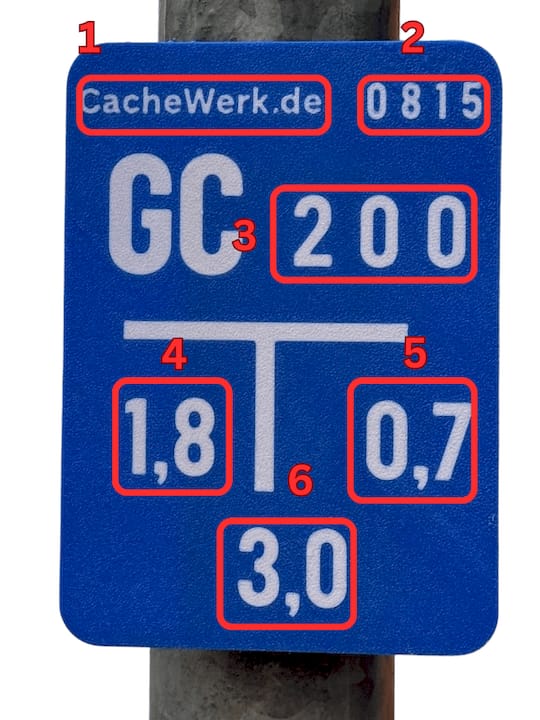
In urban areas, a ready-made camouflage concept is worthwhile instead of DIY. The Fake Water Shield from CacheWerk disappears inconspicuously into the cityscape with a post holder, as does the Fake Traffic Sign as an urban camouflage hide. Both are designed for longevity and are directly available in Germany, including spare parts such as seals and spare logbooks.
- Urban, high muggle factor: Fake Water Shield or Fake Traffic Sign
- Forest, high humidity: PETG container or ammo can
- Coast, salt air and UV: Prefer PETG, check seals more frequently
Pro-Tip: Combine an urban camouflage sign with a small PETG inner container. This way, the logbook remains dry even if the outer shell gets damaged.
Owner's Perspective: What Really Matters
The most expensive container is useless if no one checks it. Those who take beta tests seriously and read community logs attentively prevent most problems before they even arise. Maintenance beats material cost, always.
Ready-Made Camouflage Hides Directly from CacheWerk
For those who want to save themselves the hassle of crafting, CacheWerk offers ready-made solutions developed precisely for this purpose. The Fake Water Shield and the Fake Traffic Sign are both urban camouflage hides with post holders that remain practically invisible in the cityscape, without hours of DIY work on your own camouflage.
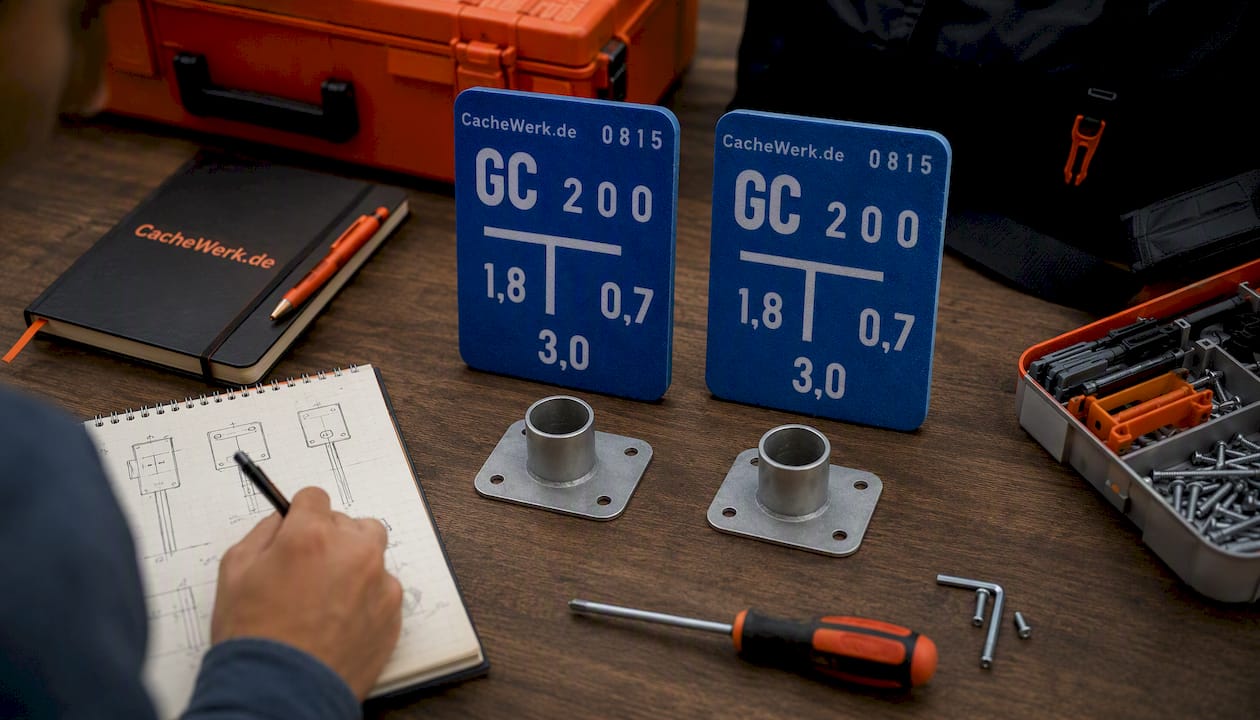
Both products come from CacheWerk's own range and are intended as ready-made solutions, not as neutral external recommendations. Those who value an customizable design will find it in the customizable Fake Water Shield; those who prefer a classic sign format will find what they're looking for in the Fake Traffic Sign. Matching spare seals and replacement logbooks are available in the shop, so your hide remains ready for use even after months of deployment. Check out both product pages and choose the variant that suits your location.
Sources
Those looking for digital instructions on emptying a browser cache will land on a different topic; there, it's about software, not physical hides in the forest or city.