
Why Collective Outdoor Adventures Change You
Collective outdoor adventures are shared nature experiences where groups build social bonds and find mental rejuvenation through shared challenges, physical activity, and exploration. Whether it's geocaching with friends, hiking with family, or outdoor team-building, studies show that these experiences achieve far more than individual activities. A 2026 travel survey by Marbach Academy reveals that 58% of travelers cite shared time as the most impactful element of their vacation. This is no coincidence. Those who understand why collective outdoor adventures are so effective can plan more consciously and experience more.
Why Collective Outdoor Adventures Strengthen Social Bonds
Shared nature experiences promote prosocial behavior with a medium effect size of Hedges’ g=0.46, as evidenced by a meta-analysis of 29 studies and 4,520 participants. This means that even brief contact with nature in a group measurably increases cooperation, helpfulness, and generosity. These effects are observed regardless of age, culture, or activity type.
Why is this the case? Nature reduces sensory overload and creates space for genuine attention to one another. In a group on a hiking trail or geocaching in a park, the pressure of screens and deadlines disappears. Instead, spontaneous conversations, collaborative problem-solving, and shared successes emerge.
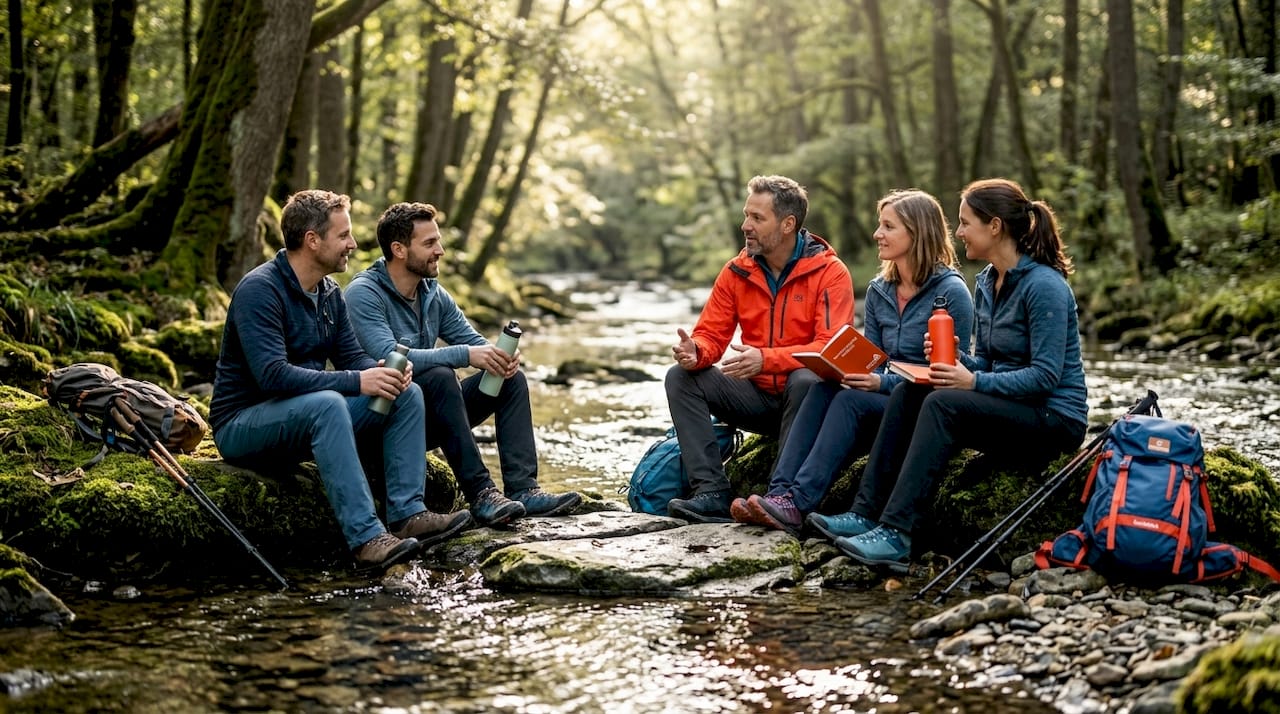
Contact with nature stabilizes social relationships, especially during collective activities, because the group, as a social system, benefits from the environment. Individuals open up more quickly when the context is relaxed and the task is clear. This is precisely what group adventures in nature offer.
The experience becomes particularly effective when you deliberately design the group structure. The following elements demonstrably enhance social effects:
- Clear roles within the group (e.g., navigator, record-keeper, time-keeper)
- Joint reflection sessions after the experience to share impressions
- Alternating leadership so everyone takes responsibility
- Conscious transition phases such as a joint briefing before starting
Pro Tip: After each group activity, schedule five minutes for a brief reflection session. Ask: "What worked well today?" This simple question deepens bonds more than the experience alone.
Shared time is better remembered when transitions and reflections are also consciously designed. Arrival, briefing, and debriefing are not trivial matters. They are the glue that turns group moments into lasting memories.
How do group nature experiences improve mental health?
Nature-based interventions reduce tension with a standardized mean difference of SMD -0.87, as shown by an umbrella review of 344 studies. At the same time, overall well-being increases by SMD 0.4. These figures are impressive, but they come with an important caveat: the quality of evidence varies, and results cannot be generalized to all groups.
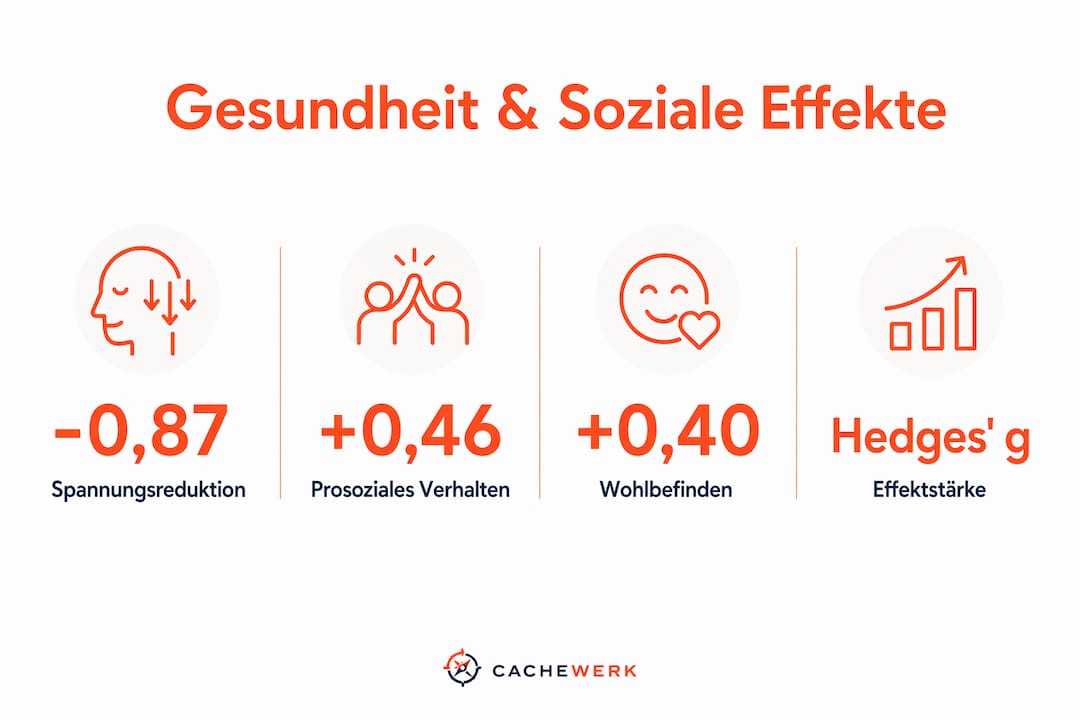
What this means for you: Group outdoor experiences are effective, but they are not a substitute for professional support in serious mental health conditions. However, as a preventive measure and for stress management, they are well-documented and practically implementable.
| Effect | Measure | Significance for groups |
|---|---|---|
| Tension Reduction | SMD -0.87 | Significant relaxation after contact with nature |
| Well-being | SMD +0.4 | Positive affect measurably increases |
| Stress Recovery | Faster than indoor activities | Outdoor sports accelerate regeneration |
| Risk of common diseases | Reduced by regular outdoor sports | Long-term health benefits |
Outdoor sports reduce the risk of common diseases and promote faster recovery from stress, as analyzed by AOK based on 133 European studies. This is even more true for groups, as social support further dampens physiological stress responses. Those who are active outdoors with others recover faster than alone.
Positive affect, meaning feelings of joy and energy, increases especially when the experience is socially embedded. A walk alone is effective. A walk with friends where you search for a geocache together or explore a new route is significantly more effective. The group amplifies the nature effect.
To be transparent: the evidence strength of nature-based effects is promising, but not equally robust for all population groups. Those who are regularly active outdoors benefit the most. One-off excursions help, but only regularity leads to sustainable changes.
What role does flow play in outdoor experiences for teams?
Flow is the psychological state of complete concentration and enjoyment of a task, where time and self-awareness fade into the background. A 2026 study in BMC Psychology with 501 outdoor participants shows that flow strongly mediates the positive effect of adventurousness on event satisfaction: the indirect effect is β=0.68, while the direct effect is only β=0.21. Thus, flow is the decisive mechanism, not adventurousness alone.
This explains why some group outings become unforgettable while others, despite beautiful scenery, remain uninspiring. When the challenge matches the group's ability, flow occurs. If the task is too easy, boredom sets in. If it's too difficult, frustration arises.
For outdoor experiences for teams, this means that planning the difficulty level is just as important as choosing the location. The following steps help you foster flow in the group:
- Assess skills: Ask the group about their experience and fitness beforehand to choose the right level.
- Set clear goals: A concrete goal (e.g., "Today we'll find five geocaches") provides orientation and focus.
- Gradually increase challenge: Start with easier tasks and increase complexity as you go.
- Minimize distractions: Put away phones, except for navigation. Full presence promotes flow.
- Celebrate successes: Short moments of shared joy after achieving goals reinforce the flow experience.
Pro Tip: With geocaching, the difficulty can be precisely controlled: choose caches with D/T ratings that match the group. Beginners start at D1/T1, experienced groups can aim for D3/T3. This keeps the flow channel open.
Flow is a key mechanism for satisfaction in outdoor group adventures. Those who consciously plan for it create experiences that will be talked about for years to come. And that is precisely the goal of collective adventures.
Together or alone outdoors: What really makes the difference?
Individual outdoor experiences have their value. Those who hike alone find silence, self-reflection, and personal freedom. But collective adventures offer something that no solo trip can replace: shared memories that permanently strengthen social bonds.
| Feature | Group Activity | Individual Activity |
|---|---|---|
| Social Bonding | Strong, through shared experiences | Low, no social interaction |
| Mental Recovery | High, enhanced by group effect | High, but individually limited |
| Flow Potential | High with good planning | Dependent on self-motivation |
| Memory Value | Very high (58% cite shared time) | Medium, less socially anchored |
| Flexibility | Lower, coordination needed | High, spontaneously possible |
The strengths of both forms can be combined. Many successful group formats incorporate individual freedom: everyone explores a section alone, and the group meets at the destination. This creates both personal experience and shared memory simultaneously.
What makes group activities special are the moments between the activities. The laughter over a wrong turn, the shared break with a view of the valley, the celebration of a found cache. These moments only arise in a group and are what make shared time so impactful.
Advantages of group outdoor activities over individual experiences:
- Social support in difficulties increases perseverance
- Shared joy measurably amplifies positive emotions
- Group planning leads to more varied routes and destinations
- Mutual motivation reduces dropout rates in bad weather
For families, it's worth looking at group travel advantages, which show how shared adventures strengthen family bonds in the long term. The key lies in conscious design: not just setting off together, but planning, experiencing, and reflecting together.
Key Takeaways
Collective outdoor adventures strengthen social bonds, improve mental health, and create flow states that significantly increase satisfaction and memorable value.
| Point | Details |
|---|---|
| Prosocial Effect | Nature contact in groups increases cooperation and helpfulness with Hedges’ g=0.46. |
| Mental Health | Nature-based group activities measurably reduce tension (SMD -0.87). |
| Flow as Key | Flow mediates satisfaction in outdoor events more strongly than adventurousness alone (β=0.68). |
| Memory Value | 58% of travelers cite shared time as the most impactful experience element. |
| Conscious Design | Roles, reflections, and tailored challenges maximize social and psychological effects. |
My experience with collective adventures in nature
For years, I've observed how groups experience outdoor activities, and one thing always strikes me: most underestimate the power of preparation. Everyone wants to get out, but few think about how the experience should be structured to truly connect people.
Research confirms what I see in practice. A group that simply sets off has fun. A group that assigns clear roles, plans together, and reflects at the end builds real bonds. The difference isn't the location or the activity. The difference is the social process.
What particularly convinces me about geocaching as a group format is that it inherently provides structure. There's a goal, a challenge, a moment of shared success. And it can be adapted for any group, from children to experienced outdoor enthusiasts. Those who want to build creative geocaches also find a creative outlet for their own group.
My honest advice: Stop viewing outdoor adventures as just a leisure activity. Treat them as a social process with a beginning, middle, and end. Then outings will become experiences that truly last.
— Benedikt
Geocaching Equipment for Unforgettable Group Adventures
Shared outdoor adventures need the right tools to truly excite. Cachewerk offers specialized geocaching equipment that elevates group activities to a new level.
Whether you're exploring as a family, group of friends, or a team: with high-quality geocaching hiding spots and accessories from Cachewerk, you'll create adventures that leave a lasting impression. For particularly creative group moments, take a look at the special hiding spots, including 3D-printed PETG items and custom camouflage solutions for urban and rural environments. Each product is designed to make your shared experience more exciting, durable, and unforgettable.
FAQ
What exactly are collective outdoor adventures?
Collective outdoor adventures are shared activities in nature where groups build social bonds through shared experiences. Typical forms include hikes with friends, geocaching tours, or outdoor team-building events.
Why are group adventures better than individual activities?
Group activities create stronger memories and prosocial effects because social interaction enhances the nature effect. According to Marbach Academy 2026, 58% of respondents name shared time as the most impactful experience element.
How does geocaching promote flow in groups?
Geocaching offers clear goals and adaptable difficulty levels that keep the flow channel open for groups. Studies show that flow indirectly mediates the effect of adventurousness on satisfaction with β=0.68.
What are the health benefits of outdoor experiences for teams?
Nature-based group activities reduce tension (SMD -0.87) and increase well-being (SMD +0.4), as evidenced by an umbrella review of 344 studies. Outdoor sports also reduce the risk of common diseases and accelerate stress recovery.
How do I plan a collective outdoor adventure correctly?
Assign clear roles, choose a challenge appropriate to the group's level, and plan a reflection session at the end. These three elements maximize social bonding, flow experience, and the memorable value of the shared adventure.