
Pourquoi le géocaching en équipe augmente le succès et le plaisir
Beaucoup considèrent le géocaching comme une activité individuelle ou pour de petits couples, mais cette vision sous-estime l'énorme potentiel des aventures en équipe. Le géocaching en équipe favorise le travail d'équipe, la communication et la motivation par la résolution collaborative de problèmes et l'exploration d'une manière que les joueurs solitaires ne connaîtront jamais. Les équipes ne découvrent pas seulement les caches plus rapidement, mais développent également des liens interpersonnels plus solides et améliorent durablement leur collaboration. Cet article explique pourquoi le géocaching en groupe augmente considérablement le succès et le plaisir, et comment optimiser ces avantages.
Table des matières
- Points clés à retenir
- Comment le géocaching en équipe favorise la communication et la motivation
- Méthodologie et organisation : tailles d'équipe idéales et déroulement d'un événement de géocaching
- Défis spéciaux et conseils d'experts pour les équipes avancées
- Conseils pratiques pour équiper des caches de géocaching de qualité pour les équipes
- Découvrez du matériel de haute qualité pour votre équipe de géocaching
- Foire aux questions
Points clés à retenir
| Point | Détails |
|---|---|
| Le travail d'équipe renforce la résolution de problèmes | La résolution collaborative d'énigmes permet d'utiliser diverses perspectives et d'obtenir des solutions plus rapides et plus créatives. |
| Taille d'équipe idéale : quatre à six personnes | La taille de groupe optimale permet la participation active de tous les membres et évite la passivité ainsi que la division en sous-groupes. |
| Équipement spécialisé utile | L'équipement spécialisé augmente la sécurité et l'efficacité des expéditions conjointes et facilite la découverte des caches. |
| Approche coordonnée sur le terrain | En terrain difficile, les membres de l'équipe doivent travailler en étroite collaboration, communiquer et utiliser les rôles de manière flexible. |
Comment le géocaching en équipe favorise la communication et la motivation
La résolution collaborative d'énigmes lors d'une sortie géocaching crée une dynamique unique qui renforce naturellement les compétences de communication. Chaque membre de l'équipe apporte des perspectives différentes lorsqu'il s'agit de déchiffrer des indices cryptés ou d'interpréter des coordonnées cachées. Cette diversité d'approches conduit souvent à des solutions plus rapides et plus créatives que celles obtenues par des joueurs solitaires.
La motivation augmente de manière exponentielle lorsque les équipes célèbrent ensemble leurs succès. Une cache difficile, trouvée après une collaboration intense, génère un sentiment de communauté qui perdure bien au-delà de l'instant présent. Les débutants bénéficient de l'expérience des membres d'équipe plus avancés, tandis que les experts approfondissent leurs compétences en expliquant et en guidant.
Principaux avantages de la communication en bref :
- L'écoute active devient une nécessité lorsque différents indices doivent être combinés
- Des instructions claires émergent naturellement lors de la navigation en terrain inconnu
- Un feedback constructif se développe lors de l'expérimentation de différentes approches de résolution
- Les signaux non verbaux prennent de l'importance dans des environnements bruyants ou étendus
Les événements d'équipe créent une dynamique positive qui se répercute directement sur le quotidien professionnel. La répartition optimale des rôles dans les équipes de géocaching permet à chaque membre d'apporter ses forces tout en développant de nouvelles compétences. Navigateur, expert en énigmes, documentariste et motivateur se complètent pour former un organisme fonctionnel.
« La recherche commune de trésors cachés soude les équipes comme peu d'autres activités. Chaque succès appartient au groupe, chaque défi est relevé ensemble. »
Des études sur les avantages du teambuilding par le géocaching prouvent que l'activité physique combinée aux défis mentaux améliore mesurablement la cohésion de groupe. Les équipes signalent une productivité accrue et une meilleure résolution des conflits après des sessions régulières de géocaching. L'environnement extérieur réduit le stress et crée un espace neutre où les hiérarchies sont temporairement abolies.
Méthodologie et organisation : tailles d'équipe idéales et déroulement d'un événement de géocaching
La taille d'équipe idéale de 4 à 6 personnes s'est avérée optimale dans la pratique. Les groupes plus petits permettent à chaque membre une participation active, tandis que les équipes plus grandes se divisent souvent en observateurs passifs et participants actifs. Avec six personnes, des sous-groupes peuvent se former spontanément pour tester différentes approches de résolution en parallèle.
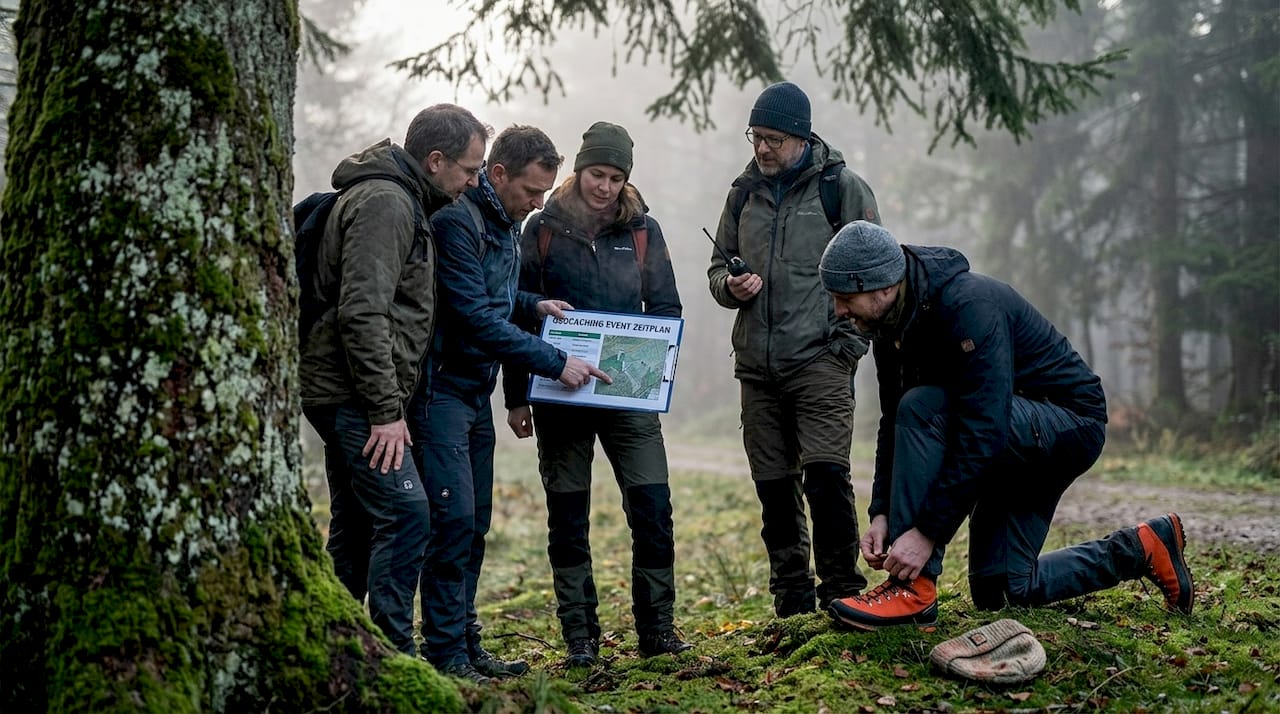
Un événement de géocaching typique dure entre deux et quatre heures, selon la difficulté et la nature du terrain. Cette durée offre suffisamment d'espace pour plusieurs caches sans risquer l'épuisement physique. Les organisateurs professionnels prévoient un temps de réserve supplémentaire pour les défis imprévus.
Déroulement structuré d'un événement de géocaching réussi :
- Introduction et briefing de sécurité (15-20 minutes) avec explication des appareils GPS et des règles de base
- Formation d'équipe et répartition des rôles (10 minutes) basée sur les forces individuelles
- Première phase d'énigmes (30-45 minutes) avec des défis plus simples pour se familiariser
- Navigation principale (60-90 minutes) avec plusieurs étapes intermédiaires et une difficulté croissante
- Résolution finale (20-30 minutes) avec discussion de groupe sur les stratégies et les découvertes
- Session de feedback (15 minutes) pour la réflexion sur la dynamique d'équipe
| Taille de l'équipe | Avantages | Défis | Durée recommandée |
|---|---|---|---|
| 2-3 personnes | Décisions rapides, communication intense | Diversité limitée des perspectives | 1,5-2 heures |
| 4-6 personnes | Équilibre optimal, compétences diverses | L'effort de coordination augmente | 2-4 heures |
| 7-10 personnes | Haute énergie, beaucoup d'idées | Risque de participants passifs | 3-5 heures |
| 10+ personnes | Grands événements possibles | Division en petites équipes nécessaire | Journée entière |
Conseil de pro : Les petites équipes de quatre personnes favorisent un engagement maximal, car chaque membre devient indispensable. La répartition optimale des rôles se fait souvent de manière organique au cours des 30 premières minutes, mais doit être activement modérée si nécessaire.
La supervision optionnelle par des guides expérimentés augmente la sécurité, en particulier sur les terrains difficiles ou pour les équipes inexpérimentées. Ces accompagnateurs n'interviennent qu'en cas de besoin et laissent les équipes travailler de manière autonome. Les consignes de sécurité doivent couvrir des sujets tels que les conditions météorologiques, les zones dangereuses et les contacts d'urgence.
Le déroulement structuré des événements d'équipe tient compte de la fatigue physique et mentale. Les pauses sont stratégiquement planifiées après des phases intenses d'énigmes ou de navigation. Les postes de ravitaillement peuvent être conçus comme des caches supplémentaires pour combiner fonctionnalité et plaisir de jeu.
Défis spéciaux et conseils d'experts pour les équipes avancées
Les caches T5 représentent le niveau de difficulté le plus élevé et nécessitent des compétences spécialisées comme l'escalade, la plongée ou un équipement technique. Ces défis extrêmes sont pratiquement impossibles à relever sans un travail d'équipe coordonné. Un membre de l'équipe sécurise pendant qu'un autre grimpe, un troisième documente et un quatrième navigue.
Les courses de qualification comme le Championnat de géocaching avec 41 équipes participantes montrent comment la compétition élève les performances d'équipe à un nouveau niveau. La planification stratégique devient aussi importante que les capacités physiques. Les équipes doivent décider quelles caches prioriser et comment utiliser leurs ressources de manière optimale.
L'entretien régulier des caches que l'on a soi-même placées assure leur succès et leur réputation à long terme au sein de la communauté. Les équipes qui placent leurs propres caches assument la responsabilité de leur état. Des conteneurs endommagés, des carnets de bord illisibles ou des chemins d'accès envahis frustrent les autres joueurs et nuisent à sa propre réputation.
| Type de défi | Compétences d'équipe requises | Préparation recommandée | Facteurs de risque |
|---|---|---|---|
| Caches T5 d'escalade | Techniques d'assurage, confiance | Entraînement d'escalade, vérification de l'équipement | Hauteur, météo |
| Caches aquatiques | Natation, plongée, étanchéité | Test de conteneurs étanches | Courant, froid |
| Caches nocturnes | Orientation dans le noir, patience | Lampes de poche, matériel réfléchissant | Visibilité, animaux sauvages |
| Caches à énigmes | Logique, créativité, recherche | Résoudre des énigmes d'entraînement | Pression du temps, frustration |
| Multicaches | Endurance, navigation, planification | Planification d'itinéraire, gestion du temps | Distance, épuisement |
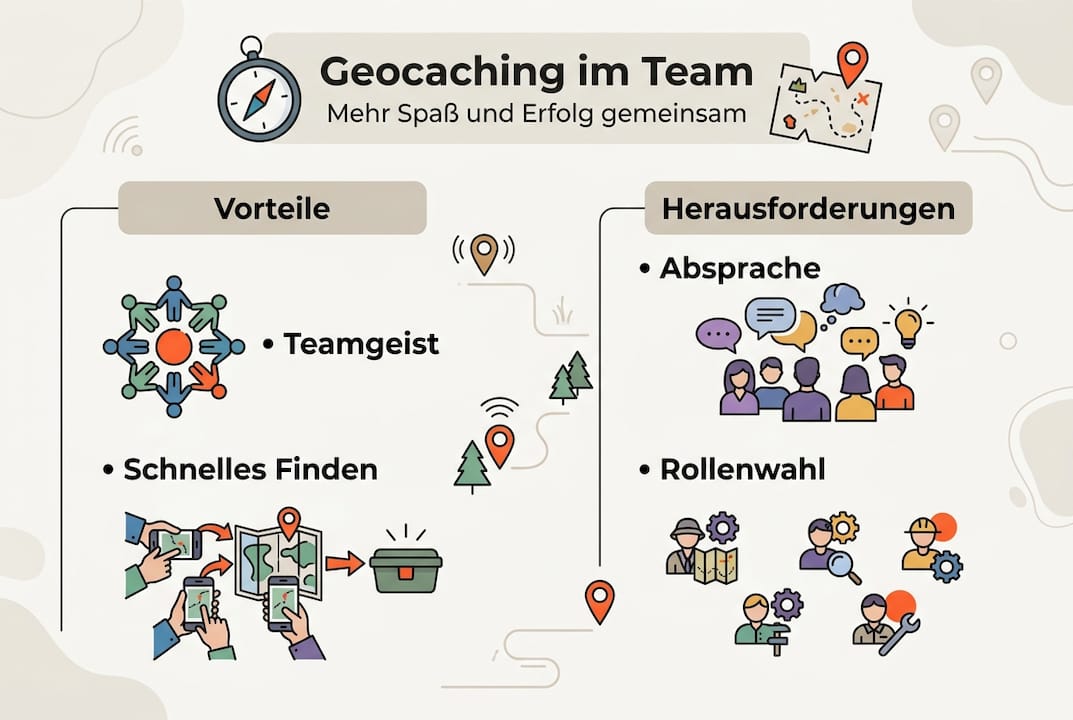
Conseil de pro : Des rôles spécialisés comme responsable de la sécurité, gestionnaire de l'équipement et chronométreur aident à relever les défis exigeants. La répartition optimale des rôles doit être explicitement discutée et documentée avant les excursions difficiles.
Les équipes avancées développent leurs propres systèmes de communication pour les environnements bruyants ou étendus. Les signes manuels, les radios ou les signaux sonores convenus permettent des actions coordonnées même sans visibilité directe. Ces systèmes deviennent une seconde nature grâce à un entraînement régulier.
La motivation au sein de l'équipe de géocaching reste élevée même en cas de revers si des objectifs clairs sont fixés et que les succès intermédiaires sont célébrés. Les équipes doivent formuler des attentes réalistes et ne pas se concentrer exclusivement sur le résultat final. Le chemin est souvent plus précieux que la destination, surtout lors de défis complexes de plusieurs jours.
Les équipes axées sur la compétition analysent systématiquement les excursions passées pour identifier les points faibles. Quelles décisions ont coûté du temps ? Où une meilleure communication aurait-elle pu aider ? Cette réflexion transforme chaque excursion en une opportunité d'apprentissage et accélère considérablement le développement de l'équipe.
Conseils pratiques pour équiper des caches de géocaching de qualité pour les équipes
Des conteneurs étanches et durables constituent la base de toute cache réussie. Les boîtes en plastique bon marché cèdent après quelques mois d'exposition aux intempéries, tandis que les produits de haute qualité assurent l'attractivité et la durabilité pendant des années. Les équipes devraient investir dans des conteneurs qui résistent à plusieurs cycles de gel-dégel et qui sont résistants aux UV.
Les caches spéciales individuelles augmentent le facteur plaisir de manière exponentielle. Une cache camouflée en souche d'arbre, en pierre ou en dispositif technique exige un sens de l'observation et récompense la créativité. Ces caches sont particulièrement appréciées dans la communauté et génèrent des évaluations positives, qui à leur tour attirent plus d'équipes.
Caractéristiques essentielles de l'équipement pour les caches d'équipe :
- Les joints toriques garantissent une étanchéité absolue même pour les caches sous-marines
- Les matériaux stabilisés aux UV évitent la fragilisation et la décoloration sur plusieurs années
- Une taille suffisante pour le carnet de bord et de petits objets d'échange motive à l'interaction
- Les marquages compatibles GPS facilitent la localisation de précision dans les zones densément végétalisées
- Les fixations magnétiques permettent des caches urbaines sur des structures métalliques
Les aspects de sécurité sur les terrains difficiles ne doivent jamais être négligés. Les caches dans les zones d'escalade ne doivent être placées que par des personnes ayant une formation appropriée. Des avertissements dans le listing informent les autres équipes des risques particuliers et de l'équipement requis.
L'entretien et le contrôle réguliers des caches sont recommandés au moins trimestriellement. Les équipes doivent tenir un calendrier d'entretien et attribuer clairement les responsabilités. Une cache négligée nuit non seulement à sa propre réputation, mais aussi à l'image de toute la communauté de géocaching.
Le choix de l'équipement et des accessoires de géocaching doit tenir compte des exigences spécifiques du terrain. Les caches urbaines nécessitent des matériaux différents de ceux des caches forestières. Le camouflage ne fonctionne que s'il correspond à l'environnement ; une cache en forme de souche d'arbre paraît déplacée sur un parking.
Les équipes qui placent leurs propres caches doivent tester le site de découverte plusieurs fois depuis différentes directions. Ce qui semble parfaitement camouflé d'une perspective peut être évident d'un autre côté. Plusieurs paires d'yeux détectent de telles faiblesses avant la publication officielle.
Les matériaux de qualité justifient leur prix plus élevé par des coûts d'entretien considérablement réduits. Un conteneur robuste qui dure cinq ans est plus économique que cinq boîtes bon marché qui doivent être remplacées chaque année. Ce calcul s'applique particulièrement aux caches difficilement accessibles, où chaque entretien représente un effort considérable.
Découvrez du matériel de haute qualité pour votre équipe de géocaching
Maintenant que vous connaissez les nombreux avantages et méthodes du géocaching en équipe, il est clair que le bon équipement est crucial pour des aventures réussies. CacheWerk propose des produits spécialement adaptés aux équipes, qui élèvent vos explorations communes à un nouveau niveau.
Notre équipement de géocaching de haute qualité a été développé par des géocacheurs expérimentés et testé dans des conditions extrêmes. Les caches spéciales durables augmentent non seulement le plaisir du jeu, mais réduisent également considérablement les efforts d'entretien. Notre cache de géocaching Faux panneau de signalisation est particulièrement populaire auprès des équipes, car elle camoufle parfaitement les caches urbaines tout en restant résistante aux intempéries. Avec le bon équipement, chaque aventure en équipe devient plus sûre, plus passionnante et plus durable.
Foire aux questions
Pourquoi le géocaching en équipe est-il utile ?
Le géocaching en équipe favorise naturellement la communication, la résolution de problèmes et les liens sociaux. Les défis communs renforcent la cohésion et créent des expériences de réussite que les joueurs solitaires ne connaissent pas.
Combien de personnes devraient faire partie de l'équipe ?
La taille d'équipe idéale est de 4 à 6 personnes pour une dynamique et une communication optimales. Les petits groupes permettent une participation active de tous les membres, tandis que les grandes équipes se divisent souvent en participants passifs et actifs.
Quel équipement est recommandé ?
Des conteneurs étanches avec des joints toriques, des matériaux stabilisés aux UV et des marquages compatibles GPS constituent la base. Les caches spéciales comme les conteneurs camouflés augmentent considérablement le plaisir et la durabilité.
Y a-t-il des défis spécifiques en équipe ?
Les caches T5 nécessitent un travail d'équipe coordonné avec des rôles spécialisés tels que sécurisateur, grimpeur et navigateur. Les courses de qualification et les compétitions testent la planification stratégique en plus des capacités physiques.
Qu'est-ce qui rend le géocaching en équipe spécial ?
La combinaison de l'activité physique, des énigmes mentales et de l'interaction sociale dans un environnement naturel crée des expériences de groupe uniques. Les équipes développent des compétences qui se répercutent directement sur le quotidien professionnel et les relations personnelles.