
Definition of a Cache Magnet: Clearly Explained
Many geocachers stumble upon the term “cache magnet” and are unsure what exactly it means. Does it refer to a cache that magnetically adheres to a surface? Or a mechanism that uses magnets to control puzzles? This ambiguity is common, and it costs you valuable time when designing clever hiding spots. The definition of a cache magnet is intentionally not uniformly fixed. In practice, it is used for a wide variety of magnet-based mechanisms. This article clears up the most common misunderstandings and shows you how to use this knowledge directly to create better cache designs.
Table of Contents
- Key Takeaways
- Cache Magnet Definition and Basic Principle
- Technical Mechanisms and Principles of Operation
- Hiding Strategies with Cache Magnets
- Comparison of Different Cache Magnet Variants
- Common Mistakes and Practical Tips
- My Experiences with Cache Magnets
- Try Cachewerk's Magnetic Hides
- FAQ
Key Takeaways
| Point | Details |
|---|---|
| Cache magnet is not a standard term | The term describes magnet-based interactions in geocaches, not a single fixed technique. |
| Two main categories exist | Magnetic latches (camouflage) and magnetically controlled puzzles (coding) serve different purposes. |
| Magnet strength and placement are crucial | Incorrect magnet configuration leads to unintended triggers or functional failures. |
| Camouflage and function can be combined | Magnetic screw hides combine visual blending with an access mechanism in one element. |
| Puzzle complexity can be increased | Proximity and sequence coding with magnets creates interactive experiences for seekers. |
Cache Magnet Definition and Basic Principle
The term “cache magnet,” as practice shows, is not a uniformly defined technical term. The designation ranges from a simple magnetic latch to complex sensor-based puzzles with diverse mechanics. The established umbrella term in the maker and geocaching community is magnet-based interaction, meaning any form of control, locking, or puzzle solving that relies on magnetic force.
A clear cache magnet explanation therefore begins with a distinction:
- Magnetic containers: The cache itself adheres magnetically to a metallic surface. No active mechanism, just passive attachment. This type is the most common and at the same time the simplest.
- Magnetic latches: A magnet in the cache body opens or closes a clasp as soon as a second magnet is nearby. The magnetic screw lock is a good example: The screw head contains a magnet, the shaft hides the logbook.
- Magnetically controlled puzzle mechanisms: Magnets control electronic switches or mechanical elements. Opening, lighting, or unlocking only occurs with correct magnet interaction.
- Proximity sensing: A magnetic switch detects the proximity of a magnet and triggers an action without direct contact.
So what exactly is a cache magnet? Most accurately, it is described as a geocache or cache element where magnetic force is actively used to control a function. The mere magnetic attachment of a nano cache to a lamppost does not, in the stricter sense, count.
Pro Tip: If you build caches yourself, this distinction will help you immediately: If you call your cache a “cache magnet,” explicitly describe what kind of magnetic mechanism you use in the listing text. This saves seekers confusion and increases the quality of your ratings.
Technical Mechanisms and Principles of Operation
The technical core of a cache magnet lies in the relationship between the magnet and the switch or latch. Understanding this allows for precise and error-free designs.
-
Reed switches as triggers: The most common switch type in gadget caches is the reed switch. It consists of two metallic contacts in a glass tube and closes the circuit as soon as a magnet comes close. When the magnet is removed, the contact opens again. This technique is inexpensive, reliable, and weather-resistant.
-
Sequence coding with multiple switches: In the well-known Magic Blocks gadget cache, four blocks with magnetic switches are combined so that a digit only lights up if the blocks are placed next to each other in the correct order. This prevents random solutions and makes the cache a real puzzle.
-
Proximity coding through targeted magnet placement: The magnet-switch logic precisely determines when an action is triggered. Precise placement of magnet and switch reliably prevents false alarms. A switch that is too close to the outer wall will react to foreign magnets in the vicinity. A switch placed too far away will not react at all.
-
Magnetic latches without electronics: Not all cache magnet mechanisms require power. A simple magnetic latch uses the attractive or repulsive force of two magnets to lock or release a lid. No battery, no electronics. Low maintenance and robust, even for outdoor use.
-
Polarity-dependent triggering: Some designs only react to a magnet with a specific pole orientation. This significantly increases security against accidental discovery, as seekers must hold the magnet with the correct side.
Pro Tip: For outdoor gadget caches, use encapsulated or sealed reed switches. Moisture is the greatest enemy of switch mechanisms in the field. An encapsulated switch will survive even winter months without problems.
Magnetic proximity and sequence coding offer one of the few ways to bring true interactivity to a geocache without seekers being able to simply guess.
Hiding Strategies with Cache Magnets
Using cache magnets in your hiding strategy opens up options that other cache types simply do not offer. This is not just about technology, but about the experience you create for seekers.

The magnetic screw head is the classic example of successful visual cloaking combined with magnetic function: The screw looks like an ordinary screw on a railing or wall. The magnet in the head holds a second magnet or opens the hollow shaft when a seeker applies the correct magnet. Muggles pass by unnoticed.
What you can use cache magnets for:
- Camouflage through integration: Magnetic screw hides, bolts, or rivets blend visually into metallic environments. They don't stand out because they look like normal fastening material.
- Increasing puzzle complexity: A magnetic switch as part of a numerical combination forces seekers to think actively, not just search. This makes your cache stand out from the crowd.
- Creating a moment of surprise: When a seeker applies a magnet and suddenly a flap pops open or an LED lights up, the "aha!" moment is guaranteed. Such experiences generate enthusiastic logs.
- Security against Muggles: Magnetic mechanisms are hardly recognizable as such for non-geocachers. A cache that can only be opened with a magnet remains secure even in busy cities.
- Interaction with adjacent cache elements: Multiple magnetic components can be designed to react to each other. Seekers, for example, must hold two elements simultaneously in the correct position.
Pro Tip: Do not place magnetic caches directly next to other magnetic objects such as metal railings or magnetic signs. Unwanted magnetic fields in the vicinity can trigger or block your mechanism even before a seeker arrives.
Comparison of Different Cache Magnet Variants
Not every magnet-based mechanism fits every location or target group. The following overview will help you choose the right variant for your cache design.
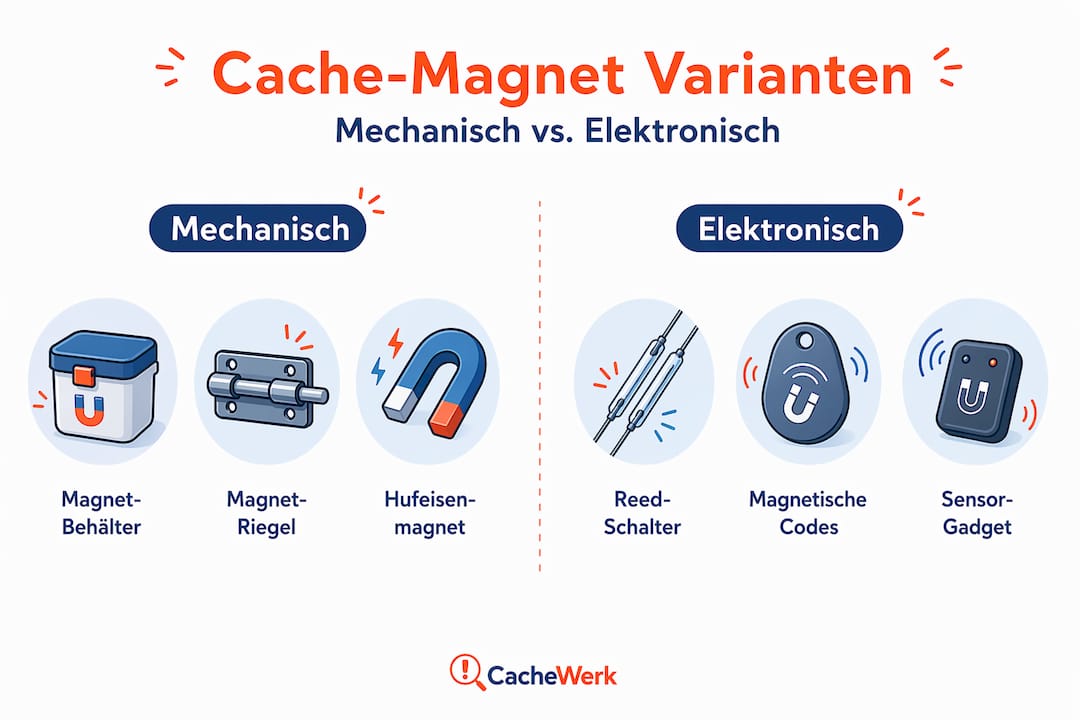
| Variant | Strength | Weakness | Recommended Use |
|---|---|---|---|
| Magnetic container (passive attachment) | Simple, inexpensive, no technology needed | No puzzle value, easily discoverable | Beginners, quick hides, urban nano-caches |
| Magnetic latch | Reliable, low maintenance, weather-resistant | Only simple open/close function | Camouflage, container closure, D2-D3 caches |
| Magnetic switch puzzle (reed switch) | High puzzle value, interactive, surprising | Requires electronics and power | Gadget caches, D4-D5, technically savvy cachers |
| Proximity sensor mechanism | Precise triggering, error-free coding | Complex construction, higher costs | Advanced gadget caches, mystery caches |
| Polarity-dependent lock | High security against accidental triggering | Requires specific tool for seekers | Puzzles with tool requirements, D4+ |
Cache types with different mechanisms range from simple magnetic containers to complex electronic gadget systems. For beginners, the magnetic latch is the ideal entry point: no electronics, yet a real added value compared to a standard container.
For experienced cache owners who want to offer their seekers an unforgettable experience, the investment in reed switch-based systems is worthwhile. The construction is learnable, the material costs are low, and the effect on seekers is enormous.
Common Mistakes and Practical Tips
Even well-planned cache magnets sometimes fail due to details. Incorrect magnet placement and unsuitable material selection are the most common causes of functional failures.
The most important points you should consider:
- Choose appropriate magnet strength: Magnets that are too weak will not reliably trigger reed switches. Magnets that are too strong can unintentionally activate adjacent switches. Neodymium magnets of size N35 to N42 are well suited for most cache mechanisms.
- Test distance between magnet and switch: Each reed switch has a different activation distance. Measure it before installation and build in a safety buffer.
- Consider metallic surroundings: Iron-rich materials nearby can deflect or amplify magnetic fields. Always test your cache at the planned location, not just at home.
- Consciously use polarity: Mark the correct side of the search magnet in the cache description if you are using a polarity-dependent lock. Frustration due to incorrect polarity unnecessarily frustrates seekers.
- Don't forget weather protection: Electronic switches and magnets tolerate moisture to varying degrees. Pot solder joints, use waterproof housings, and test your cache after heavy rain.
Pro Tip: Before releasing your cache, perform a “stress test”: Place the cache outdoors for a day in rain and frost before publishing it. What works in the living room must also work in the field in winter.
My Experiences with Cache Magnets
I vividly remember my first magnetically controlled gadget cache. I had installed a reed switch that was supposed to light up an LED. Everything worked perfectly at home. In the field, right next to a metal railing, the switch had already triggered before the seeker even had the magnet out of their pocket.
What I learned from this: Technical planning is only half the battle. The location determines whether a cache magnet mechanism works or not. Since then, I thoroughly test every new cache on site, with real magnets, in a real environment.
What still fascinates me about magnet-based mechanisms is their effect on seekers. I've received logs like "I had no idea that was possible" or "I had to laugh when the flap suddenly opened." You don't get such feedback for a film canister cache under a rock.
My honest advice: Don't start with the most complex system. A simple magnetic latch on a well-camouflaged container is already a real added value. And once you understand how a magnet and switch work together, you'll want to build increasingly complex mechanisms. That's the real learning curve with cache magnets. It's fun.
— Benedikt
Try Cachewerk's Magnetic Hides
You now know how cache magnets work and which variant is right for your project. The next step is implementation. Cachewerk has exactly the products you need to apply your knowledge directly.
Cachewerk's magnetic screw hide combines optical camouflage with a real magnetic mechanism in a single, weatherproof product made from PETG print. Perfect for urban locations where camouflage is crucial. If you prefer to build an interactive trick cache with a hidden logbook, check out the Mini Hau-den-Lukas. It shows how mechanics and a moment of surprise go hand in hand. Cachewerk provides the basis, you bring the idea.
FAQ
What exactly is a cache magnet?
A cache magnet is a geocache or cache element in which magnetic force is actively used to control a function, for example, to open a lock, trigger a switch, or solve a puzzle. Passive magnetic attachment alone does not count in the stricter sense.
What types of cache magnet mechanisms are there?
The most common types are magnetic containers (passive attachment), magnetic latches, reed switch-based puzzle mechanisms, and polarity-dependent locks. Each variant has different complexity and applications.
How do I prevent false triggers with my cache magnet?
Precisely test the switch distance, choose the appropriate magnet strength, and consider metallic objects in the surroundings. Targeted placement of magnet and switch reliably prevents unintentional triggers.
Do I need electronics knowledge for a cache magnet?
You don't need any electronics knowledge for simple magnetic latches. Reed switch-based systems require basic knowledge of circuits, but are easy to implement with simple instructions.
Is a cache magnet weatherproof?
That depends on its construction. Magnetic latches without electronics are very weatherproof. Electronic switches must be potted and housed in waterproof enclosures to withstand rain and frost.