
Ergonomic Cache Hides: Comfortable, Secure, and Inclusive
Many cache owners believe their hide is successful because it is found. However, they overlook a crucial point: a findable cache is not automatically easily accessible or fairly placed. Especially for families with strollers, elderly people, or wheelchair users, geocaching quickly becomes an obstacle if hides are too high, too narrow, or incorrectly rated. Ergonomics in geocaching means ensuring enjoyment and access for everyone. This article shows you which principles truly matter and how to implement them practically.
Table of Contents
- Fundamentals of Ergonomics in Cache Hiding
- Accessibility and Inclusion in Cache Hiding
- Coordinate Accuracy: Frustration or Find Guarantee?
- Practical Checklists for Ergonomic Cache Hides
- What Many Overlook: Ergonomics as Key to Sustainable Geocaching Success
- With the Right Equipment for Ergonomic Cache Hides
- Frequently Asked Questions about Ergonomics in Cache Hiding
Key Insights
| Point | Details |
|---|---|
| Ergonomics ensure inclusion | Accessible, well-rated hides allow all geocachers more joy and success. |
| Exact coordinates prevent frustration | Multiple measurements and careful placement prevent futile searches and environmental damage. |
| Checklists help in everyday life | With clear control questions for the location and hide, ergonomics always remain in focus. |
| Good planning protects the environment | Sustainable and ergonomic cache hides reduce uncontrolled searching and environmental impact. |
Fundamentals of Ergonomics in Cache Hiding
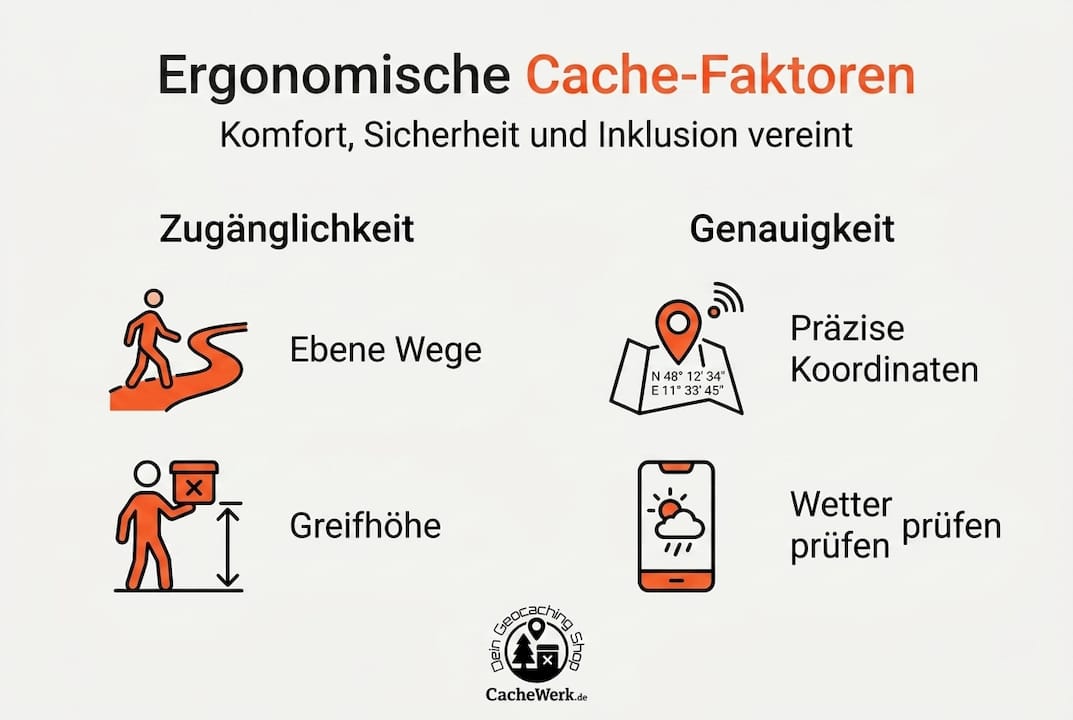
Ergonomics sounds like office chairs and keyboards. In geocaching, it means something different: placing a hide so that it is safe, comfortable, and accessible to as many people as possible without unnecessary effort. An ergonomic hide considers the physical capabilities of seekers, the terrain conditions, and a realistic assessment of difficulty and accessibility.
It sounds simple. In practice, however, it often fails due to small details.
The most important basic principles at a glance:
- Convenient access for various user groups, i.e., children, seniors, people with physical disabilities, and families with strollers
- Realistic and honest evaluation of terrain and difficulty when creating the cache
- Safety and sustainability come before creativity; a spectacular hide is useless if it's dangerous
- Clear protection against environmental damage from frequent searches in the wrong area
„Ergonomics means search-friendly, inclusive designs: Correct rating and placement prevent frustration, promote inclusion for wheelchair users and families, and prioritize safety and sustainability over mere creativity."
Good ergonomic outdoor design follows the principle: Less effort for the user means more enjoyment of the experience. This applies to park benches as well as geocaches. The less a person has to struggle to reach a hide, the more positive the experience remains in memory.
Pro tip: Test your hide yourself with your eyes closed, or have someone with limited mobility walk the path before publishing the cache. The feedback will surprise you.
A common misconception is that a low terrain rating simply means: "The path is short." In fact, it says something about how physically demanding the terrain is. T1 means not only short, but flat, obstacle-free, and accessible to people with limited mobility. This distinction is fundamental to everything that follows.
Accessibility and Inclusion in Cache Hiding
Accessibility is not a nice-to-have. It is the consistent implementation of an honest terrain rating. Anyone who rates their cache with T1 is publicly declaring: This cache is accessible to everyone, including wheelchair users.
What this means in concrete terms is shown in the following overview:
| Criterion | Requirement for T1 |
|---|---|
| Path condition | Even, paved or firm ground |
| Distance to parking lot | Maximum 800 meters |
| Container grip height | Between 40 cm and 1.40 m |
| Obstacles | No steps, stones, roots or narrow passages |
| Ground stability | No soft, wet or uneven ground |
These wheelchair-accessible requirements are not optional recommendations, but clear criteria that every cache owner must adhere to for a T1 rating.
Typical stumbling blocks that prevent inclusion:
- Containers are placed too high or too low, for example directly on the ground in a hollow or on a wall ledge above head height
- The access path is only partially paved and becomes impassable when wet
- Narrow passages in the path, such as bollards, fences or parked vehicles, block wheelchairs
- Seasonal changes such as snow, leaves or floods change the actual accessibility
- Construction sites near the cache change the route without notice
Pro tip: Use ergonomic outdoor equipment to sit at wheelchair height yourself when inspecting your hideout. This changes the perspective enormously.
A particularly underestimated problem is seasonal changes. A path that is easily wheelchair accessible in summer can become a danger zone in winter due to black ice. Then the T1 rating is factually incorrect. As a cache owner, you are responsible for either communicating such changes in the description or temporarily deactivating the cache.
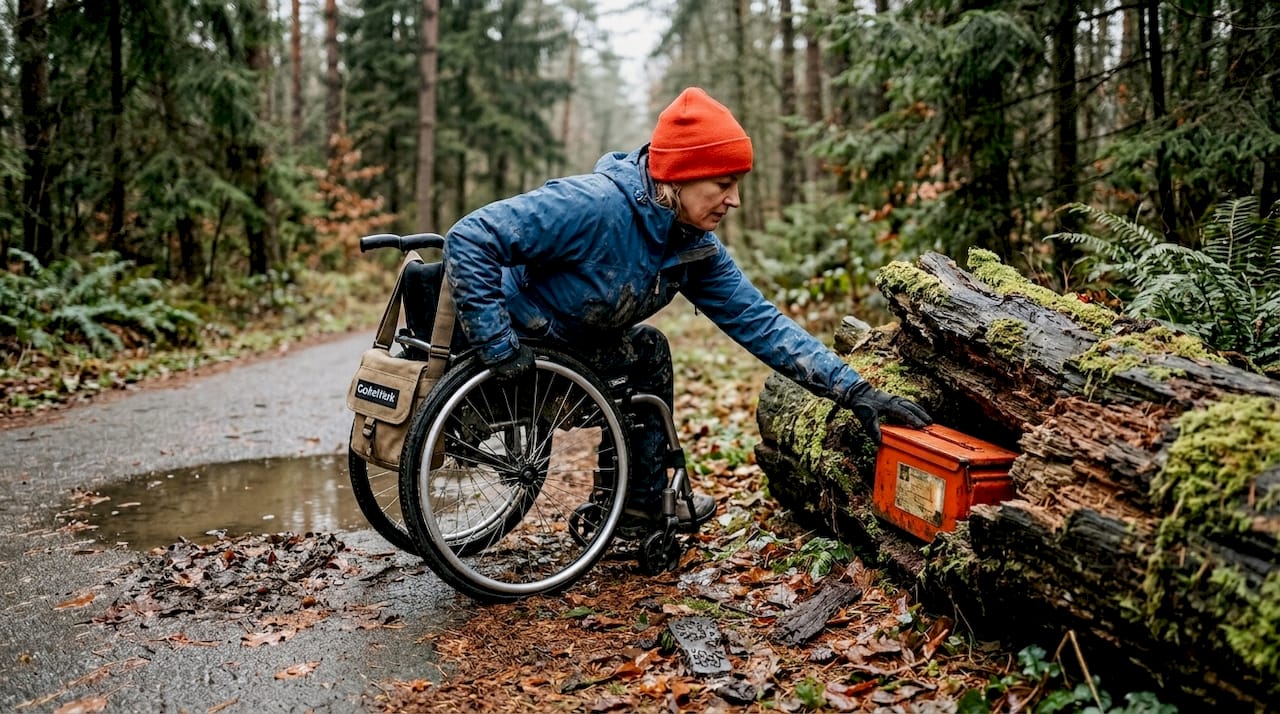
Families with children also benefit from well-thought-out ergonomics. A cache at an adult's reach height may be unattainable for a child without help. This is not a problem for a T2 or T3 rating, but for an explicitly family-friendly cache, the height should be chosen carefully.
Coordinate Accuracy: Frustration or Find Guarantee?
Precise coordinates are one of the most underestimated aspects of cache placement. Many creators measure once, type in the number, and think that's it. The result: seekers frustratingly circle the wrong tree, plants are trampled, environments are damaged.
Yet, good coordinate measurement is not rocket science; it just takes a little patience.
Why inaccurate coordinates cause harm:
- Seekers search in the wrong area, trampling vegetation
- Frustration leads to negative logs and a poor rating
- The cache is more frequently logged as "not found" and is suspected of being lost
- Repeated searches in a confined space can leave visible footpaths
| Method | Accuracy | Time Required | Recommendation |
|---|---|---|---|
| Single measurement with smartphone | 5 to 15 meters deviation | Very low | Not recommended |
| Single measurement with GPS device | 3 to 8 meters deviation | Low | Limited suitability |
| Waypoint averaging with GPS | 1 to 3 meters deviation | Medium | Recommended |
| Multiple measurements on different days | Under 2 meters deviation | High | Highly recommended |
Waypoint averaging with GPS is the most reliable method for single measurements on site. You stand still at the measurement point for at least three to four minutes and let the device calculate the average of several individual values. Even better: you repeat the measurement on another day and at a different time of day. Satellite positions change, and a measurement in the morning can differ significantly from a measurement in the afternoon.
Step-by-step guide to precise coordinate measurement:
- Go to the exact hiding spot with your GPS device
- Activate waypoint averaging (Average function) in the app or on the device
- Stand still at the same spot for at least three to four minutes
- Note the averaged coordinates and the displayed deviation
- Return on another day and repeat the measurement
- Calculate the average of both measurements for the final result
- Only publish if the deviation is less than 20 meters, ideally less than 5 meters
Pro tip: For even better results, special apps like c:geo or Garmin's Basecamp are recommended, as they directly support waypoint averaging and save the measurement values for later comparison. Further tips on GPS-accurate cache hides can be found in our blog.
Also, pay attention to the environment during measurement. Under a dense canopy or in a narrow city valley surrounded by tall buildings, GPS signals deteriorate significantly. In such situations, only a longer averaging time or a measurement time with better satellite coverage will help.
Practical Checklists for Ergonomic Cache Hides
Knowledge alone is not enough. What you need is a clear routine that you follow before publishing each cache. This will prevent the most common mistakes and save you from having to make adjustments later.
Checklist before publishing:
- Have you walked the path from the nearest parking lot yourself and checked for obstacles?
- Is the container's gripping height actually between 40 cm and 1.40 m for T1 caches?
- Have you recorded the coordinates using waypoint averaging and measured them on at least two different days?
- Does your terrain and difficulty rating truly match what a seeker will find?
- Have you considered seasonal changes, and if so, is this noted in the cache description?
- Are there surveillance cameras nearby or areas where searching might seem problematic?
- Is the container sealed watertight so that the logbook and contents remain dry in the rain?
Step-by-step routine for final checks:
- Visit the hideout at least once without the cache, purely for terrain assessment
- Photograph the area from the perspective of a wheelchair user or child
- Note all possible seasonal limitations, such as winter ice, flooding, or construction work
- Have a test finder, who does not know your hideout, test search for the cache
- Adjust the description and rating based on feedback
- Activate the cache only after at least 24 hours of rest for final verification
Incorrect T1 ratings particularly frustrate wheelchair users, as they explicitly rely on such information to plan excursions. Anyone who advertises T1 but has hidden an uneven forest path betrays trust. This affects the entire image of the local geocaching community.
Also, consider edge cases. A cache next to a construction site can be unreachable for weeks. A surveillance camera at the hideout can put seekers in uncomfortable situations. These factors must be entered in the description or resolved as a temporary deactivation. Geocaching thrives on trust and mutual respect.
What Many Overlook: Ergonomics as Key to Sustainable Geocaching Success
Here's a thought that many cache owners find uncomfortable: The most spectacular hide is not the best. It's often the most maintenance-intensive, the riskiest, and the most exclusive. A cache on a hard-to-reach rock might sound impressive, but it excludes 80 percent of the community and simultaneously increases ecological pressure due to repeated visits on a narrow path.
Ergonomically designed caches have a measurably longer lifespan. Why? Because they are reported broken less often. Because the logs are more positive. Because the container is more accessible and can therefore be maintained more regularly. Prioritizing accessibility means investing in the quality of your own caches.
There's another blind spot even experienced geocachers have: remembering the rating. Someone who places their cache in summer and then doesn't revisit it in autumn relies on a rating that is months old. The terrain changes. Leaves cover paths, frost makes paths slippery, construction sites appear overnight. Regular maintenance visits are not a sign of uncertainty; they are a sign of responsibility.
The community benefits from every cache owner who contributes their part. When seekers know that a cache is correctly rated, they rely on this system. If they learn that ratings are often unreliable, they lose trust. This sets in motion a negative spiral that affects not only individual caches but local geocaching as a whole.
Less spectacular, but honest and safe: This is ultimately the better strategy for anyone who wants their caches not just placed, but also loved.
With the Right Equipment for Ergonomic Cache Hides
You now know what ergonomic caches are all about and how to plan them. Now it's about implementing these principles materially. Because a well-planned hide also needs the right container, suitable camouflage material, and a stable, weather-resistant setup.
At Geocaching equipment from cachewerk.de you will find exactly that: products designed for durability, weather resistance and thoughtful placement. Whether you are looking for a small nano cache for urban environments or a robust container for the forest path, the selection is geared towards real geocaching needs. For creative urban caches, it is worth taking a look at creative hides, such as the fake traffic sign, which can be placed inconspicuously and at the same time ergonomically graspable. Good accessories not only make the cache more durable, they also make regular maintenance easier for you.
Frequently Asked Questions about Ergonomics in Cache Hides
Must T1 caches always be wheelchair accessible?
Yes, T1 terrain means a level and obstacle-free access up to a maximum of 800 meters from the parking lot, as well as a hide height between 40 cm and 1.40 m. These requirements are binding, not optional.
How do I correctly measure GPS coordinates for caches?
Use waypoint averaging with GPS, stand still at the measurement point for at least three to four minutes, and repeat the measurement on another day for a reliable average.
What can happen if the cache is difficult to access?
Finders get frustrated, vegetation is trampled by unnecessary environmental damage, and the cache accumulates negative logs or is actively avoided.
What is the ideal height for an ergonomic cache hide?
The ideal gripping height for barrier-free caches is between 40 cm and 1.40 m, making them easily accessible for wheelchair users and adults without climbing or bending down.