
Creative Geocaching Hides: Building Caches with 3D Printing
TL;DR:
- 3D printing enables individual, cost-effective, and weatherproof geocaching hides.
- Material choice (PLA, PETG, ABS) influences durability and environmental compatibility.
- Careful planning, testing, and rule-compliant placement are essential for long-term success.
Imagine this: Your carefully placed cache is reported after two weeks of rain because the logbook is completely soaked. This is exactly the problem many geocachers are solving today with a self-printed casing from a 3D printer. What used to be possible only with expensive custom-made items is now accessible to every hobbyist. In this article, you will learn why 3D printing is so exciting for geocaching, which materials really hold up, how to create your own cache step-by-step, and what legal and ecological considerations you need to keep in mind.
Table of Contents
- The Advantages of 3D Printing for Geocachers
- Material Selection and Print Settings: What Matters
- Instructions: How to Design and Print Your Own Geocache
- Legal and Ecological Notes on Placing 3D Printed Caches
- What Really Counts with 3D Printed Caches: Our Experience
- Discover More Creative Hides and Accessories
- Frequently Asked Questions about 3D Printing in Geocaching
Key Takeaways
| Point | Details |
|---|---|
| Individual hides possible | 3D printing makes unique and creative geocache hides easy to implement. |
| Material selection is crucial | Choose PLA for sustainability or PETG/ABS for extreme weather conditions. |
| Observe rules | Caches must be environmentally friendly, waterproof, and legally placed. |
| In-house production saves costs | Self-printed caches are cheaper than purchased containers and can be custom designed. |
The Advantages of 3D Printing for Geocachers
Off-the-shelf standard hides are practical, but they have clear limitations. They often look similar, don't always fit the environment, and cost money in the long run. 3D printing fundamentally changes that. You can design a model once and print it as many times as you like. This saves costs and gives you maximum freedom in design.
A major advantage is customization. You can integrate coordinates directly into the model, build in hidden compartments, or choose camouflage that perfectly matches the surroundings. 3D printing revolutionizes geocaching through personalized, cost-effective hides that simply wouldn't be possible with standard products.
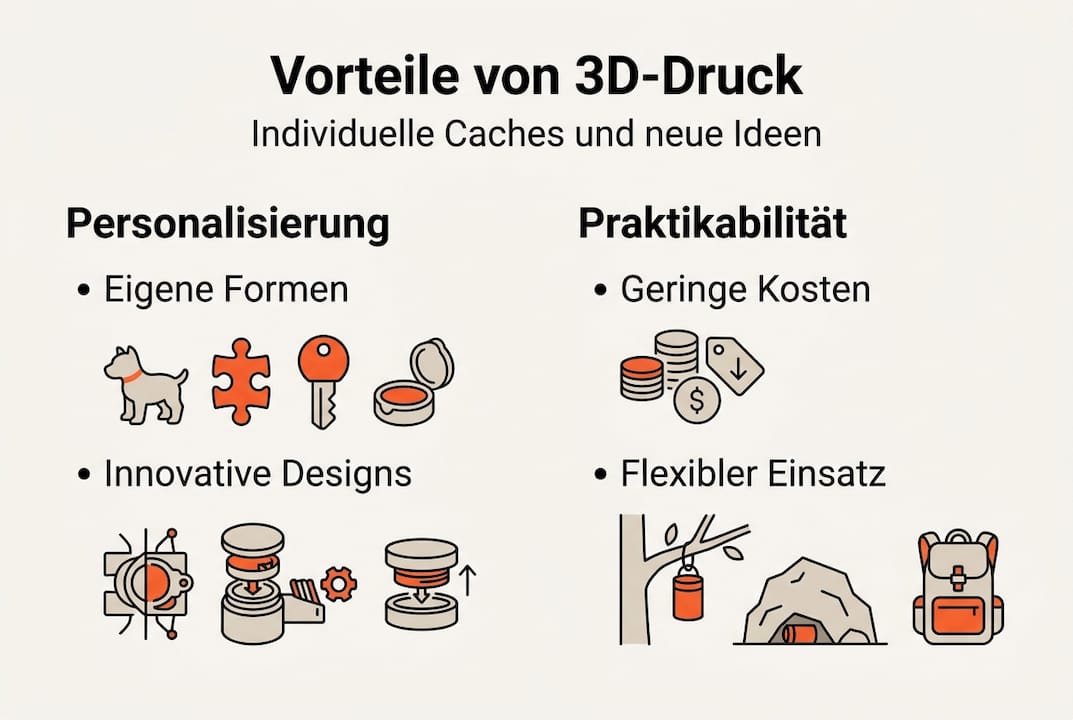
Platforms like Thingiverse and Cults3D offer hundreds of free STL files (these are the template files for the 3D printer) specifically for geocaching. From realistic tree stumps to stones and even fishing hooks, almost everything is available. You download the file, adapt it if necessary, and start printing. If you want to learn more about 3D-printed geocaches, you'll find plenty of inspiration there.
Why 3D printing is so attractive to geocachers:
- Low cost per print after initial printer purchase
- High creativity through customizable designs
- Easy reproduction in case of loss or damage
- Technical gimmicks like magnetic closures or false bottoms possible
- Camouflage in almost any form: mushrooms, branches, screws, stones
| Feature | Purchased Hide | 3D Printed Cache |
|---|---|---|
| Cost | Medium to high | Low after purchase |
| Individuality | Low | Very high |
| Reproducibility | Not possible | As many times as needed |
| Camouflage | Limited | Virtually unlimited |
| Technical extras | Rare | Easily integrated |
Special hides like geocaching fishing hooks or camouflage mushrooms are particularly impressive. These would hardly be feasible without a 3D printer. The community actively exchanges such ideas and inspires each other.
Pro Tip: Download an STL file and open it in a program like Tinkercad or Fusion 360. There, you can adjust dimensions, engrave initials, or add your own texture. This makes every cache truly unique.
Material Selection and Print Settings: What Matters
A creative design is of little use if the cache breaks after the first frosty night. Therefore, material selection is just as important as the design itself.
The three most common filaments for geocaching caches are PLA, PETG, and ABS. PLA is biodegradable and well suited for most conditions, while PETG is more robust for extreme conditions. ABS is very hard, but more difficult to print and less environmentally friendly.
| Material | Weather Resistance | Stability | Environment | Price |
|---|---|---|---|---|
| PLA | Medium | Medium | Good (biodegradable) | Low |
| PETG | High | High | Medium | Medium |
| ABS | Very High | Very High | Poor | Medium |
For most caches in temperate climates, PLA is perfectly sufficient. For extreme sun exposure, severe frost, or continuous humidity, PETG is the better choice. At CacheWerk, we use PETG for our own 3D products because it combines durability and workability well.
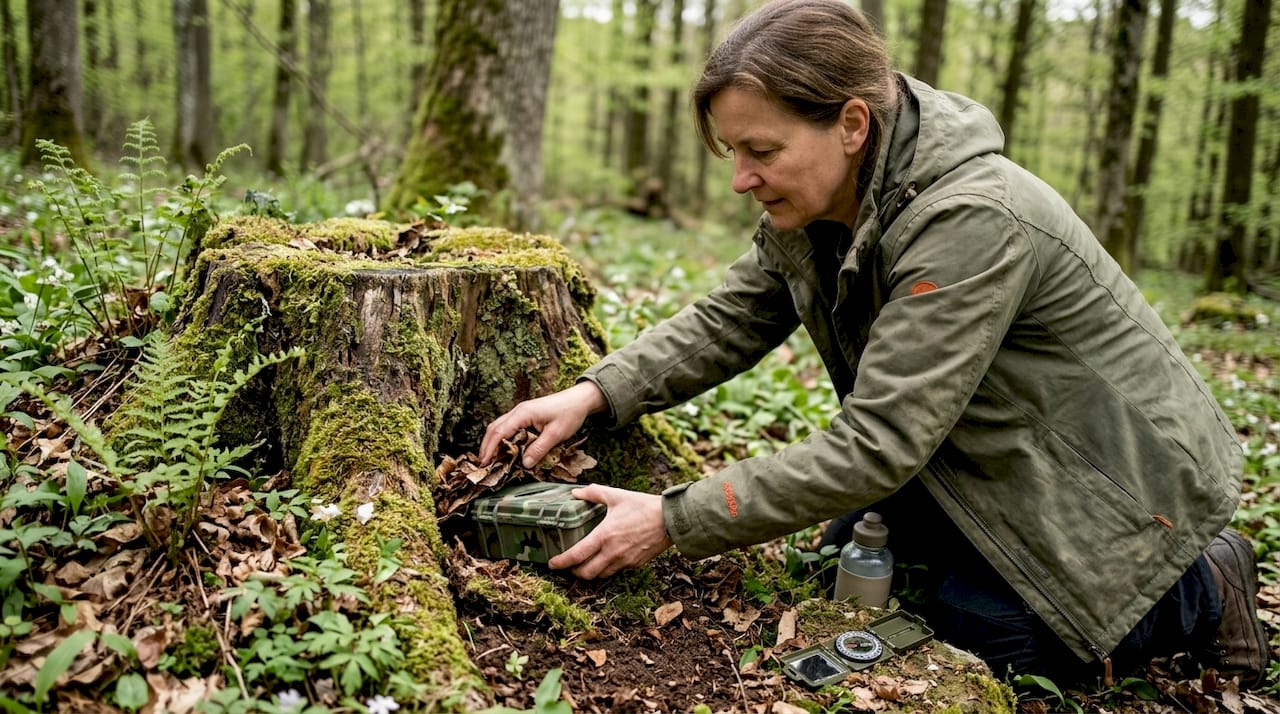
For print settings, the recommended infill and layer height for durable outdoor prints are 0.2 mm layer height, at least 3 perimeters (i.e., outer walls), and 5 to 15 percent infill. Gyroid is recommended as an infill pattern because it is uniformly stable. The nozzle temperature is between 200 and 245 degrees Celsius, depending on the material.
Important points for outdoor-ready prints:
- At least 3 perimeters for stable outer walls
- Gyroid infill at 10 to 15 percent for a good weight-to-stability ratio
- Always seal or pack logbooks in plastic bags
- Carefully align screw caps to prevent leaks
- Check the print for cracks and gaps after completion
A frequently underestimated problem: FDM prints (the most common printing method with filament) are never completely waterproof. Water can seep in, especially at screw connections. Experience reports on leaky geocaching containers show that even seemingly tight housings can fail. Therefore, the plastic bag around the logbook is not an optional extra step, but a must.
According to community experience, well-printed caches made of PETG or PLA last at least one year under normal outdoor conditions if settings and post-processing are correct. This is a clear argument for having your own printer.
Instructions: How to Design and Print Your Own Geocache
Now, let's get concrete. Here's the complete path from the first thought to the finished, ready-to-hide cache.
- Develop an idea: Consider where the cache will be hidden. Forest, city, near water? The environment determines the shape. Roughly sketch out what the cache should look like.
- Find or create an STL file: Download free STL files from platforms like Thingiverse or Cults3D. Alternatively, model it yourself with Tinkercad (free, browser-based).
- Adjust the model: Adapt dimensions to your logbook. Set wall thickness to at least 2 mm. Add camouflage or details.
- Slice: Divide the model into print layers in a slicer program (e.g., Cura or PrusaSlicer). Here you set layer height, infill, and temperature.
- Print and check: After printing, test for fit. Lid and bottom must close snugly. Check for cracks or gaps.
- Post-process: Smooth the casing with sandpaper, paint with acrylic paint or camouflage spray. For urban caches, stone spray or rust-effect paints are also suitable.
Typical errors occur in steps 3 and 5. Walls that are too thin break when opened. A poorly fitting lid lets in water. The solution: Print the casing twice, test it at home with water, and correct the model before taking it into nature.
“Our caches withstand several seasons of rain, frost, and heat.” (Experience report from the Geocaching Community on Reddit)
You can find more practical examples and design ideas in the Geocache Design practice example on our blog.
Pro Tip: Always print critical parts like lids and closures twice. Test the fit dry and then under running water. Only when both are correct should the cache be placed in its hide.
Legal and Ecological Notes on Placing 3D Printed Caches
You've printed your cache, painted it, and are ready to hide it. But before you go, there are a few important rules you should know.
Basically: Caches must be waterproof, placed environmentally friendly, and must not be buried. This sounds simple but is often disregarded. Burying means interfering with the ground and is forbidden in most countries.
Checklist before hiding:
- Never bury caches or carve into trees
- No hides in nature reserves, breeding grounds, or private property
- Pack logbook in a waterproof bag
- Obtain permission if necessary (e.g., in city parks)
- Place cache in a way that no vegetation is damaged
- Plan regular checks and maintenance
For material, it's worth choosing PLA if the cache ever needs to be removed or gets lost. PLA is biodegradable and less harmful to the environment than ABS. For long-term hides, PETG is still more sensible because it lasts longer and thus produces less waste.
The Leave No Trace principle also applies to geocaching. Tips can be found at Leave No Trace for Geocachers. In short: Leave the place as you found it. No digging, no breaking branches, no removing moss.
A sustainable cache is also a well-maintained cache. Anyone who regularly visits their hiding spot will recognize early on if the casing is cracking or the logbook is getting damp. Then simply re-print and replace.
Pro Tip: Document your hide in a sustainable hide log and track maintenance intervals. This way you keep an overview and your cache remains in good condition permanently.
What Really Counts with 3D Printed Caches: Our Experience
Many geocachers focus primarily on camouflage when it comes to 3D printing. This is understandable, as a perfectly camouflaged cache is fun. But in practice, it always turns out: Robustness beats aesthetics. A cache that falls apart after three months is worthless to the community, no matter how good it looks.
What really makes the difference is the field test before the official hiding. Leave the cache outside for a week, then open it and check if moisture has entered. This one week will save you and the seekers a lot of frustration.
In our view of 3D printing, we have learned that community feedback is gold. Anyone who rates their cache after the first month and reads feedback quickly improves their design. Sometimes a conspicuous but robust cache is better than a perfectly camouflaged one that breaks after a winter. Sustainability comes from experimenting, learning, and consistent care.
Discover More Creative Hides and Accessories
You are now perfectly equipped to plan and implement your first 3D printed geocache. If you want to start directly with a finished product or get inspired, CacheWerk is the right place for you.
For example, check out the Tree Mushroom Geocache Hide: a high-quality, PETG-printed cache that fits perfectly into natural environments. In the Discover Special Hides section, you'll find unusual ideas for every terrain. And if you want to equip your craft project with the right accessories, you'll find what you're looking for in the Geocaching Equipment section. Get inspired and take your next hide to a new level!
Frequently Asked Questions about 3D Printing in Geocaching
Which material is best suited for durable geocaching hides?
PLA is biodegradable and suitable for most conditions, but PETG or ABS are significantly more robust in extreme weather and recommended for long-term hides.
How do you protect logbooks in 3D printed caches from moisture?
Always use a plastic bag around the logbook, as FDM prints are not completely waterproof and water can penetrate, especially at closures.
Are self-printed caches officially allowed?
Yes, 3D printed caches are allowed as long as they comply with environmental compatibility rules, are not buried, and the logbook is packed waterproof.
Where can I find STL files for geocaching hides?
Free STL files for geocaching hides are available on platforms like Thingiverse and Cults3D, many of them specifically for different hide types and environments.
