
Must-Haves for Cache Owners: The Practical Guide 2026
As a cache owner, you bear full responsibility for your cache. Everything from site selection to regular maintenance is in your hands. Those who know the right must-haves for cache owners will save themselves a lot of trouble later on. Because a poorly equipped cache means wet logbooks, frustrated finders, and in the worst case, archiving. This guide shows you exactly what equipment, tools, and strategies really matter.
Table of Contents
- Key Takeaways
- 1. Must-Haves for Cache Owners: The Selection Criteria
- 2. Robust, Weatherproof Container as a Foundation
- 3. Correctly Implementing Logbook and Writing Protection
- 4. Technical and Creative Camouflage as a Must-Have
- 5. Comparison: Popular Containers and Accessories at a Glance
- 6. Accessories for Cache Owners: What Else Matters
- 7. Practical Checklist: Cache Owner Checklist for Equipment and Maintenance
- 8. Sustainability and Resource Conservation in Cache Operation
- 9. Communication as an Underestimated Must-Have
- My Experience as a Cache Owner: What Really Matters
- Find Equipment for Cache Owners at Cachewerk
- FAQ
Key Takeaways
| Point | Details |
|---|---|
| Robust containers are mandatory | Weatherproof containers protect the logbook and significantly reduce maintenance effort. |
| Location selection is crucial | A well-chosen, protected location prevents many typical maintenance problems from the outset. |
| Maintenance is part of the concept | A cache is not a set-and-forget project, but requires regular inspection and care. |
| Creative camouflage enhances fun | Original hiding places like fake signs make the find more exciting and protect the cache at the same time. |
| Consistently use logs | Needs Maintenance and Owner Maintenance logs are indispensable communication tools for every owner. |
1. Must-Haves for Cache Owners: The Selection Criteria
Before you spend money on equipment, you should know what criteria to use for selection. Not every product fits every location. Not every solution works the same way in an urban environment as it does in the forest.
These are the most important selection criteria:
- Weather resistance: Rain, frost, direct sunlight. Your cache is outdoors all year round. Materials must be UV-stable, waterproof, and frost-resistant.
- Usability for finders: A container that no one can open without special tools causes frustration. Good equipment is intuitive to use.
- Maintenance effort: How often do you have to go to the cache? The more robust the equipment, the less frequent the maintenance trips.
- Location-specific suitability: A nano-container in a waterlogged forest area is doomed to fail. Consider what your specific location demands.
- Price-performance ratio: More expensive is not automatically better. Many inexpensive solutions last for years if used wisely.
The site selection is particularly central, as a well-chosen and protected location prevents many subsequent problems.
Pro tip: Visit your planned location in bad weather before placing the cache there. What seems dry on a sunny day can be underwater when it rains.
2. Robust, Weatherproof Container as a Foundation
The container is the heart of every cache. Without a solid container, nothing else works. Weatherproof containers and packaging the logbook in a waterproof zip-bag are the most important physical measures for long-lasting caches.
What types of containers are there and what are they suitable for?
- Film canisters and nano-containers: Ideal for urban micro-caches. Small, inconspicuous, but sensitive to moisture. Definitely choose one with a seal.
- Plastic screw-top containers: An inexpensive classic. Good for forest locations, but the seals age and need to be checked regularly.
- Military ammunition boxes (Ammo Cans): Durable, truly waterproof, and robust. Ideal for locations with a high risk of vandalism or harsh weather conditions.
- Special PETG printed enclosures: Custom-made shapes that blend into the environment. Highly resistant and creative. Cachewerk offers 3D-printed solutions of exactly this quality.
- Lock-and-Lock containers: Affordable, widely available, and with a good sealing system. Work well in medium to large sizes.
Always remember: the container size also determines the experience. Only a large container allows for the inclusion of trade items, which is a particular incentive for many finders.
3. Correctly Implementing Logbook and Writing Protection
The logbook is the only physical document of a cache. If it gets wet, becomes illegible, or is full, the cache becomes unattractive or even unloggable for many finders. Therefore, logbook protection is one of the absolute must-have cache tools.
Here's how to protect your logbook correctly:
- Use zip-bags: Always place the logbook in a resealable bag. Even if the container is supposed to be waterproof. Double protection never hurts.
- Plan for spare logbooks: Always put one or two spare logbooks in the cache. Finders appreciate being able to replace the full book themselves.
- Pencils instead of pens: Pens fail in cold and damp conditions. Pencils write reliably, even if the paper is slightly damp.
- Weatherproof pens: Special weatherproof pens exist for particularly demanding locations. They are a small investment with a big impact.
- Adapt logbook format: For micro-caches, there are narrow roll logbooks that fit into tight containers. Always use the format appropriate for the container.
Pro tip: Label the logbook outside with the cache name and date of the last refill. This way, you'll immediately see how old the current logbook is on your next maintenance visit.
4. Technical and Creative Camouflage as a Must-Have
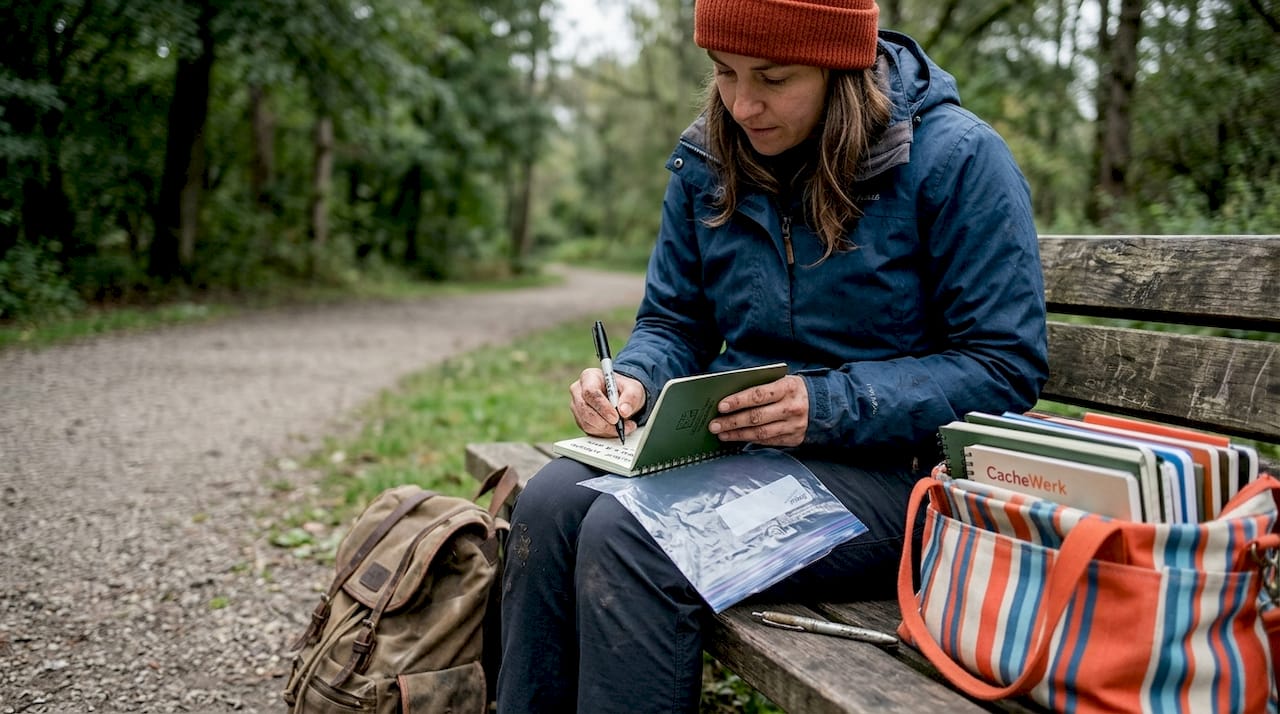
The best containers are useless if a muggle spots the cache at first glance. Creative camouflage is therefore not a luxury, but a core component of important cache tools.
Accurately record GPS coordinates
Before you camouflage and hide, you should record the coordinates of your cache as accurately as possible. Use a GPS-enabled app or a dedicated device and measure the coordinates multiple times at different times of the day. Fluctuations of up to 5 meters are normal. An average of several measurements provides the best accuracy.
Implement creative hiding ideas
Fake objects are one of the most popular camouflage methods in geocaching. A fake hydrant sign, for example, offers functional protection and makes the find more exciting. Such creative hiding places increase the fun for geocachers and keep curious muggles away.
Other proven camouflage options:
- Magnetic containers under metal covers
- Art objects disguised as stones, tree stumps, or branches
- Inconspicuous pipes or cable duct imitations for urban locations
- Wall mounts behind signs or boxes
Tool kit for quick maintenance
Always take a small kit with you on maintenance visits: a new logbook, fresh zip-bags, a weatherproof pen, tape, and a cleaning cloth. Being prepared on-site solves problems in minutes instead of hours.
5. Comparison: Popular Containers and Accessories at a Glance
| Container / Accessory | Weather Protection | Suitable for | Maintenance Effort |
|---|---|---|---|
| Nano Container (Metal) | medium | Urban micros | low to medium |
| Lock-and-Lock Box | good | Forest, field, parks | low |
| Ammunition Box (Ammo Can) | very good | Nature, exposed locations | very low |
| 3D-printed enclosure (PETG) | very good | Urban and nature | low |
| Film canister | low | Dry urban locations | high |
| Fake sign hide | very good | Urban locations | very low |
Pro tip: PETG enclosures from 3D printing are more UV-stable and impact-resistant than conventional PLA. For outdoor-exposed locations, this material difference is well worth it.
Lock-and-Lock containers offer the best price-performance ratio for beginners. Ammo cans are ideal if you know your location has harsh conditions. For urban creativity, fake objects and 3D-printed special enclosures are the first choice.
6. Accessories for Cache Owners: What Else Matters
Not everything revolves around the container itself. Many owners underestimate the surrounding elements that separate a truly good cache from a mediocre one.
- Trackables and trade items: Small surprises in the cache increase its attractiveness. Think of trackables, buttons, or small natural materials.
- Labels with info: A small laminated sheet with hints for muggles or explanations for non-geocachers can prevent many problems.
- Waterproof labels: Label your container outside with the cache ID and contact information. This way, an honest finder can return the cache.
- Mounting material: Cable ties, magnets, waterproof tape, and small screws belong in every cache bag. You always need something on the go.
- Camouflage paint or tape: For containers attached to trees or rock walls. A Lock-and-Lock container wrapped in camouflage tape disappears almost invisibly in the undergrowth.
For caches with technical components, such as containers with battery-operated elements, it is worth looking at water-resistant battery holders. These reliably protect electronic components from moisture.
7. Practical Checklist: Cache-Owner Checklist for Equipment and Maintenance
A structured approach saves time and prevents typical mistakes. Here is a compact Cache Owner Checklist that you can use for every new cache and every maintenance visit.
Before placement:
- Check location in various weather conditions
- Measure coordinates multiple times and calculate the average
- Test container for leaks (water bath test)
- Pack logbook in zip-bag and insert
- Add spare logbook and weatherproof pen
- Finalize camouflage and test from a finder's perspective
- Prepare cache listing and provide honest hints
During every maintenance visit:
- Check container for leaks and damage
- Inspect logbook, replace if necessary
- Replace zip-bag
- Check trade items and trackables
- Improve camouflage if necessary
- Set Owner Maintenance Log to update maintenance status
- Temporarily disable if the cache is not in good condition until the next maintenance
A Needs Maintenance Log from a finder is always an early warning sign, not an attack. Those who take it seriously and react quickly build trust within the community.
Remember: maintenance as a continuous task increases the long-term cache lifespan and finder satisfaction.
8. Sustainability and Resource Conservation in Cache Operation
An aspect often missing in many guides: How do you operate your cache in the most resource-efficient way possible? This concerns not only the environment but also your own effort.
Durable materials mean less waste and fewer trips to the location. Those who rely on high-quality containers may not need to replace them for ten years. Cheap alternatives often have to be replaced after one season.
If your cache requires batteries, it's worth handling batteries sustainably. Rechargeable batteries in weatherproof holders significantly reduce waste and costs in the long run.
For multicaches, in particular: All stages must remain intact, as missing intermediate stages abruptly end the tour and cause massive frustration. Therefore, always plan a larger maintenance budget for multi-part caches and check all stages simultaneously.
9. Communication as an Underestimated Must-Have
Many owners only think of physical items when it comes to "equipment." However, communication with the community is one of the most effective tools available.
Respond to finder logs, especially if someone reports a problem. Thank finders who leave helpful hints. Communicate with the reviewer if you have questions about placement or guidelines. Reviewers ensure quality, but they do not relieve the owner of their duty and care. This means: after activation, everything is back to you.
A short reply log takes two minutes and shows the community that you, as the owner, are present and engaged. This makes your cache more attractive, even without physical changes.
My Experience as a Cache Owner: What Really Matters
Over the past few years, I've seen many caches that started with enthusiasm and were archived after a year. Not because the idea was bad, but because the basic equipment wasn't right or because the owner underestimated what "staying active" truly means.
My honest assessment: Choosing the right container and the right location is 70% of the work. Those who proceed cleverly here will save themselves countless maintenance trips. I've seen caches with simple Lock-and-Lock containers that have been running problem-free for years, and expensive special enclosures that leaked after two months. Because the location simply wasn't suitable.
What surprised me most personally: How much influence communication with finders has on one's own commitment. When someone leaves an enthusiastic log or offers constructive criticism, it's incredibly motivating. And the geocaching community benefits from engaged owners who connect other players through their caches.
My advice to everyone just starting out: begin with a solid, simple cache. Save creative experiments for your second or third. And use the practical guide for cache maintenance before placing your cache. The effort is worth it.
— Benedikt
Find Equipment for Cache Owners at Cachewerk
You now know what matters. Now all you need is the right equipment.
Cachewerk specializes precisely in these needs. Whether it's weatherproof containers, 3D-printed special PETG housings, creative fake hides, or complete Geocaching accessories for your next cache. The product range covers everything a cache owner truly needs. Products for urban locations as well as rural areas. Durable, well-thought-out, and ready for immediate use. Take a look and find the equipment that suits your cache concept.
FAQ
What are the most important must-haves for cache owners?
The most important must-haves are a weatherproof container, a logbook in a zip-lock bag, weatherproof pens, and spare logbooks. Additionally, creative camouflage and a well-chosen location are essential.
How often should you maintain your cache?
Checking every two to three months is advisable for most locations. After storms or upon receiving Needs Maintenance logs, you should react promptly.
What is a Needs Maintenance log?
A Needs Maintenance log signals to the owner that the cache has a problem, such as a wet logbook or a damaged container. It's an early warning system for cache quality.
What should be done after maintenance?
After each maintenance, the owner must post an Owner Maintenance log to remove the Needs Maintenance status. Without this step, the cache is still considered in need of repair.
Which container is best for beginners?
Lock-and-Lock containers offer the best balance of price, watertightness, and ease of handling. They are well-suited for forest and park locations and are easy to maintain.