
Differences in Cache Types: The Complete Comparison
Geocaching captivates millions of people worldwide. But those new to it quickly face an unexpected question: What types of caches are there anyway, and what exactly differentiates them? The differences between cache types are far greater than many might suspect. While a Traditional Cache and a Mystery Cache share the same goal, they have completely different rules, requirements, and experiences. In this article, you will learn about all the important cache types, understand their rating systems, and then know exactly which type suits you and your next adventure.
Table of Contents
- Key Takeaways
- The Basic Cache Types Explained
- Special Cache Types and Their Characteristics
- Rating System and Attributes for Caches
- Cache Types Compared: Which One Suits You?
- Strategies for More Success with Every Cache Type
- My Personal Assessment of the Cache Types
- Your Next Cache Deserves the Right Hide
- FAQ
Key Takeaways
| Point | Details |
|---|---|
| Variety of Cache Types | Geocaching offers much more than the classic container in the woods, from Traditional to EarthCache. |
| Understand the Rating System | D/T values from 1 to 5 help you choose caches appropriate for your skill and terrain. |
| Utilize Attributes | Up to 15 attributes in the listing prepare you for specifics like night caches or difficult terrain. |
| Preparation per Cache Type | Mystery and Multi-Caches require significantly more planning than a simple Traditional Cache. |
| Choose the Right Type | With the right cache type, geocaching is more enjoyable for beginners and pros alike. |
The Basic Cache Types Explained
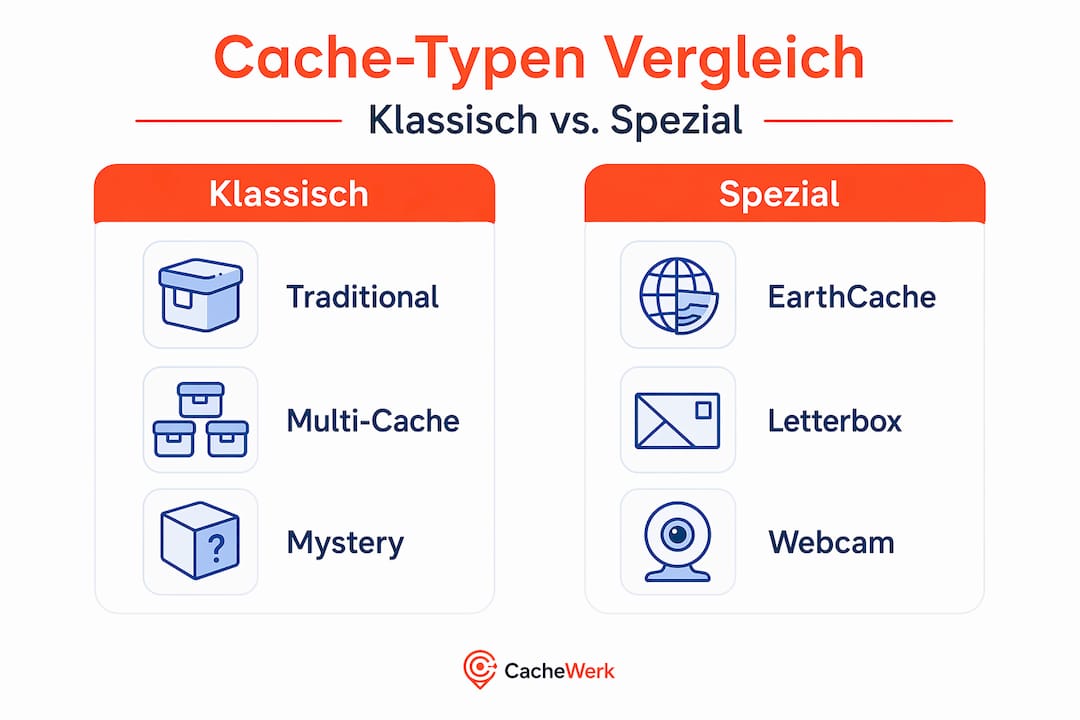
The heart of every geocaching excursion is the cache type. Knowing the differences saves time, frustration, and sometimes even several futile kilometers. The three most common types are Traditional, Multi, and Mystery.
Traditional Cache
The Traditional Cache is the classic and ideal for beginners. The coordinates in the listing point exactly to the spot where the container is located. You enter the coordinates into the GPS and go directly there. Done. No pre-puzzling, no intermediate stages.
A Traditional Cache is perfect for a first outing because it requires little preparation. Only this cache type can be created directly via the mobile app. All other types require the web browser for this. That says a lot about its simplicity.
Multi-Cache
A Multi-Cache consists of at least two stages. At the first stage, you'll find a clue or coordinates that lead you to the next stage. The final container awaits at the end. The number of intermediate stages is decided by the cache owner.
The special thing is: the fun is in the journey, not just the destination. Multi-Caches often lead you through cities, forests, or along historical routes. Planning is more important than with a Traditional Cache, because stages and interim results must be correctly understood and noted.
Mystery Cache (Puzzle Cache)
With a Mystery Cache, there's no direct path to the container at the beginning. Instead, you solve an online puzzle, task, or number sequence to determine the true final coordinates. Only then do you start navigating.

The puzzles range from simple picture puzzles to complex encryption or programming tasks. Many geocachers appreciate this type because it challenges the mind before the legs get involved. However, many newcomers underestimate the effort: without a solved puzzle, the listing coordinates often intentionally lead nowhere.
Key features at a glance:
- Traditional Cache: Directly at the listed coordinates, low effort, ideal for beginners
- Multi-Cache: Multiple stages, medium effort, suitable for groups and extended tours
- Mystery Cache: Puzzle solving required, highest preparation effort, rewarded with a creative experience
Special Cache Types and Their Characteristics
Besides the three main types, there are other cache types that function completely differently in concept and execution. Anyone who truly understands geocaching also knows these.
EarthCache
The EarthCache has no physical container. None at all. Instead, it leads you to a geologically interesting spot such as a rock outcrop, a volcanic crater, or a special mineral deposit. Proof of your visit is not by signing a logbook, but by answering geological questions that you send to the cache owner via message.
EarthCaches were created in collaboration with the Geological Society of America and have a clear educational mission. The focus is on learning, not searching. For nature enthusiasts, families with curious children, or geocachers who want to expand their knowledge, EarthCaches are particularly motivating.
Letterbox Hybrid
The Letterbox Hybrid combines geocaching with another British tradition: letterboxing. With letterboxing, you find a stamp and a logbook in a hidden location. You stamp your own booklet, and the stamp from the container is stamped into the logbook there.
A Letterbox Hybrid combines exactly that with geocaching coordinates. You find the container via GPS, but it also contains a stamp. This makes this type particularly attractive for collectors and anyone who likes to take home a physical souvenir. The equipment expands here: you need your own stamp booklet and a stamp.
Webcam Cache
Webcam Caches are rare today but fascinating. Proof of visit is not by finding a container, but by a photo of you taken by a public webcam. You stand in front of the camera, someone takes a screenshot, or you manage to save an image yourself.
This type of cache often requires coordination, sometimes a second person at the computer. They are a special challenge for many geocachers, precisely because they are so unusual.
Characteristics of these three types:
- EarthCache: No container, educational task required, educational focus
- Letterbox Hybrid: Physical container with stamp, bring your own booklet
- Webcam Cache: Rare, proof via webcam photo, no physical container at the location
Pro Tip: With an EarthCache, it's worth reading the questions beforehand and actively looking for the answers on site. If you go unprepared, you often stand clueless in front of the rock.
Rating System and Attributes for Caches
Two numbers accompany every cache in the listing: Difficulty (D) and Terrain (T). Both values range from 1 to 5 and tell you at a glance what to expect.
What D and T Mean
D/T ratings help you choose caches appropriate for your skills and equipment. This is how the scale works:
- D1: The container is easy to find, no prior knowledge needed
- D3: Medium difficulty, requires some experience or thought
- D5: Extremely difficult, often weeks without a find
- T1: Easily accessible on foot, also for wheelchairs or strollers
- T5: Accessible only with climbing equipment, diving, or similar
This table shows typical combinations and what they mean:
| D/T Combination | Meaning | Suitable for |
|---|---|---|
| D1 / T1 | Easy container, easy terrain | Beginners, families |
| D3 / T2 | Puzzle or brainteaser, normal terrain | Experienced beginners |
| D2 / T4 | Easy task, difficult terrain | Climbers, outdoor athletes |
| D5 / T5 | Highest demands on mind and body | Professionals, specialists |
Understanding Attributes in the Listing
In addition to D and T, up to 15 attributes in the listing provide important information at a glance. Attributes are small symbols that the cache owner has set to better prepare finders. They show, for example:
- Child-friendliness
- Winter suitability
- Whether dogs are allowed
- Whether night equipment is needed
- Whether the cache is accessible for strollers
Well-set attributes significantly reduce frustration on site. Anyone arriving with a dog and seeing "no dogs" in the listing saves themselves a wasted trip. Premium users can even use attributes for targeted cache searches.
Pro Tip: Before every cache outing, don't just look at the D/T values, but also read through the set attributes. Especially for T4 or T5, a missing climbing rope can be a real problem.
Cache Types Compared: Which One Suits You?
Here you can see all important cache types at a glance, with typical effort, duration, and target group:
| Cache Type | Effort | Typical Duration | Ideal for |
|---|---|---|---|
| Traditional | Low | 15 to 60 minutes | Beginners, families |
| Multi | Medium | 1 to 4 hours | Groups, hiking enthusiasts |
| Mystery | High | Pre-work plus 1 to 3 hours | Puzzle lovers |
| EarthCache | Low to medium | 30 to 90 minutes | Nature lovers |
| Letterbox Hybrid | Medium | 30 to 90 minutes | Collectors, traditionalists |
Tips for Beginners
Those just starting out should focus on Traditional Caches with D1/T1 or D2/T2. Caches with low difficulty allow for quick successes and build confidence in GPS navigation. Multi-Caches as a second step are ideal once you are familiar with the app and logbook.
You should only attempt Mystery Caches once you are confident with basic navigation. The puzzle can take a lot of time, and without experience with geocaching coordinates, frustration can quickly arise.
Notes on Equipment
Caches vary greatly in size, from Nano to Large. This influences what you need:
- Nano and Micro: Tweezers help in pulling out the log strip
- Small: A pen for signing the logbook is usually sufficient
- Large: Space for trade items, pen, own logbook is useful
- Multi and Mystery: Take a notebook for intermediate coordinates and clues
Pro Tip: Always carry the solved Mystery coordinates in paper form. If your smartphone battery dies, you'll be left in the woods without target coordinates.
Strategies for More Success with Every Cache Type
Many geocachers have experienced how incorrect preparation can ruin the fun. With the right strategies, you can tailor your approach specifically to the cache type.
For a Traditional Cache: plan your arrival, bring a pen, done. But for a Multi-Cache, you need more. The logic of the individual stages and their sequence must be understood before you set off. If you skip stage 2, you'll never find stage 3.
Common mistakes and how to avoid them:
- Misjudging D/T: Look at pictures and previous logs to better assess reality than just the number
- Puzzle not fully solved: Only start a Mystery Cache once you have the final coordinates
- Ignoring attributes: Lack of preparation for night, cold, or wet terrain costs comfort and safety
- No notebook: With Multi-Caches, interim results are lost without being written down
- Expecting the wrong cache size: Anyone looking for a Nano cache like a film canister is looking in the wrong place
Good attributes in the listing not only help with preparation but also protect against real safety risks. A night cache without a headlamp ends badly.
Also choose cache types according to your personal preference. Those who enjoy puzzling will find their home in a Mystery Cache. Those who want to experience nature are better off with an EarthCache or a Multi through a national park.
Pro Tip: Before trying a new cache type, read three to five recent logs from other finders. They often contain the best tips for typical pitfalls.
My Personal Assessment of the Cache Types
I've been involved for years and have experienced all the major cache types intensely. What always surprises me: most newcomers vastly underestimate the Mystery Cache. Not because of the difficulty of the puzzle, but because they forget that the listing coordinates are deliberately wrong. This leads to searches for a container that isn't even there.
My personal favorite is the Multi-Cache. It combines movement, thought, and the joy of each new stage into a true experience. What I've learned: the best Multi-Caches tell a story. Each stage is a chapter. When a cache owner understands this, an unforgettable experience is created.
EarthCaches, in my opinion, are underestimated. Many geocachers pass them over because there's no physical container involved. Yet, you often learn more about a place from an EarthCache than from any other variant. I particularly recommend them for trips with children.
What I also observe: those who hide creatively, meaning those who choose more unusual containers for Mystery Caches or perfectly camouflaged objects for Traditional Caches, receive significantly better logs and more joy in return. The hide itself is part of the experience. It's worth investing more time and creativity here.
— Benedikt
Your Next Cache Deserves the Right Hide
Once you know which cache type suits you, the next question quickly arises: How does the hide itself become an experience? A well-camouflaged cache is a sign of respect for the finder.
At Cachewerk, you'll find creative solutions for every cache type. The tree fungus as a hide is a perfect example of a camouflaged outdoor hide that is barely noticeable in the forest, yet durable and weatherproof. For all other requirements, from nano containers to large outdoor caches, Cachewerk's Geocaching accessory range offers the right equipment. Let yourself be inspired and give your next cache the hide it deserves.
FAQ
What are the most common cache types in geocaching?
The most common types are Traditional, Multi, and Mystery. Traditional Caches are found directly at the listed coordinates, while Multi-Caches require multiple stages and Mystery Caches require a puzzle to be solved beforehand.
What is an EarthCache and how do you log it?
An EarthCache has no physical container. The visit is proven by answering geological questions, which are sent via message to the cache owner.
What do the D/T values mean for a cache?
D stands for Difficulty (difficulty of finding) and T for Terrain (accessibility of the terrain). Both values range from 1 (easy) to 5 (very difficult) and help you choose the right cache for your abilities.
Why are attributes important in the cache listing?
Attributes prepare finders for special features such as night caches, child-friendliness, or necessary climbing equipment and help avoid unsuitable or unsafe tours.
Which cache type is best suited for beginners?
Traditional Caches with low D/T values are best suited for beginners because they can be found directly at the target coordinates without puzzles or intermediate stations.