Geocaching branch hide: How to build a weatherproof cache

The most robust branch hide is a hollow branch with a waterproof inner container and an O-ring seal. This keeps the logbook dry, allows the owner to perform maintenance quickly, and ensures the camouflage looks credible even up close. Those who don't have time to craft their own can find ready-made hides that incorporate these principles.
In short:
- Weatherproof branch hides use a waterproof inner container with an O-ring seal to effectively keep moisture out.
- For permanent camouflage, concrete imitations are suitable, while natural materials are best for temporary hides.
- Placement should be clearly visible but out of the direct line of sight of passersby to minimize maintenance requirements and the risk of discovery.
- Regular checks every six months are necessary to inspect the logbook, seals, and accessibility, and to fix any damage early on.
- Ready-made hides, such as street lamp or fence bolt caches, offer quick solutions that utilize proven sealing and camouflage principles.
Table of Contents
- Branch hide geocaching: Which materials are suitable for inner containers and camouflage
- How to build a weatherproof branch hide step-by-step
- Adhesive, casting, and painting techniques for permanent camouflage
- Maintenance and common mistakes with branch hides
- Cachewerk in practice: From theory to ready-made solutions
- Author's perspective: Practicality over perfection
- Ready-made branch hides from Cachewerk for immediate use
- Sources
- FAQ
Branch hide geocaching: Which materials are suitable for inner containers and camouflage
A branch hide is only as good as what's inside. A preform (petling) offers the best balance of volume and seal, as it was originally designed for beverages and therefore comes standard with a reliable screw cap. Nano containers are tiny and fit into thin branches, but provide almost no room for a logbook and are harder to keep dry. Small metal or plastic containers fall somewhere in between, but almost always require an additional seal because their lids rarely close truly water-tight.
A common technical problem is often underestimated: Polyethylene and polypropylene—the plastics used in most preforms and containers—are difficult to bond. Standard adhesives flake off or hold for only a few weeks. If you want to attach camouflage directly to such a container, you should roughen the surface beforehand or prepare it with sturdy adhesive tape before applying a top layer.
For the seal itself, there is a simple rule: An O-ring on the thread or a double zip-lock layer around the logbook will prevent most moisture damage, Geocaching. A backup logbook in a second, separate bag is not a luxury, but the cheapest insurance against a soaked cache.
For external camouflage, there are three options:
- Concrete imitation: Very robust, weatherproof for years, but heavier and more complex to produce
- Plastic cones or bark: Lightweight, cheaply mass-produced, ideal for 3D printing
- Wood cladding: Looks the most natural, but weathers itself and requires occasional re-treatment
Permanent solutions made of synthetic resin or concrete are worthwhile for hides that are intended to remain in the same place for years. Temporary camouflage made of natural materials is better suited for events or hides that move frequently anyway.
How to build a weatherproof branch hide step-by-step
Before you begin, consider the planned location. Is the branch thick enough to accommodate a cavity without becoming unstable? Can the hide be reached without much difficulty, while still being placed out of the direct line of sight of passersby? These two questions are more decisive for later success than any crafting skill.
The following equipment should be at hand: cordless drill with a Forstner bit, sharp utility knife, sandpaper, the chosen inner container, O-ring or silicone, construction adhesive, and paint or pigments for the finish, as recommended in the detailed DIY guide for custom battery packs. The CacheWiki provides a comprehensive overview of useful tools for owners and seekers.
- Check the location: Monitor muggle frequency along the path, plan accessibility for later maintenance.
- Create the cavity: Use a Forstner bit or chisel to create a cavity that fits the inner container exactly—no larger.
- Fix the inner container: Attach it with a small amount of construction adhesive at points so it doesn't loosen, but remains removable if necessary.
- Apply seal: Insert O-ring or apply a thin layer of silicone to the rim of the thread, then let it dry.
- Model the camouflage: Shape bark, moss, or the cast outer shell precisely around the opening.
- Test: Test the container underwater or with a damp cloth, then simulate access with gloves.
Pro tip: Create a quick maintenance plan on paper while building. Note down the construction date, materials used, and planned first check interval. This will save you valuable time later when filling out the owner maintenance log.
For those who want to visually follow the entire process again, the tutorial on durable cache hides by Cachewerk provides detailed implementation with photos.
Adhesive, casting, and painting techniques for permanent camouflage
Not all glue is as good as it claims. Expanding foam is suitable for roughly filling large cavities and cutting to shape afterward. Construction adhesive is the better choice for surfaces constantly under tension or exposed to weather, while spray adhesive is suitable for lightweight materials like moss or bark. Hot glue seems practical at first, but often fails faster in cold weather or due to UV exposure than other variants, as discussions in the Geoclub forum show.
For cast outer shells, concrete or screed is clearly preferable to plaster because it withstands moisture better and does not crumble as easily. Important during curing: The material should be covered in the shade and dried slowly; otherwise, the surface will crack and later look brittle rather than natural.
When finishing, the last layer often determines the overall impression:
- Use matte paints instead of glossy colors
- Mix natural pigments or fine sand into the final paint layer
- Glue on real moss or pieces of bark instead of just painting them on
Community experiences show a clear trend: Matte surfaces mixed with natural materials look more credible up close than even the most intricately painted glossy surface.
Maintenance and common mistakes with branch hides
A branch hide is never finished; it requires regular attention. Regular visual inspections and additional checks after severe storms are usually sufficient to identify damage early. Hard-to-reach hides are maintained less frequently, and according to Geocaching, that leads to longer downtimes and frustrated finders.
These points belong on every maintenance checklist:
- Check logbook for moisture, replace immediately if necessary
- Renew zip-lock secondary packaging if it appears brittle
- Check the seal on the inner container for cracks
- Ensure accessibility without special tools
Three errors keep appearing in practice: Hides are placed too high, turning maintenance into a climbing chore. Casting compounds without any breathability trap moisture inside instead of draining it. And glossy paint finishes stand out immediately in sunlight, even though exactly the opposite was the goal.
Cachewerk in practice: From theory to ready-made solutions
The described principles, such as waterproof inner containers, maintenance-friendly placement, and credible finishes, are key aspects in the development of geocache hides. The products originate from practical engagement with the exact problems described in the construction chapter above: poorly bonding plastics, unreliable seals, and overly conspicuous surfaces.
Some geocache hides are based on 3D printing with PETG, a material that is easier to paint and bond while remaining weather-resistant. Those who wish to supplement their own construction guide with further ideas will find additional inspiration for elaborate constructions in the Outdoor Cache Hide Guide from Cachewerk.
- PETG instead of PE/PP for better adhesive and paint adhesion
- Practical tutorials instead of just product descriptions
- Developed by active geocachers, not at the drafting board
Author's perspective: Practicality over perfection
The most beautiful camouflage is useless if the owner doesn't want to open it after three months. I have seen more broken caches due to hard-to-reach hides than due to poor camouflage. If you have to make a compromise during construction, you should always make it in favor of maintainability, never in favor of a few millimeters more realism.
— Benedikt
Ready-made branch hides from Cachewerk for immediate use
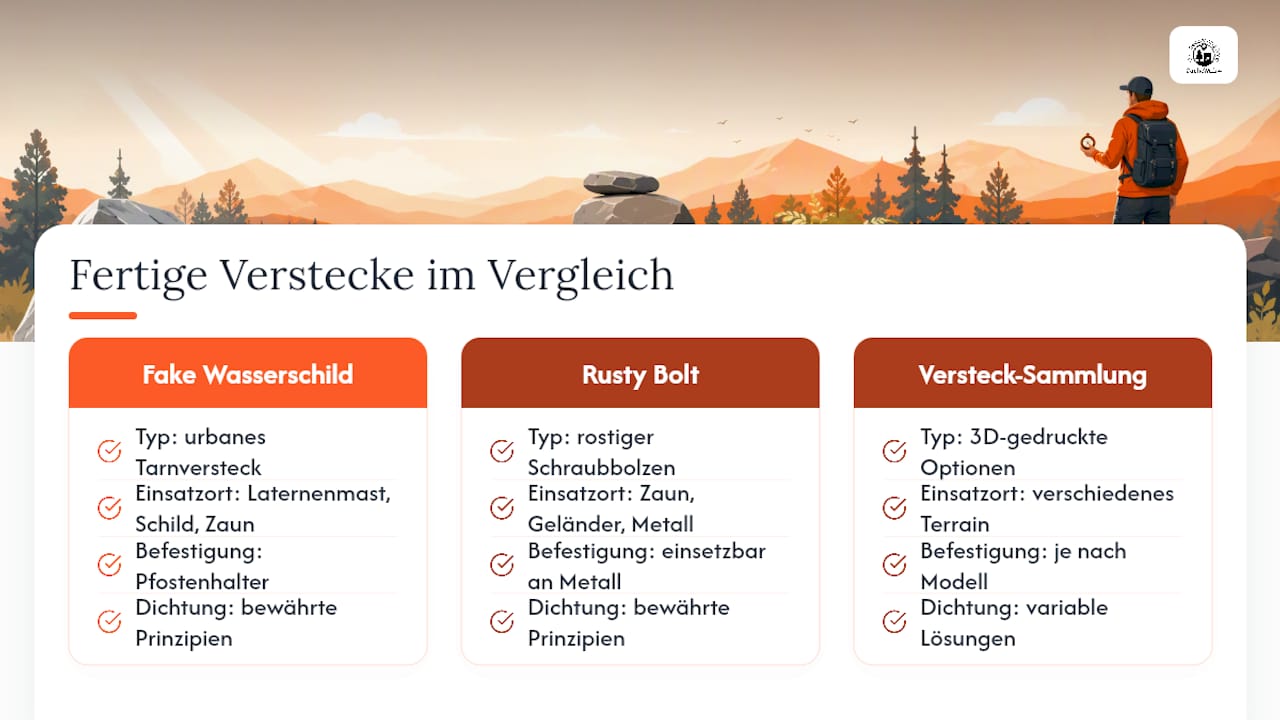
If you have read the building instructions and would rather get started right away instead of casting and gluing yourself, you can also purchase ready-made solutions that close this gap. The geocaching hide "Fake Wasserschild" (Fake Water Sign) is an urban camouflage hide with a post mount that remains practically invisible in the cityscape. It is particularly suitable for lamp posts, signposts, or fences, where a classic branch hide would be out of place.
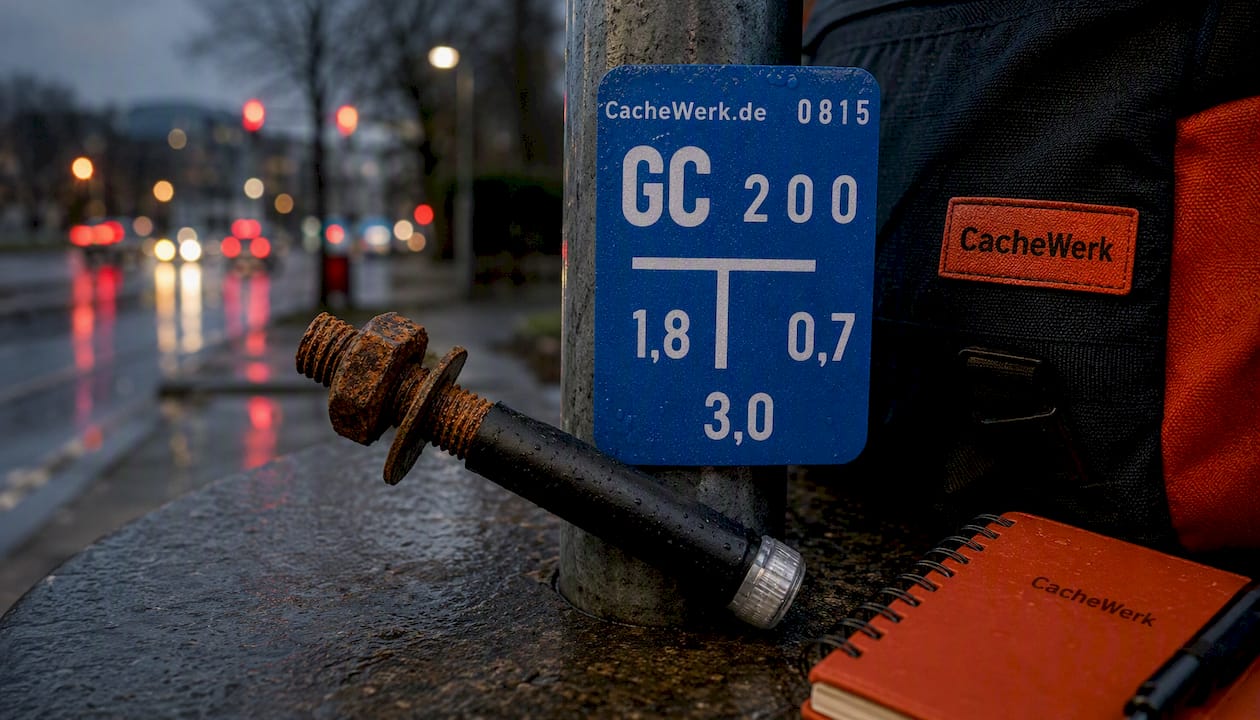
For urban environments with a rustic character, the Geocaching Rusty Bolt Cache is a great option. The rusty bolt look with an integrated nano container looks deceptively real on fences, railings, or metal structures and requires no additional moisture treatment. Both hides are built with proven sealing principles, eliminating the need for drills, casting compound, and testing phases.
For those looking for more than just two individual products, the collection of geocaching hides and accessories contains additional 3D-printed options and materials for your own projects. Check out the product pages, compare the application scenarios with your own cache location, and order directly if one of the two solutions fits your next cache.
Sources
For deeper technical details, the Geoclub forum on adhesive techniques with real user reports is worth checking out. A real example of a documented branch hide, including maintenance status, can be found in Opencaching listing OC15F0A.
FAQ
What is a branch hide in geocaching?
A branch hide is a cache container camouflaged in or on a hollow branch, usually with a waterproof inner container like a preform. The camouflage ranges from real bark to replica branches made of plastic or concrete.
What ideas are there for unusual geocaching hides?
Besides classic branch hides, urban camouflage like fake traffic signs or rusty bolts work particularly well in city areas, such as the Fake Water Sign or the Rusty Bolt Cache from Cachewerk. Conical imitations and concrete imitations are also among the most popular creative variants.
Which geocache is considered particularly famous in Germany?
There is no official ranking of the "best" geocache in Germany, as popularity depends heavily on region and personal taste. Owner communities and regional forums like the Geoclub forum are good places to find currently recommended hides in your own area.
Are there countries without geocaches?
Yes, there are currently no registered geocaches in some very remote or politically inaccessible regions, including isolated island nations and parts of Central Asia. However, the exact list is constantly changing as the community continuously explores new territories.
How often should I maintain my branch hide?
A visual inspection every six months is usually sufficient; in addition, a check after severe storms or frost periods is recommended. It is important to inspect the logbook, seal, and accessibility, as emphasized by geocaching.com in their maintenance tips.